You're viewing free preview questions — 6 questions previewing here — subscribe to unlock 82 more, plus the Full Question Bank, Mock Papers & Worksheets.Upgrade
Back

Forms of radiation: properties, detection and uses — Free MYP4 Physics Practice Questions

Free questions

Open in full, with answers, mark scheme and examiner insights.

Question 1Criterion C · Band 3-4 · Easy · 4 marksrevisionprep.com

Detection methods: Geiger-Müller counter, Photographic film
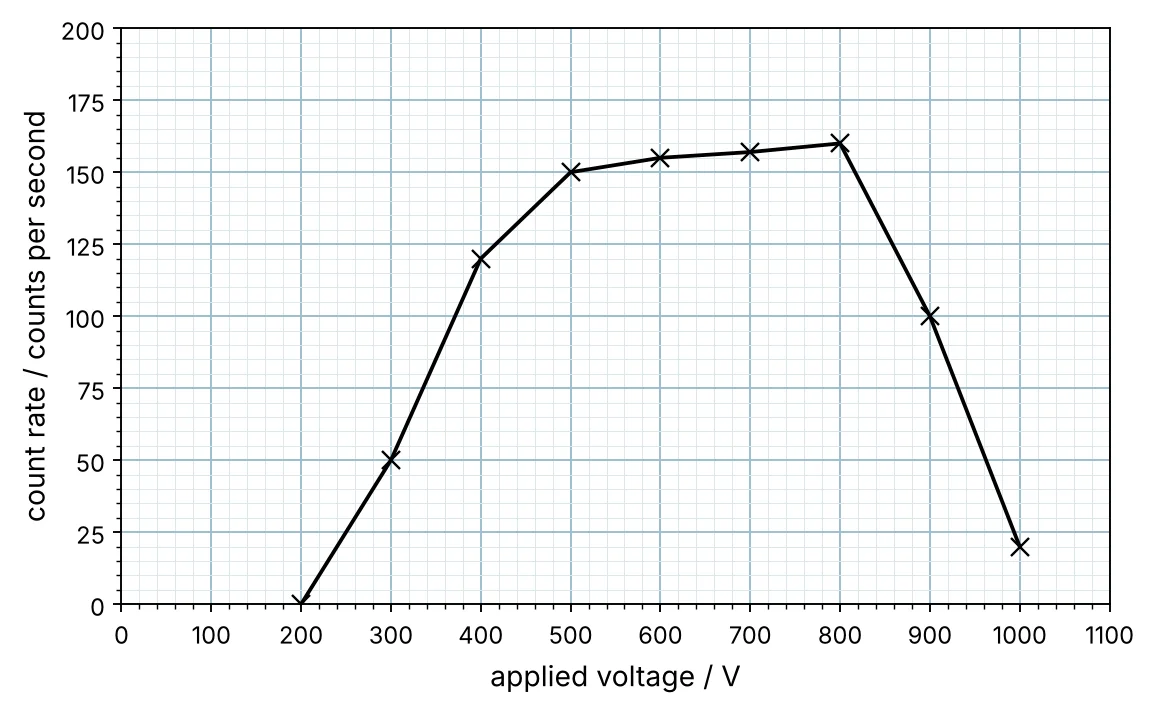
A GM tube is placed near a constant radiation source. The graph shows how the count rate changes as the voltage across the tube is increased from 200 V to 1000 V.
Question diagram
(a)
Describe how the count rate changes as the voltage increases from 200 V to 500 V. [1]Criterion C (ii) · Level 3-4
(b)
Identify the range of voltages over which the count rate hardly changes. [1]Criterion C (ii) · Level 3-4
(c)
Calculate the percentage increase in count rate between 500 V and 800 V. [2]Criterion C (i) · Level 3-4

revisionprep.com

Summary Answer

Not available for this question.

Model Answer

Not available for this question.

Marking Scheme

Not available for this question.

Examiner Insights

Not available for this question.

Question 2Criterion A · Band 1-2 · Easy · 3 marksrevisionprep.com

Background radiation: Natural sources (cosmic, rocks), Artificial sources
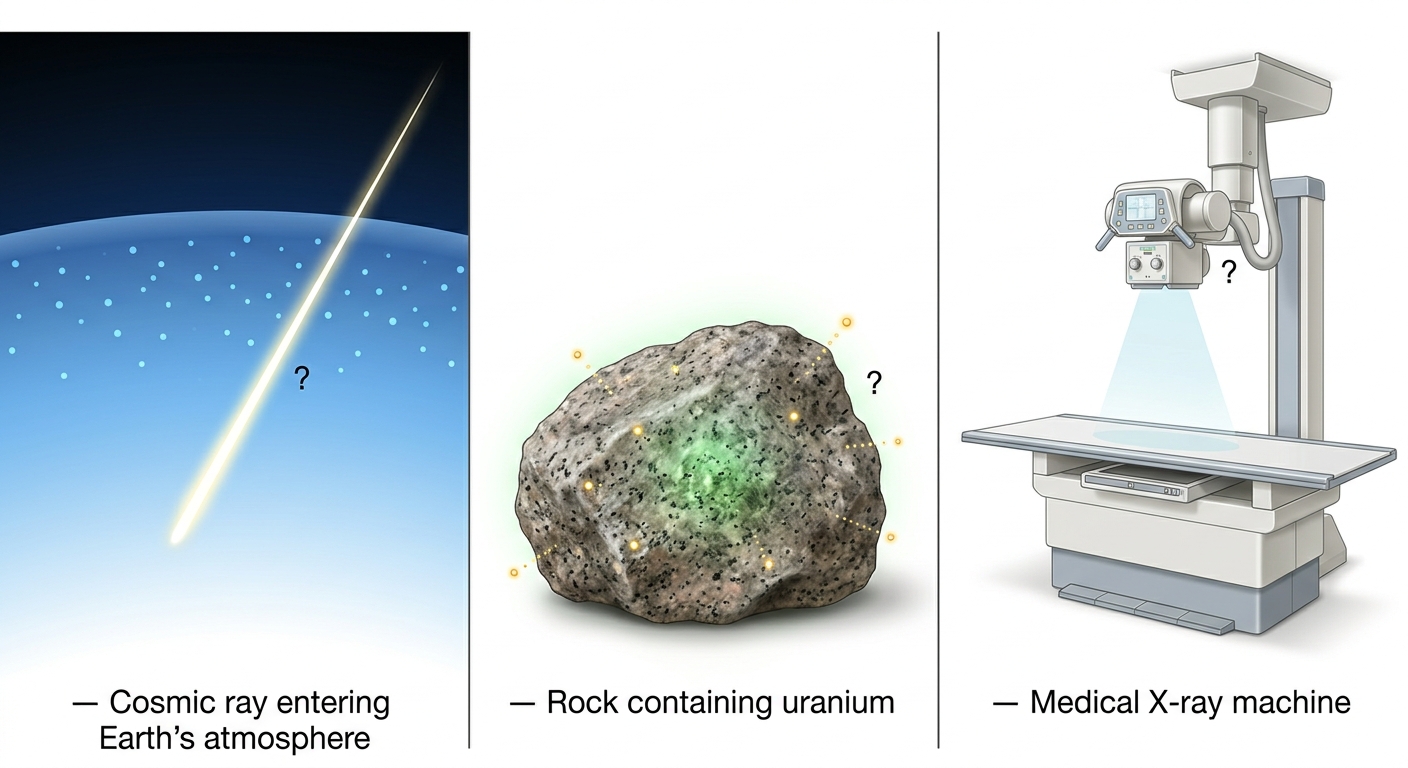
The diagram shows three sources of radiation: a cosmic ray entering the Earth's atmosphere, a rock containing uranium and a medical X-ray machine.
Question diagram
(a)
Identify the two natural sources of radiation shown in the diagram. [1]Criterion A (i) · Level 1-2
(b)
Identify the artificial source shown in the diagram. [1]Criterion A (i) · Level 1-2
(c)
State one other natural source of background radiation that is not shown. [1]Criterion A (i) · Level 1-2

revisionprep.com

Summary Answer

Not available for this question.

Model Answer

Not available for this question.

Marking Scheme

Not available for this question.

Examiner Insights

Not available for this question.

Question 3Criterion B · Band 3-6 · Medium · 8 marksrevisionprep.com

Nature of each radiation: Mass, charge, speed
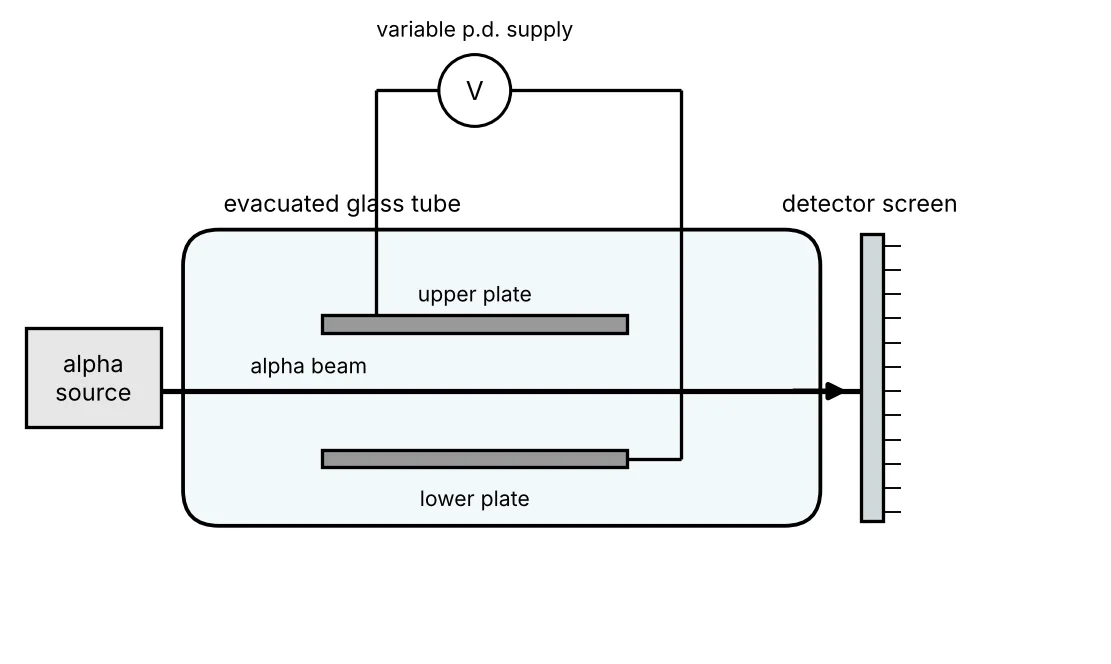
The diagram shows apparatus in which alpha particles from a source travel through an evacuated glass tube, between two parallel charged plates, to a detector screen. The potential difference between the plates can be changed using the supply.
Question diagram
(a)
State a research question for an investigation using this apparatus. [1]Criterion B (i) · Level 3-4
(b)
Formulate a hypothesis for the investigation and explain it using scientific reasoning. [2]Criterion B (ii) · Level 5-6
(c)
Identify the independent variable, the dependent variable and two control variables, and explain how one control variable is kept constant. [3]Criterion B (iii) · Level 5-6
(d)
Explain why the tube must be evacuated, and describe how sufficient data will be collected. [2]Criterion B (iv) · Level 5-6

revisionprep.com

Summary Answer

Not available for this question.

Model Answer

Not available for this question.

Marking Scheme

Not available for this question.

Examiner Insights

Not available for this question.

Question 4Criterion A · Band 3-6 · Medium · 6 marksrevisionprep.com

Penetrating power, ionising power and biological damage

A hospital uses lead to shield staff from a gamma source. The count rate at the staff position is 800 counts per second with no shield. Every 12 mm of lead halves the count rate.
(a)
Determine the thickness of lead needed to reduce the count rate to 200 counts per second. [2]Criterion A (ii) · Level 3-4
(b)
Determine the count rate behind 48 mm of lead. [2]Criterion A (ii) · Level 3-4
(c)
Explain why no thickness of lead can reduce the count rate from the gamma source to exactly zero. [2]Criterion A (i) · Level 5-6

revisionprep.com

Summary Answer

Not available for this question.

Model Answer

Not available for this question.

Marking Scheme

Not available for this question.

Examiner Insights

Not available for this question.

Question 5Criterion D + A · Band 5-8 · Challenge · 10 marksrevisionprep.com

Types of radiation :Alpha (α) particles, Beta (β) particles, Gamma (γ) rays
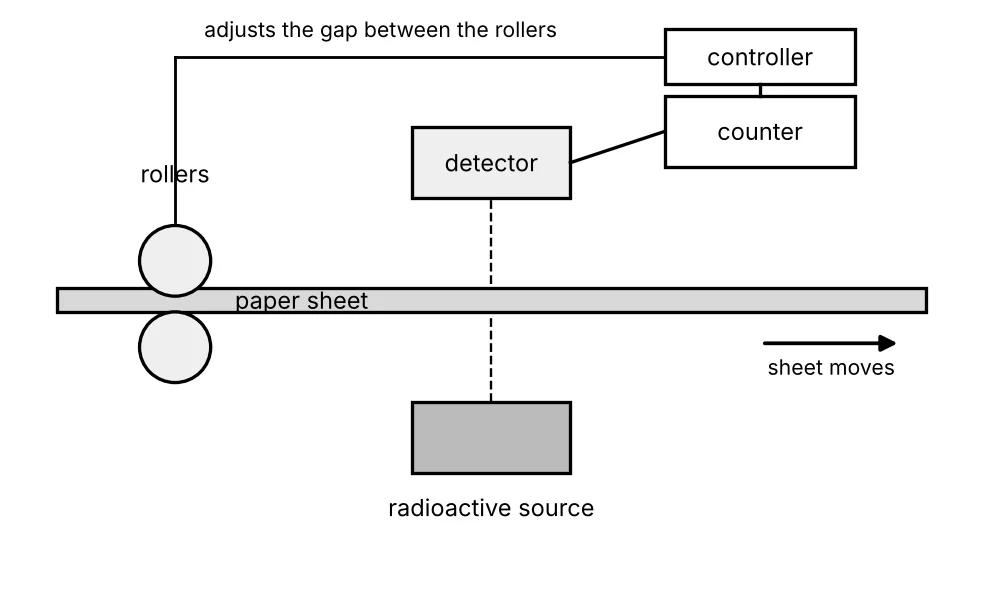
A paper mill measures the thickness of a moving sheet of paper with a radioactive source on one side of the sheet and a detector on the other. The counter reading depends on the thickness of the paper. The mill employs 40 workers. It must choose a type of source, and is also considering replacing the gauge with a laser gauge that costs three times as much.
Question diagram
(a)
Explain why a source of beta particles is more suitable for this gauge than a source of alpha particles or a source of gamma rays. [3]Criterion A (ii) · Level 5-6
(b)
Explain how the counter reading is used to keep the paper at a constant thickness. [2]Criterion D (i) · Level 5-6
(c)
Evaluate whether the mill should keep the radioactive gauge or buy the laser gauge. Refer to at least two perspectives, such as worker safety, waste, cost and reliability, and reach a justified conclusion. [5]Criterion D (ii), D (iii) · Level 7-8

revisionprep.com

Summary Answer

Not available for this question.

Model Answer

Not available for this question.

Marking Scheme

Not available for this question.

Examiner Insights

Not available for this question.

Question 6Criterion A · Band 3-8 · Challenge · 10 marksrevisionprep.com

Deflection in electric and magnetic fields
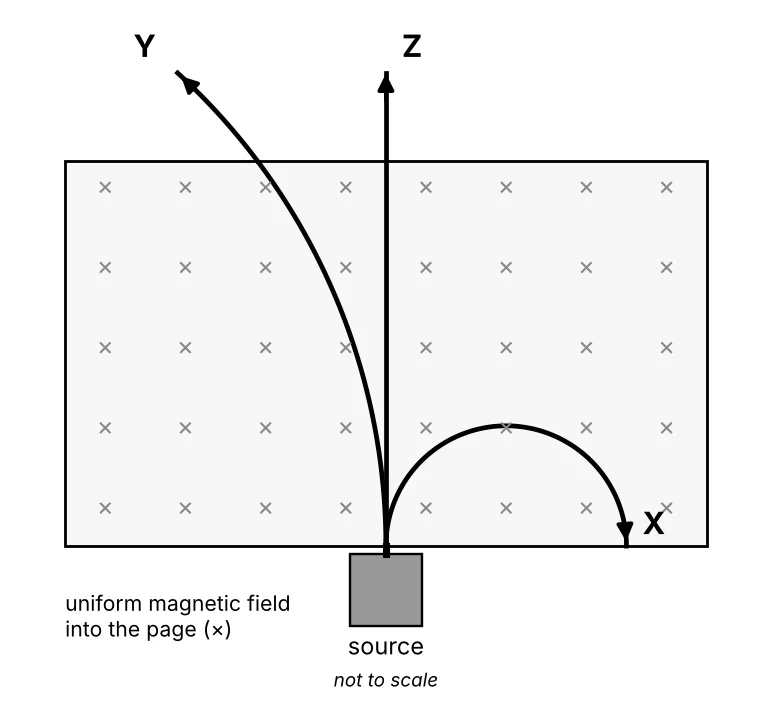
A narrow beam from a source that emits alpha particles, beta particles and gamma rays travels upwards in a vacuum into a uniform magnetic field directed into the page. The beam splits into three paths, X, Y and Z. In this field a moving positive charge is pushed to the left. The radius of the curved path of a charged particle is proportional to (mass × speed) ÷ charge.

ParticleMass (u)ChargeSpeed (10⁶ m s⁻¹)Alpha4.0+215Beta0.00055−1200\begin{array}{|l|c|c|c|}\hline \text{Particle} & \text{Mass (u)} & \text{Charge} & \text{Speed (10⁶ m s⁻¹)} \\ \hline \text{Alpha} & 4.0 & +2 & 15 \\ \hline \text{Beta} & 0.00055 & \text{−1} & 200 \\ \hline\end{array}
Question diagram
(a)
Identify the radiation that follows each of the paths X, Y and Z. Give a reason for each. [3]Criterion A (ii) · Level 3-4
(b)
Explain why the speed of the particle on path Y stays the same although it follows a curved path. [2]Criterion A (ii) · Level 5-6
(c)
The field is now reversed so that it points out of the page. Describe how the three paths change. [2]Criterion A (ii) · Level 5-6
(d)
A student says: 'Path X curves more than path Y because beta particles are faster than alpha particles.' Use the table and the relationship in the stem to evaluate this explanation. [3]Criterion A (iii) · Level 7-8

revisionprep.com

Summary Answer

Not available for this question.

Model Answer

Not available for this question.

Marking Scheme

Not available for this question.

Examiner Insights

Not available for this question.

That's every free question here — 6 of 88.

+82 more questions, plus Mock Papers & Worksheets, are waiting in Premium.

Upgrade