You're viewing free preview questions — 6 questions previewing here — subscribe to unlock 228 more, plus the Full Question Bank, Mock Papers & Worksheets.Upgrade
Back

Radioactivity and nuclear decay — Free MYP4 Physics Practice Questions

Free questions

Open in full, with answers, mark scheme and examiner insights.

Question 1Criterion A · Band 1-4 · Easy · 4 marksrevisionprep.com

Changes in atomic number and mass number
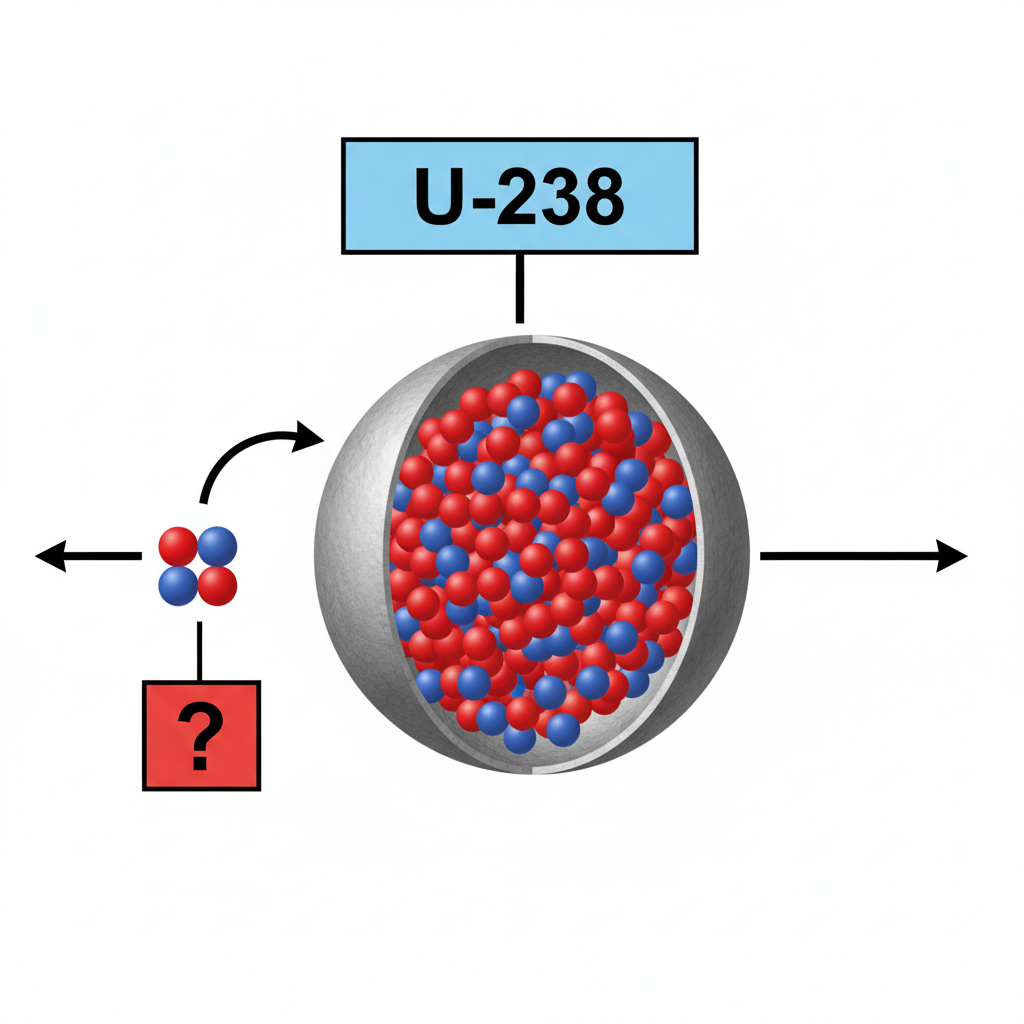
The diagram shows a uranium-238 nucleus, 92238U{}^{238}_{92}\text{U}, emitting a particle made of two protons and two neutrons.
Question diagram
(a)
Name the particle emitted. [1]Criterion A (i) · Level 1-2
(b)
Deduce the mass number and atomic number of the nucleus left behind. [2]Criterion A (ii) · Level 1-2
(c)
The element with atomic number 90 is thorium. Write the nuclide symbol for the nucleus left behind. [1]Criterion A (ii) · Level 3-4

revisionprep.com

Summary Answer

Not available for this question.

Model Answer

Not available for this question.

Marking Scheme

Not available for this question.

Examiner Insights

Not available for this question.

Question 2Criterion A · Band 1-2 · Easy · 2 marksrevisionprep.com

Writing nuclear equations

Radium-226 decays according to the equation 88226Ra→86222Rn+ZAX{}^{226}_{88}\text{Ra} \rightarrow {}^{222}_{86}\text{Rn} + {}^{A}_{Z}\text{X}

(a) Deduce AA and ZZ for X and name the particle. [2]

revisionprep.com

Summary Answer

Not available for this question.

Model Answer

Not available for this question.

Marking Scheme

Not available for this question.

Examiner Insights

Not available for this question.

Question 3Criterion A · Band 1-6 · Medium · 5 marksrevisionprep.com

Spontaneous and random nature of decay
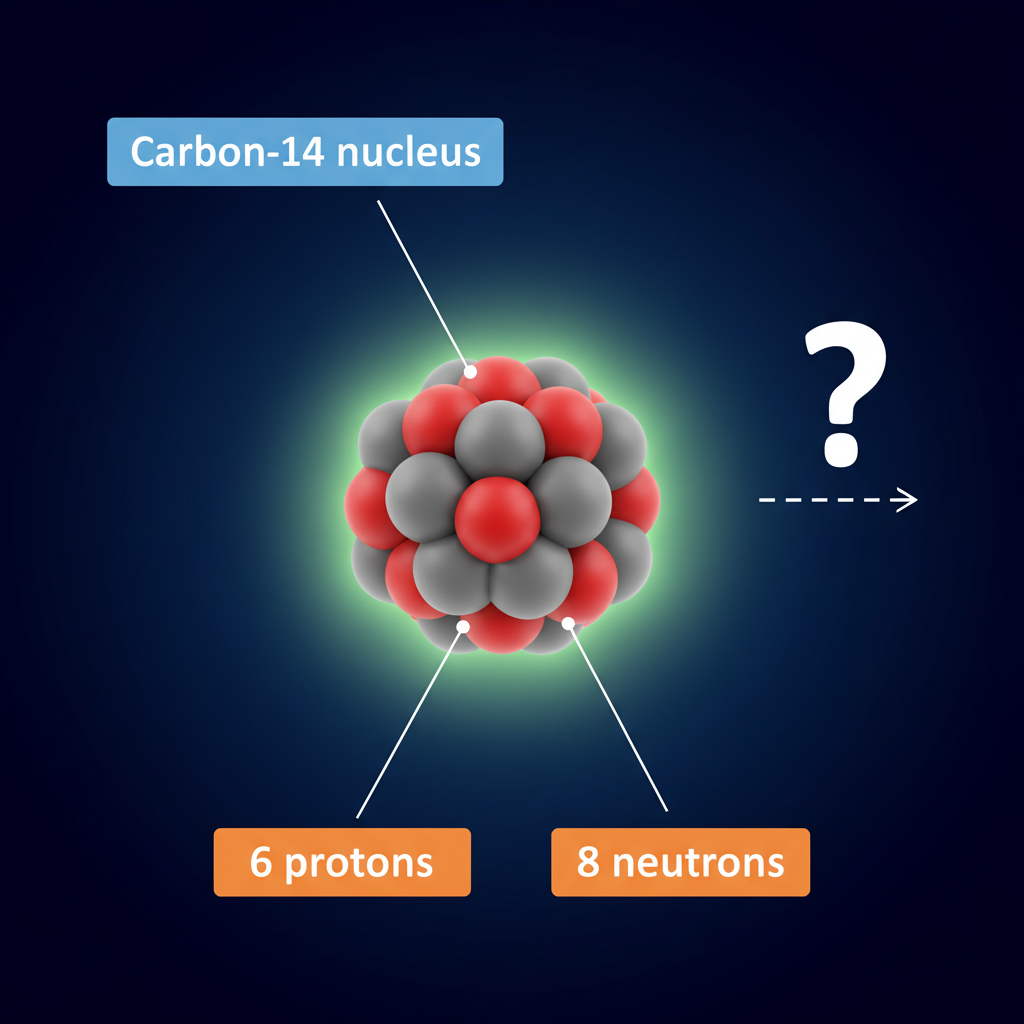
The diagram shows a single carbon-14 nucleus. It is radioactive.
Question diagram
(a)
State the nucleon number of this nucleus. [1]Criterion A (i) · Level 1-2
(b)
Explain why it is impossible to say when this nucleus will decay. [2]Criterion A (i) · Level 3-4
(c)
A 1 g sample of wood contains about 5×10105 \times 10^{10} carbon-14 nuclei. Explain why the activity of this sample can be predicted accurately. [2]Criterion A (ii) · Level 5-6

revisionprep.com

Summary Answer

Not available for this question.

Model Answer

Not available for this question.

Marking Scheme

Not available for this question.

Examiner Insights

Not available for this question.

Question 4Criterion D + A · Band 3-6 · Medium · 8 marksrevisionprep.com

Alpha, beta and gamma decay processes

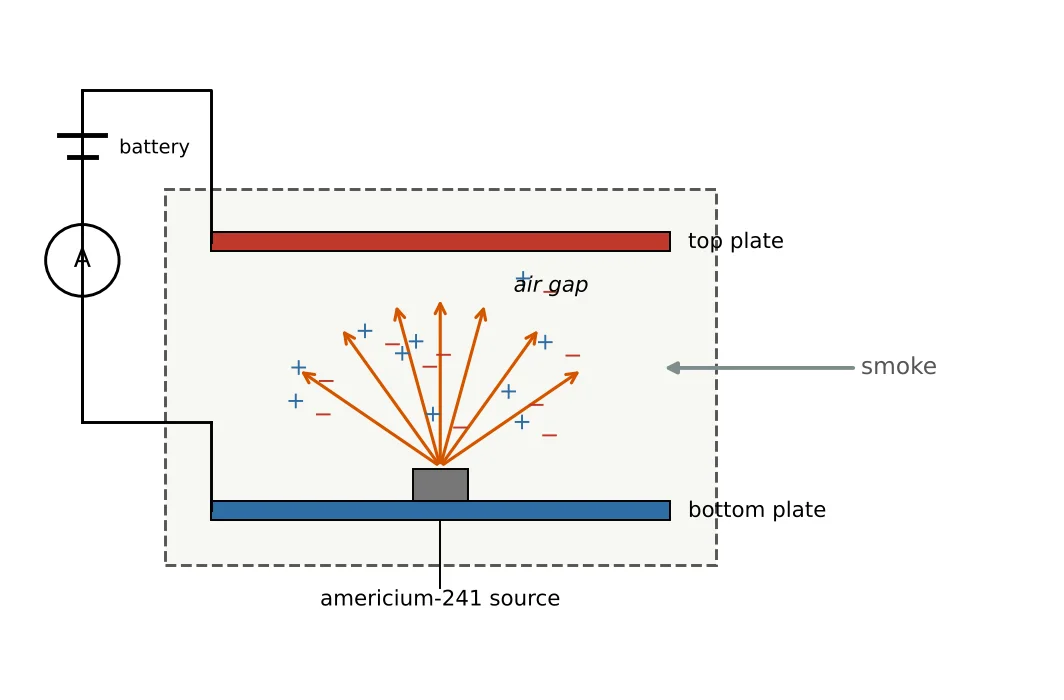
The diagram shows an ionisation smoke detector. Americium-241 emits alpha particles that ionise the air between two plates, so a small current flows. Americium-241 has a half-life of 432 years.
Question diagram
(a)
Explain why an alpha source is chosen for this detector. [2]Criterion A (ii) · Level 3-4
(b)
Explain why smoke entering the detector sets off the alarm. [2]Criterion D (i) · Level 5-6
(c)
Outline why the detector is safe for people in the room. [1]Criterion D (i) · Level 3-4
(d)
Suggest why the source does not need replacing during the detector's life. [1]

(e) Some people want smoke detectors that contain americium-241 to be banned because they contain a radioactive material. Explain why such detectors are still safe to use in homes. [2]
Criterion D (i) · Level 3-4

revisionprep.com

Summary Answer

Not available for this question.

Model Answer

Not available for this question.

Marking Scheme

Not available for this question.

Examiner Insights

Not available for this question.

Question 5Criterion B · Band 3-8 · Challenge · 9 marksrevisionprep.com

Definition of radioactivity

A student wants to find out how the thickness of aluminium affects the count rate from a beta source. Available: a sealed beta source, a Geiger-Müller tube and counter, aluminium sheets each 0.5 mm thick, a metre rule, tongs and a stopwatch.
(a)
Write a research question for this investigation. [1]Criterion B (i) · Level 3-4
(b)
Formulate a hypothesis and explain it using scientific reasoning. [2]Criterion B (ii) · Level 5-6
(c)
Identify the independent and dependent variables and two control variables, stating how each control variable is kept constant. [3]Criterion B (iii) · Level 5-6
(d)
Describe a method, including how background radiation is dealt with and one safety precaution. [3]Criterion B (iv) · Level 7-8

revisionprep.com

Summary Answer

Not available for this question.

Model Answer

Not available for this question.

Marking Scheme

Not available for this question.

Examiner Insights

Not available for this question.

Question 6Criterion C · Band 3-8 · Challenge · 8 marksrevisionprep.com

Conservation laws in nuclear reactions

A student reads about four decays.

Americium-241 (Z=95Z = 95) becomes neptunium-237 (Z=93Z = 93).
Potassium-40 (Z=19Z = 19) becomes calcium-40 (Z=20Z = 20).
Polonium-214 (Z=84Z = 84) becomes lead-210 (Z=82Z = 82).
Bismuth-210 (Z=83Z = 83) becomes polonium-210 (Z=84Z = 84).
(a)
Present the information in a table with columns: parent, change in AA, change in ZZ, particle emitted. [3]Criterion C (i) · Level 3-4
(b)
Describe the pattern that links the changes in AA and ZZ to the particle emitted. [2]Criterion C (ii) · Level 5-6
(c)
Use the pattern to predict the daughter when thorium-228 (Z=90Z = 90) emits an alpha particle (Z = 88 is radium). [1]Criterion C (ii) · Level 3-4
(d)
Explain how the pattern follows from conservation of nucleon number and charge. [2]Criterion C (ii) · Level 7-8

revisionprep.com

Summary Answer

Not available for this question.

Model Answer

Not available for this question.

Marking Scheme

Not available for this question.

Examiner Insights

Not available for this question.

That's every free question here — 6 of 234.

+228 more questions, plus Mock Papers & Worksheets, are waiting in Premium.

Upgrade