You're viewing free preview questions — 5 questions previewing here — subscribe to unlock 64 more, plus the Full Question Bank, Mock Papers & Worksheets.Upgrade
Light in Communication and Technology — Free MYP4 Physics Practice Questions

1QuestionFiber Optics and Total Internal ReflectionConcept Practice
2 marks~3 minCriterion D
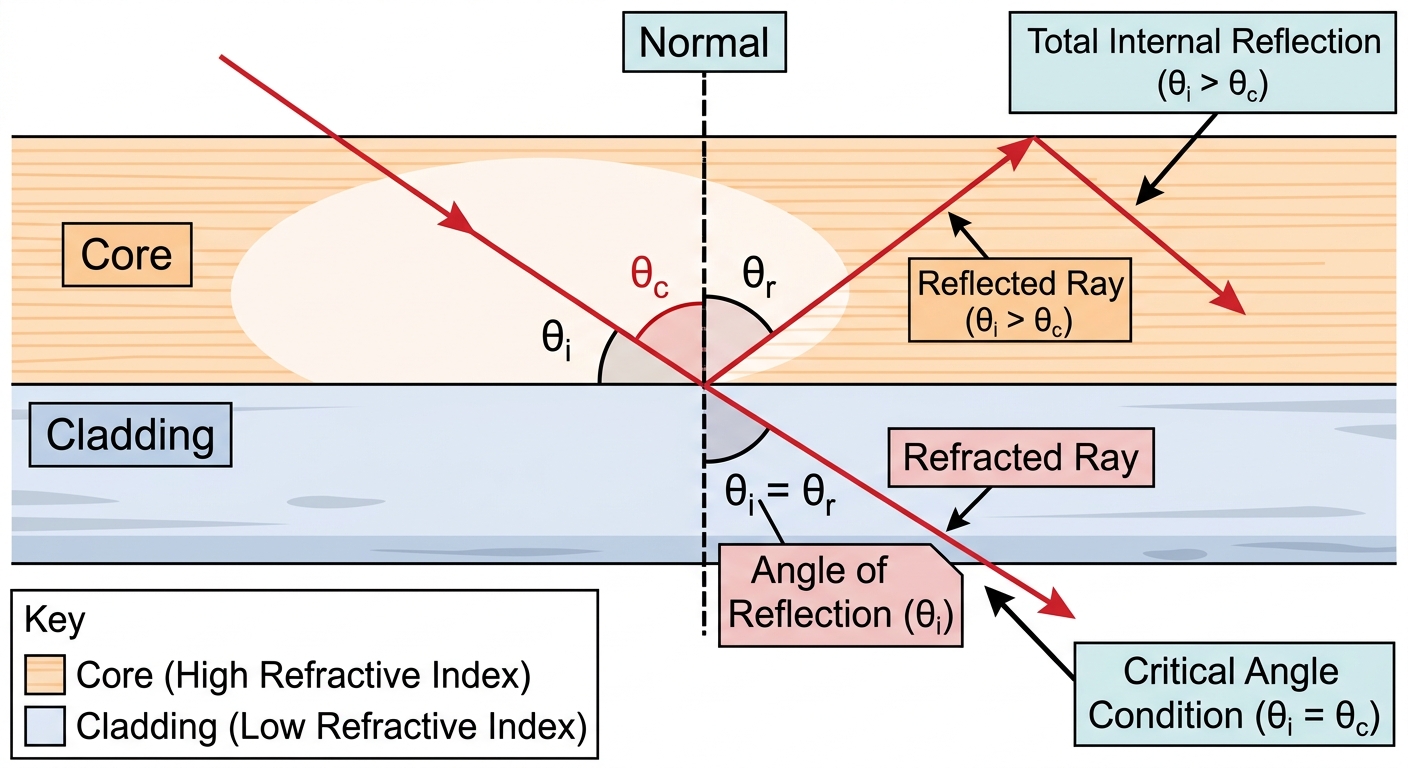
Fiber optic cables transmit light signals by total internal reflection. Internet providers use fiber optics to deliver high-speed broadband, yet coverage remains uneven across different regions.
a
Identify one real-world application of fiber optic cables beyond internet provision. [1]
b
Explain one reason why fiber optic cables are difficult to deploy for internet access in rural communities. [1]

Solutions
2QuestionLasers and Optical DevicesAssessment Practice
5 marks~8 minCriterion C
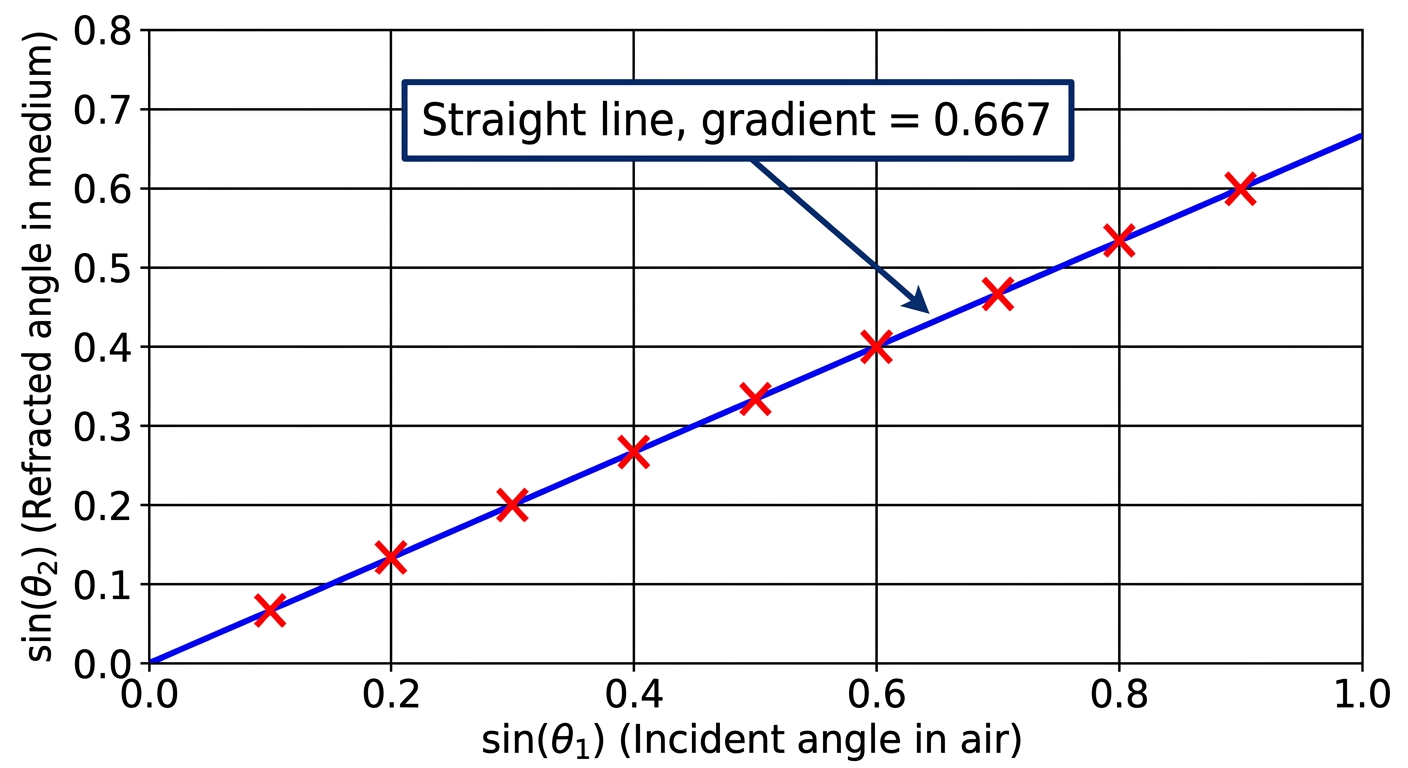
A laser beam travels from air into an unknown transparent medium. The angles of incidence (in air) and refraction (in the medium) are measured across several trials and plotted as versus . The graph is a straight line through the origin with gradient .
Snell's law: , where for air.
Refractive indices of candidate media:
Crown glass: 1.52 — Flint glass: 1.62 — Diamond: 2.42 — Water: 1.33
Snell's law: , where for air.
Refractive indices of candidate media:
Crown glass: 1.52 — Flint glass: 1.62 — Diamond: 2.42 — Water: 1.33
a
Deduce the relationship between the gradient of the graph and the refractive index of the medium. [1]
b
Calculate the refractive index of the medium. [2]
c
A technician claims the medium is crown glass. Evaluate this claim using your calculated value and the data provided. [2]
Solutions
3QuestionDigital vs Analog Signals IntroductoryConcept Practice
2 marks~3 minCriterion A
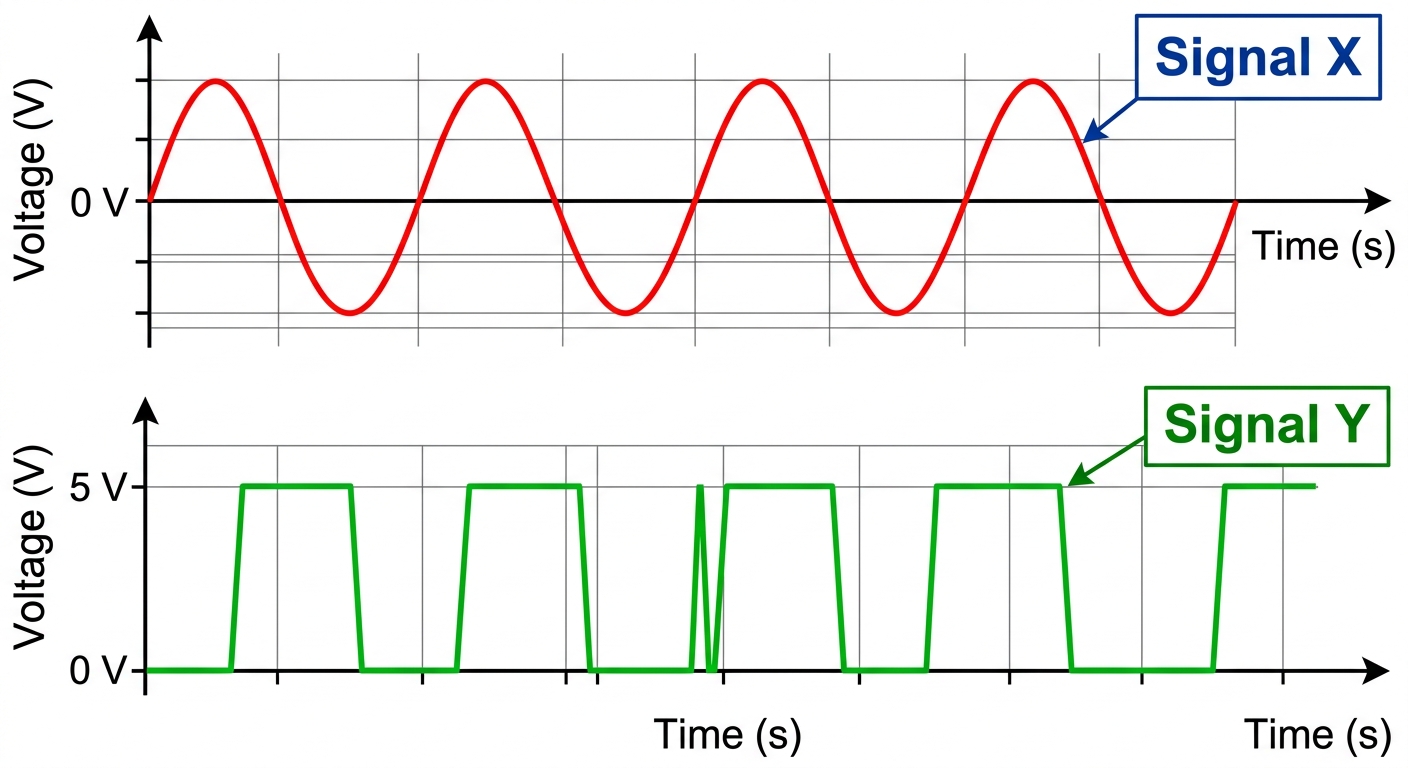
The diagram shows two electrical signals plotted on voltage–time axes.
Signal X is a smooth, continuous wave that varies sinusoidally between and .
Signal Y alternates sharply between exactly and .
Signal X is a smooth, continuous wave that varies sinusoidally between and .
Signal Y alternates sharply between exactly and .
a
Identify which signal is digital. [1]
b
State one characteristic of digital signals that distinguishes them from analog signals. [1]
Solutions
4QuestionAssessment Practice
6 marks~9 minCriterion D
Data
| Distance (m) | 1 | 2 | 3 | 4 | 5 |
|---|---|---|---|---|---|
| Measured signal (dBm) |
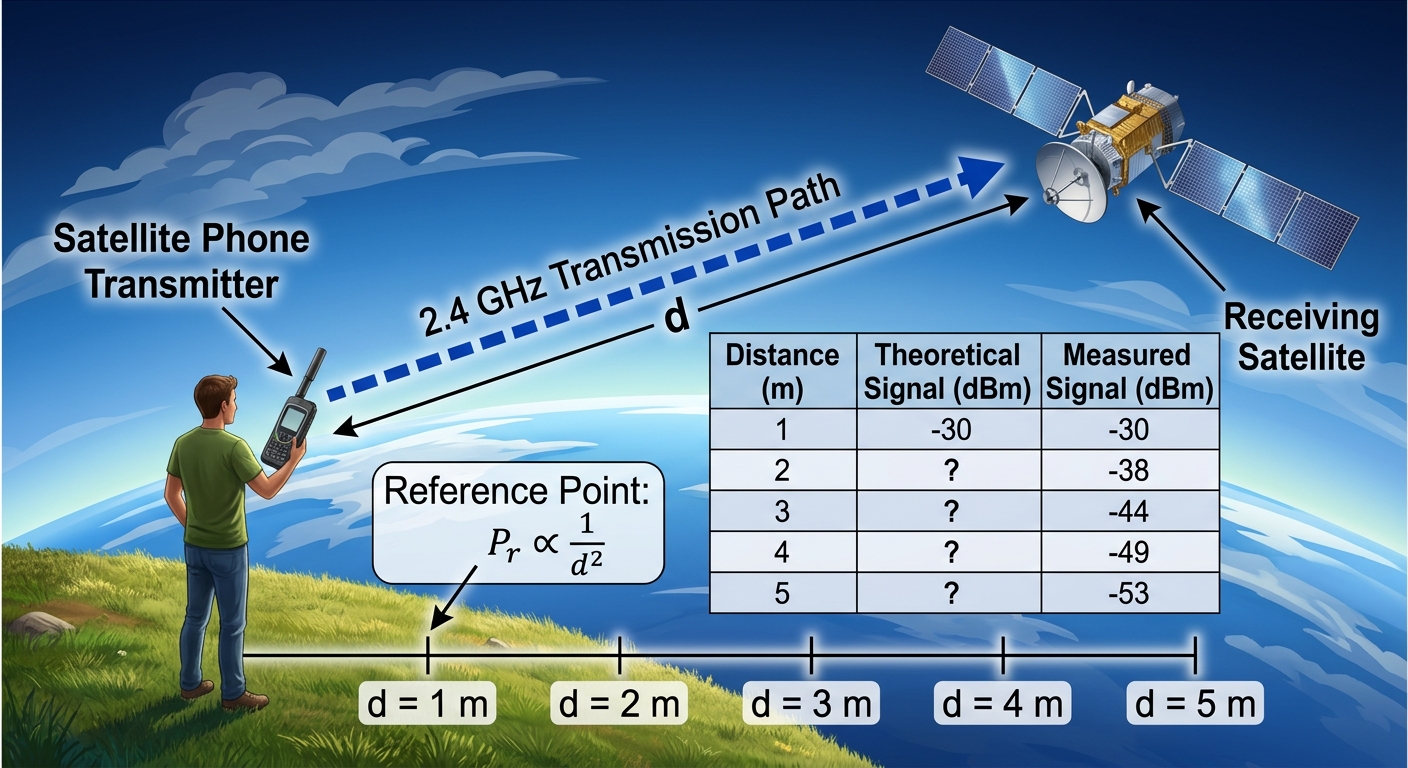
In satellite communication, a phone transmits at 2.4 GHz. Signal strength follows the inverse-square law, , where is distance from the transmitter. In decibels, the change in signal strength relative to 1 m is given by dB. The signal strength at 1 m is dBm.
Measured
Measured
a
Calculate the theoretical signal strength (dBm) at distances of 2 m, 3 m, 4 m, and 5 m. [2]
b
Deduce the percentage deviation of the measured signal from the theoretical value at each distance using:
[2]
[2]
c
Evaluate the validity of the inverse-square law as a model for this data, identifying at least one physical reason for any systematic trend in the deviations. [2]
Solutions
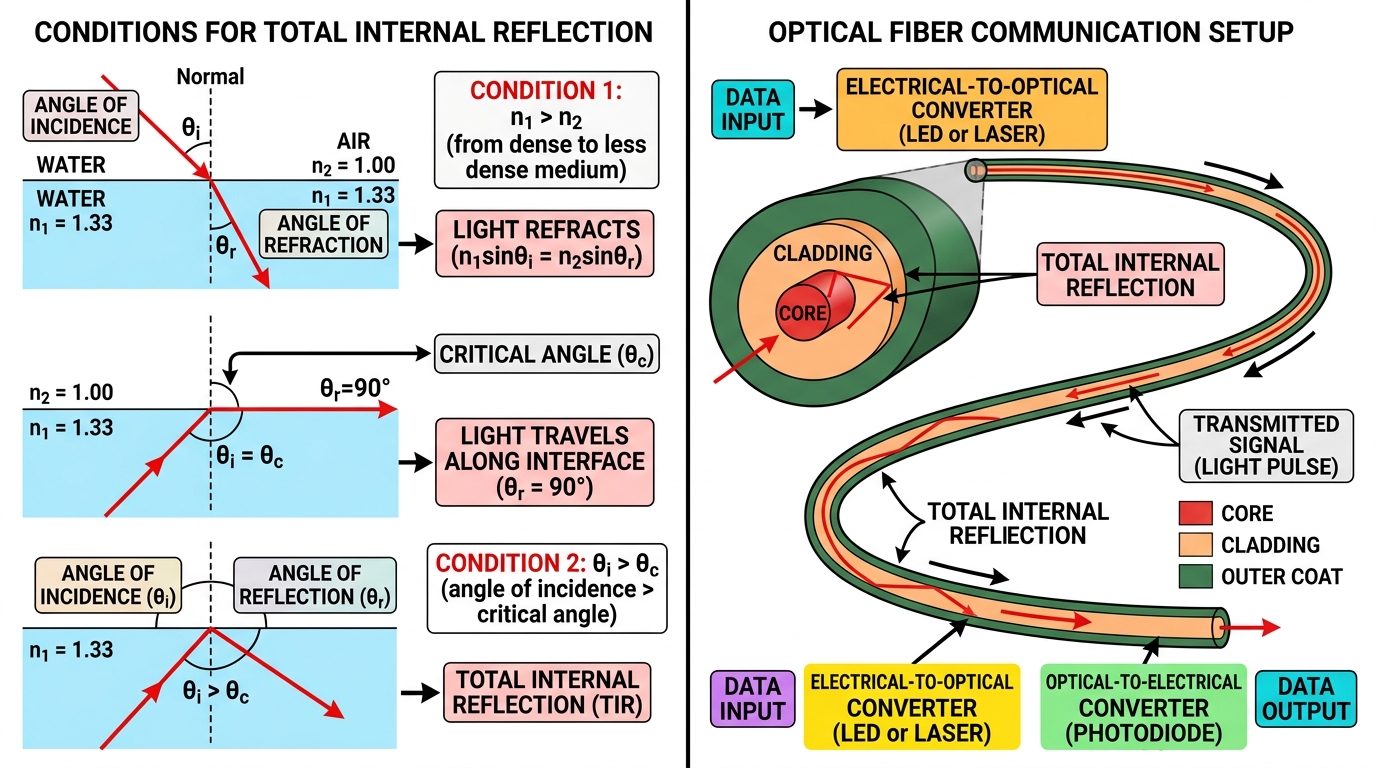
5QuestionFiber Optics and Total Internal ReflectionAssessment Practice
8 marks~12 minCriterion A
An optical fibre carries light signals through a glass core (refractive index ) surrounded by cladding (refractive index ).
a
State the two conditions required for total internal reflection to occur at the core–cladding boundary. [2]
b
Construct a ray diagram showing light undergoing total internal reflection inside the optical fibre. Label the core, cladding, angle of incidence , and angle of reflection . [2]
c
Explain how total internal reflection allows an optical fibre to transmit communication signals over long distances with minimal signal loss. [2]
d
The critical angle for this fibre is given by . Calculate and analyse whether a ray striking the boundary at 68° will undergo total internal reflection. [2]
Solutions
That's every free question here — 5 of 69.
+64 more questions, plus Mock Papers & Worksheets, are waiting in Premium.