You're viewing free preview questions — 6 questions previewing here — subscribe to unlock 175 more, plus the Full Question Bank, Mock Papers & Worksheets.Upgrade
Back

Wave properties and wave behaviour — Free MYP4 Physics Practice Questions

Free questions

Open in full, with answers, mark scheme and examiner insights.

Question 1Criterion A + D · Band 1-4 · Easy · 6 marksrevisionprep.com

Wave speed: v = fλ

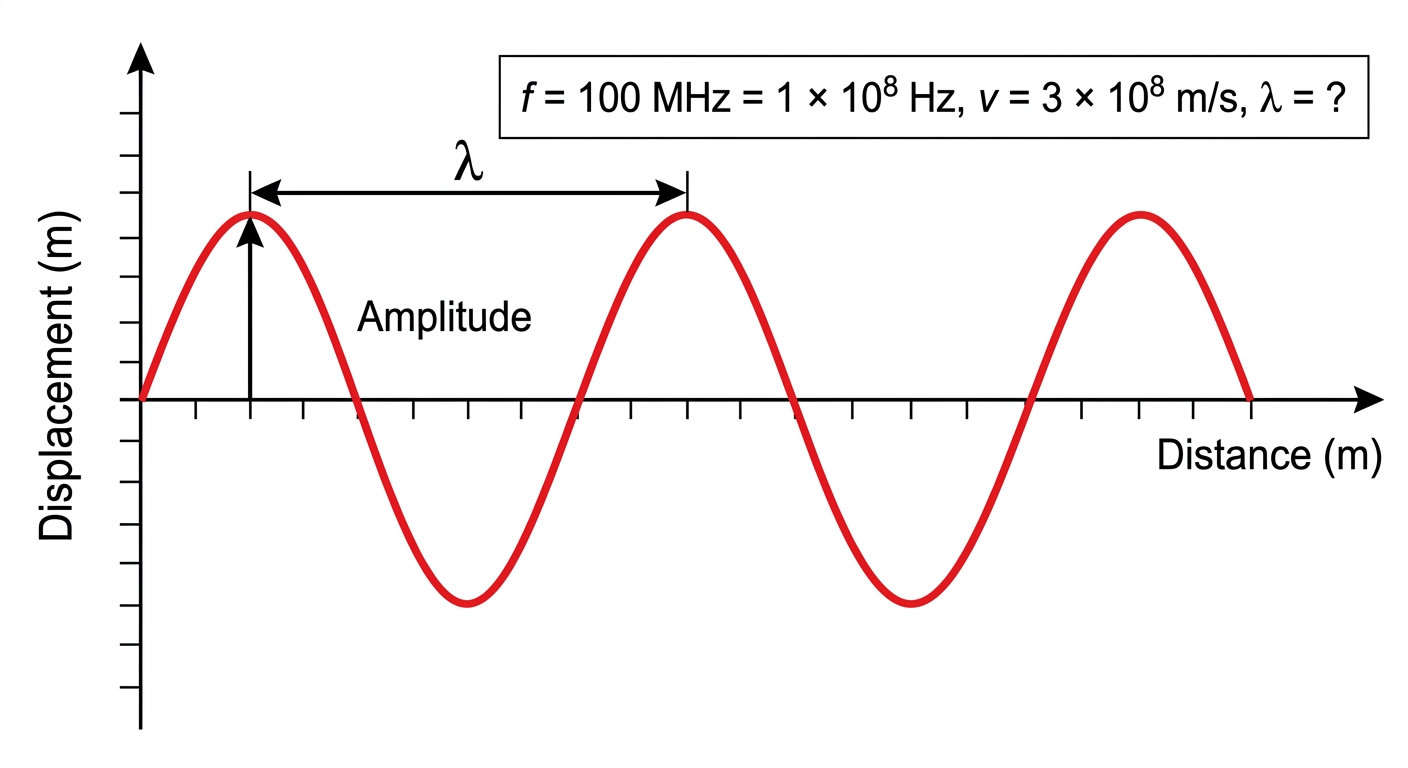
A radio station broadcasts at 100 MHz. The diagram shows the wave with its wavelength and amplitude marked. Radio waves travel at 3.0 × 10⁸ m s⁻¹.
Question diagram
(a)
Calculate the wavelength of the radio waves. [2]Criterion A (ii) · Level 1-2
(b)
A second station broadcasts at 200 MHz. State its wavelength and describe the relationship between frequency and wavelength for radio waves. [2]Criterion A (ii) · Level 3-4
(c)
Explain why radio stations can be received from satellites in space but sound from a loudspeaker on a satellite could not reach Earth. [2]Criterion D (i) · Level 3-4

revisionprep.com

Summary Answer

Not available for this question.

Model Answer

Not available for this question.

Marking Scheme

Not available for this question.

Examiner Insights

Not available for this question.

Question 2Criterion A · Band 1-4 · Easy · 6 marksrevisionprep.com

Crest, trough, compression and rarefaction
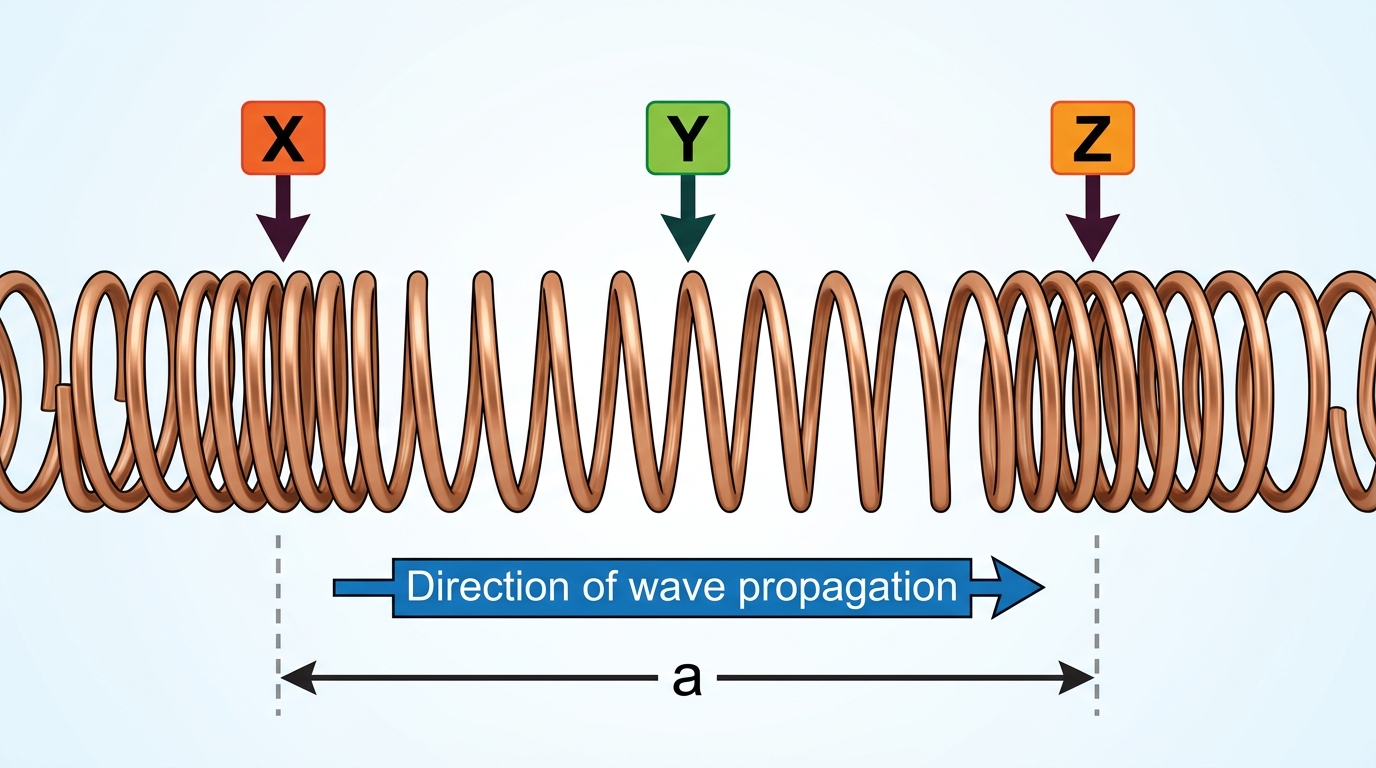
The diagram shows a longitudinal wave on a slinky at one instant. Regions X, Y and Z are labelled, and the distance a from X to Z is 0.30 m. The end of the slinky is moved backwards and forwards 4.0 times per second.
Question diagram
(a)
Name the feature of the wave at X and at Y. [1]Criterion A (i) · Level 1-2
(b)
Describe the difference between the coils at X and at Y. [2]Criterion A (i) · Level 3-4
(c)
State what distance a represents, and calculate the speed of the wave. [2]Criterion A (ii) · Level 3-4
(d)
Determine the distance from X to Y. [1]Criterion A (ii) · Level 3-4

revisionprep.com

Summary Answer

Not available for this question.

Model Answer

Not available for this question.

Marking Scheme

Not available for this question.

Examiner Insights

Not available for this question.

Question 3Criterion C · Band 3-6 · Medium · 7 marksrevisionprep.com

Transverse vs Longitudinal Waves

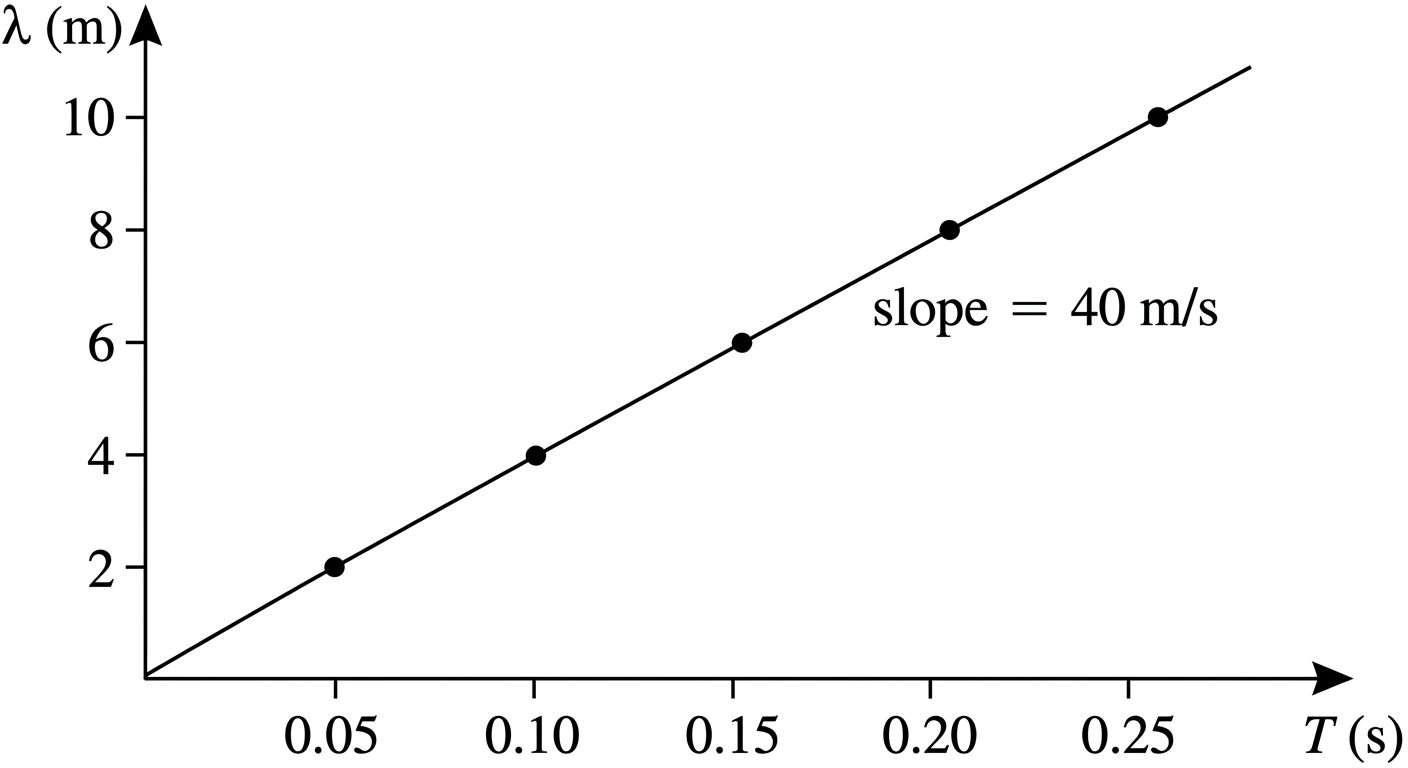
A student measures the wavelength λ and the period T of several waves on the same stretched string. The graph shows her results.
Question diagram
(a)
Use the graph to determine the wave speed on the string. [2]Criterion C (i), C (ii) · Level 3-4
(b)
Explain why the points lie on a straight line through the origin. [2]Criterion C (ii) · Level 5-6
(c)
A wave on this string has a wavelength of 2.0 m. Calculate its frequency. [2]Criterion C (i) · Level 3-4
(d)
Predict the wavelength of a wave with a period of 0.30 s on the same string. [1]Criterion C (ii) · Level 3-4

revisionprep.com

Summary Answer

Not available for this question.

Model Answer

Not available for this question.

Marking Scheme

Not available for this question.

Examiner Insights

Not available for this question.

Question 4Criterion D + A · Band 3-6 · Medium · 5 marksrevisionprep.com

Diffraction of Waves

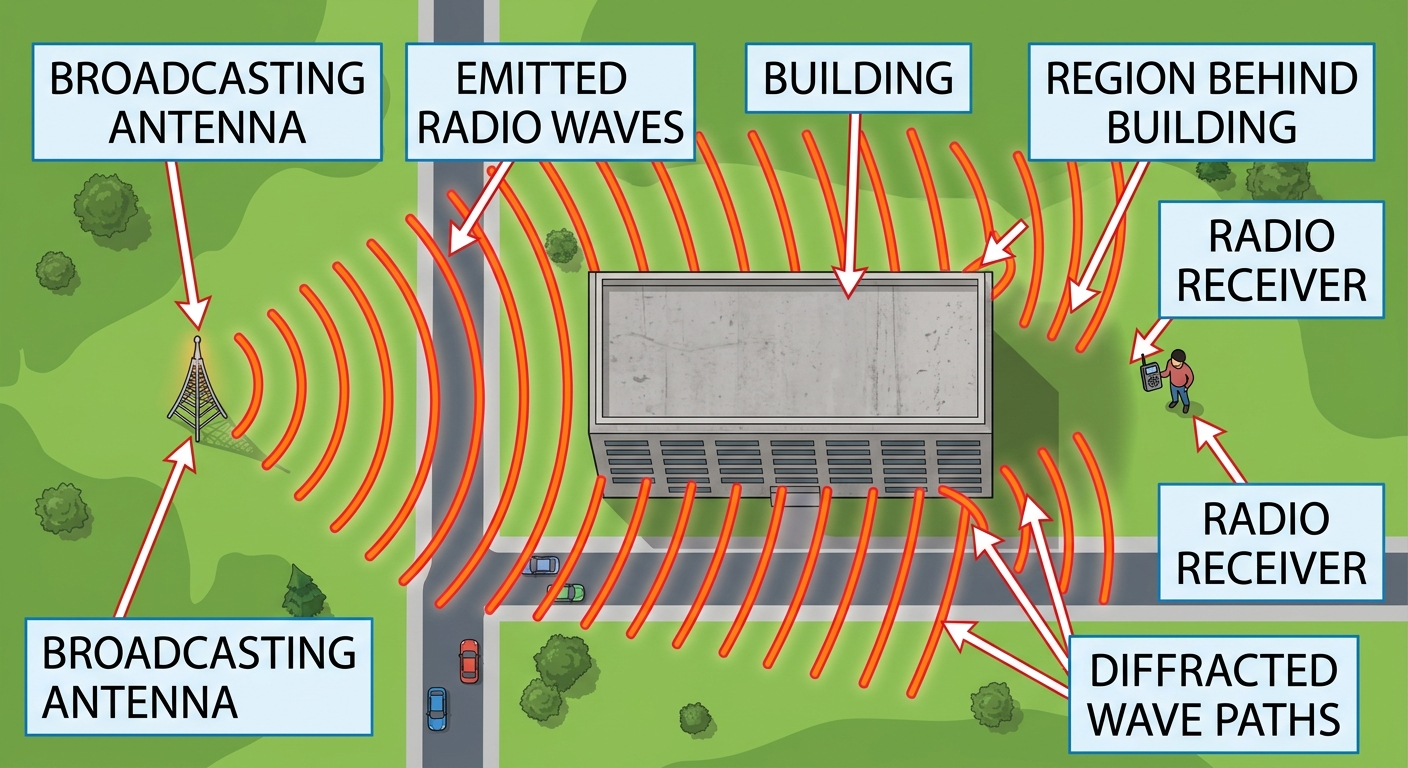
The diagram shows radio waves of wavelength 200 m from a broadcasting antenna reaching a receiver behind a building 40 m wide. Radio waves travel at 3.0 × 10⁸ m s⁻¹.
Question diagram
(a)
Calculate the frequency of the radio waves. [2]Criterion A (ii) · Level 3-4
(b)
A TV signal with a wavelength of 0.50 m is weak behind the same building, although the radio signal is strong. Explain why, and suggest one way the TV company could improve reception for homes behind the building. [3]Criterion D (i) · Level 5-6

revisionprep.com

Summary Answer

Not available for this question.

Model Answer

Not available for this question.

Marking Scheme

Not available for this question.

Examiner Insights

Not available for this question.

Question 5Criterion A + D · Band 1-8 · Challenge · 8 marksrevisionprep.com

Definition and Examples of Waves

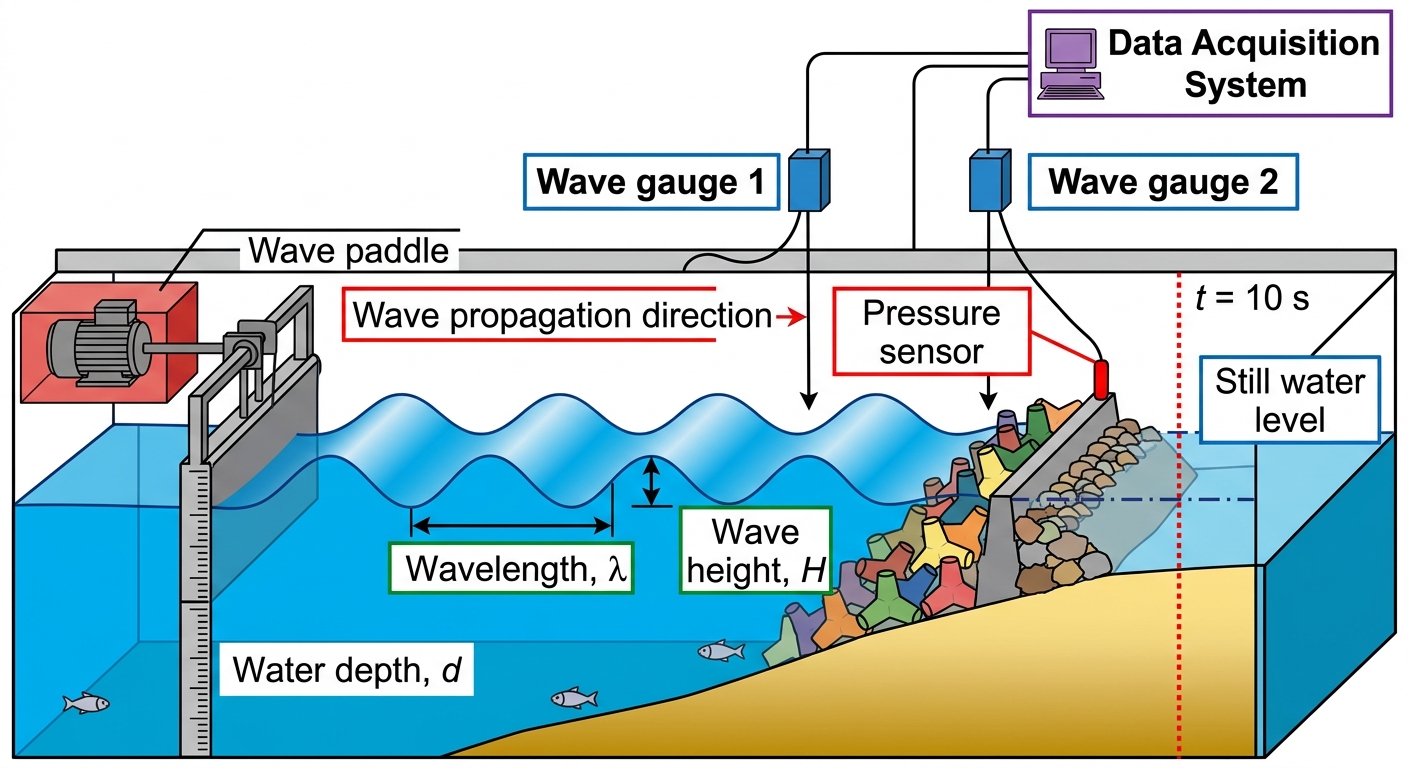
An engineer tests a model breakwater (a barrier that protects a harbour) in the wave tank shown. The paddle makes regular waves with a wavelength of 1.2 m and a frequency of 0.80 Hz. Real storm waves arrive from several directions at once, with different heights and periods.
Question diagram
(a)
Calculate the speed of the waves in the tank. [2]Criterion A (ii) · Level 1-2
(b)
Explain how the wave gauges could be used to find the frequency of the waves. [2]Criterion A (i) · Level 3-4
(c)
Evaluate whether results from this tank alone are enough to approve the breakwater design for a stormy coast. [4]Criterion D (ii) · Level 7-8

revisionprep.com

Summary Answer

Not available for this question.

Model Answer

Not available for this question.

Marking Scheme

Not available for this question.

Examiner Insights

Not available for this question.

Question 6Criterion B + C · Band 5-8 · Challenge · 10 marksrevisionprep.com

Wavelength, frequency, amplitude and period
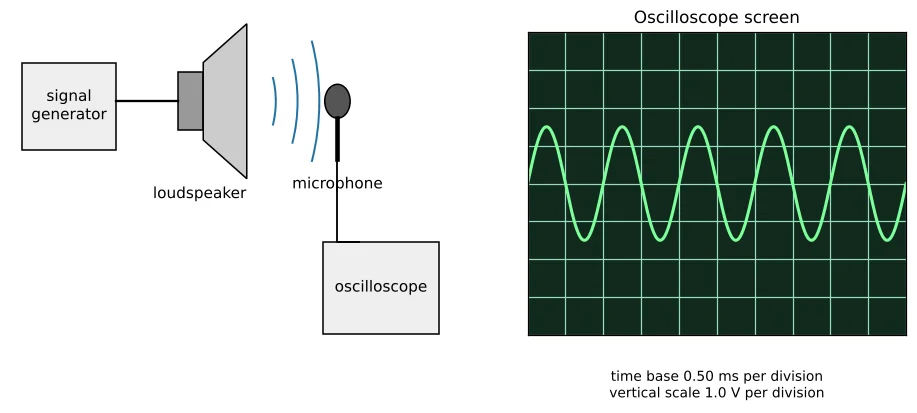
A student wants to find out whether making a sound louder changes its frequency. She connects a signal generator to a loudspeaker and places a microphone in front of it. The microphone is connected to an oscilloscope, as drawn. On the oscilloscope screen each horizontal division is 0.50 ms and each vertical division is 1.0 V. She can read the screen to within 0.1 division.
Question diagram
(a)
Formulate a hypothesis for how the frequency measured by the microphone depends on the loudness of the sound, and explain it using scientific reasoning. [2]Criterion B (ii) · Level 5-6
(b)
State the independent variable and the dependent variable, and explain how two other variables are controlled. [3]Criterion B (iii) · Level 5-6
(c)
Explain how she can find the frequency of the sound from the trace as accurately as possible. [2]Criterion B (iv) · Level 5-6
(d)
She repeats the investigation for five amplitudes. The table shows the number of divisions taken by one complete wave on the screen.

Amplitude / divisions0.51.01.52.02.5Divisions for one complete wave2.02.02.02.02.1\begin{array}{|l|c|c|c|c|c|}\hline \text{Amplitude / divisions} & 0.5 & 1.0 & 1.5 & 2.0 & 2.5 \\ \hline \text{Divisions for one complete wave} & 2.0 & 2.0 & 2.0 & 2.0 & 2.1 \\ \hline\end{array}

Calculate the frequency for each amplitude and evaluate your hypothesis. [3]
Criterion C (ii), C (iii) · Level 7-8

revisionprep.com

Summary Answer

Not available for this question.

Model Answer

Not available for this question.

Marking Scheme

Not available for this question.

Examiner Insights

Not available for this question.

That's every free question here — 6 of 181.

+175 more questions, plus Mock Papers & Worksheets, are waiting in Premium.

Upgrade