You're viewing free preview questions — 6 questions previewing here — subscribe to unlock 87 more, plus the Full Question Bank, Mock Papers & Worksheets.Upgrade
Back

Forms and Conservation of Energy — Free MYP4 Physics Practice Questions

Free questions

Open in full, with answers, mark scheme and examiner insights.

Question 1Criterion A · Band 1-4 · Easy · 4 marksrevisionprep.com

Energy stores and transfers

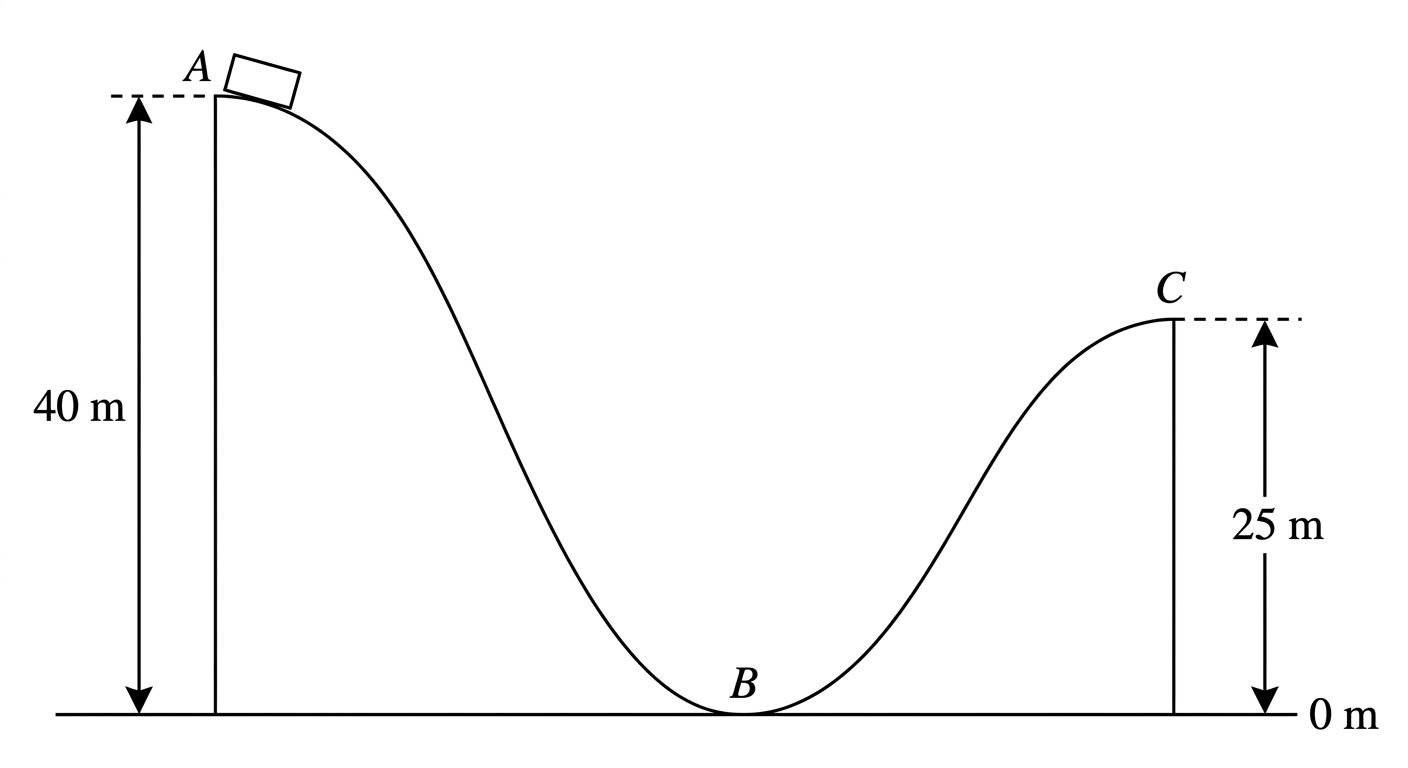
The diagram shows part of a roller-coaster track. A car of mass 800 kg starts from rest at A, 40 m above the ground, runs down to B at ground level and up to C, 25 m above the ground. Take g = 9.8 N kg⁻¹.
Question diagram
(a)
Calculate the gravitational potential energy of the car at A, relative to the ground. [2]Criterion A (ii) · Level 1-2
(b)
Assuming no energy is dissipated, calculate the speed of the car at B. [2]Criterion A (ii) · Level 3-4

revisionprep.com

Summary Answer

Not available for this question.

Model Answer

Not available for this question.

Marking Scheme

Not available for this question.

Examiner Insights

Not available for this question.

Question 2Criterion B + A · Band 3-4 · Easy · 6 marksrevisionprep.com

Kinetic and gravitational potential energy: Ek = ½mv², Ep = mgh
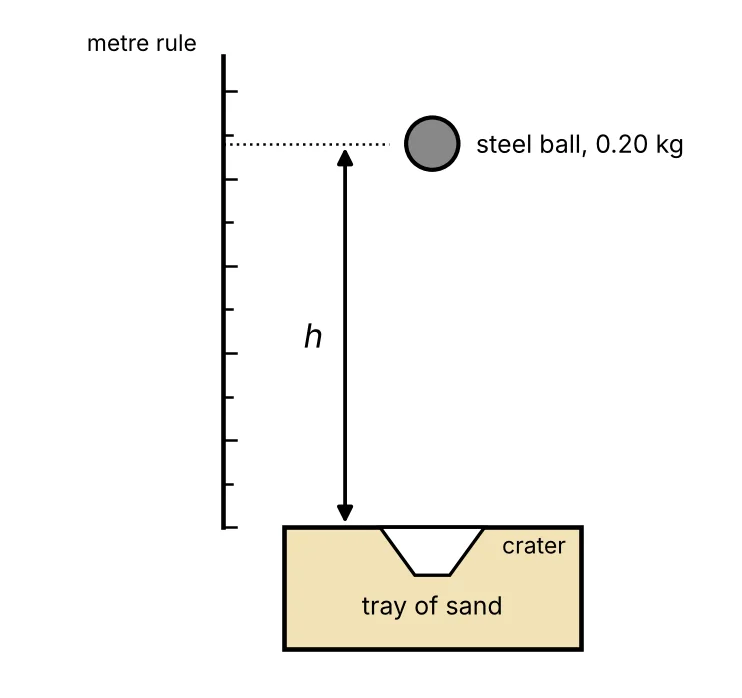
A student drops a steel ball of mass 0.20 kg from different heights into a tray of sand and measures the depth of the crater it makes, as shown. Take g = 9.8 N kg⁻¹.
Question diagram
(a)
Calculate the gravitational potential energy of the ball when it is released from a height of 0.80 m. [2]Criterion A (ii) · Level 3-4
(b)
Identify the independent variable and the dependent variable in this investigation. [2]Criterion B (iii) · Level 3-4
(c)
Suggest one change to the method that would make the results more reliable, and explain why it helps. [2]Criterion B (iv) · Level 3-4

revisionprep.com

Summary Answer

Not available for this question.

Model Answer

Not available for this question.

Marking Scheme

Not available for this question.

Examiner Insights

Not available for this question.

Question 3Criterion C + A · Band 1-6 · Medium · 8 marksrevisionprep.com

Energy Transformations and Real-Life Examples
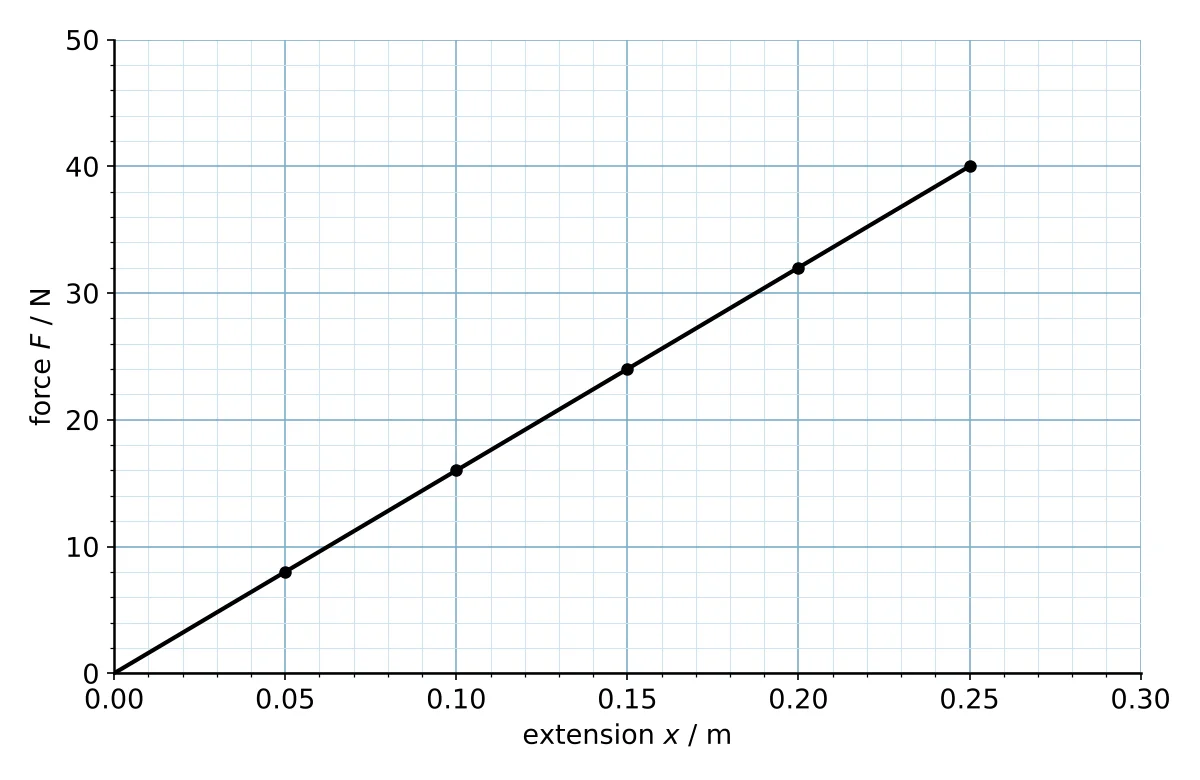
The graph shows how the force needed to stretch the elastic of a catapult depends on its extension. The catapult is used to launch a ball of mass 20 g.
Question diagram
(a)
State the force needed to stretch the elastic by 0.25 m. [1]Criterion C (ii) · Level 1-2
(b)
The energy stored in the elastic equals the area under the force-extension graph. Calculate the energy stored when the extension is 0.25 m. [2]Criterion C (i) · Level 3-4
(c)
Assuming all of this energy is transferred to the ball, calculate the launch speed of the ball. [2]Criterion A (ii) · Level 3-4
(d)
The measured launch speed is 19 m s⁻¹. Calculate the efficiency of the catapult and suggest where the wasted energy goes. [3]Criterion C (i), C (ii) · Level 5-6

revisionprep.com

Summary Answer

Not available for this question.

Model Answer

Not available for this question.

Marking Scheme

Not available for this question.

Examiner Insights

Not available for this question.

Question 4Criterion A · Band 3-6 · Medium · 7 marksrevisionprep.com

Law of Conservation of Energy

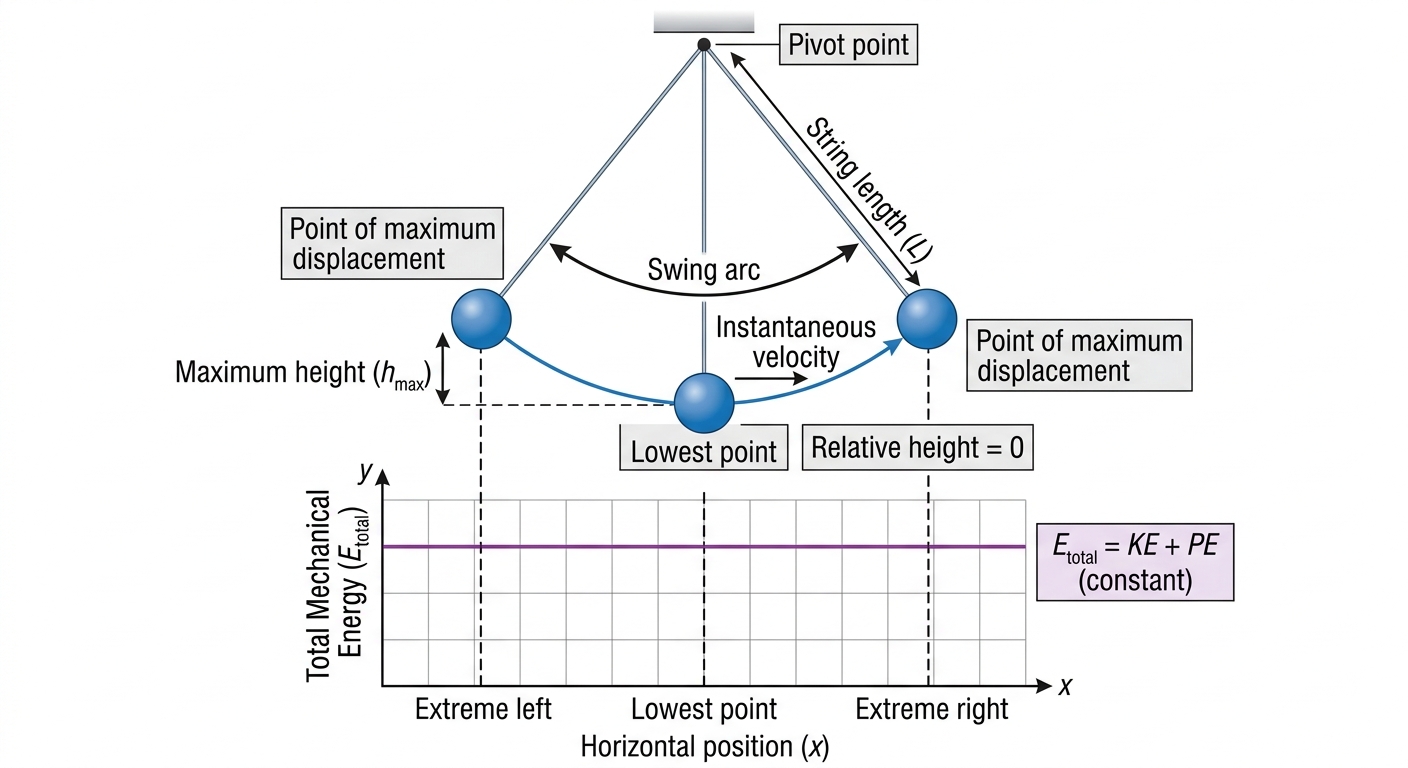
The diagram shows a simple pendulum. The bob, of mass 0.20 kg, is released from rest at A, a height of 0.15 m above its lowest point B, and swings up to C on the other side. Air resistance and friction are negligible. Take g = 9.8 N kg⁻¹.
Question diagram
(a)
Calculate the speed of the bob at B. [2]Criterion A (ii) · Level 3-4
(b)
Calculate the speed of the bob when it is 0.075 m above B on its way to C. [2]Criterion A (ii) · Level 5-6
(c)
A student claims that the bob will reach exactly the same height at C as at A. Evaluate this claim. [3]Criterion A (iii) · Level 5-6

revisionprep.com

Summary Answer

Not available for this question.

Model Answer

Not available for this question.

Marking Scheme

Not available for this question.

Examiner Insights

Not available for this question.

Question 5Criterion D + B · Band 5-8 · Challenge · 10 marksrevisionprep.com

Energy Flow in Systems

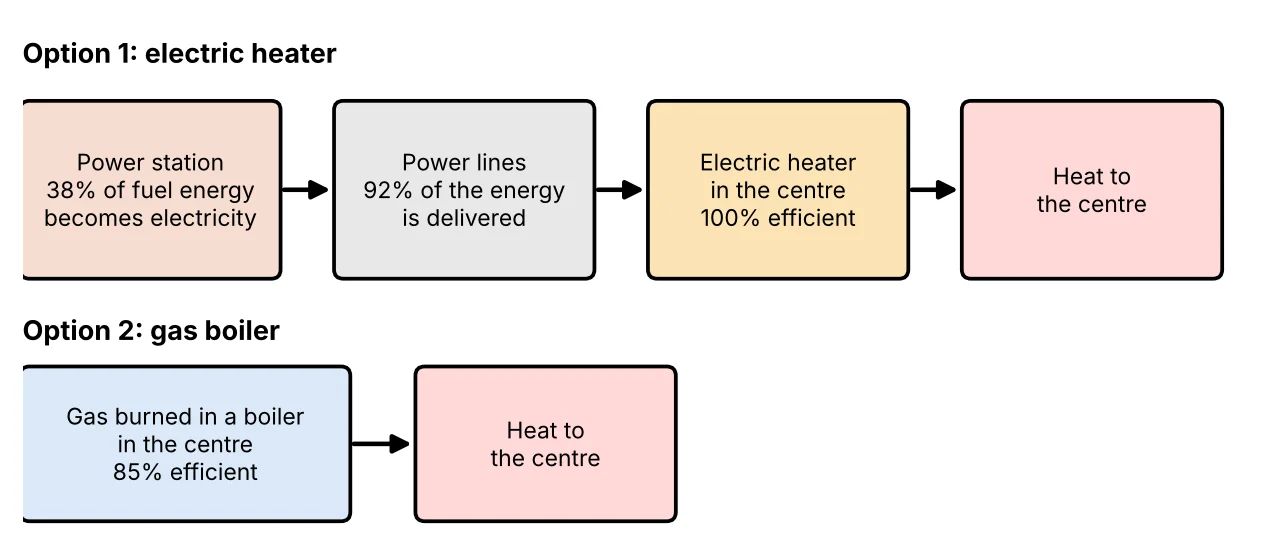
A leisure centre needs 100 kWh of heat energy for its pool each hour. The council compares two options, shown in the diagrams. The table gives the cost and the carbon dioxide produced for each kWh of energy delivered to the centre.

Energy sourceCost per kWh delivered / dollarsCarbon dioxide per kWh delivered / kgElectricity from the grid0.200.30Gas to the boiler0.070.20\begin{array}{|l|c|c|}\hline \text{Energy source} & \text{Cost per kWh delivered / dollars} & \text{Carbon dioxide per kWh delivered / kg} \\ \hline \text{Electricity from the grid} & 0.20 & 0.30 \\ \hline \text{Gas to the boiler} & 0.07 & 0.20 \\ \hline\end{array}
Question diagram
(a)
Calculate the amount of fuel energy that must be used at the power station for option 1, and the amount of gas energy for option 2, to provide 100 kWh of heat. [2]Criterion D (i) · Level 5-6
(b)
The boiler maker says the boiler is 85% efficient. Describe how the council could check this claim. [3]Criterion B (iv) · Level 5-6
(c)
Calculate the cost and the mass of carbon dioxide for each option to provide 100 kWh of heat. [2]Criterion D (i) · Level 5-6
(d)
Discuss which option the council should choose. Refer to economic and environmental implications and say what might change your decision. [3]Criterion D (ii) · Level 7-8

revisionprep.com

Summary Answer

Not available for this question.

Model Answer

Not available for this question.

Marking Scheme

Not available for this question.

Examiner Insights

Not available for this question.

Question 6Criterion A + D · Band 3-8 · Challenge · 10 marksrevisionprep.com

Useful vs Wasted Energy and Sankey Diagrams
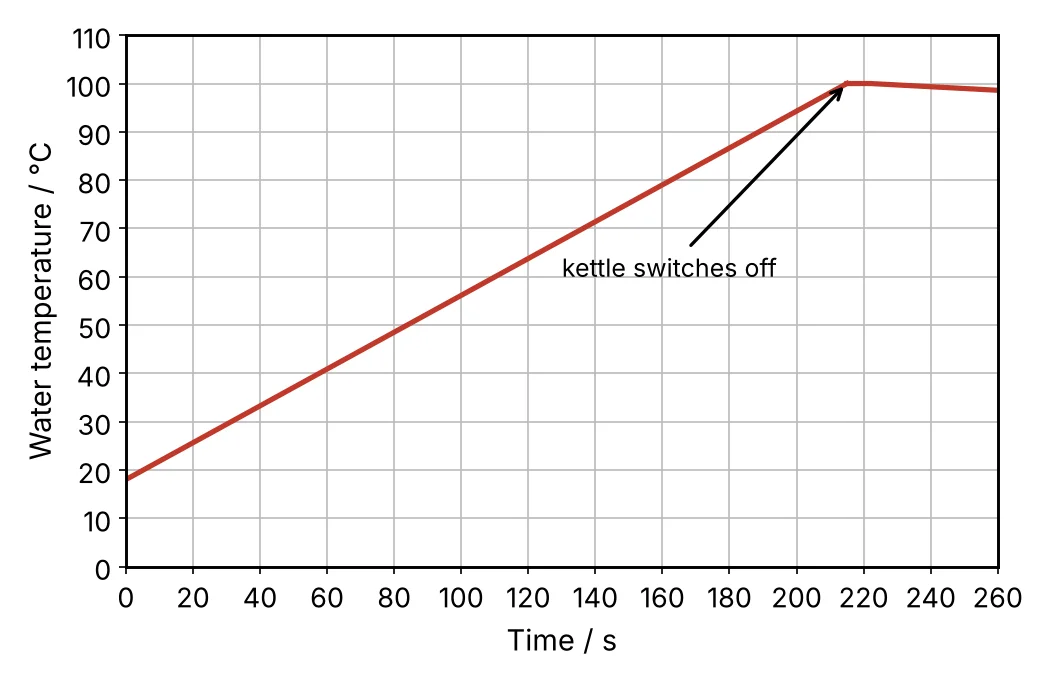
An electric kettle is rated at 2.4 kW. It is switched on at t=0t = 0 with 1.2 kg of water in it. The graph shows how the temperature of the water changes. The specific heat capacity of water is 4200 J kg⁻¹ °C⁻¹.
Question diagram
(a)
Use the graph to find the time the kettle takes to boil the water, then calculate the electrical energy transferred to the kettle in this time. [2]Criterion A (ii) · Level 3-4
(b)
Calculate the efficiency of the kettle. [2]Criterion A (ii) · Level 5-6
(c)
A new kettle of the same power is 92% efficient. A hotel has 200 of these kettles and each is used to boil this mass of water, from the same starting temperature, six times a day. Calculate the electrical energy the hotel saves in one day by replacing the old kettles. Give your answer in kWh. [3]Criterion A (ii) · Level 5-6
(d)
Electricity costs 0.15 dollars per kWh. Each new kettle costs 40 dollars and lasts 5 years. Discuss whether the hotel should replace all 200 kettles now. Refer to one economic implication and one environmental implication. [3]Criterion D (ii) · Level 7-8

revisionprep.com

Summary Answer

Not available for this question.

Model Answer

Not available for this question.

Marking Scheme

Not available for this question.

Examiner Insights

Not available for this question.

That's every free question here — 6 of 93.

+87 more questions, plus Mock Papers & Worksheets, are waiting in Premium.

Upgrade