You're viewing free preview questions — 5 questions previewing here — subscribe to unlock 85 more, plus the Full Question Bank, Mock Papers & Worksheets.Upgrade
Human Impact and Climate Change — Free MYP5 Biology Practice Questions

1QuestionCarbon Cycle and Human DisruptionConcept Practice
2 marks~3 minCriterion A
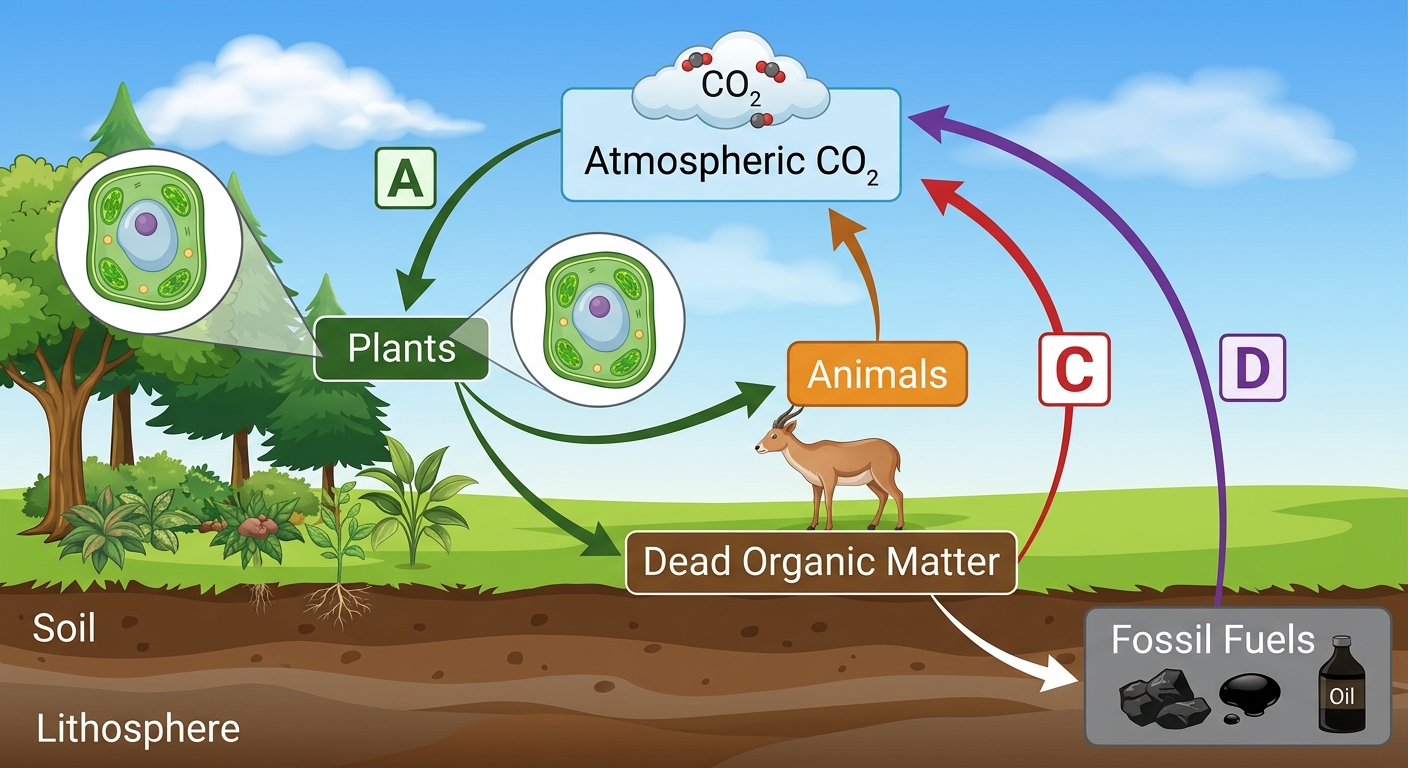
The diagram below shows a simplified carbon cycle. Arrows A, B, C, and D connect the atmosphere (), plants, animals, dead organic matter, and fossil fuels. Arrow A points from the atmosphere to plants. Arrow B points from plants to animals. Arrow C points from dead organic matter to the atmosphere. Arrow D points from fossil fuels to the atmosphere.
(a) Identify the process represented by arrow A, and name the organelle in plant cells where this process occurs. [2]
(a) Identify the process represented by arrow A, and name the organelle in plant cells where this process occurs. [2]

Solutions
2QuestionClimate Action and Global CitizenshipAssessment Practice
3 marks~5 minCriterion C
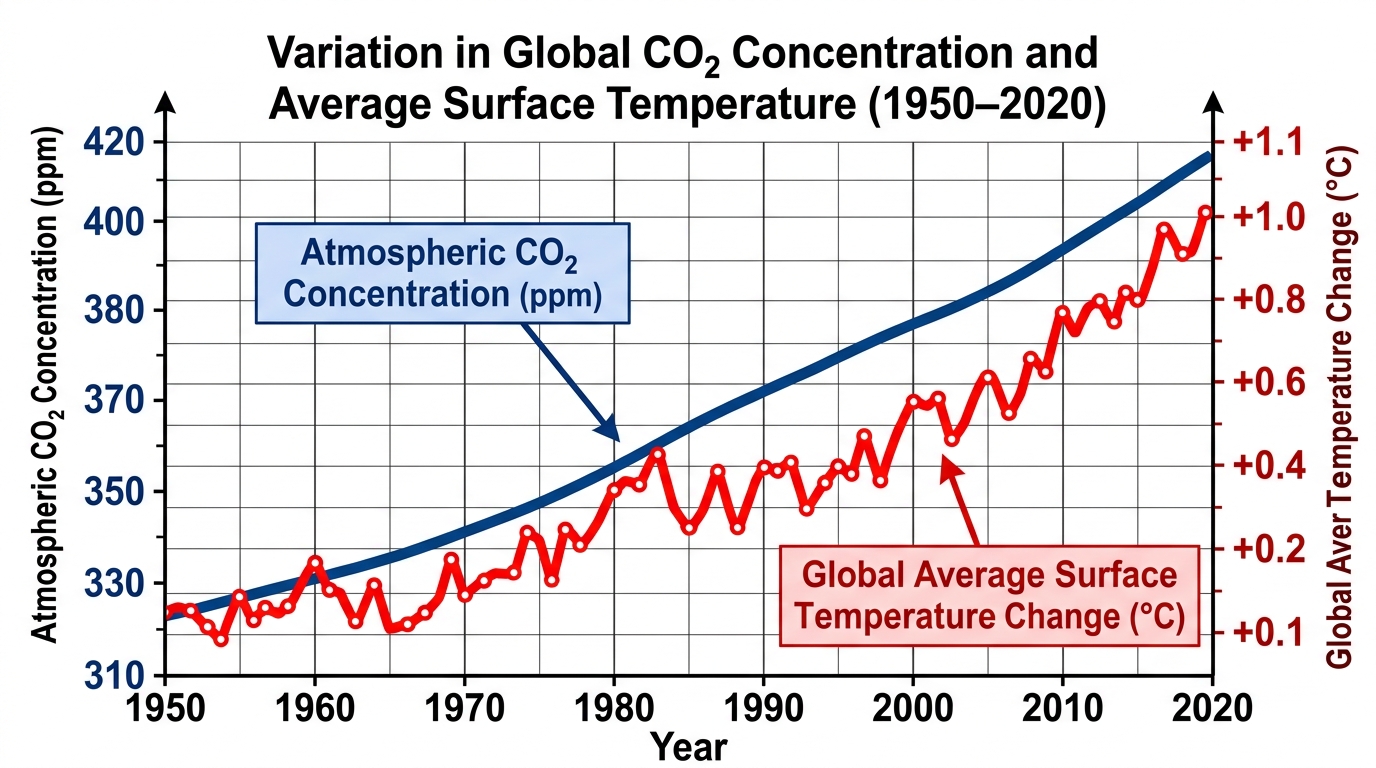
The graph below shows global atmospheric concentration (ppm) and global average surface temperature anomaly (°C) from 1950 to 2020.
a
Describe the relationship between atmospheric concentration and global average surface temperature shown in the graph. [1]
b
Explain how acts as a greenhouse gas to trap heat in the atmosphere. [1]
c
Analyse why a continued rise in atmospheric concentration is likely to accelerate, rather than simply maintain, the rate of global temperature increase. [1]
Solutions
3QuestionCarbon Cycle and Human DisruptionAssessment Practice
3 marks~5 minCriterion D
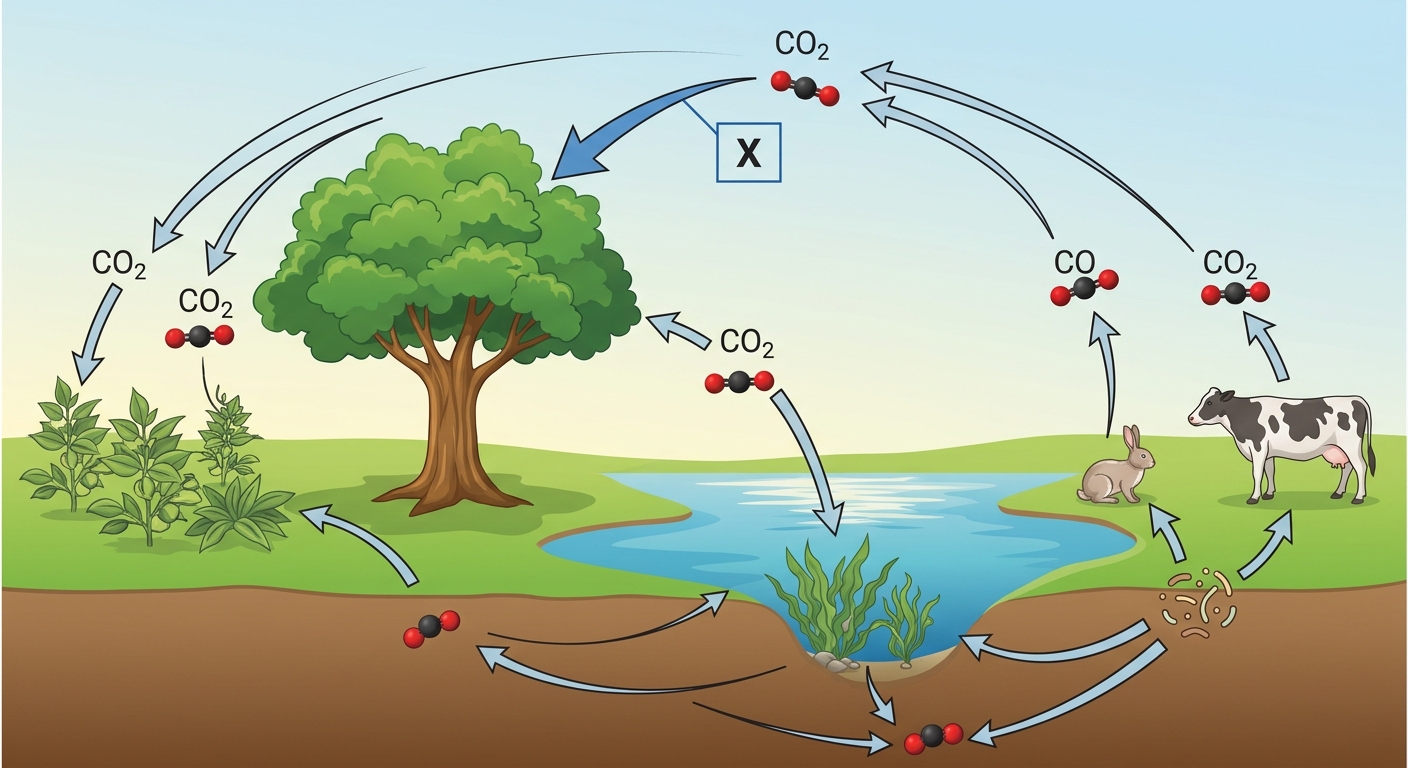
The diagram below shows a simplified carbon cycle. Arrow X represents the movement of carbon dioxide from the atmosphere into a tree.
a
Identify the biological process represented by arrow X. [1]
b
Explain how deforestation reduces the rate of the process shown by arrow X, and state the effect this has on atmospheric CO₂ concentration. [1]
c
Evaluate the claim that deforestation has a greater impact on atmospheric CO₂ than the burning of fossil fuels, using your knowledge of the carbon cycle. [1]
Solutions
4QuestionCarbon Cycle and Human DisruptionAssessment Practice
4 marks~6 minCriterion A
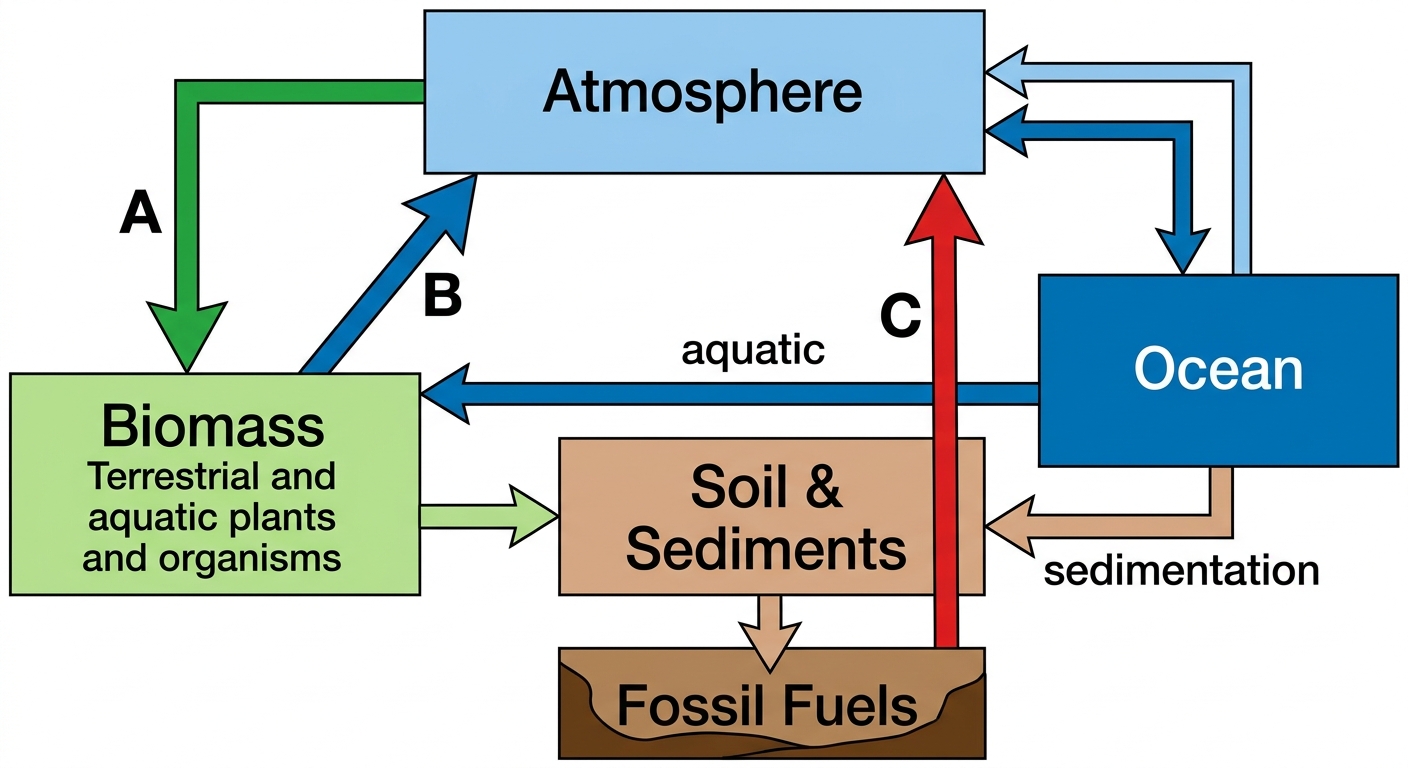
The simplified carbon cycle diagram below shows four reservoirs — atmosphere, oceans, fossil fuels, and biomass — connected by labelled flux arrows.
- Arrow A: atmosphere → biomass
- Arrow B: biomass → atmosphere
- Arrow C: fossil fuels → atmosphere
- Arrow A: atmosphere → biomass
- Arrow B: biomass → atmosphere
- Arrow C: fossil fuels → atmosphere
a
Identify the process represented by each arrow and describe the role of the organisms involved. [2]
b
Explain how increasing the flux represented by Arrow C, without a corresponding increase in Arrow A, disrupts the balance between carbon reservoirs. Use evidence from the diagram in your answer. [2]
Solutions
5QuestionDeforestation, Urbanization, and Land UseAssessment Practice
8 marks~12 minCriterion D
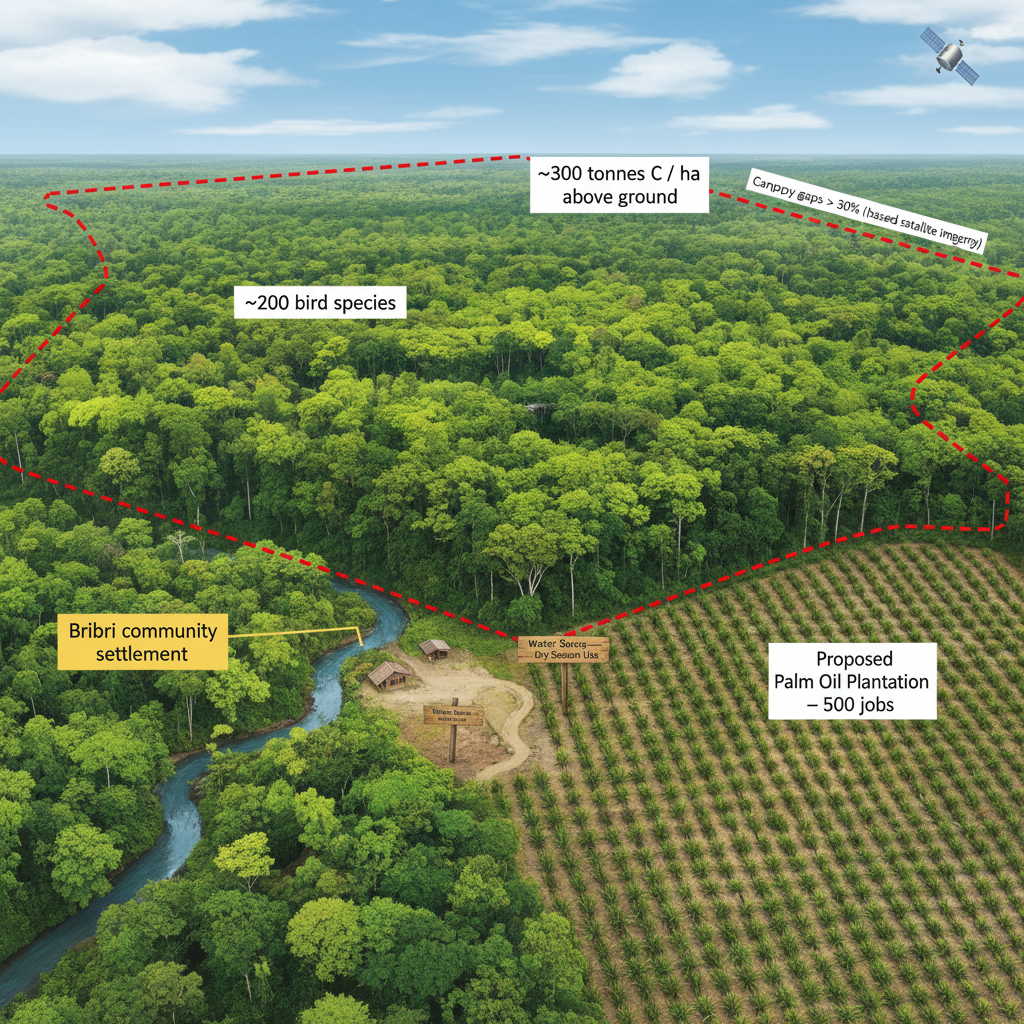
A proposal has been made to convert a 50-year-old secondary forest in Costa Rica into a palm oil plantation. The site supports over 200 bird species, stores an estimated 300 tonnes of carbon per hectare above ground, and serves as the dry-season water source for the Indigenous Bribri community. The developer argues that satellite imagery showing canopy gaps across more than 30% of the area proves the forest is 'degraded', and that the plantation will create 500 local jobs and reduce palm oil imports from deforested regions in Southeast Asia.
a
Identify TWO environmental impacts of replacing this forest with a palm oil plantation. For each impact, refer to a specific ecological concept. [2]
b
Identify TWO societal impacts on the Bribri community, linking each impact to their specific dependence on the forest. [2]
c
Evaluate the developer's use of satellite imagery alone to classify the forest as 'degraded'. In your response, discuss at least TWO limitations of relying solely on remote-sensing data for this environmental impact assessment. [4]
Solutions
That's every free question here — 5 of 90.
+85 more questions, plus Mock Papers & Worksheets, are waiting in Premium.