You're viewing free preview questions — 6 questions previewing here — subscribe to unlock 54 more, plus the Full Question Bank, Mock Papers & Worksheets.Upgrade
Back

Nutrition and Biochemistry — Free MYP5 Biology Practice Questions

Free questions

Open in full, with answers, mark scheme and examiner insights.

Question 1Criterion A · Band 1-2 · Easy · 3 marksrevisionprep.com

Carbohydrates, proteins and lipids

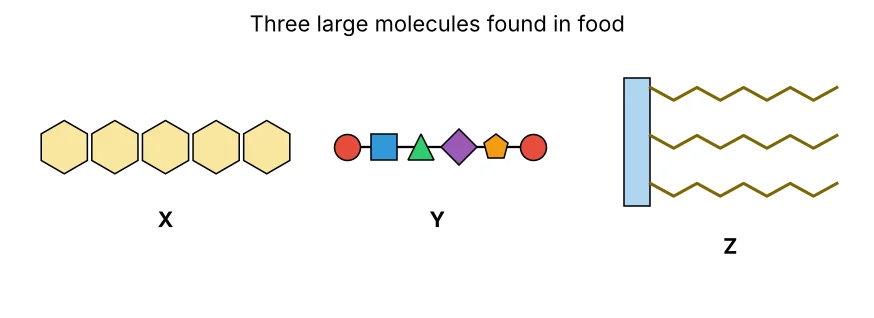
The diagram shows simplified models of three large biological molecules, X, Y and Z, found in food.

(a) Identify which molecule, X, Y or Z, is starch, which is a protein and which is a lipid (triglyceride). [3]
Question diagram

revisionprep.com

Summary Answer

Not available for this question.

Model Answer

Not available for this question.

Marking Scheme

Not available for this question.

Examiner Insights

Not available for this question.

Question 2Criterion A + C · Band 1-4 · Easy · 6 marksrevisionprep.com

Food tests

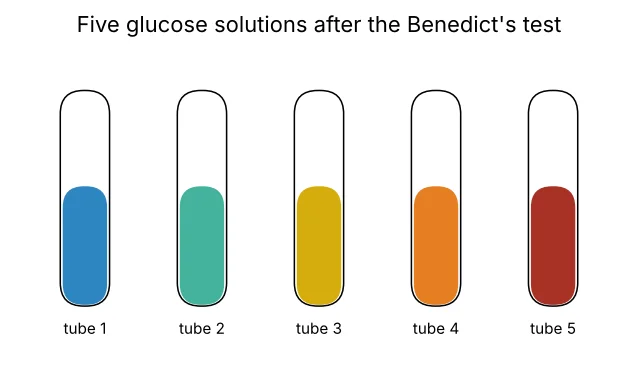
A student heated five glucose solutions of known concentration with Benedict's reagent. The diagram shows the colours of tubes 1 to 5 afterwards.
Question diagram
(a)
Identify the tube that contained the most glucose. [1]Criterion C (ii) · Level 1-2
(b)
Describe how to carry out the Benedict's test on a food sample. [3]Criterion A (i) · Level 3-4
(c)
Explain how the student could use these tubes to estimate the glucose concentration of a fruit juice. [2]Criterion C (ii) · Level 3-4

revisionprep.com

Summary Answer

Not available for this question.

Model Answer

Not available for this question.

Marking Scheme

Not available for this question.

Examiner Insights

Not available for this question.

Question 3Criterion A · Band 3-6 · Medium · 6 marksrevisionprep.com

Carbohydrates, proteins and lipids

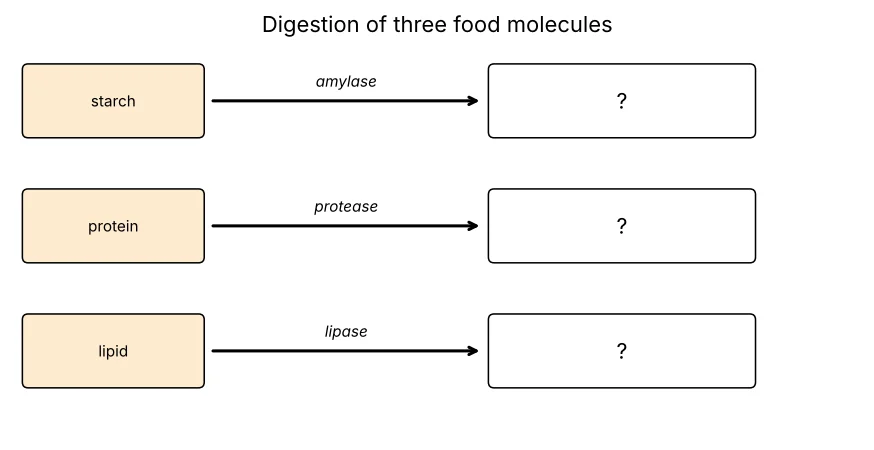
The diagram shows how three large food molecules are broken down in the digestive system. The products are labelled with question marks.
Question diagram
(a)
State the names of the products of the digestion of starch, of protein and of lipid. [3]Criterion A (i) · Level 3-4
(b)
Explain why large food molecules must be digested before they can be used by the body. [2]Criterion A (ii) · Level 3-4
(c)
Suggest why a person whose pancreas cannot make lipase passes fatty faeces. [1]Criterion A (ii) · Level 5-6

revisionprep.com

Summary Answer

Not available for this question.

Model Answer

Not available for this question.

Marking Scheme

Not available for this question.

Examiner Insights

Not available for this question.

Question 4Criterion B · Band 3-6 · Medium · 8 marksrevisionprep.com

Food tests

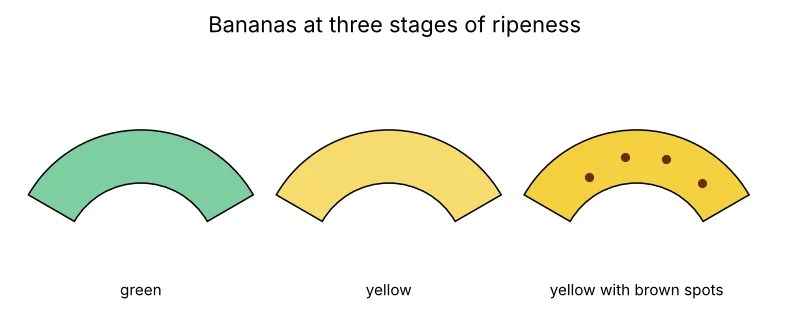
As bananas ripen they change from green to yellow to yellow with brown spots, and they taste sweeter. A student wants to investigate how ripeness affects the amount of reducing sugar in bananas, using Benedict's reagent and glucose solutions of known concentration.
Question diagram
(a)
Write a research question for this investigation. [1]Criterion B (i) · Level 3-4
(b)
Formulate a hypothesis and explain it using scientific reasoning. [2]Criterion B (ii) · Level 5-6
(c)
Explain how the student should make the comparison fair and give an estimate of the sugar concentration. [3]Criterion B (iii) · Level 5-6
(d)
Describe two safety precautions for this investigation. [2]Criterion B (iv) · Level 3-4

revisionprep.com

Summary Answer

Not available for this question.

Model Answer

Not available for this question.

Marking Scheme

Not available for this question.

Examiner Insights

Not available for this question.

Question 5Criterion C + A · Band 1-8 · Challenge · 8 marksrevisionprep.com

Balanced diet and deficiency diseases

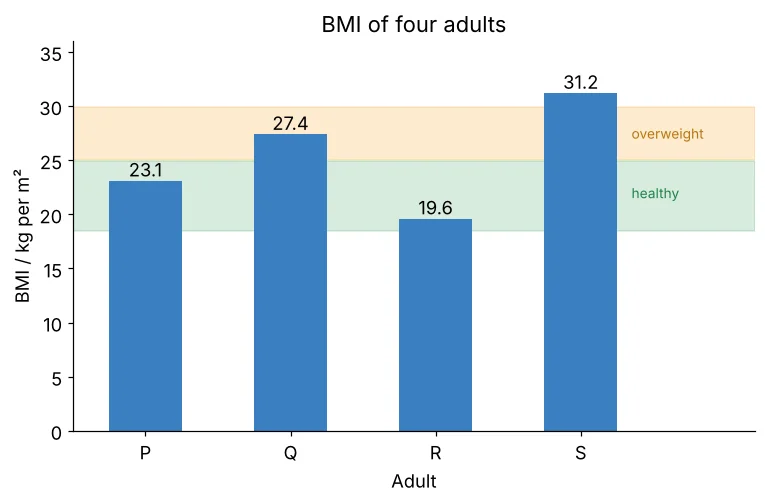
Body mass index (BMI) is calculated as BMI = mass in kg ÷ (height in m)². For adults, a BMI of 18.5 to 24.9 is usually classed as healthy, and 25.0 to 29.9 as overweight. The graph shows the BMI of four adults.

P: 23.1; Q: 27.4; R: 19.6; S: 31.2
Question diagram
(a)
Calculate the BMI of an adult who has a mass of 70 kg and a height of 1.65 m. Give your answer to one decimal place. [2]Criterion C (i) · Level 3-4
(b)
Classify this adult using the categories given. [1]Criterion C (ii) · Level 1-2
(c)
Explain how eating more energy than the body uses leads to an increase in body mass. [2]Criterion A (ii) · Level 3-4
(d)
Adult S is a professional rugby player with a lot of muscle. Evaluate the use of BMI to judge whether S has a healthy body mass. [3]Criterion C (iii) · Level 7-8

revisionprep.com

Summary Answer

Not available for this question.

Model Answer

Not available for this question.

Marking Scheme

Not available for this question.

Examiner Insights

Not available for this question.

Question 6Criterion D + C · Band 3-8 · Challenge · 9 marksrevisionprep.com

Energy content of food

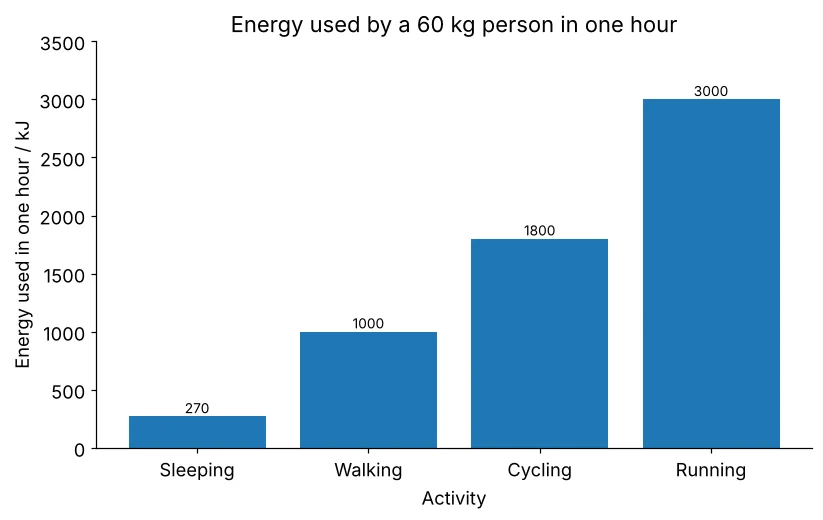
The graph shows the approximate energy used in one hour by a 60 kg person doing different activities.

Sleeping: 270 kJ; walking: 1000 kJ; cycling: 1800 kJ; running: 3000 kJ

A chocolate bar contains 1100 kJ. Some health experts want food labels to show 'activity equivalents', such as the minutes of walking needed to use the energy in the food.
Question diagram
(a)
Calculate how many minutes of running would use the energy in one chocolate bar. [2]Criterion C (i) · Level 3-4
(b)
Calculate how many minutes of walking would use the same energy. [1]Criterion C (i) · Level 3-4
(c)
Explain how activity-equivalent labels could help people manage their body mass. [2]Criterion D (i) · Level 3-4
(d)
Discuss the implications of putting activity-equivalent labels on all snack foods, considering at least two perspectives. [4]Criterion D (ii) · Level 7-8

revisionprep.com

Summary Answer

Not available for this question.

Model Answer

Not available for this question.

Marking Scheme

Not available for this question.

Examiner Insights

Not available for this question.

That's every free question here — 6 of 60.

+54 more questions, plus Mock Papers & Worksheets, are waiting in Premium.

Upgrade