You're viewing free preview questions — 4 questions previewing here — subscribe to unlock 107 more, plus the Full Question Bank, Mock Papers & Worksheets.Upgrade
Carboxylic Acids — Free MYP5 Chemistry Practice Questions

1QuestionFunctional group (-COOH) / General FormulaConcept Practice
2 marks~3 minCriterion A
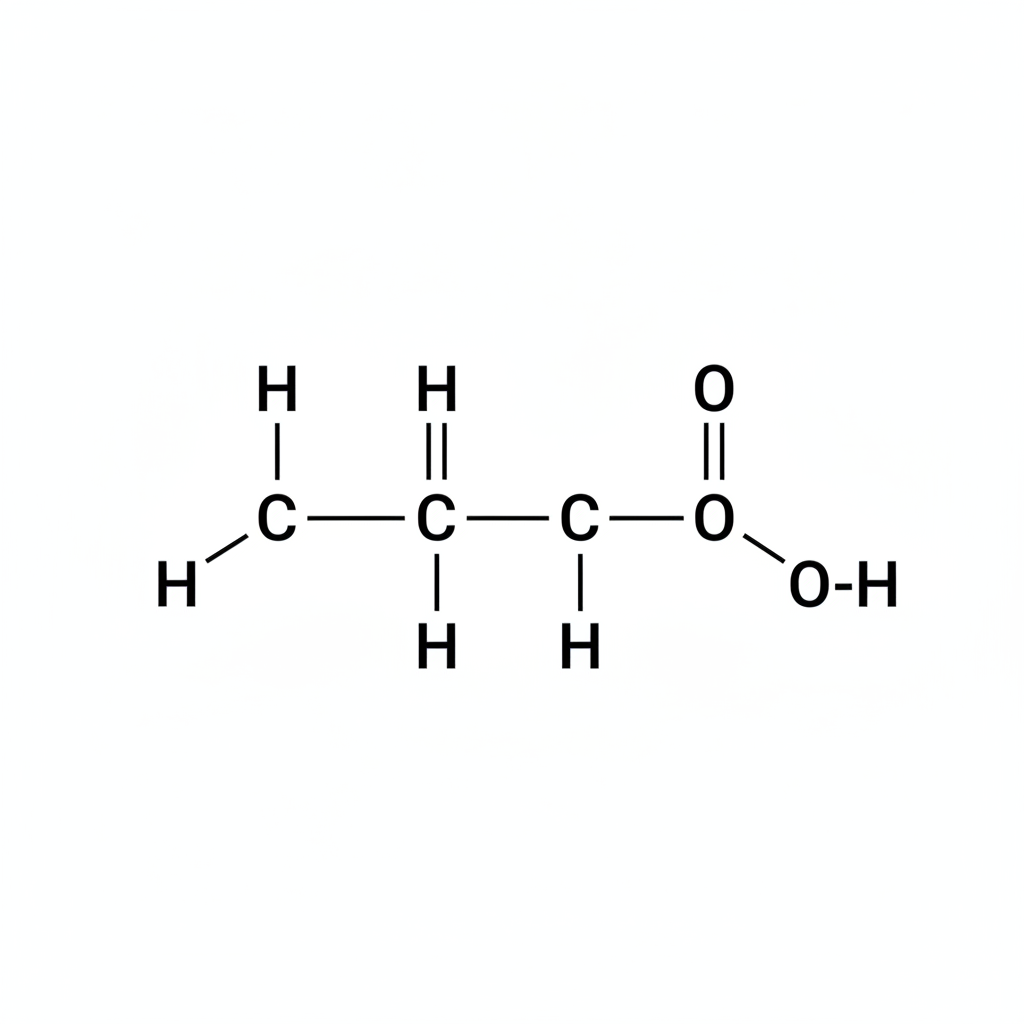
Propanoic acid has the following structural formula:
a
Identify the carboxyl functional group in the structure above by circling or labelling it clearly. [1]
b
Deduce the molecular formula of propanoic acid from its structural formula, and explain how the presence of the carboxyl group accounts for the acidic behaviour of carboxylic acids in aqueous solution. [1]

Solutions
2QuestionReactions:With metals and With bases (neutralization) and With carbonates (CO₂ production)Assessment Practice
5 marks~8 minCriterion C
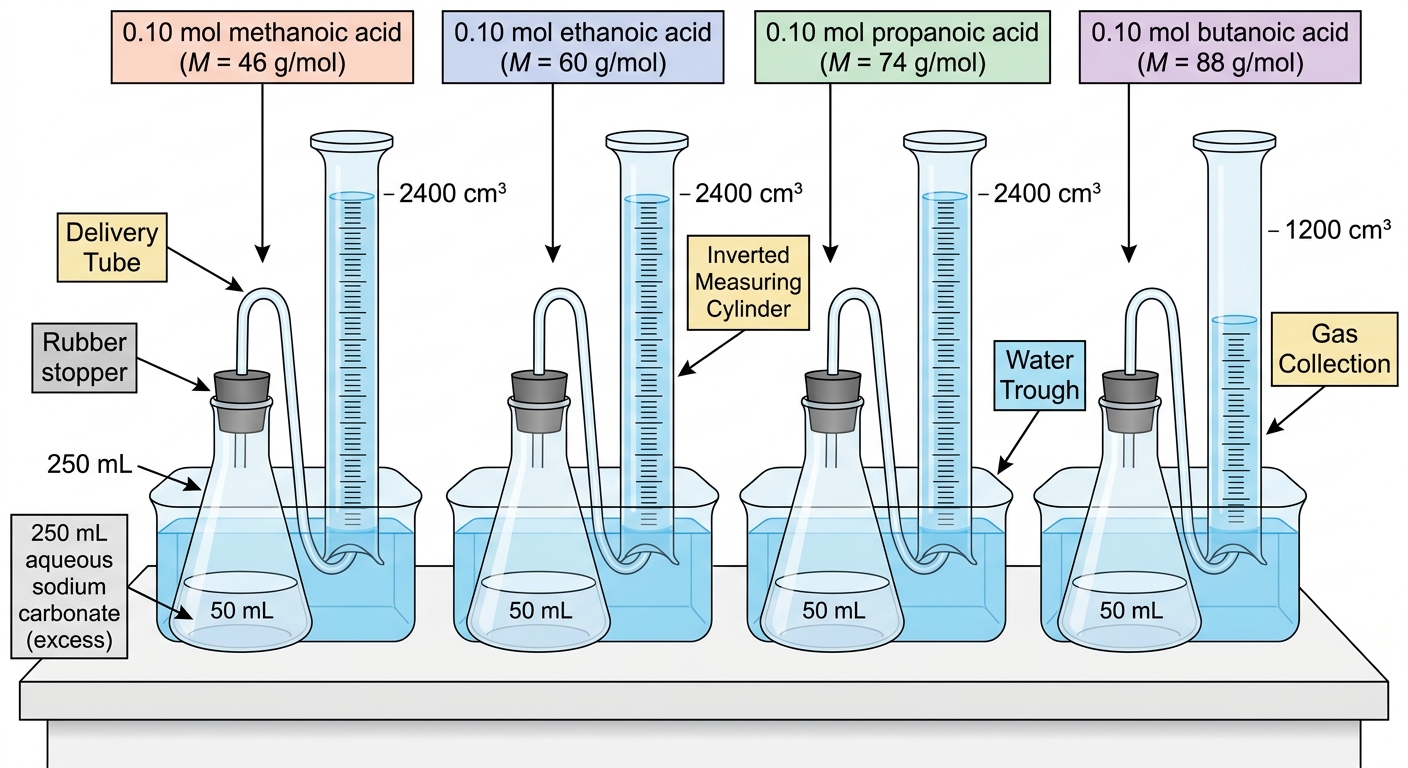
When mol of each carboxylic acid reacts with excess sodium carbonate at room temperature and pressure, the following volumes of are collected.
At room temperature and pressure, 1 mol of gas occupies 24 000 cm³.
| Acid | methanoic | ethanoic | propanoic | butanoic |
|---|---|---|---|---|
| Molar mass (g/mol) | 46 | 60 | 74 | 88 |
| Volume of (cm³) | 2400 | 2400 | 2400 | 1200 |
At room temperature and pressure, 1 mol of gas occupies 24 000 cm³.
a
Construct the balanced chemical equation, with state symbols, for the reaction of ethanoic acid with sodium carbonate. [1]
b
Deduce the expected volume of produced when 0.10 mol of a monoprotic carboxylic acid reacts with excess sodium carbonate, and show your reasoning. [2]
c
Analyse the data to identify the anomalous result and evaluate whether the trend in acid strength across the homologous series can account for the anomaly. [2]
Solutions
3QuestionNaming carboxylic acidsAssessment Practice
5 marks~8 minCriterion D
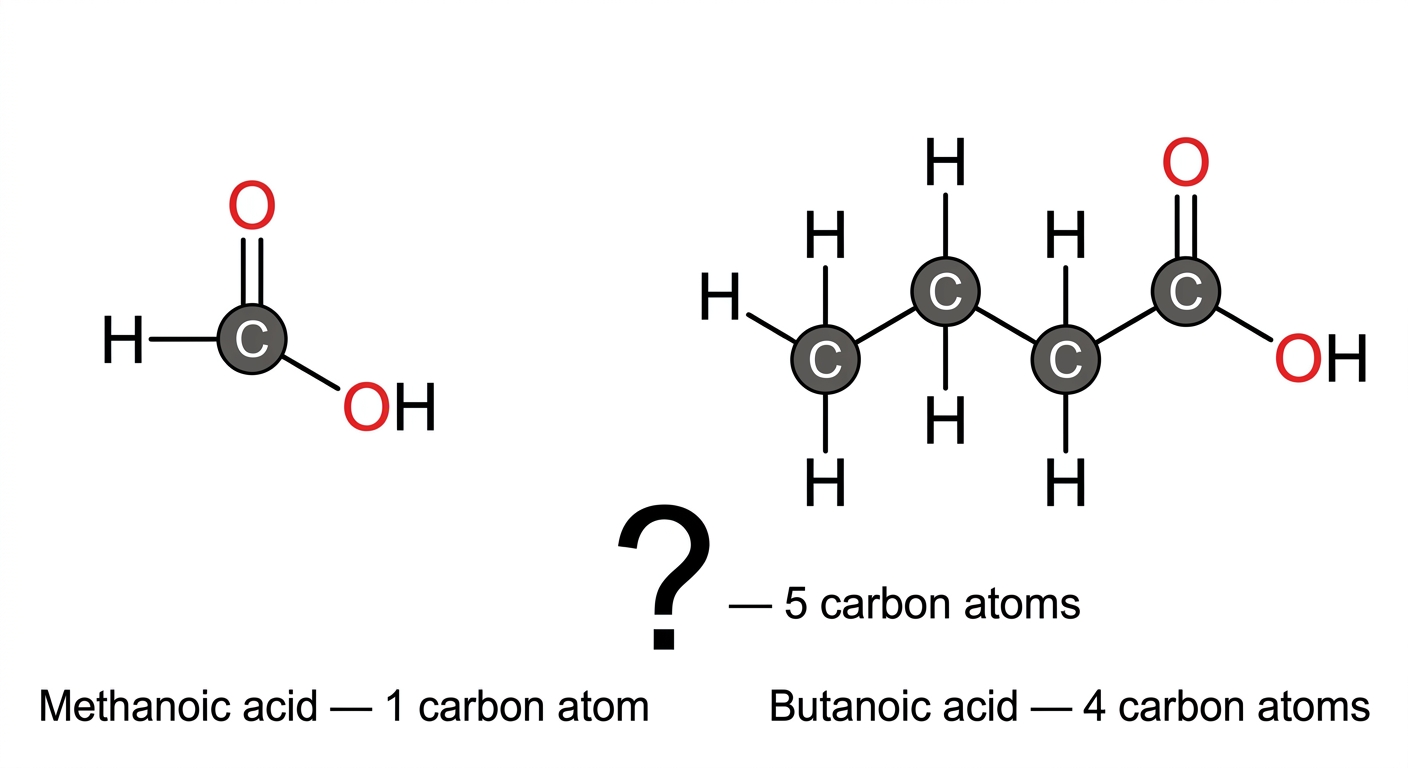
Methanoic acid (, 1 carbon) is found in ant venom and causes skin irritation. Butanoic acid (, 4 carbons) is responsible for the smell of rancid butter and can cause nausea. In the IUPAC naming system for carboxylic acids, the prefix indicates the number of carbon atoms in the chain: methanoic = 1C, ethanoic = 2C, propanoic = 3C, butanoic = 4C.
a
State the IUPAC name of the carboxylic acid with 5 carbon atoms in its chain. [1]
b
Explain how the chain length indicated by an IUPAC name can be used to predict the volatility and health effects of a carboxylic acid. Use methanoic acid and butanoic acid as examples. [2]
c
Evaluate the reliability of using an IUPAC name alone to assess the health risks of a carboxylic acid, identifying at least one specific limitation. [2]
Solutions
4QuestionFunctional group (-COOH) / General FormulaAssessment Practice
2 marks~3 minCriterion B
The molecular formulas of the first four carboxylic acids are given below.
| Carboxylic acid | Methanoic | Ethanoic | Propanoic | Butanoic |
|---|---|---|---|---|
| Number of carbon atoms () | 1 | 2 | 3 | 4 |
| Molecular formula |
a
Deduce the general formula that relates the number of carbon atoms to the molecular formula of these carboxylic acids. [1]
b
Justify the prediction that pentanoic acid () has the molecular formula , by referring to the structure of the carboxylic acid functional group . [1]
Solutions
That's every free question here — 4 of 111.
+107 more questions, plus Mock Papers & Worksheets, are waiting in Premium.