You're viewing free preview questions — 6 questions previewing here — subscribe to unlock 90 more, plus the Full Question Bank, Mock Papers & Worksheets.Upgrade
Back

Fractional distillation and cracking of crude oil — Free MYP5 Chemistry Practice Questions

Free questions

Open in full, with answers, mark scheme and examiner insights.

Question 1Criterion A · Band 1-2 · Easy · 3 marksrevisionprep.com

Crude oil as a mixture of hydrocarbons
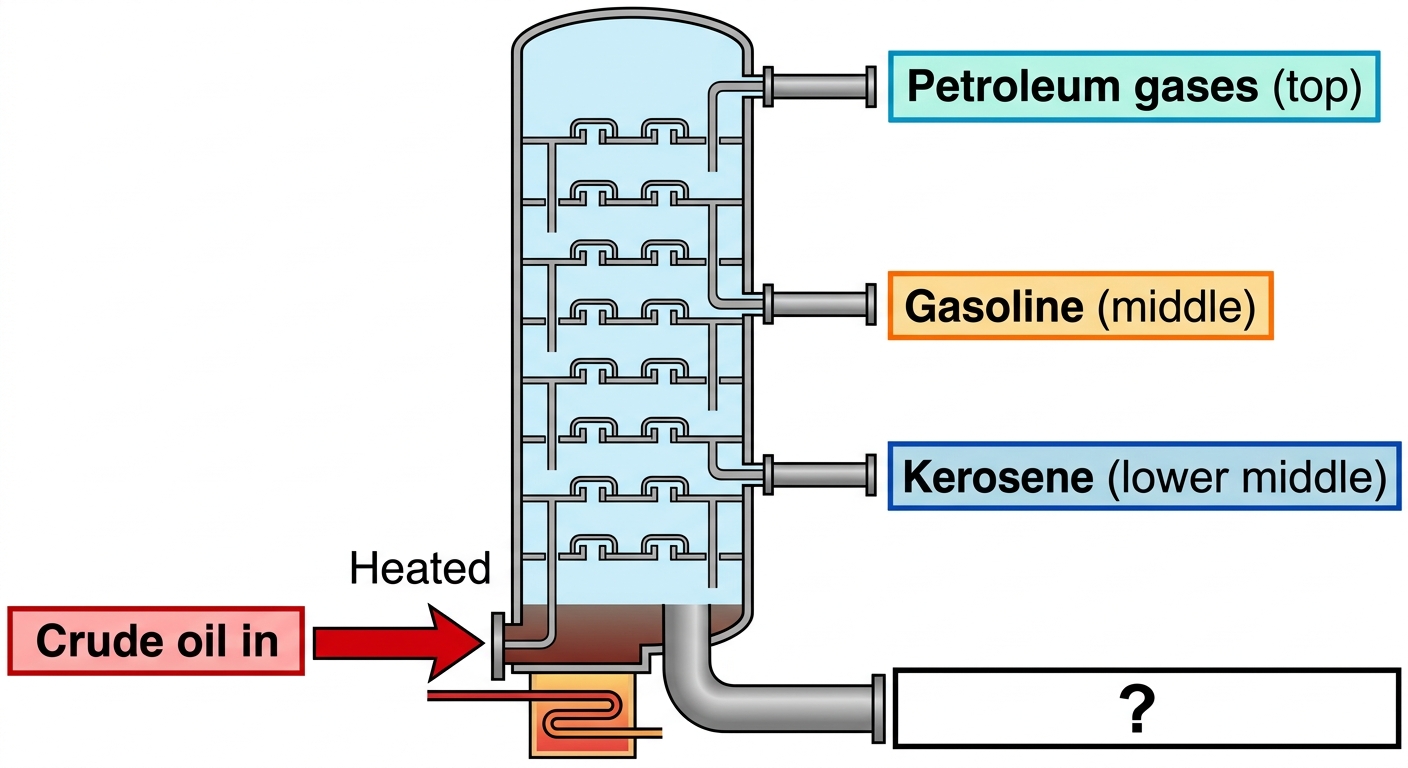
The diagram shows a simplified fractionating column used to separate crude oil. The fraction leaving one outlet is labelled ?.
Question diagram
(a)
Crude oil is described as a mixture. State what this means. [1]Criterion A (i) · Level 1-2
(b)
Suggest the name of the fraction leaving the outlet labelled ?, and state one use of this fraction. [2]Criterion A (ii) · Level 1-2

revisionprep.com

Summary Answer

Not available for this question.

Model Answer

Not available for this question.

Marking Scheme

Not available for this question.

Examiner Insights

Not available for this question.

Question 2Criterion C + A · Band 3-4 · Easy · 7 marksrevisionprep.com

Refinery gases

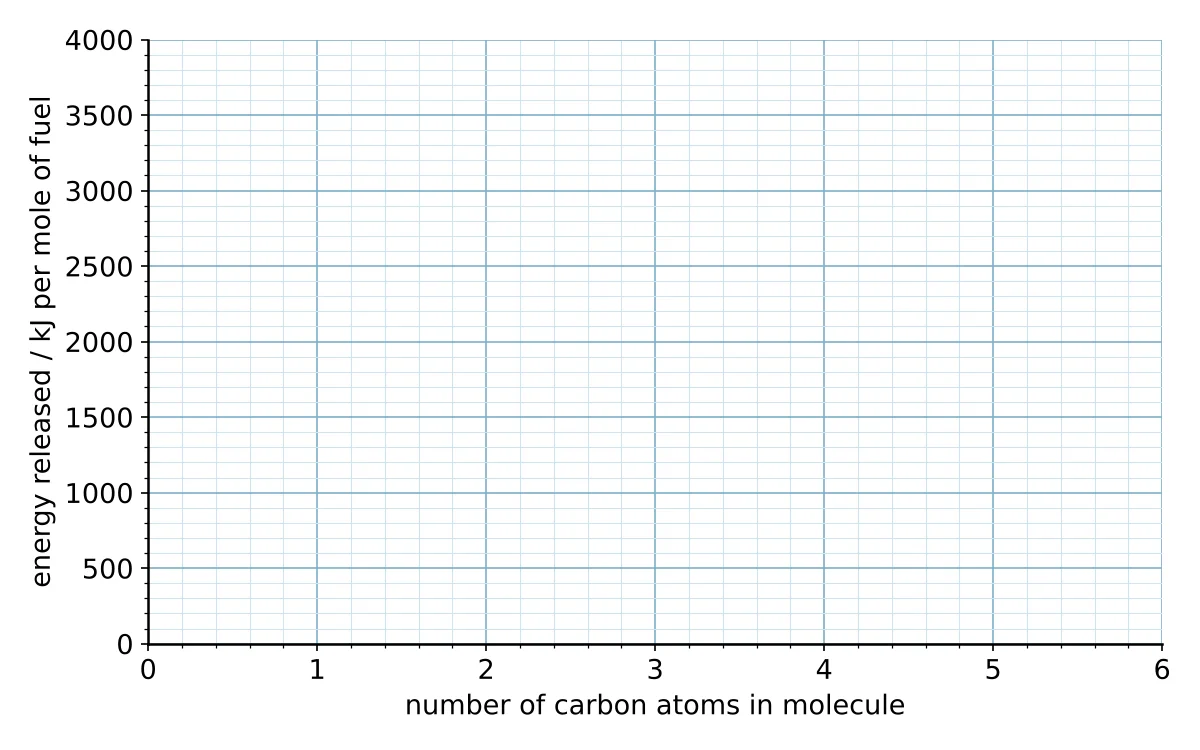
The energy released when one mole of each refinery gas burns completely is shown.

Methane (1 carbon atom): 890 kJ
Ethane (2 carbon atoms): 1560 kJ
Propane (3 carbon atoms): 2220 kJ
Butane (4 carbon atoms): 2878 kJ

The grid is provided for your answer to (a).
Question diagram
(a)
Plot the data on the grid and draw a line of best fit. [3]Criterion C (i) · Level 3-4
(b)
Calculate the mean increase in energy released for each extra carbon atom. [2]Criterion C (i) · Level 3-4
(c)
Predict the energy released when one mole of pentane burns. [1]Criterion C (ii) · Level 3-4
(d)
Explain why each extra carbon atom increases the energy released by about the same amount. [1]Criterion A (i) · Level 3-4

revisionprep.com

Summary Answer

Not available for this question.

Model Answer

Not available for this question.

Marking Scheme

Not available for this question.

Examiner Insights

Not available for this question.

Question 3Criterion D + A · Band 3-6 · Medium · 7 marksrevisionprep.com

Chain length vs boiling point

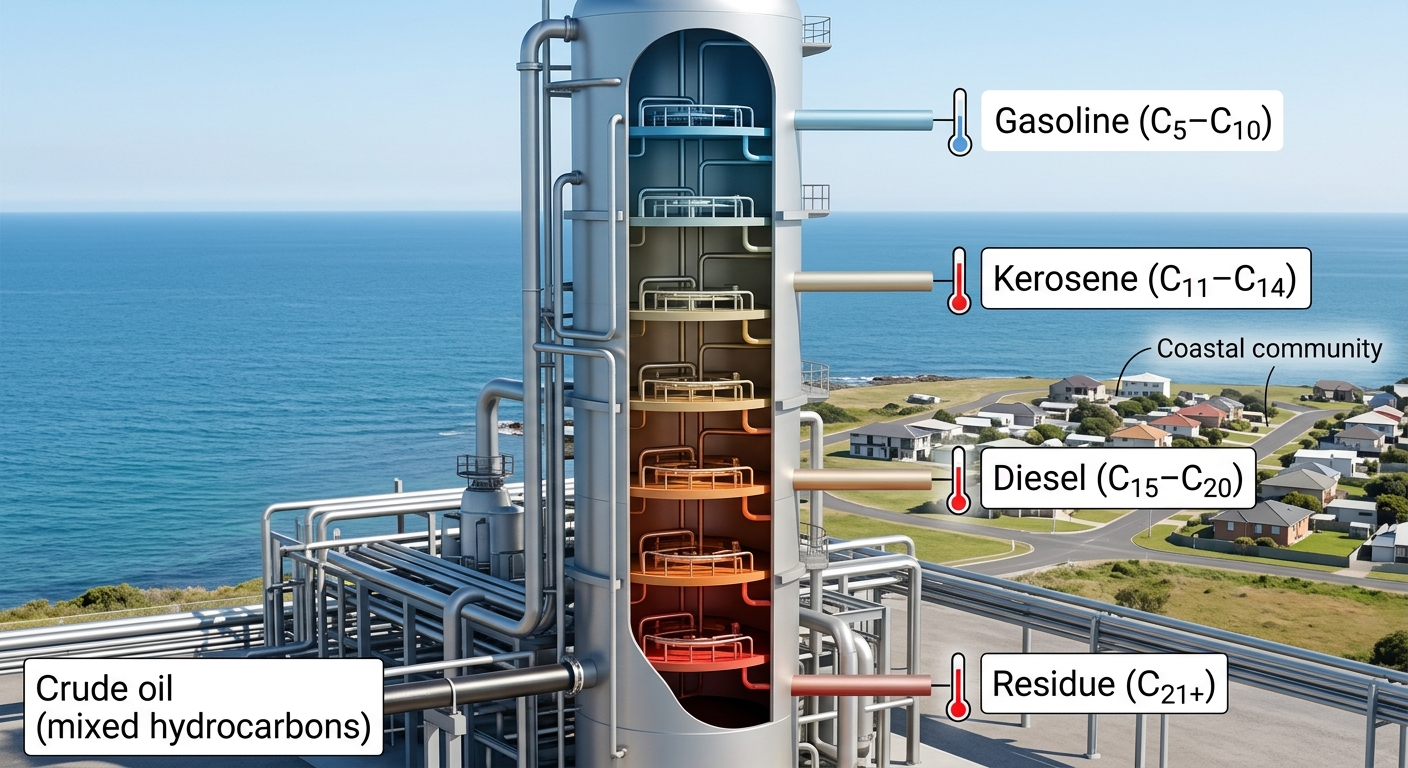
A company plans a fractionating plant on the coast, shown in the diagram, that would produce more diesel (C₁₅-C₂₀) and less gasoline (C₅-C₁₀). It claims this will reduce emissions of volatile organic compounds (VOCs), hydrocarbon vapours that escape into the air.
Question diagram
(a)
Explain why diesel releases less hydrocarbon vapour into the air than gasoline. [2]Criterion A (i) · Level 3-4
(b)
Identify one social benefit and one social cost of the plant for the coastal community. [2]Criterion D (ii) · Level 3-4
(c)
Discuss two limitations of the company's claim that the plant will reduce VOC emissions overall. [3]Criterion D (ii) · Level 5-6

revisionprep.com

Summary Answer

Not available for this question.

Model Answer

Not available for this question.

Marking Scheme

Not available for this question.

Examiner Insights

Not available for this question.

Question 4Criterion B · Band 3-6 · Medium · 10 marksrevisionprep.com

Viscosity and flammability trends

Samples of hexane, octane, decane and liquid paraffin (about C₁₆) are available. A student wants to investigate how the chain length of a hydrocarbon affects its viscosity, by timing how long a fixed volume takes to flow out of a burette.
(a)
State a research question for this investigation. [1]Criterion B (i) · Level 3-4
(b)
Formulate a testable hypothesis and explain it using scientific reasoning. [2]Criterion B (ii) · Level 5-6
(c)
Identify the independent and dependent variables. [2]Criterion B (iii) · Level 3-4
(d)
Explain how two control variables would be kept the same. [2]

(e) Design a method that collects sufficient, reliable data, including one safety precaution. [3]
Criterion B (iii) · Level 5-6

revisionprep.com

Summary Answer

Not available for this question.

Model Answer

Not available for this question.

Marking Scheme

Not available for this question.

Examiner Insights

Not available for this question.

Question 5Criterion A · Band 1-8 · Challenge · 4 marksrevisionprep.com

Purpose of fractional distillation

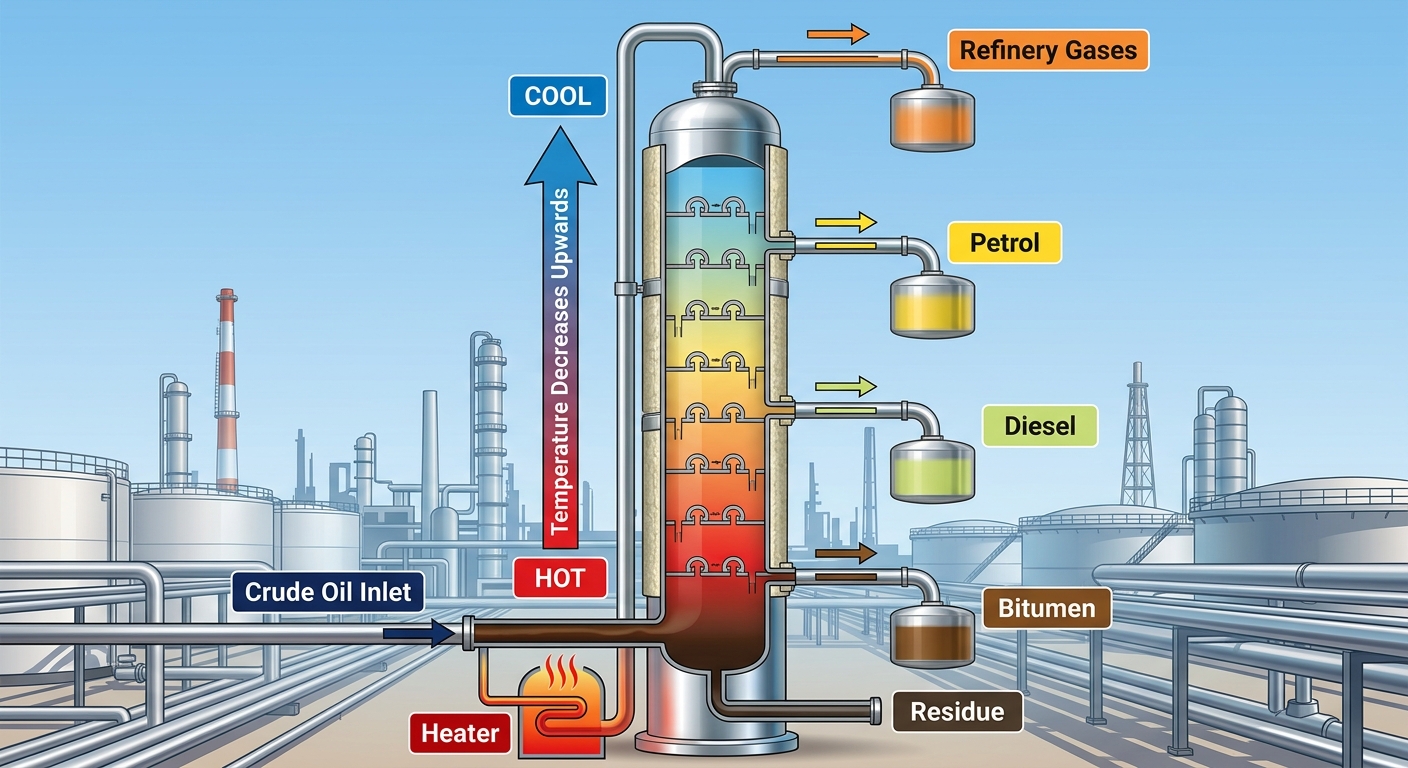
The diagram shows a fractionating column used in a refinery.
Question diagram
(a)
Identify the fraction in the diagram that is collected between petrol and bitumen. [1]Criterion A (ii) · Level 1-2
(b)
A student writes: "Petrol comes out near the top because petrol vapour is lighter than air." Explain why this explanation is wrong and give the correct reason. [3]Criterion A (iii) · Level 7-8

revisionprep.com

Summary Answer

Not available for this question.

Model Answer

Not available for this question.

Marking Scheme

Not available for this question.

Examiner Insights

Not available for this question.

Question 6Criterion A + D · Band 3-8 · Challenge · 8 marksrevisionprep.com

Fractionating column: structure and uses of each fraction
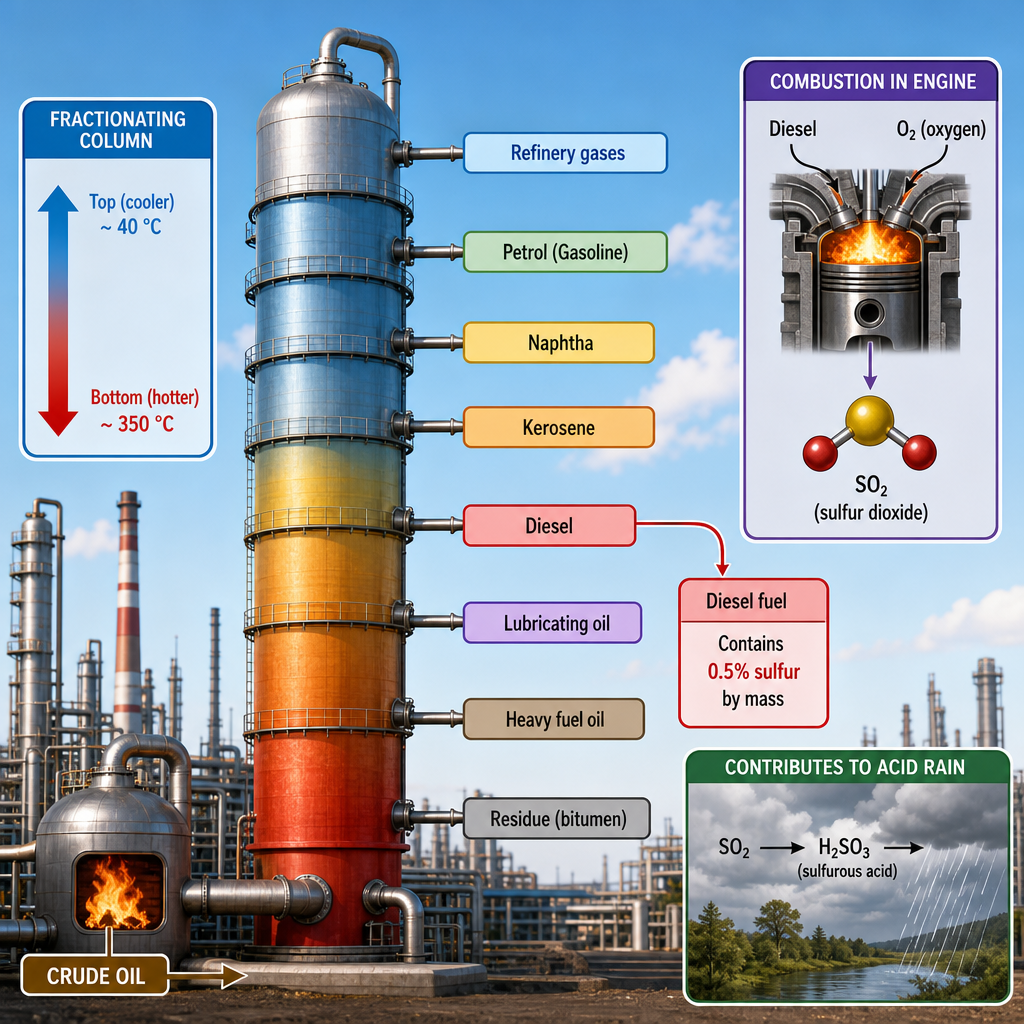
The diagram shows that the diesel collected from a fractionating column contains 0.5 % sulfur by mass. When the diesel is burned, the sulfur forms sulfur dioxide, SO₂, which reacts with water in the air. (ArA_r: S = 32, O = 16)
Question diagram
(a)
Write balanced equations for sulfur burning in oxygen to form SO₂, and for SO₂ reacting with water to form sulfurous acid, H₂SO₃. [2]Criterion A (ii) · Level 3-4
(b)
Calculate the mass of SO₂ formed when 1000 kg of this diesel is burned completely. [3]Criterion A (ii) · Level 3-4
(c)
Evaluate the use of an extra desulfurisation process at the refinery to remove sulfur from diesel before it is sold. [3]Criterion D (ii) · Level 7-8

revisionprep.com

Summary Answer

Not available for this question.

Model Answer

Not available for this question.

Marking Scheme

Not available for this question.

Examiner Insights

Not available for this question.

That's every free question here — 6 of 96.

+90 more questions, plus Mock Papers & Worksheets, are waiting in Premium.

Upgrade