You're viewing free preview questions — 4 questions previewing here — subscribe to unlock 114 more, plus the Full Question Bank, Mock Papers & Worksheets.Upgrade
Introduction to Organic Compounds — Free MYP5 Chemistry Practice Questions

1QuestionCovalent bonding in organic moleculesConcept Practice
3 marks~5 minCriterion A
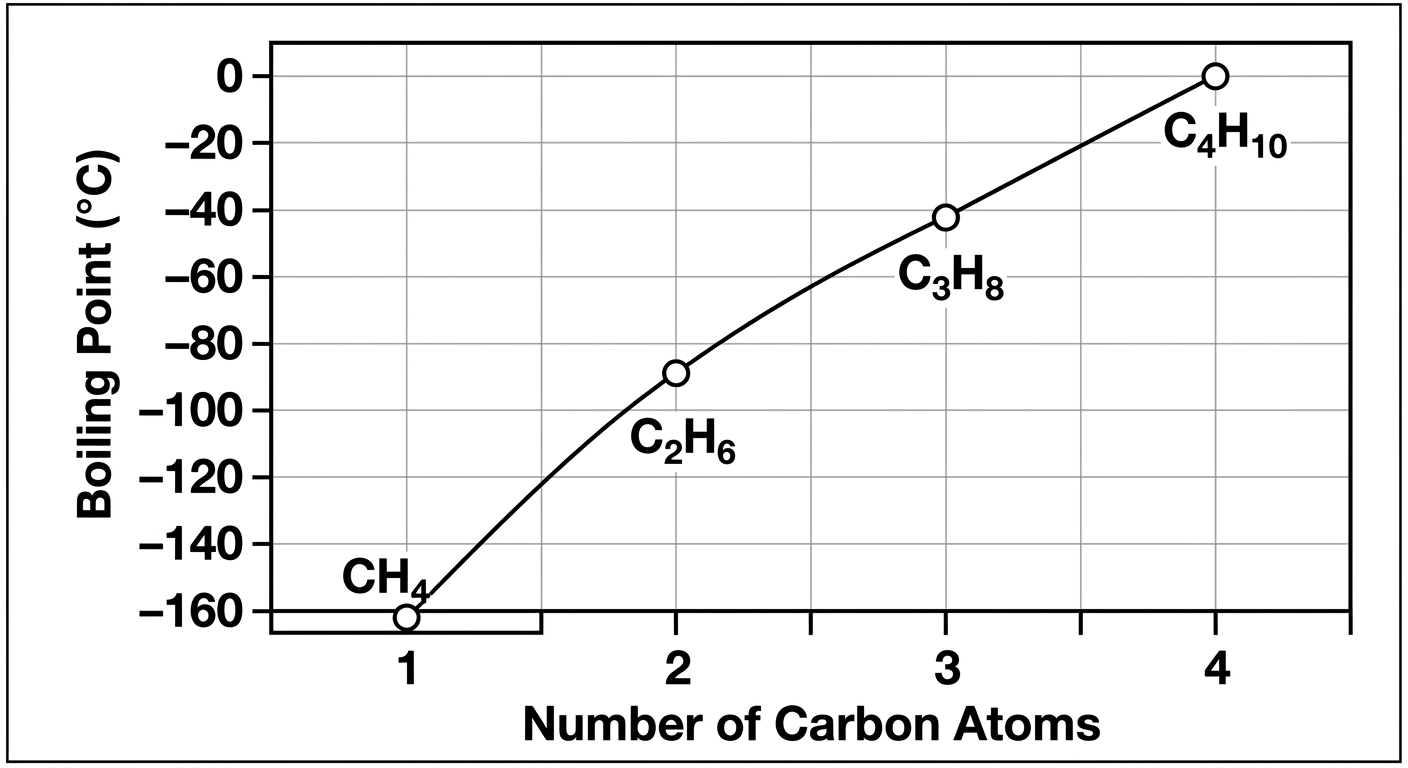
The graph below shows the boiling points of four straight-chain alkanes: methane (), ethane (), propane (), and butane ().
a
State the trend in boiling point as the number of carbon atoms increases from methane to butane. [1]
b
Identify the type of intermolecular force responsible for this trend. [1]
c
Explain why longer carbon chains produce stronger intermolecular forces, resulting in higher boiling points. [1]

Solutions
2QuestionOrganic vs inorganic compounds (comparison)Assessment Practice
3 marks~5 minCriterion D
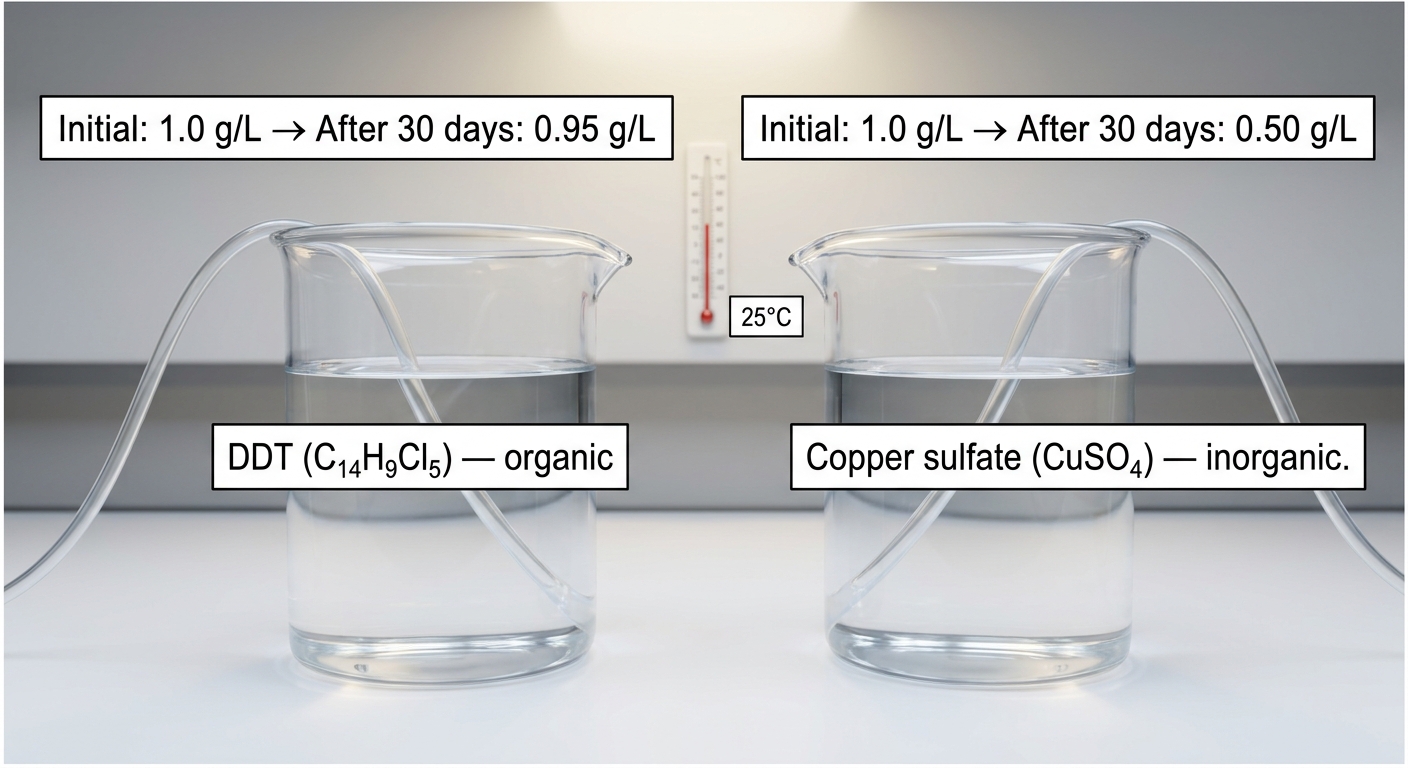
A student investigates the environmental persistence of two pesticides: DDT (), an organic compound, and copper sulfate (), an inorganic salt. Each is dissolved in a separate water sample at an initial concentration of . After 30 days under controlled conditions (, constant light, aeration), the concentrations measured are:
DDT:
Copper sulfate:
DDT:
Copper sulfate:
a
Deduce which pesticide is more persistent, using quantitative evidence from the data. [1]
b
Discuss TWO limitations of this experiment that may prevent the results from accurately predicting the ecological impact of these pesticides in a real river ecosystem. In your discussion, refer to the organic or inorganic nature of each pesticide. [2]
Solutions
3QuestionTetravalency of carbon/ CatenationAssessment Practice
5 marks~8 minCriterion B
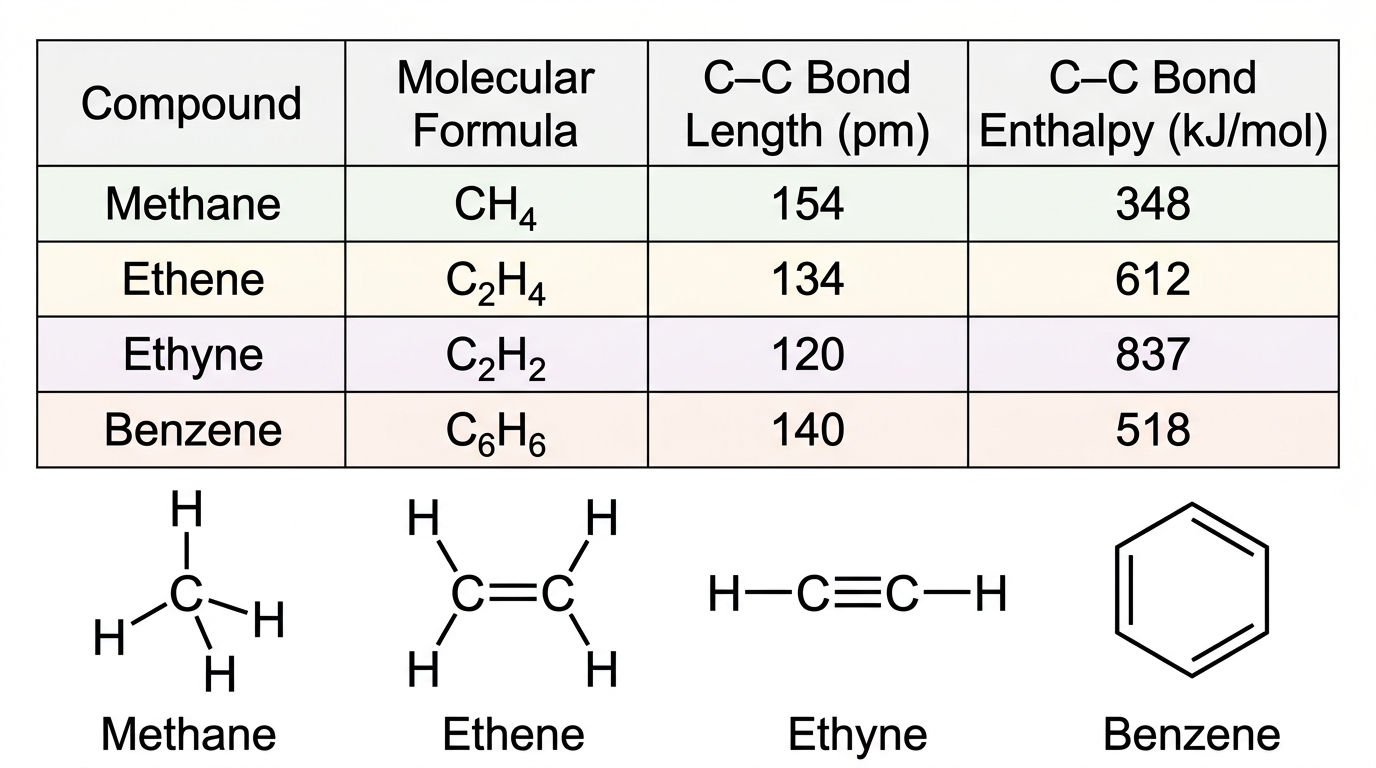
The table below shows data for four organic compounds.
Compound — Molecular formula — C–C bond length (pm) — C–C bond enthalpy (kJ/mol)
Methane — — 154 — 348
Ethene — — 134 — 612
Ethyne — — 120 — 837
Benzene — — 140 — 518
Compound — Molecular formula — C–C bond length (pm) — C–C bond enthalpy (kJ/mol)
Methane — — 154 — 348
Ethene — — 134 — 612
Ethyne — — 120 — 837
Benzene — — 140 — 518
a
State the relationship between C–C bond length and bond enthalpy shown by methane, ethene, and ethyne. [1]
b
Using the data, deduce why benzene's bond length (140 pm) and bond enthalpy (518 kJ/mol) are anomalous compared to the pattern in (a). [2]
c
Analyse whether benzene violates the tetravalency rule, using the concept of delocalized electrons to support your reasoning. [2]
Solutions
4QuestionSaturated vs unsaturated compoundsAssessment Practice
5 marks~8 minCriterion C
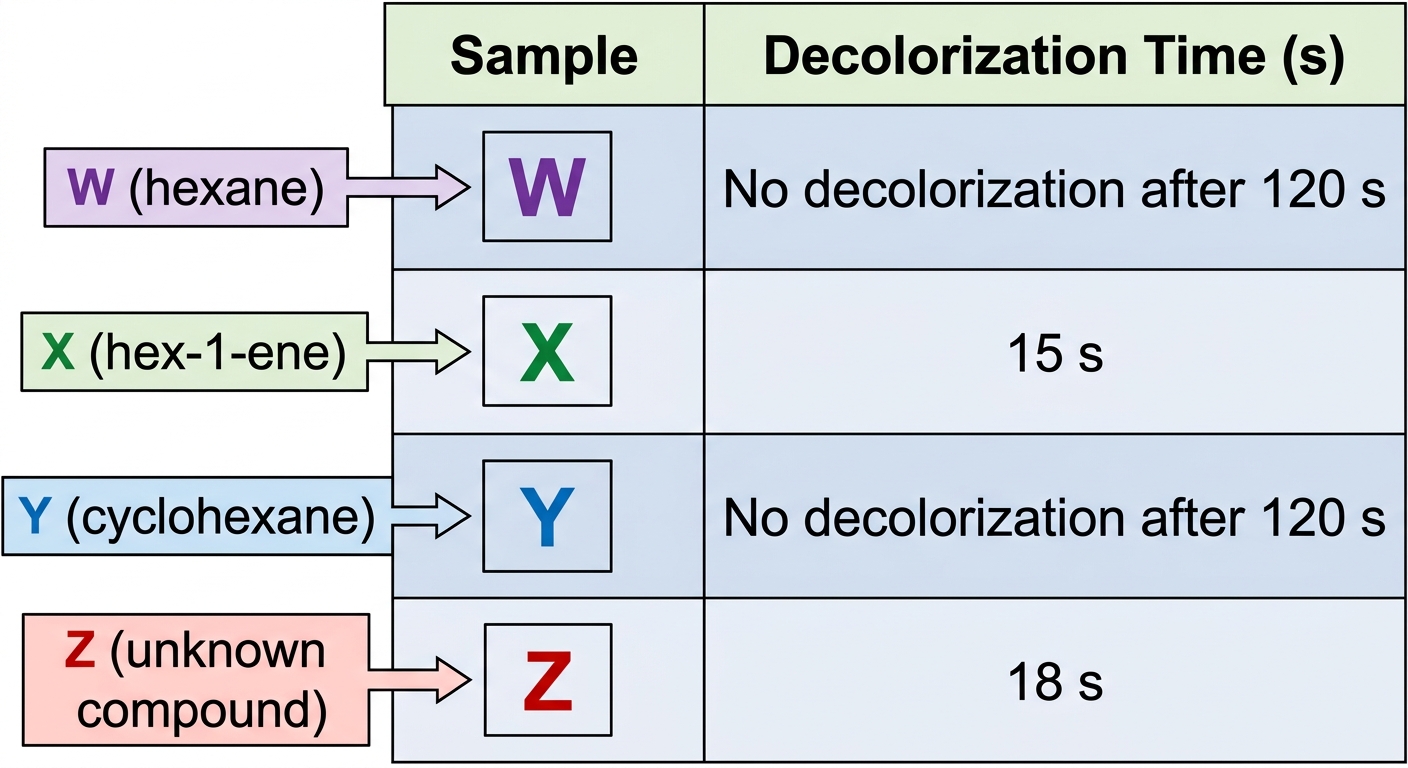
A student tests four liquid samples — W, X, Y, and Z — with bromine water to investigate saturation. Decolorization times are recorded:
Sample W: no decolorization after 120 s
Sample X: decolorizes in 15 s
Sample Y: no decolorization after 120 s
Sample Z: decolorizes in 18 s
W is hexane (saturated), X is hex-1-ene (unsaturated), and Y is cyclohexane (saturated). Z is unknown.
A hypothesis states: "Sample Z contains a carbon–carbon double bond."
Sample W: no decolorization after 120 s
Sample X: decolorizes in 15 s
Sample Y: no decolorization after 120 s
Sample Z: decolorizes in 18 s
W is hexane (saturated), X is hex-1-ene (unsaturated), and Y is cyclohexane (saturated). Z is unknown.
A hypothesis states: "Sample Z contains a carbon–carbon double bond."
a
State what is observed when bromine water reacts with a compound containing a bond, and identify the type of reaction occurring. [1]
b
Using the data from W, X, and Y, explain why bromine water is a reliable test for distinguishing saturated from unsaturated compounds. [2]
c
Evaluate the hypothesis using all four samples' data, identifying one limitation of this conclusion. [2]
Solutions
That's every free question here — 4 of 118.
+114 more questions, plus Mock Papers & Worksheets, are waiting in Premium.