You're viewing free preview questions — 4 questions previewing here — subscribe to unlock 262 more, plus the Full Question Bank, Mock Papers & Worksheets.Upgrade
IUPAC Naming of Organic Compounds — Free MYP5 Chemistry Practice Questions

1QuestionMultiple substituents (di, tri, tetra…)Concept Practice
2 marks~3 minCriterion A
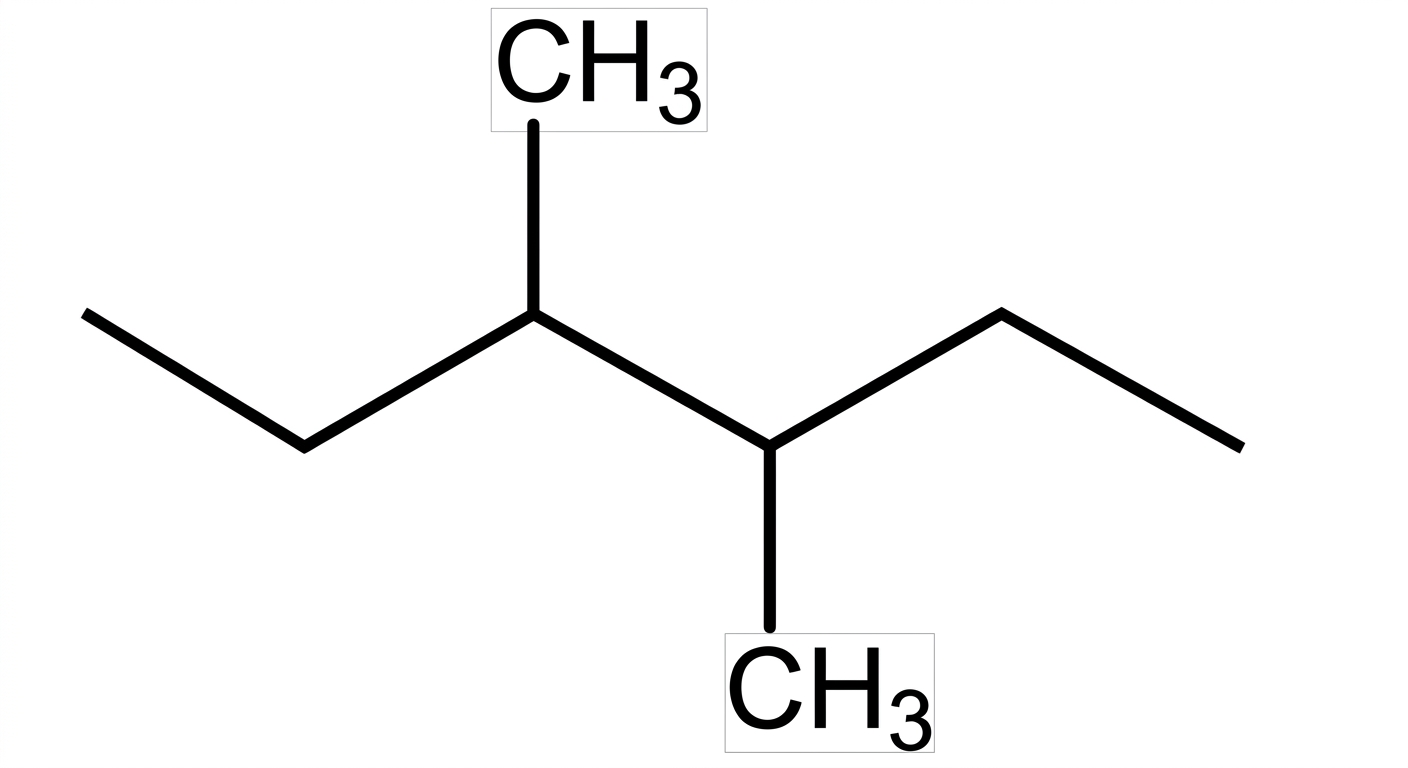
The structural formula below shows a straight-chain alkane with four carbon atoms. A methyl group () is attached to carbon-2 and another methyl group is attached to carbon-3. Each carbon satisfies tetravalency.
(a) Deduce the IUPAC name of this compound. [2]
(a) Deduce the IUPAC name of this compound. [2]

Solutions
2QuestionNaming cyclic compounds (basic)Assessment Practice
5 marks~8 minCriterion D
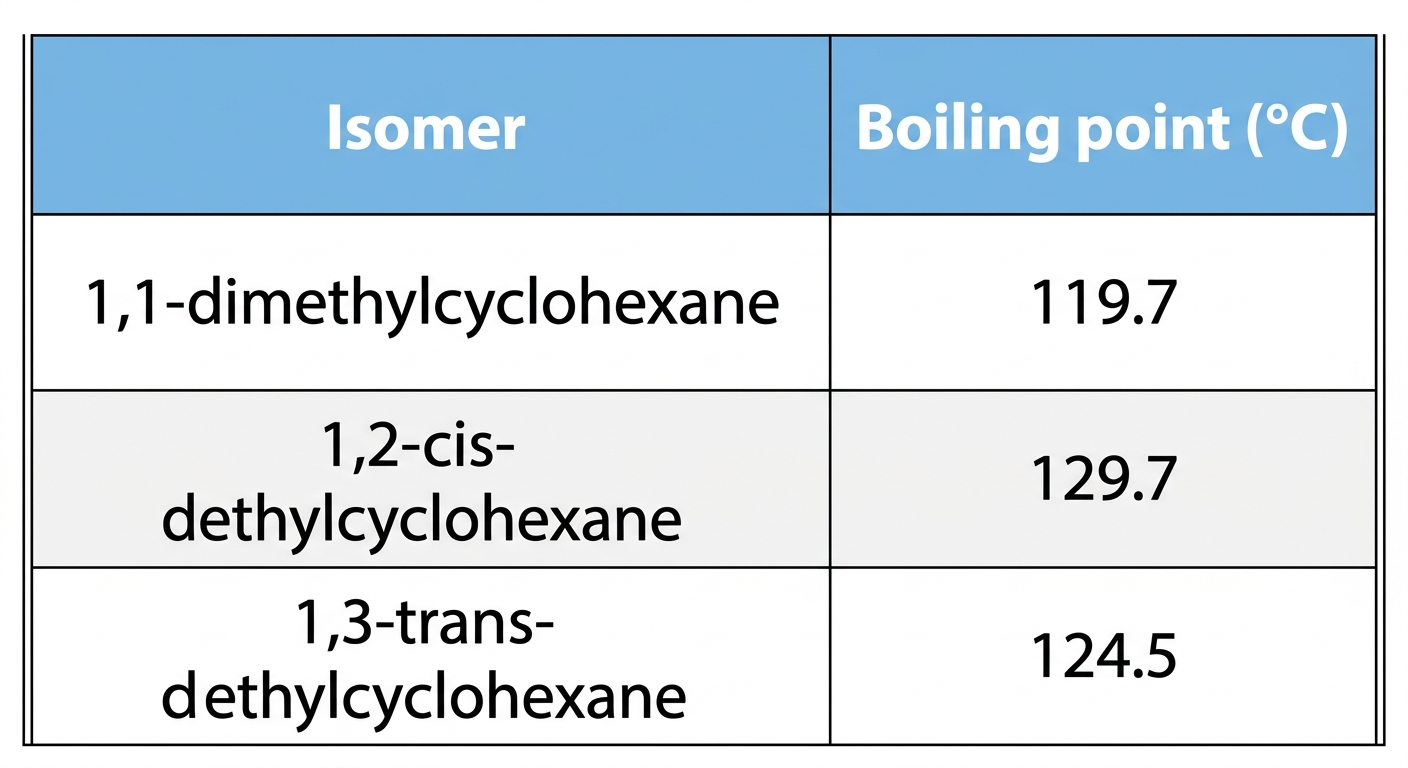
Three isomers of have the following experimentally measured boiling points:
1,1-dimethylcyclohexane: 119.7 °C
1,2-cis-dimethylcyclohexane: 129.7 °C
1,3-trans-dimethylcyclohexane: 124.5 °C
1,1-dimethylcyclohexane: 119.7 °C
1,2-cis-dimethylcyclohexane: 129.7 °C
1,3-trans-dimethylcyclohexane: 124.5 °C
a
Draw the structural formula of each isomer using wedge-dash notation to show the position and stereochemistry of the methyl groups. [2]
b
Explain how the position of the methyl groups affects the symmetry and polarity of each isomer. [1]
c
Evaluate which isomer's structure best accounts for the observed order of boiling points, justifying your answer in terms of intermolecular forces. [2]
Solutions
3QuestionNaming cyclic compounds (basic)Assessment Practice
5 marks~8 minCriterion B
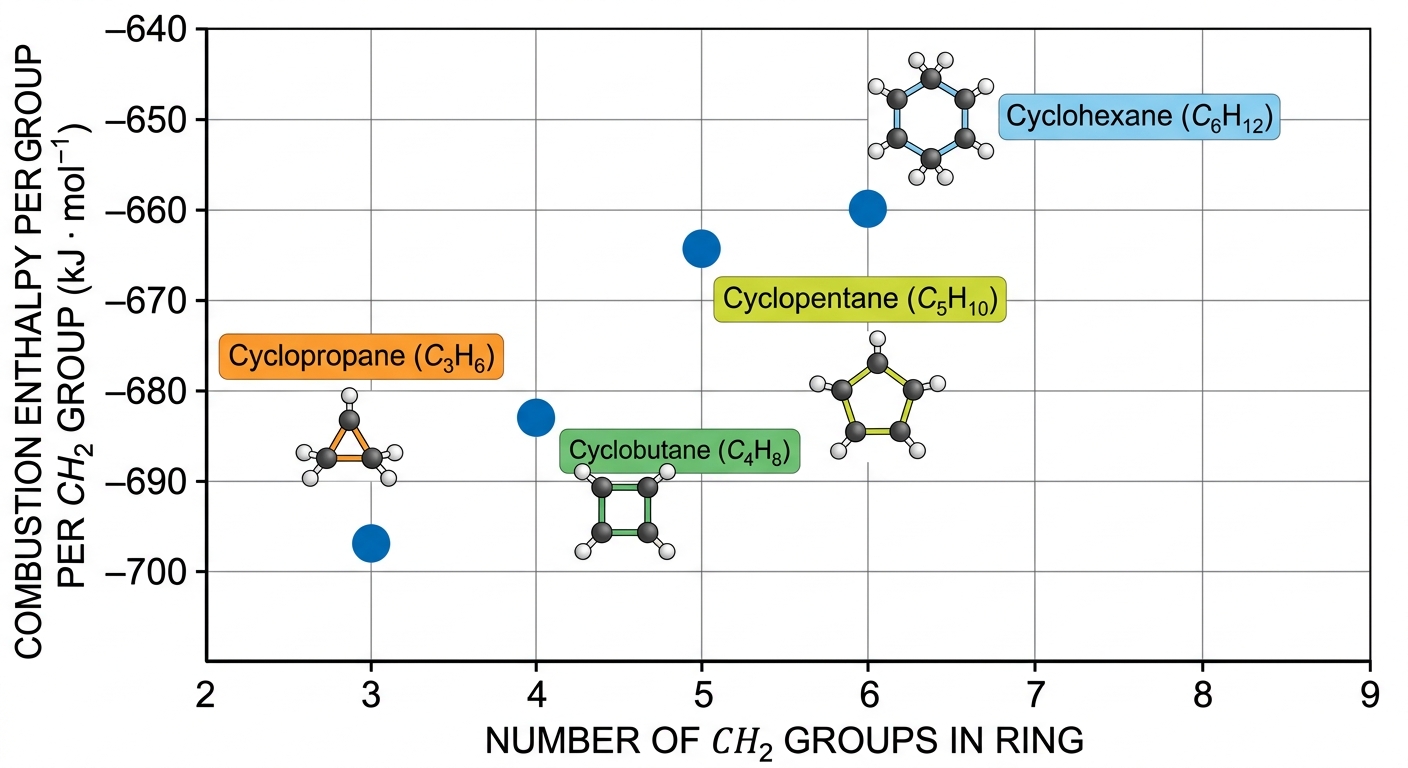
The standard enthalpy of combustion per group for four cycloalkanes is given below.
| Cycloalkane | cyclopropane | cyclobutane | cyclopentane | cyclohexane |
|---|---|---|---|---|
| Enthalpy per / kJ mol |
a
Identify the trend in combustion enthalpy per as ring size increases from cyclopropane to cyclohexane. [1]
b
Deduce the combustion enthalpy per for cycloheptane (), showing your reasoning from the data. [2]
c
Justify the trend identified in (a) using Baeyer strain theory, and explain why the values approach a limiting enthalpy as ring size increases. [2]
Solutions
4QuestionNaming compounds with functional groups like Alcohols (-ol) and Carboxylic acids (-oic acid)Assessment Practice
5 marks~8 minCriterion C
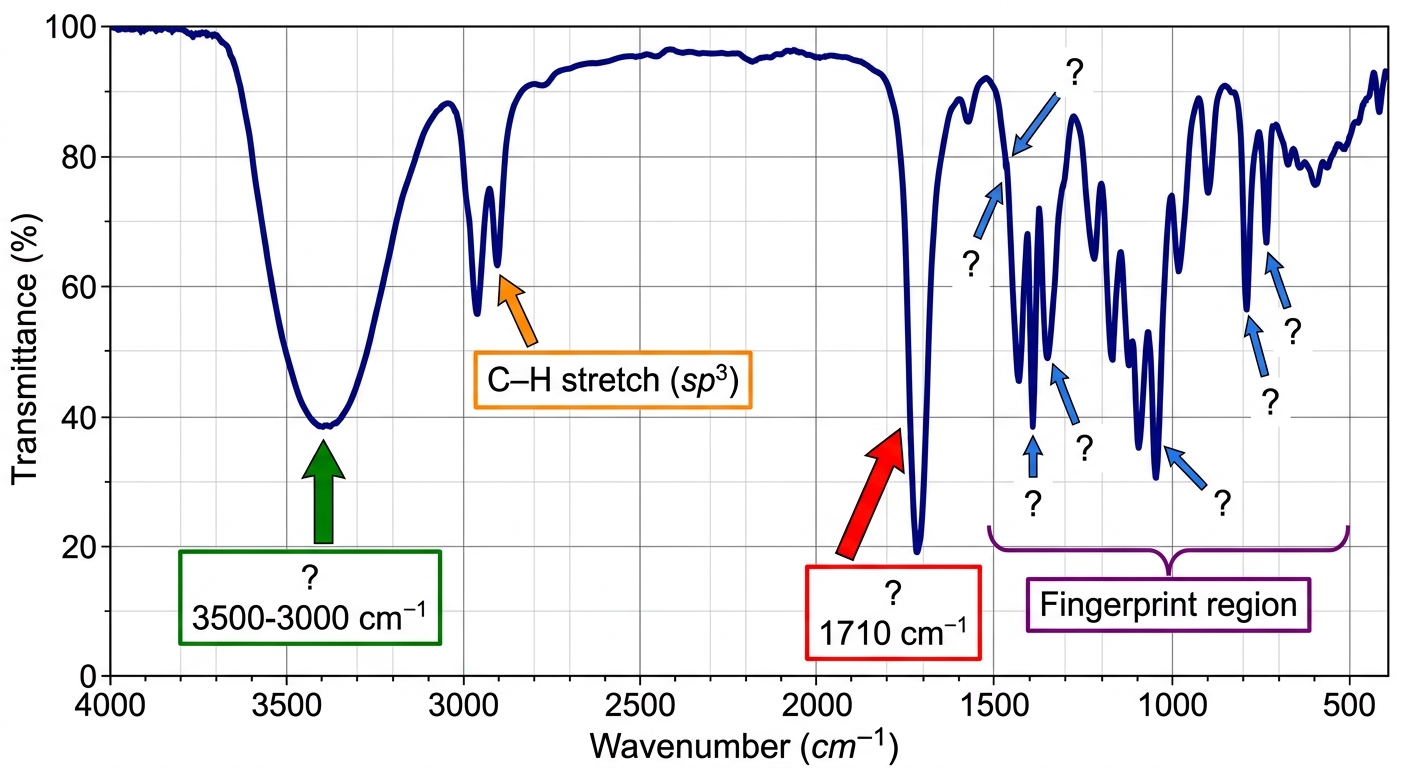
An unknown organic compound has the molecular formula . Its infrared (IR) spectrum shows a strong, broad absorption at approximately and a strong, sharp absorption at approximately .
Two students propose different identities for the compound:
Student 1: "The compound is propan-1-ol."
Student 2: "The compound is propanoic acid."
Two students propose different identities for the compound:
Student 1: "The compound is propan-1-ol."
Student 2: "The compound is propanoic acid."
a
Identify the functional groups responsible for each IR absorption band. [2]
b
State the IUPAC name and structural formula of the correct compound. [1]
c
Evaluate both students' claims, explaining why one is supported by the spectral data and the other is not. [2]
Solutions
That's every free question here — 4 of 266.
+262 more questions, plus Mock Papers & Worksheets, are waiting in Premium.