You're viewing free preview questions — 4 questions previewing here — subscribe to unlock 78 more, plus the Full Question Bank, Mock Papers & Worksheets.Upgrade
Chormatography and its applications — Free MYP5 Chemistry Practice Questions

1QuestionApplications (forensics, food testing, drug analysis)Concept Practice
2 marks~3 minCriterion A
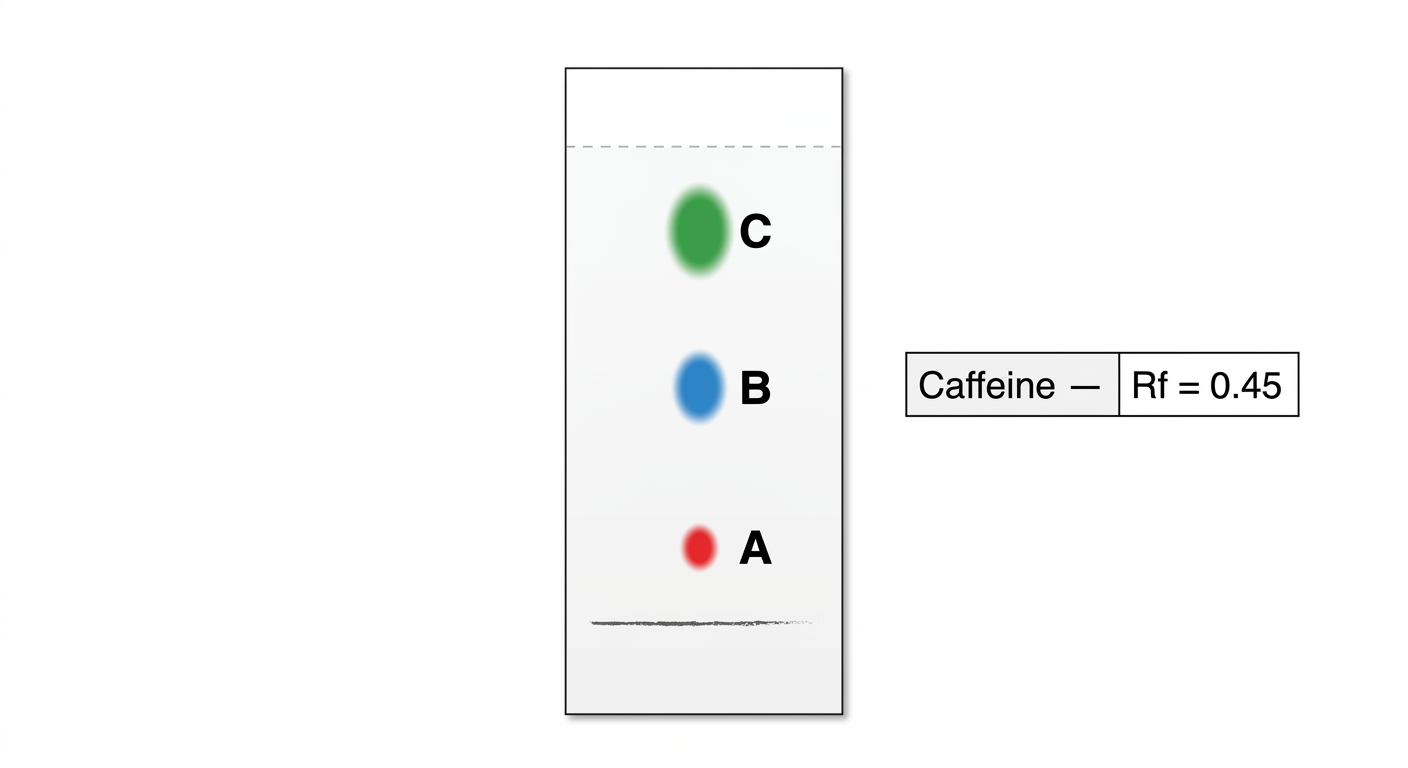
A paper chromatogram of a sports drink shows three spots labelled A, B, and C. The solvent front travelled 8.0 cm from the baseline. Spot A travelled 2.4 cm, spot B travelled 3.6 cm, and spot C travelled 6.0 cm.
A reference table states that caffeine has an value of under identical conditions.
A reference table states that caffeine has an value of under identical conditions.
a
Calculate the value for each spot. [1]
b
Deduce which spot corresponds to caffeine, justifying your answer using your calculated values. [1]

Solutions
2QuestionApplications (forensics, food testing, drug analysis)Assessment Practice
6 marks~9 minCriterion D
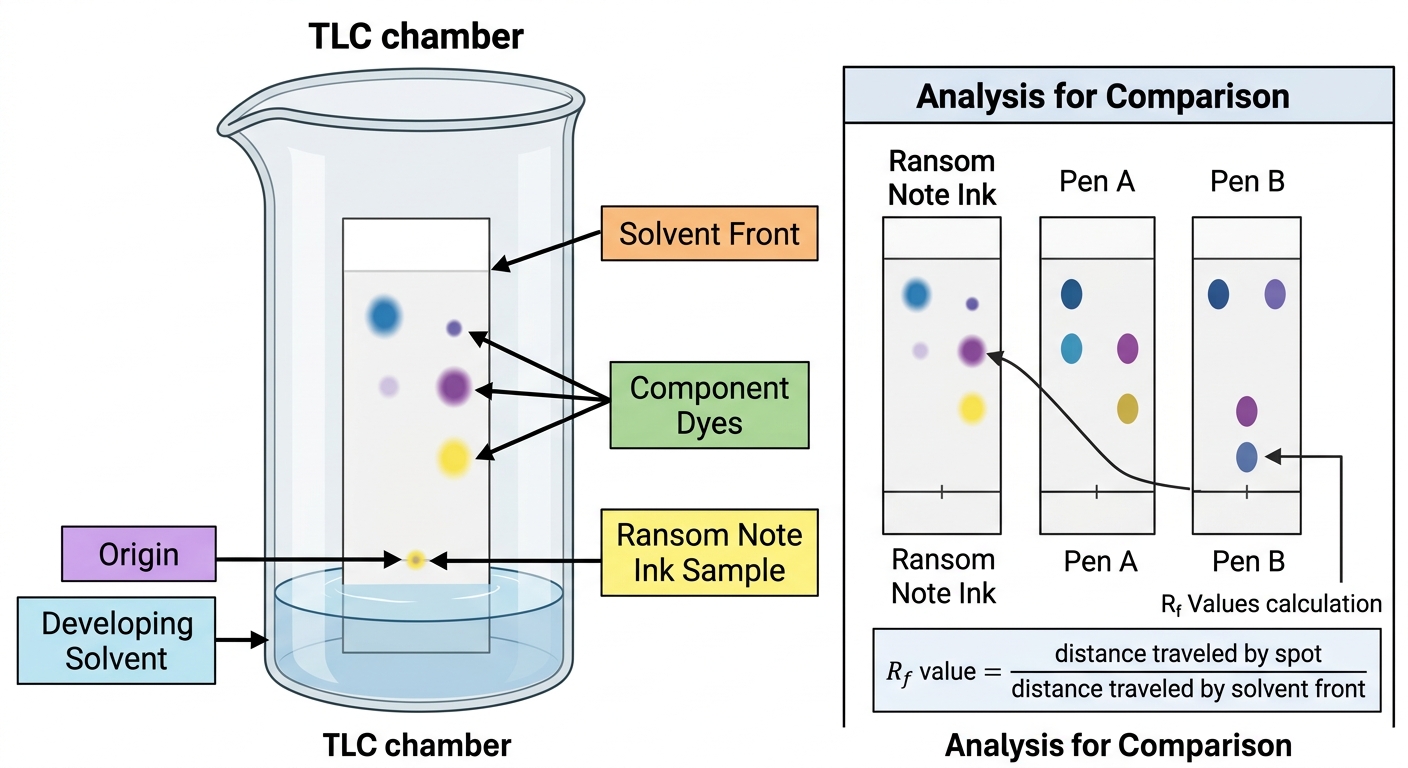
A forensic laboratory uses thin-layer chromatography (TLC) to analyse ink from ransom notes. Polar solvents such as ethyl acetate and methanol are used as the mobile phase; both are toxic and must be disposed of as hazardous waste. Fume hoods operate continuously to protect technicians and consume significant electrical energy. TLC separates ink components by their differing affinities for the stationary and mobile phases, producing an Rf value unique to each component.
a
Discuss the societal benefits of using TLC in forensic ink analysis. [2]
b
Analyse the environmental costs arising from solvent use and energy consumption in this procedure. [2]
c
Evaluate the overall trade-off between the societal benefits and environmental costs of TLC in forensic contexts, considering the limitations of the technique. [2]
Solutions
3QuestionApplications (forensics, food testing, drug analysis)Assessment Practice
8 marks~12 minCriterion C
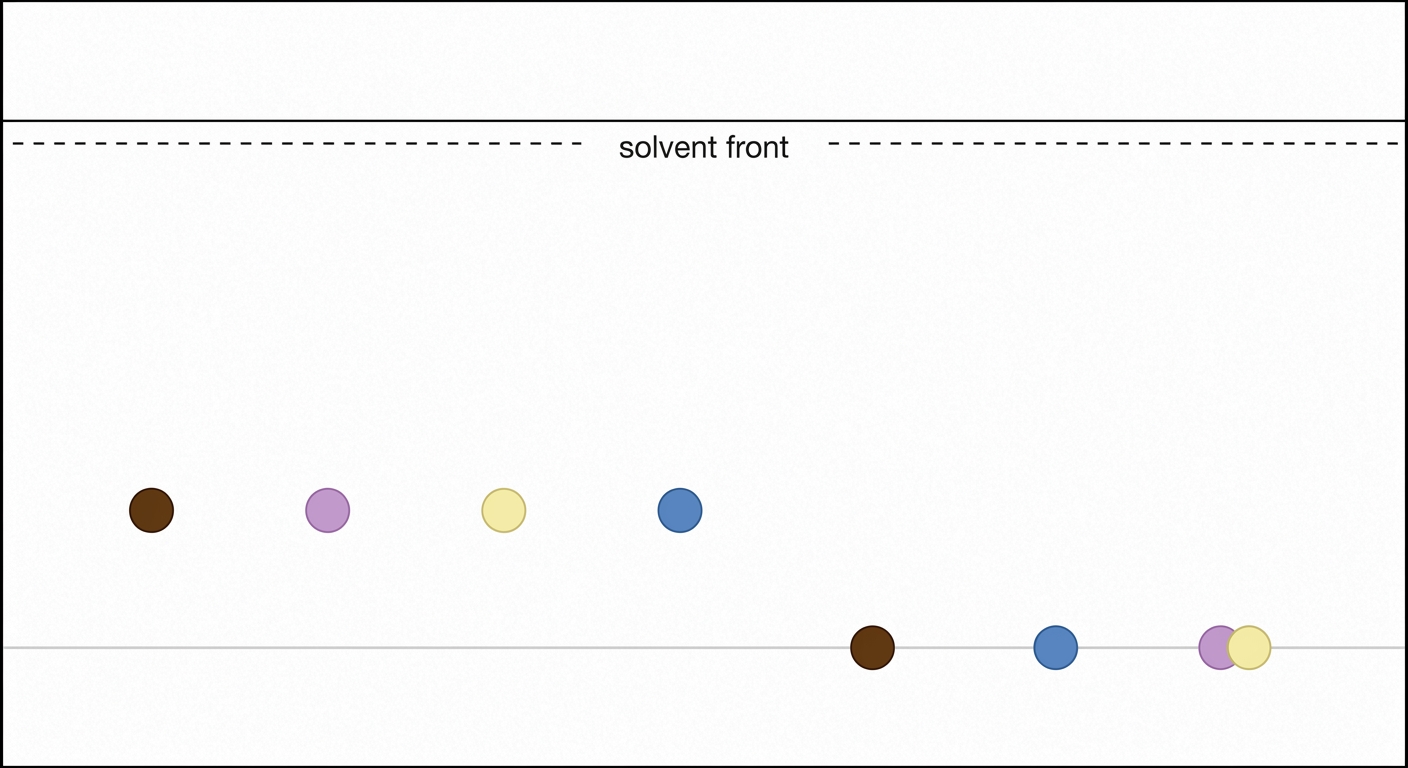
A forensic chemist investigates a suspect document by analysing three ink samples (X, Y, Z) using thin-layer chromatography (TLC). The stationary phase is silica gel; the mobile phase is hexane:ethyl acetate (9:1). Reference values: caffeine , paracetamol , aspirin , codeine . The solvent front travels cm; the codeine reference spot travels cm. Observed spots: Sample X — one spot at ; Sample Y — one spot at ; Sample Z — two spots at and .
a
Show that the value of the codeine reference standard is consistent with . [2]
b
Explain how the polarity of the stationary and mobile phases accounts for the relative positions of caffeine () and aspirin () on the chromatogram. [2]
c
Justify whether Sample Y can be reliably identified as codeine, using evidence, the possibility of co-elution, and at least one confirmatory strategy. [4]
Solutions
4QuestionApplications (forensics, food testing, drug analysis)Assessment Practice
6 marks~9 minCriterion B
A forensic scientist examines five ink samples from a forged document using paper chromatography in two solvents: water (polar) and ethanol (less polar).
Spots in water: A = 1, B = 2, C = 1, D = 3, E = 2
values in water: A = 0.45; B = 0.30 and 0.60; C = 0.70; D = 0.25, 0.50, and 0.55; E = 0.20 and 0.35
Spots in ethanol: A = 1, B = 1, C = 1, D = 2, E = 1
values in ethanol: A = 0.72; B = 0.55; C = 0.80; D = 0.40 and 0.62; E = 0.68
Spots in water: A = 1, B = 2, C = 1, D = 3, E = 2
values in water: A = 0.45; B = 0.30 and 0.60; C = 0.70; D = 0.25, 0.50, and 0.55; E = 0.20 and 0.35
Spots in ethanol: A = 1, B = 1, C = 1, D = 2, E = 1
values in ethanol: A = 0.72; B = 0.55; C = 0.80; D = 0.40 and 0.62; E = 0.68
a
Deduce which ink samples are pure substances and which are mixtures, using evidence from both solvents. [2]
b
Analyse the data for ink sample B across both solvents and generalise a rule linking solvent polarity to the effectiveness of chromatographic separation. [2]
c
Evaluate whether hexane (a non-polar solvent) would be suitable for identifying the individual components of ink sample D. Use your rule from part (b) and the data for sample D to support your judgement. [2]
Solutions
That's every free question here — 4 of 82.
+78 more questions, plus Mock Papers & Worksheets, are waiting in Premium.