You're viewing free preview questions — 4 questions previewing here — subscribe to unlock 77 more, plus the Full Question Bank, Mock Papers & Worksheets.Upgrade
Distillation and fractional distillation — Free MYP5 Chemistry Practice Questions

1QuestionApplications (petroleum refining, water purification)Concept Practice
2 marks~3 minCriterion A
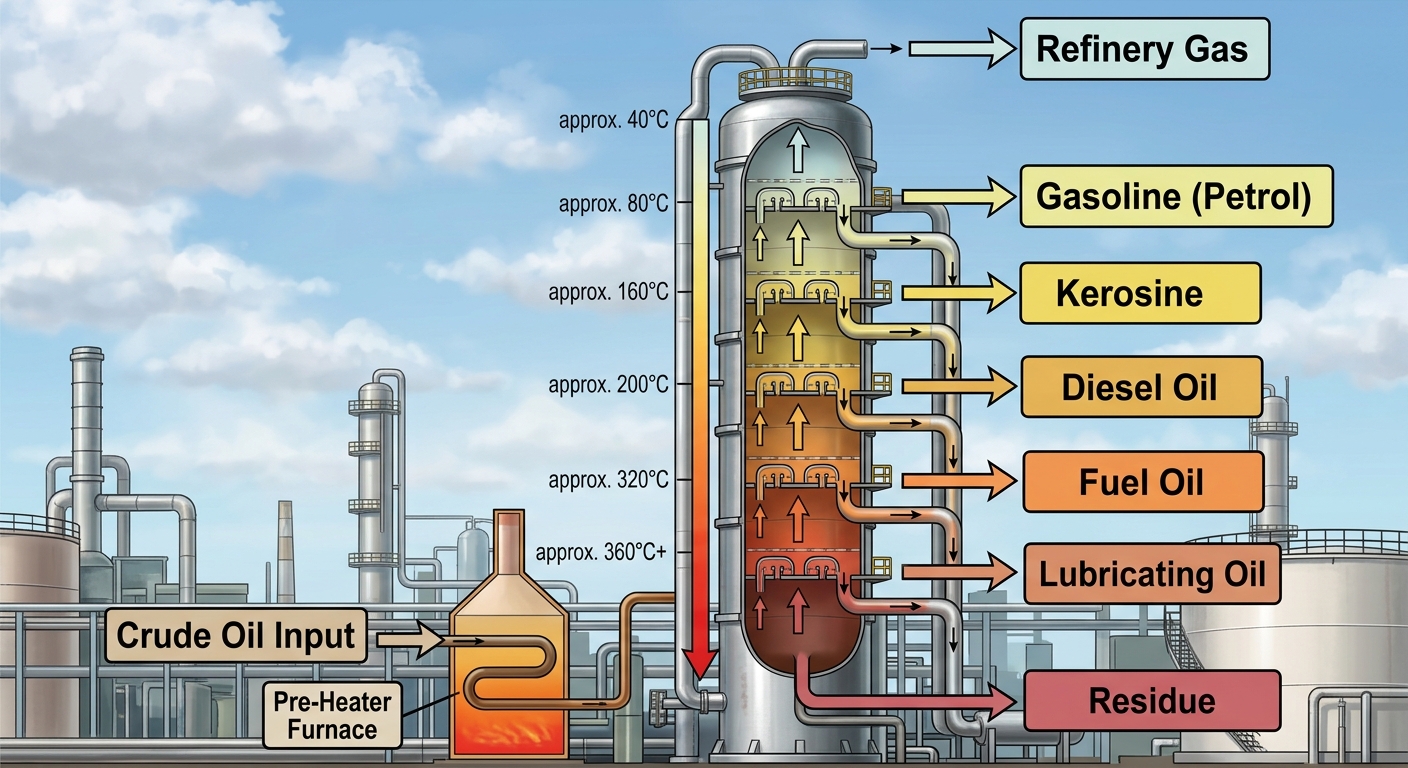
A fractionating column used in petroleum refining maintains a temperature gradient: approximately 350 °C at the base and 40 °C at the top.
Refer to the diagram of the fractionating column provided.
Refer to the diagram of the fractionating column provided.
a
Identify where in the column the fraction with the highest boiling point is collected. [1]
b
Explain why this fraction collects at that location rather than higher up the column. [1]

Solutions
2QuestionFractionating column and temperature gradientAssessment Practice
6 marks~9 minCriterion D
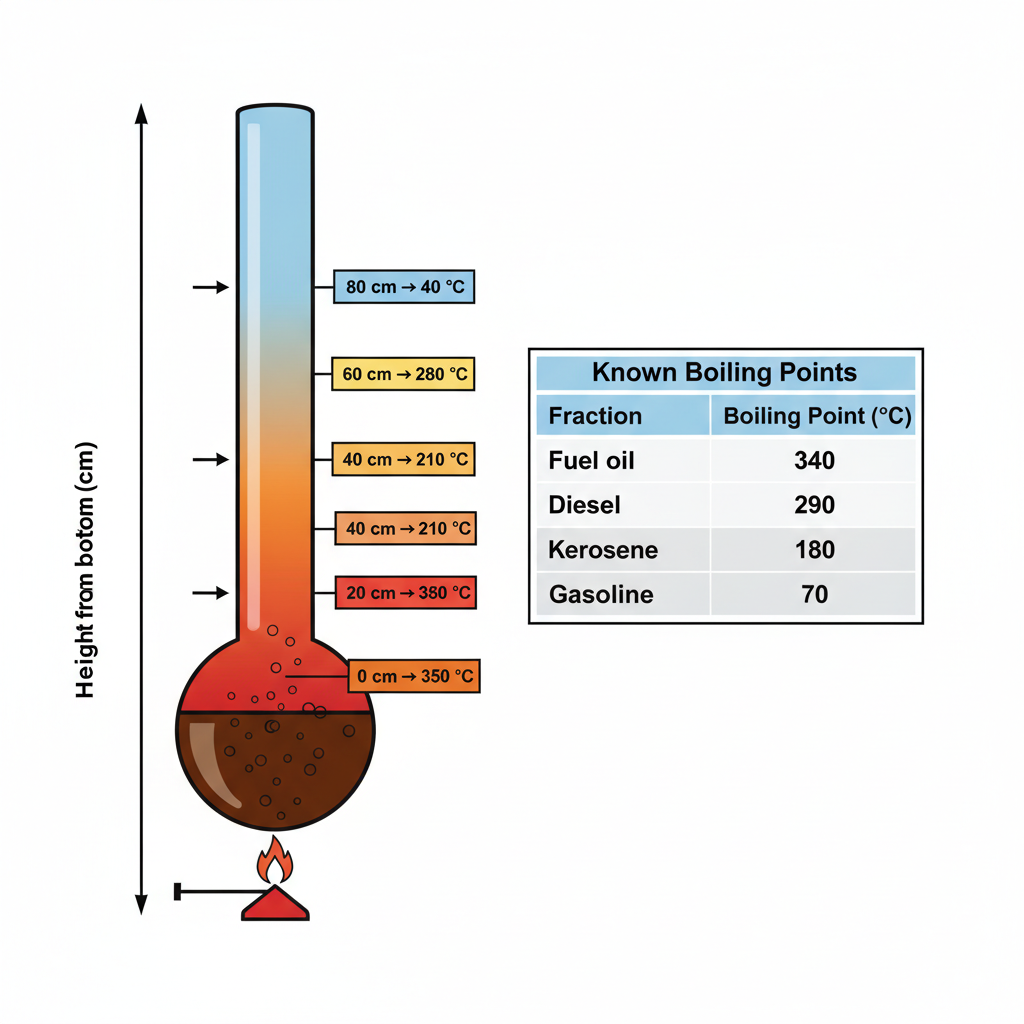
During the fractional distillation of a crude oil mixture, temperatures were recorded at five heights along the fractionating column.
Known boiling points of hydrocarbon fractions:
Fuel oil: 340 °C
Diesel: 290 °C
Kerosene: 180 °C
Gasoline: 70 °C
| Height from base (cm) | 0 | 20 | 40 | 60 | 80 |
|---|---|---|---|---|---|
| Temperature (°C) | 350 | 280 | 210 | 150 | 40 |
Known boiling points of hydrocarbon fractions:
Fuel oil: 340 °C
Diesel: 290 °C
Kerosene: 180 °C
Gasoline: 70 °C
a
Deduce which hydrocarbon fraction condenses at a height of 20 cm. [2]
b
The temperature at 40 cm is 210 °C. Justify why no single fraction condenses cleanly at this height, and explain what this indicates about the separation occurring there. [2]
c
Analyse the temperature reading of 40 °C at 80 cm. Identify the anomaly and evaluate one specific flaw in the column setup that could account for it. [2]
Solutions
3QuestionSimple distillation (separating solvent from solution)Assessment Practice
6 marks~9 minCriterion C
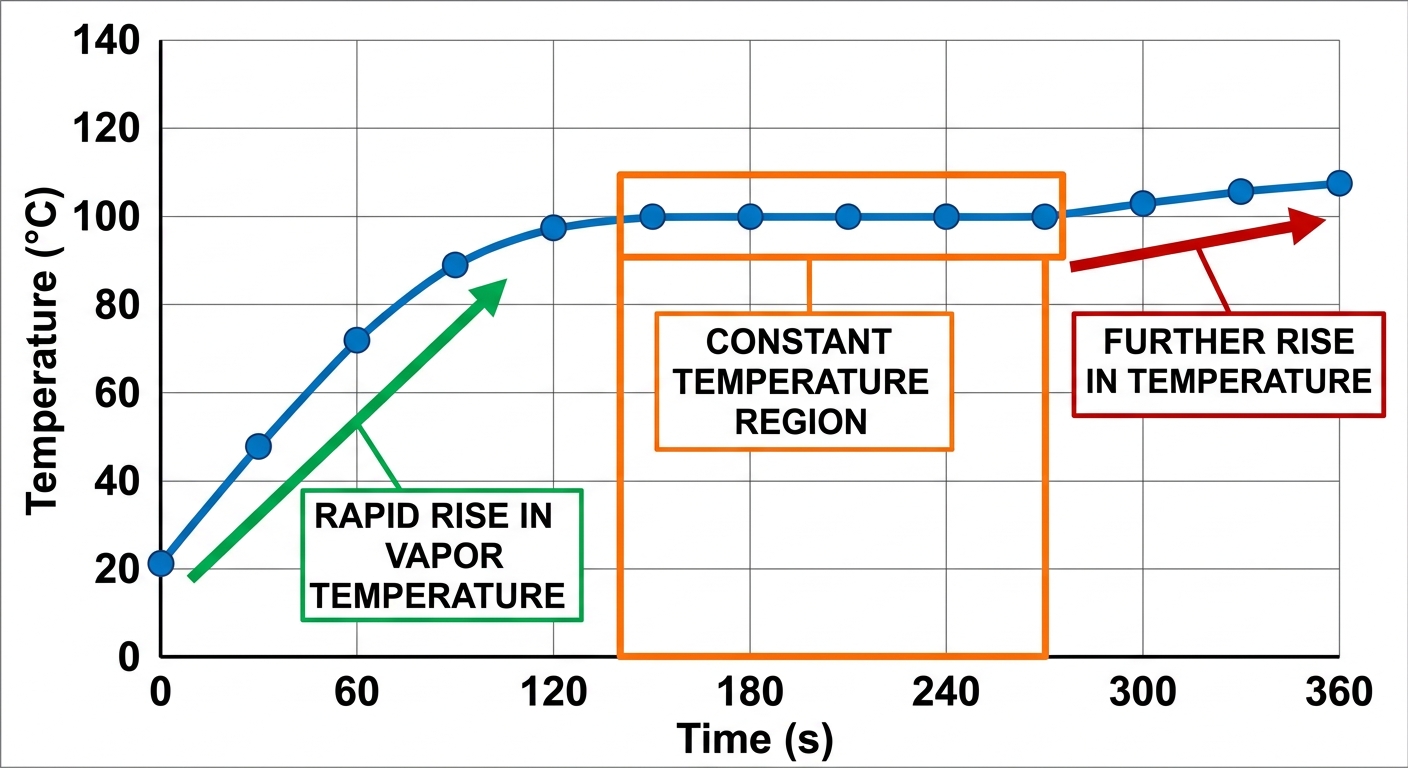
A student performed a simple distillation of seawater to obtain pure water. She recorded the temperature of the vapour every 30 s. The data are shown below.
Time (s): 0, 30, 60, 90, 120, 150, 180, 210, 240, 270, 300, 330, 360
Temperature (°C): 22, 48, 72, 89, 98, 100, 100, 100, 100, 100, 103, 105, 107
Time (s): 0, 30, 60, 90, 120, 150, 180, 210, 240, 270, 300, 330, 360
Temperature (°C): 22, 48, 72, 89, 98, 100, 100, 100, 100, 100, 103, 105, 107
a
Identify the time interval during which the temperature remained constant and explain why it remained constant at that value. [2]
b
Explain why the temperature rose above 100 °C after 270 s, referring to the composition of the liquid remaining in the distillation flask. [2]
c
Analyse the full data set to determine whether the distillate collected over the entire distillation is pure water. Justify your conclusion with reference to specific values from the data. [2]
Solutions
4QuestionApplications (petroleum refining, water purification)Assessment Practice
5 marks~8 minCriterion B
The table below shows data for five fractions obtained from the fractional distillation of crude oil.
Kerosene, used as jet fuel, has a boiling point range of 150–275 °C and contains hydrocarbons with 10 to 16 carbon atoms.
| Fraction | A | B | C | D | E |
|---|---|---|---|---|---|
| Boiling point range (°C) | 30–100 | 100–175 | 175–275 | 275–350 | 350–400 |
| Main carbon chain length (C atoms) | – | – | – | – | – |
Kerosene, used as jet fuel, has a boiling point range of 150–275 °C and contains hydrocarbons with 10 to 16 carbon atoms.
a
Deduce which fraction (A–E) is most likely to be kerosene. [1]
b
Explain, using the data in the table, how boiling point is related to carbon chain length in these hydrocarbon fractions. [2]
c
Explain, at the molecular level, why this relationship between carbon chain length and boiling point exists. [2]
Solutions
That's every free question here — 4 of 81.
+77 more questions, plus Mock Papers & Worksheets, are waiting in Premium.