You're viewing free preview questions — 4 questions previewing here — subscribe to unlock 82 more, plus the Full Question Bank, Mock Papers & Worksheets.Upgrade
Filtration, Evaporation and Crystallization — Free MYP5 Chemistry Practice Questions

1QuestionChoosing appropriate method based on mixture typeConcept Practice
2 marks~3 minCriterion A
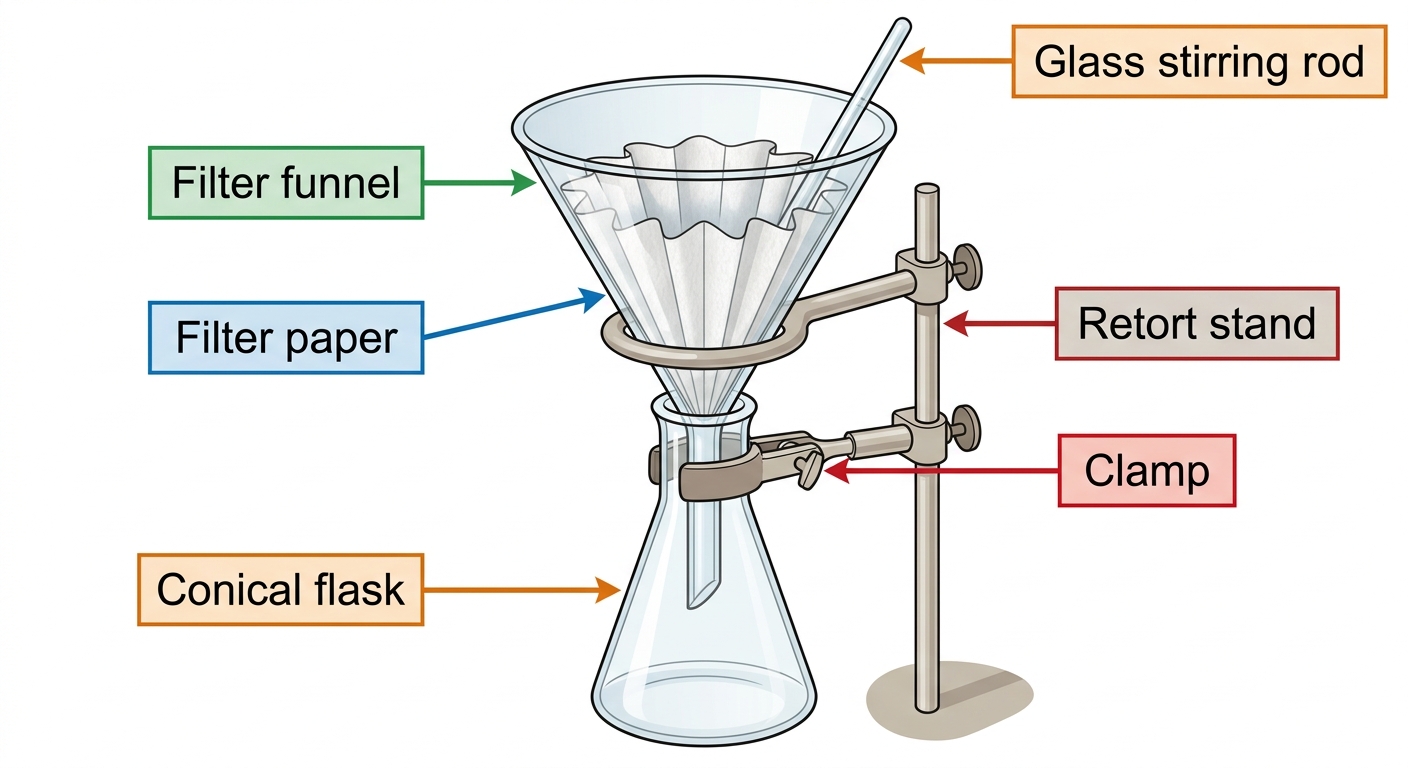
A student sets up a filtration apparatus to separate sand from a sand–water mixture. The diagram shows the complete setup, including a retort stand, a glass rod, a beaker, and the filtration components.
a
State the name of the piece of equipment that directly supports the filter paper during filtration. [1]
b
Explain why filtration is a suitable separation method for this mixture rather than evaporation. [1]

Solutions
2QuestionEvaporation to obtain dissolved solidsAssessment Practice
3 marks~5 minCriterion C
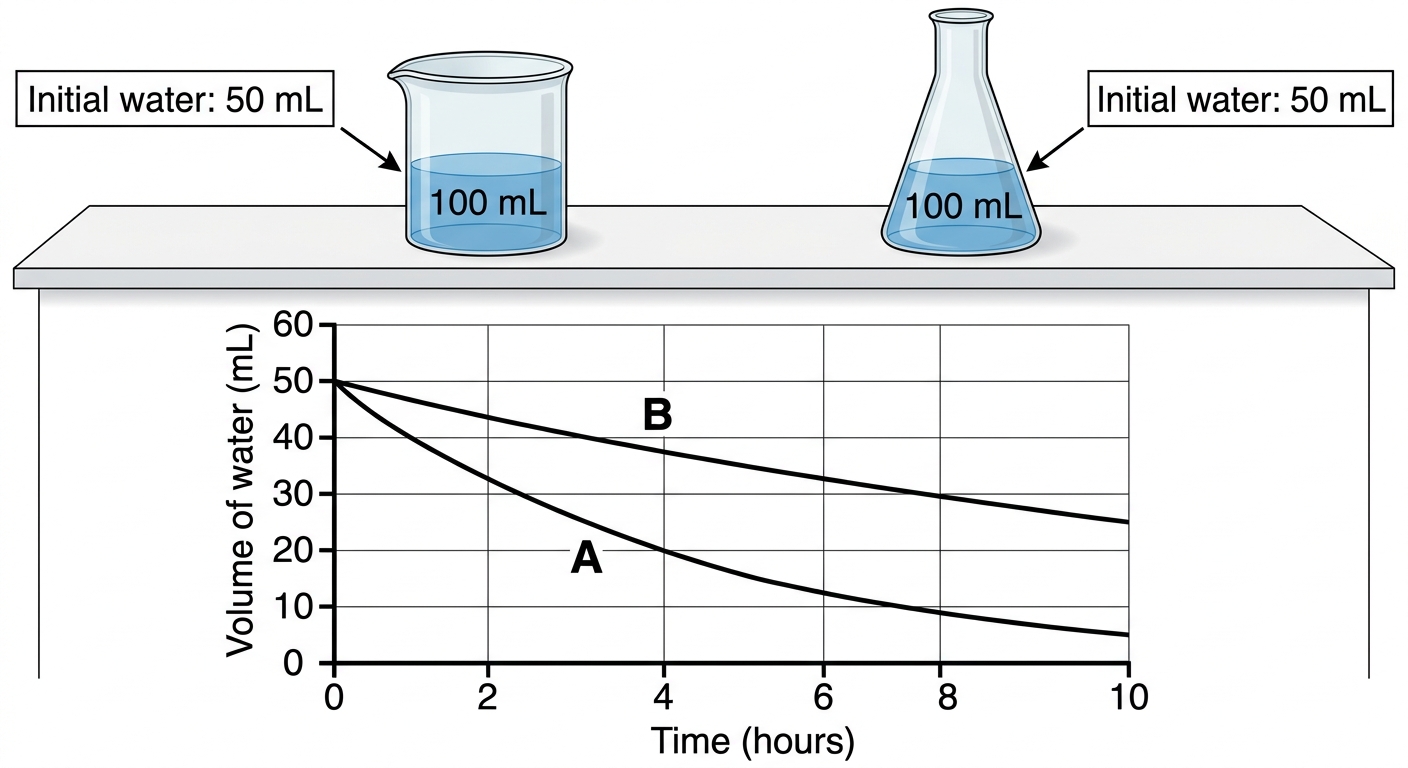
A student monitors the volume of water remaining in two open containers — a wide beaker and a narrow conical flask — over six hours. Both containers start with 50 mL of water and are left in identical conditions. The graph shows two curves, A and B, plotting volume (mL) against time (hours).
a
Describe the trend shown by both curves. [1]
b
Identify which curve corresponds to the wide beaker and which to the narrow conical flask. Justify your answer using the concept of surface area. [1]
c
A student claims that temperature, not surface area, is the main factor causing the difference between curves A and B. Evaluate this claim. [1]
Solutions
3QuestionChoosing appropriate method based on mixture typeAssessment Practice
6 marks~9 minCriterion D
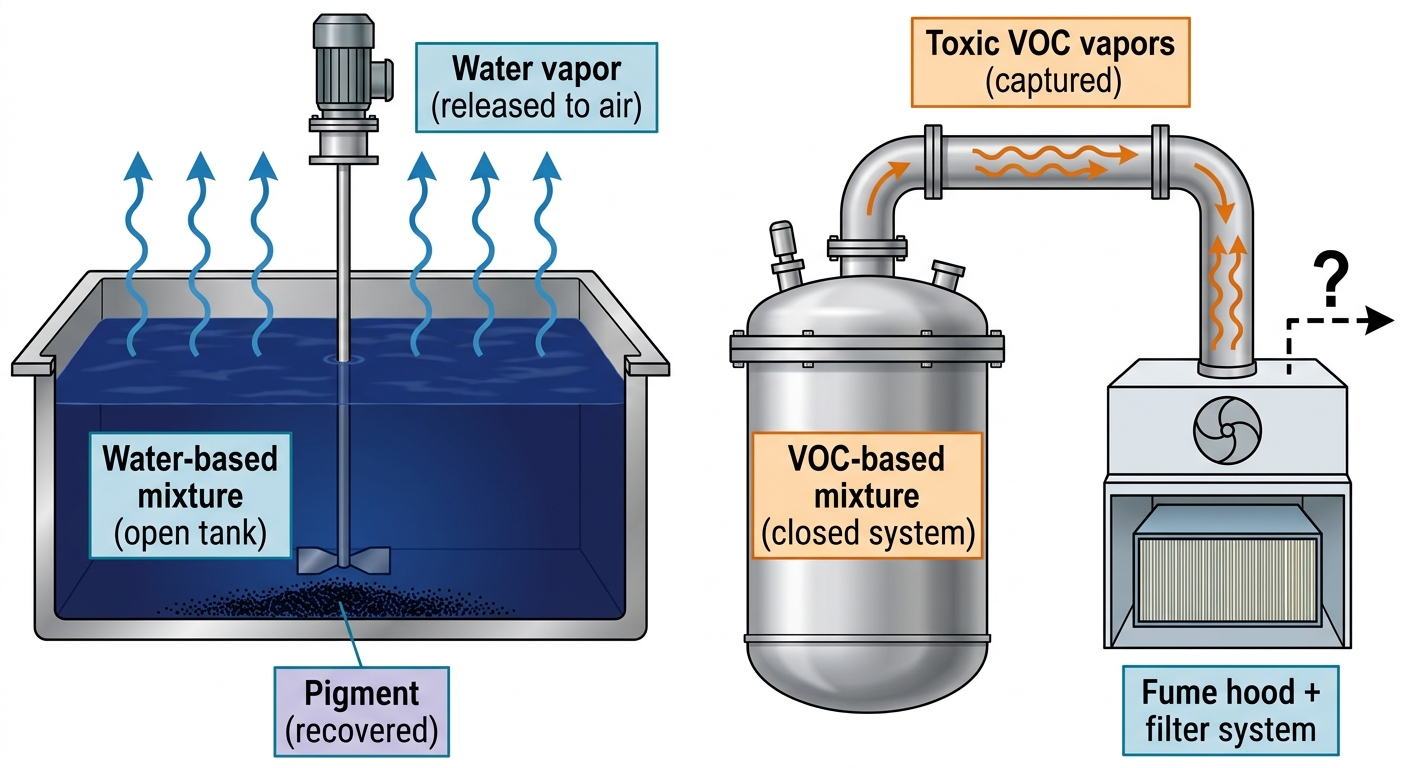
A paint manufacturer tests two solvents to dissolve a pigment: water and a volatile organic compound (VOC). The water-based mixture is evaporated in an open tank, releasing only water vapour. The VOC-based mixture must be evaporated inside a closed system fitted with a fume hood to capture toxic vapours; this system carries higher operational and maintenance costs. VOC vapours that escape contribute to ground-level ozone formation and smog.
a
Explain why evaporation is a suitable separation method for recovering the pigment from either mixture. [2]
b
Discuss the environmental and health implications of choosing the VOC solvent rather than water. [2]
c
Evaluate the limitation of relying on evaporation alone to protect workers from hazardous solvent vapours in the workplace. [2]
Solutions
4QuestionCrystallization for obtaining pure solidsAssessment Practice
3 marks~5 minCriterion B
A student purifies copper(II) sulfate by crystallization, varying the cooling rate of a saturated solution. The results are shown below.
In each trial, 50.0 g of crude copper(II) sulfate was used.
| Cooling rate (°C/min) | 1 | 5 | 15 | 30 |
|---|---|---|---|---|
| Mass of purified crystals (g) | 42.5 | 38.0 | 30.5 | 22.0 |
| Percentage yield (%) | 85.0 | 76.0 | 61.0 | 44.0 |
In each trial, 50.0 g of crude copper(II) sulfate was used.
a
Describe the trend in percentage yield as cooling rate increases. [1]
b
Explain why slower cooling produces larger crystals. [1]
c
Explain why slower cooling produces purer crystals, and evaluate whether maximising crystal purity always means maximising percentage yield. [1]
Solutions
That's every free question here — 4 of 86.
+82 more questions, plus Mock Papers & Worksheets, are waiting in Premium.