You're viewing free preview questions — 6 questions previewing here — subscribe to unlock 68 more, plus the Full Question Bank, Mock Papers & Worksheets.Upgrade
Back

Solubility and factors affecting it — Free MYP5 Chemistry Practice Questions

Free questions

Open in full, with answers, mark scheme and examiner insights.

Question 1Criterion A · Band 1-4 · Easy · 4 marksrevisionprep.com

Definition of solubility (maximum solute in solvent)
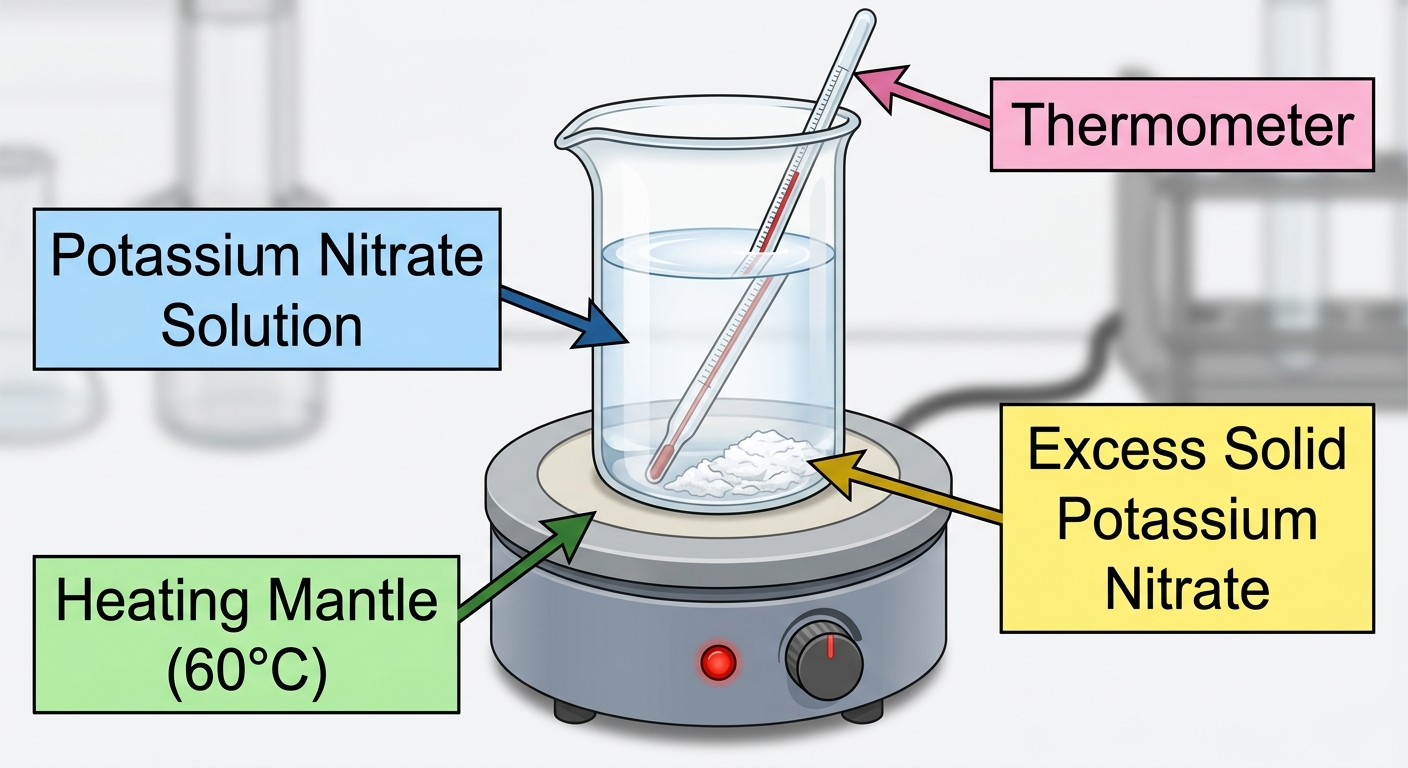
The diagram shows a beaker of potassium nitrate solution on a heating mantle set to 60 °C. Excess solid potassium nitrate stays at the bottom of the beaker after stirring.
Question diagram
(a)
Identify the solute and the solvent in the beaker. [1]Criterion A (i) · Level 1-2
(b)
State how the diagram shows that the solution is saturated. [1]Criterion A (i) · Level 1-2
(c)
A sample of the clear solution is taken at 60 °C. It contains 33.0 g of potassium nitrate dissolved in 30.0 g of water. Calculate the solubility of potassium nitrate at 60 °C in g per 100 g of water. [2]Criterion A (ii) · Level 3-4

revisionprep.com

Summary Answer

Not available for this question.

Model Answer

Not available for this question.

Marking Scheme

Not available for this question.

Examiner Insights

Not available for this question.

Question 2Criterion A · Band 1-2 · Easy · 3 marksrevisionprep.com

Interpreting solubility curves (basic graph reading)
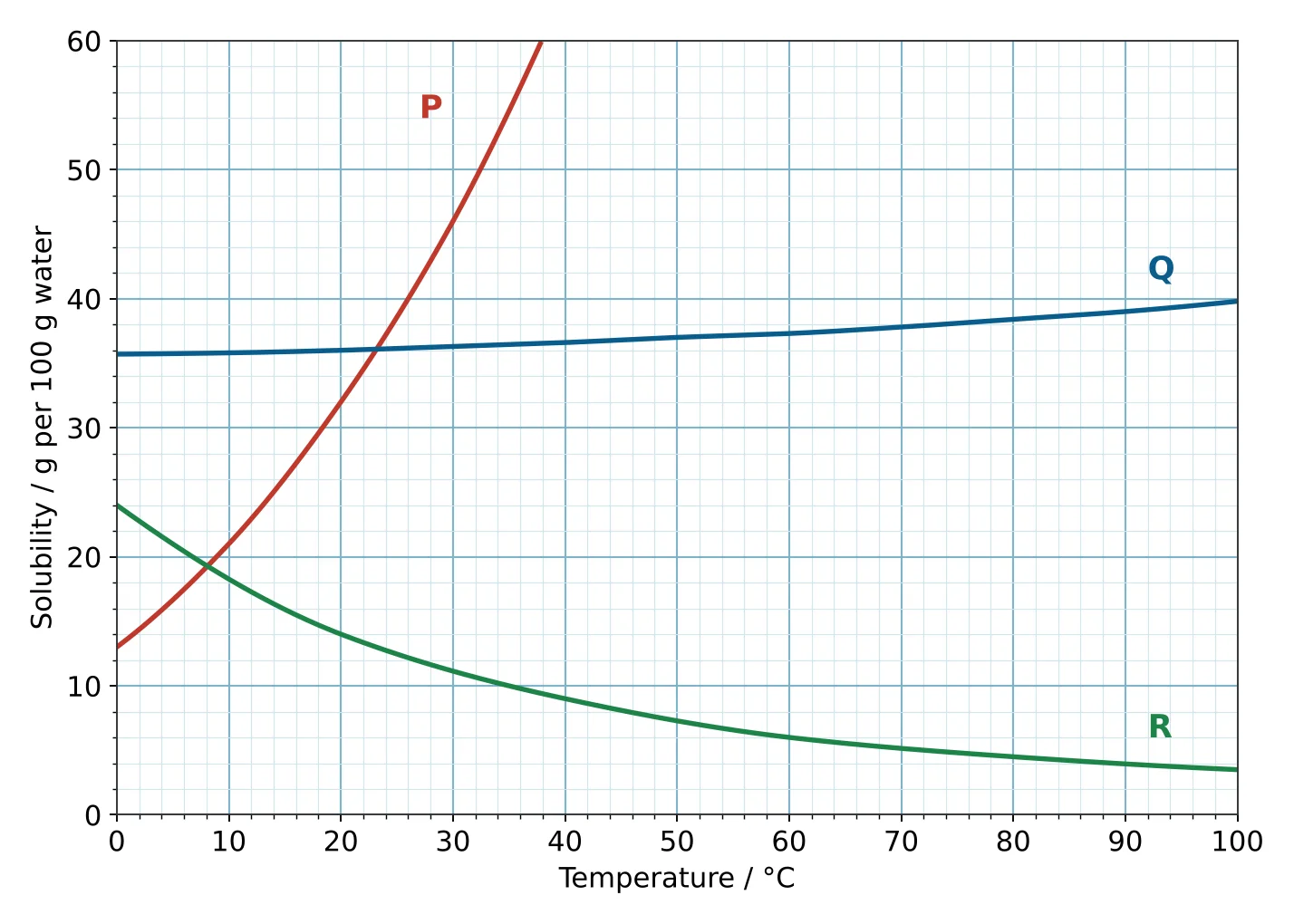
The graph shows solubility curves for three salts, P, Q and R. P is potassium nitrate and Q is sodium chloride.
Question diagram
(a)
Identify the salt whose solubility decreases as temperature increases. [1]Criterion A (ii) · Level 1-2
(b)
Use the graph to state the solubility of Q at 50 °C. [1]Criterion A (ii) · Level 1-2
(c)
Use the graph to estimate the temperature at which P and R have the same solubility. [1]Criterion A (ii) · Level 1-2

revisionprep.com

Summary Answer

Not available for this question.

Model Answer

Not available for this question.

Marking Scheme

Not available for this question.

Examiner Insights

Not available for this question.

Question 3Criterion C + A · Band 1-6 · Medium · 7 marksrevisionprep.com

Definition of solubility (maximum solute in solvent)
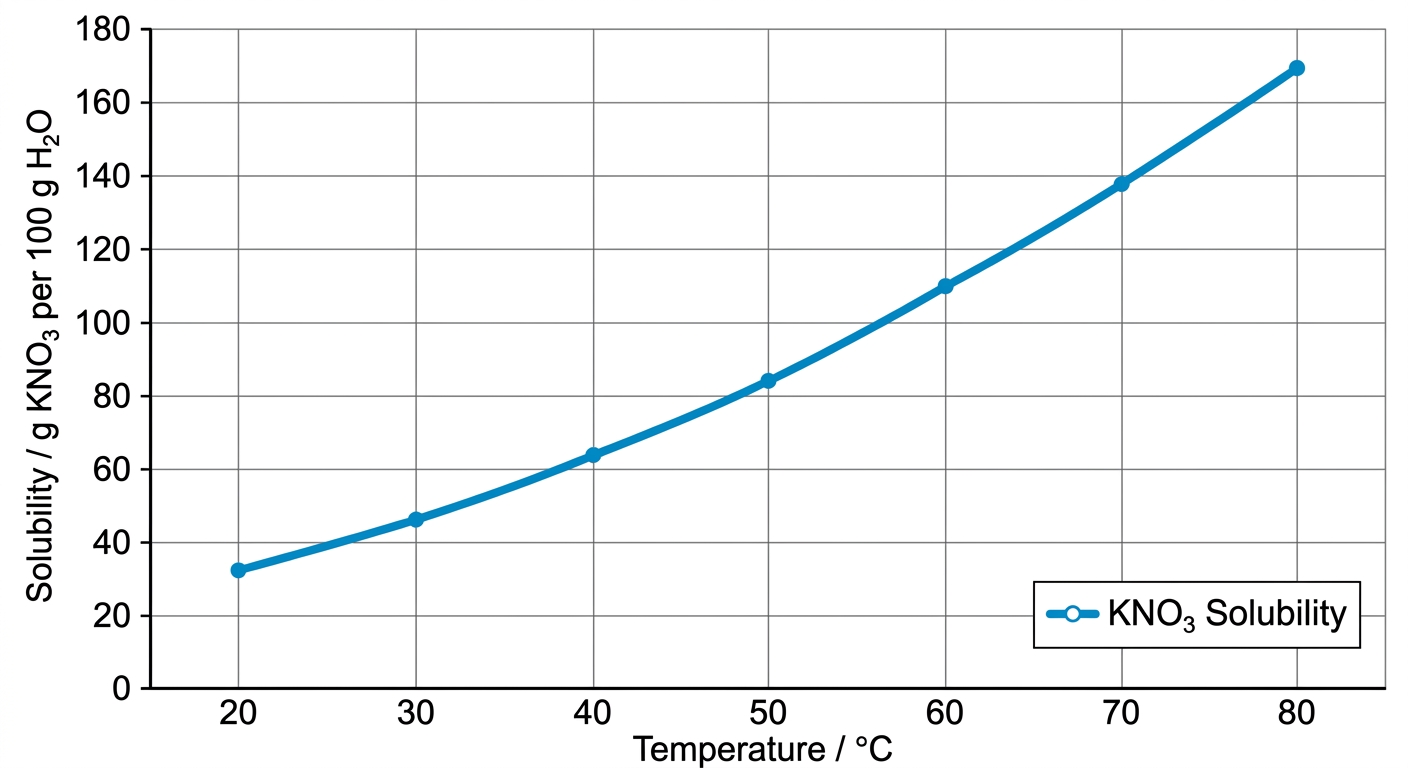
The graph shows the solubility of potassium nitrate, KNO₃, in water between 20 °C and 80 °C.
Question diagram
(a)
Use the graph to state the solubility of KNO₃ at 50 °C. [1]Criterion A (ii) · Level 1-2
(b)
Describe how the solubility of KNO₃ changes between 20 °C and 80 °C. Refer to the shape of the graph. [2]Criterion C (ii) · Level 3-4
(c)
A student says: "Doubling the temperature in °C always doubles the solubility." Evaluate this claim using two pairs of values from the graph. [2]Criterion C (iii) · Level 5-6
(d)
Calculate the minimum mass of water needed to dissolve 42 g of KNO₃ at 30 °C. [2]Criterion A (ii) · Level 5-6

revisionprep.com

Summary Answer

Not available for this question.

Model Answer

Not available for this question.

Marking Scheme

Not available for this question.

Examiner Insights

Not available for this question.

Question 4Criterion A · Band 1-6 · Medium · 6 marksrevisionprep.com

Saturated, unsaturated, and supersaturated solutions
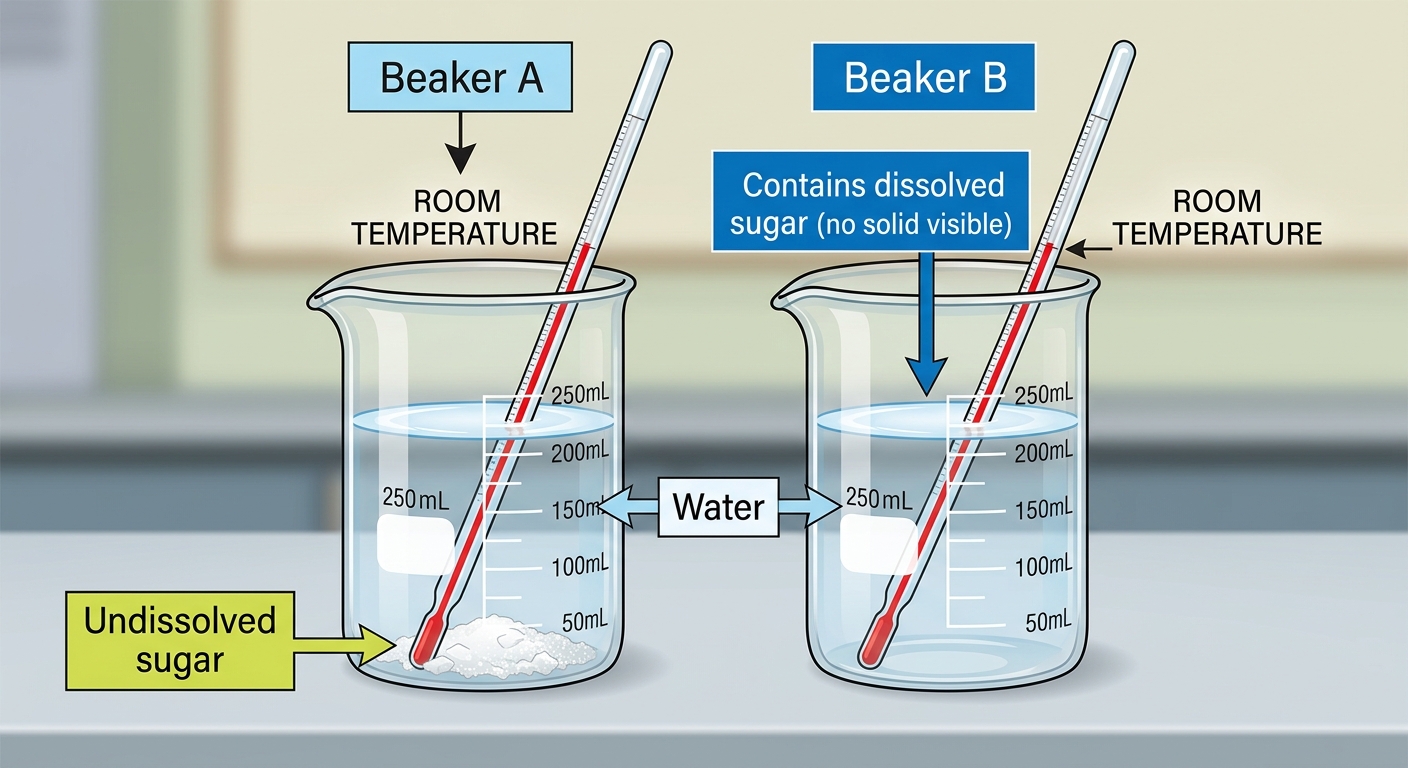
The diagram shows two beakers of sugar solution at room temperature. Beaker A has undissolved sugar at the bottom. Beaker B contains a clear solution with no solid visible.
Question diagram
(a)
Identify which beaker must contain a saturated solution and give a reason. [1]Criterion A (i) · Level 1-2
(b)
A student says Beaker B must be unsaturated because no solid can be seen. Evaluate this statement. [2]Criterion A (iii) · Level 5-6
(c)
Describe a simple test, using one small sugar crystal, that would show whether Beaker B is unsaturated, saturated or supersaturated. State the result for each case. [3]Criterion A (ii) · Level 5-6

revisionprep.com

Summary Answer

Not available for this question.

Model Answer

Not available for this question.

Marking Scheme

Not available for this question.

Examiner Insights

Not available for this question.

Question 5Criterion B + A · Band 1-8 · Challenge · 9 marksrevisionprep.com

Effect of temperature on solubility (solids vs gases)
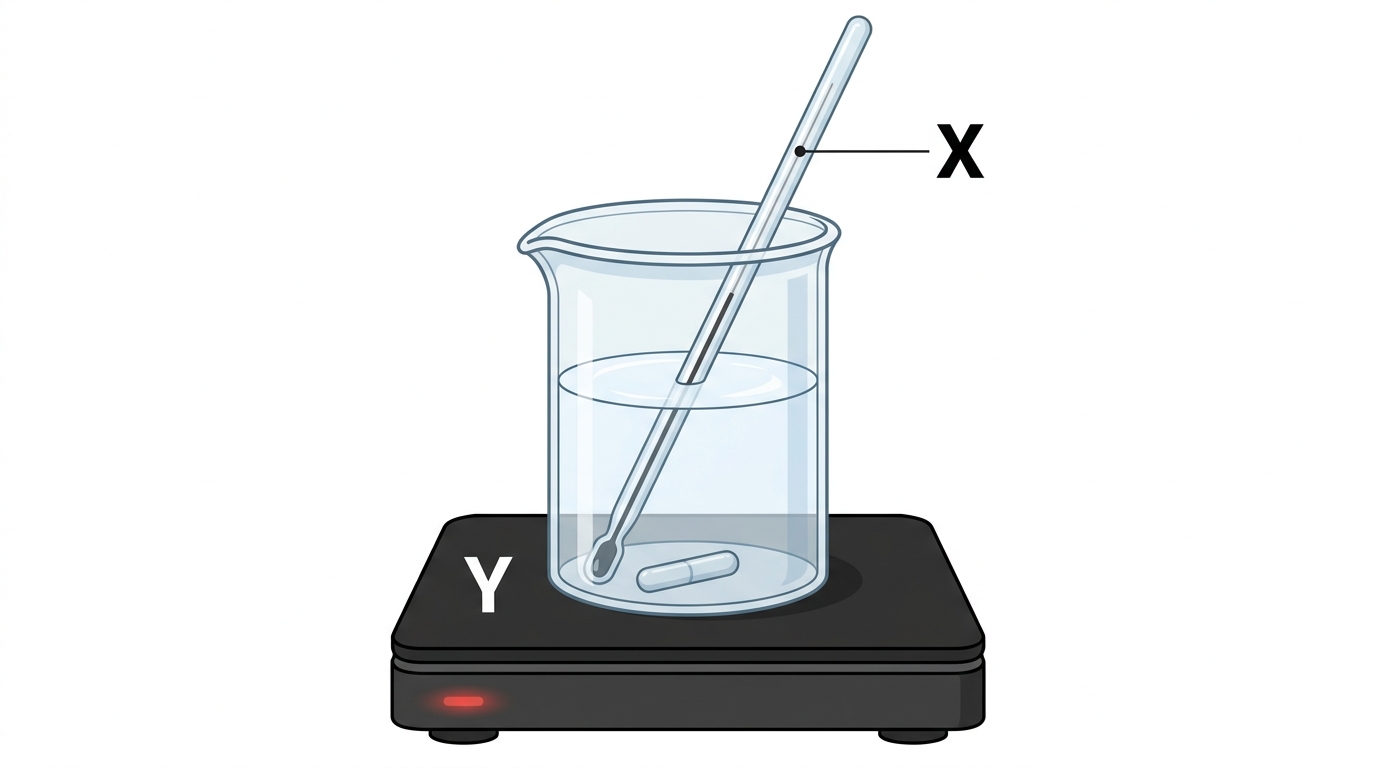
The diagram shows apparatus a student will use to investigate how temperature affects the solubility of potassium nitrate in water.
Question diagram
(a)
Identify apparatus X and apparatus Y. [1]Criterion A (i) · Level 1-2
(b)
State a research question for this investigation. [1]Criterion B (i) · Level 3-4
(c)
Formulate a hypothesis and explain it using scientific reasoning. [2]Criterion B (ii) · Level 5-6
(d)
Identify the independent and dependent variables, and describe how two control variables will be kept constant. [3]

(e) Explain how the student will know that each solution is saturated, and how she will collect sufficient data. [2]
Criterion B (iii) · Level 5-6

revisionprep.com

Summary Answer

Not available for this question.

Model Answer

Not available for this question.

Marking Scheme

Not available for this question.

Examiner Insights

Not available for this question.

Question 6Criterion D + A · Band 3-8 · Challenge · 8 marksrevisionprep.com

Effect of pressure on gas solubility

Deep divers sometimes breathe heliox, a mixture of helium and oxygen, instead of air. The table compares how well the two gases dissolve in blood.

GasVolume dissolved in 1 L of blood at 37 ∘C and 1 atm / cm3nitrogen14.7helium8.7\begin{array}{|l|c|}\hline \text{Gas} & \text{Volume dissolved in 1 L of blood at 37 }{}^{\circ}\text{C and 1 atm / cm}^{3} \\ \hline \text{nitrogen} & \text{14.7} \\ \hline \text{helium} & \text{8.7} \\ \hline\end{array}
(a)
Calculate how many times more soluble in blood nitrogen is than helium. [2]Criterion A (ii) · Level 3-4
(b)
Explain how replacing nitrogen with helium reduces the risk of the bends. [2]Criterion D (i) · Level 5-6
(c)
Discuss two implications of using heliox for deep dives, from different perspectives. [4]Criterion D (ii) · Level 7-8

revisionprep.com

Summary Answer

Not available for this question.

Model Answer

Not available for this question.

Marking Scheme

Not available for this question.

Examiner Insights

Not available for this question.

That's every free question here — 6 of 74.

+68 more questions, plus Mock Papers & Worksheets, are waiting in Premium.

Upgrade