You're viewing free preview questions — 4 questions previewing here — subscribe to unlock 72 more, plus the Full Question Bank, Mock Papers & Worksheets.Upgrade
Solutions, colloids and suspensions — Free MYP5 Chemistry Practice Questions

1QuestionCharacteristics of colloids (Tyndall effect – light scattering)Concept Practice
2 marks~3 minCriterion A
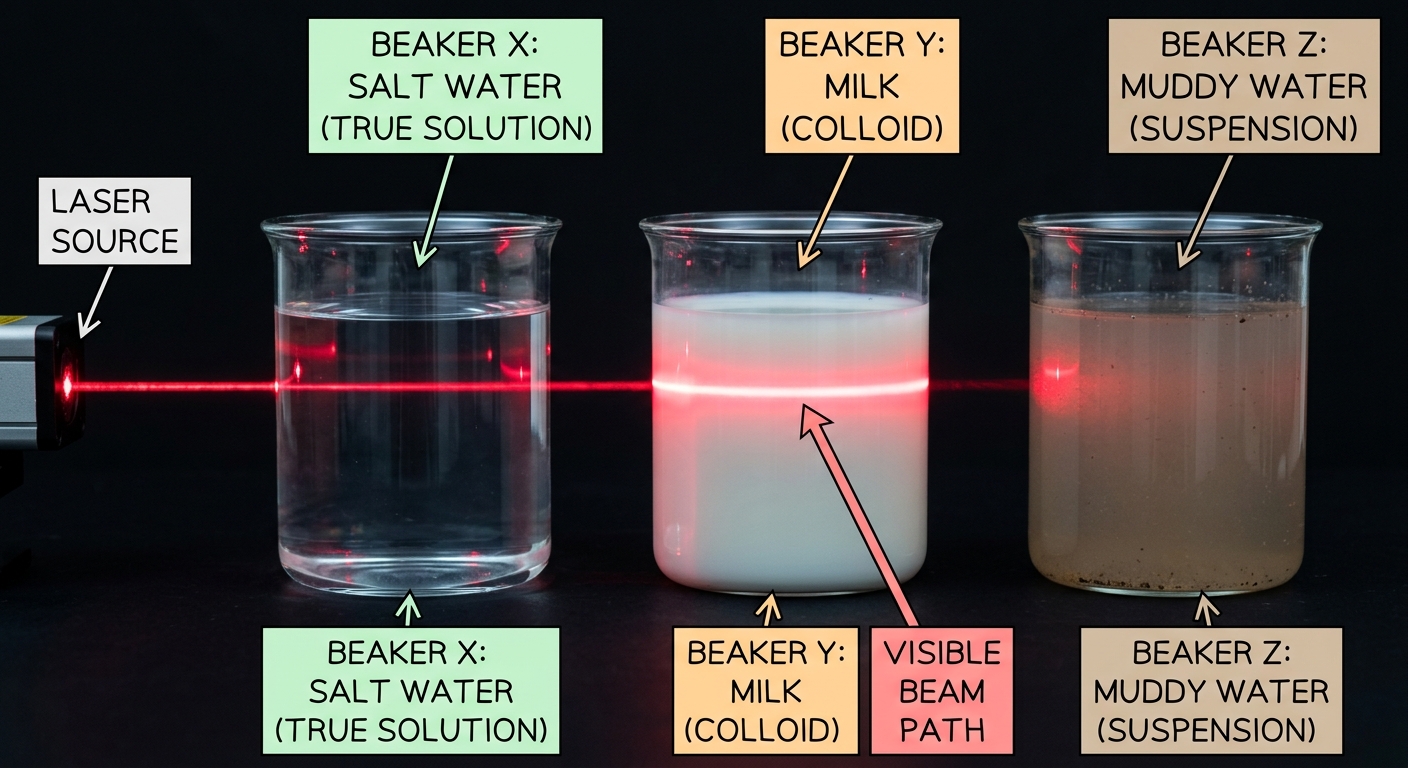
A laser beam is directed through three beakers in sequence.
Beaker X contains salt water (a true solution).
Beaker Y contains milk (a colloid).
Beaker Z contains muddy water (a suspension).
The laser beam is clearly visible as a bright path inside one beaker only.
Beaker X contains salt water (a true solution).
Beaker Y contains milk (a colloid).
Beaker Z contains muddy water (a suspension).
The laser beam is clearly visible as a bright path inside one beaker only.
a
Identify which beaker shows the Tyndall effect and state the name of the optical phenomenon responsible for the visible beam path. [1]
b
Explain why the laser beam is not visibly scattered in Beaker X, even though salt is dissolved in the water. [1]

Solutions
2QuestionCharacteristics of colloids (Tyndall effect – light scattering)Assessment Practice
3 marks~5 minCriterion C
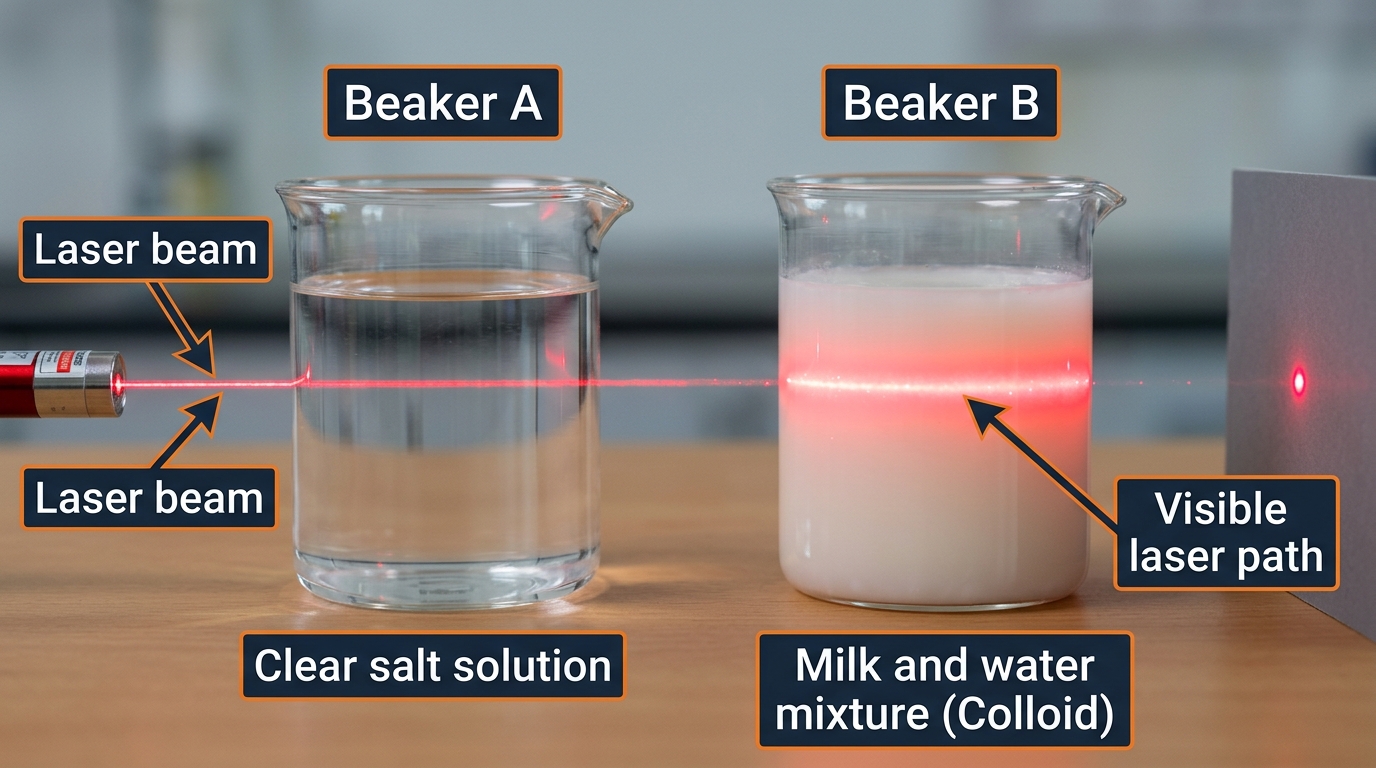
A laser beam is directed through two beakers. Beaker A contains a clear aqueous sodium chloride solution; Beaker B contains a dilute milk–water mixture. The beam is invisible inside Beaker A but traces a bright, visible path through Beaker B.
a
Identify the phenomenon responsible for the visible beam in Beaker B. [1]
b
Explain, with reference to particle size, why the beam is visible in Beaker B but not in Beaker A. [1]
c
A student claims that adding more salt to Beaker A would eventually make the beam visible. Evaluate this claim. [1]
Solutions
3QuestionParticle size differences (solution vs colloid vs suspension)Assessment Practice
6 marks~9 minCriterion B
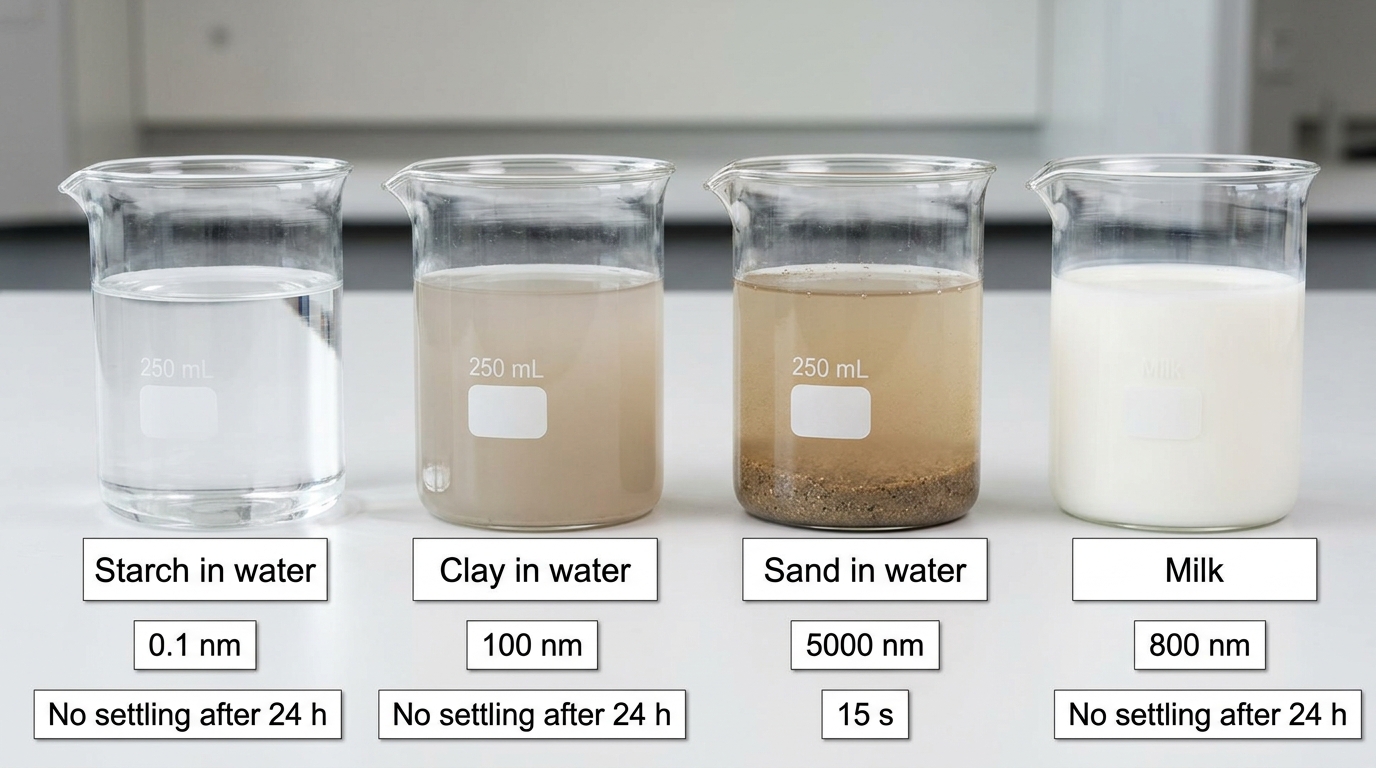
Four mixtures were tested under identical conditions (still water, 20 °C). Results are shown below.
| Mixture — Starch in water | Particle diameter (nm): | Settling: No settling after 24 h |
|---|---|---|
| Mixture — Clay in water | Particle diameter (nm): | Settling: No settling after 24 h |
| Mixture — Sand in water | Particle diameter (nm): | Settling: 15 seconds |
| Mixture — Milk | Particle diameter (nm): | Settling: No settling after 24 h |
a
Classify each mixture as a solution, colloid, or suspension. Justify each classification using both particle diameter and settling behaviour. [2]
b
Deduce a general rule linking particle diameter to mixture type, using the pattern shown in the data above. [2]
c
A student dissolves gelatin in hot water and allows it to cool. The gelatin particles have an average diameter of nm. Evaluate whether this mixture will behave as a solution, colloid, or suspension, and identify one condition that, if changed, could cause the mixture to settle visibly. [2]
Solutions
4QuestionCharacteristics of colloids (Tyndall effect – light scattering)Assessment Practice
6 marks~9 minCriterion D
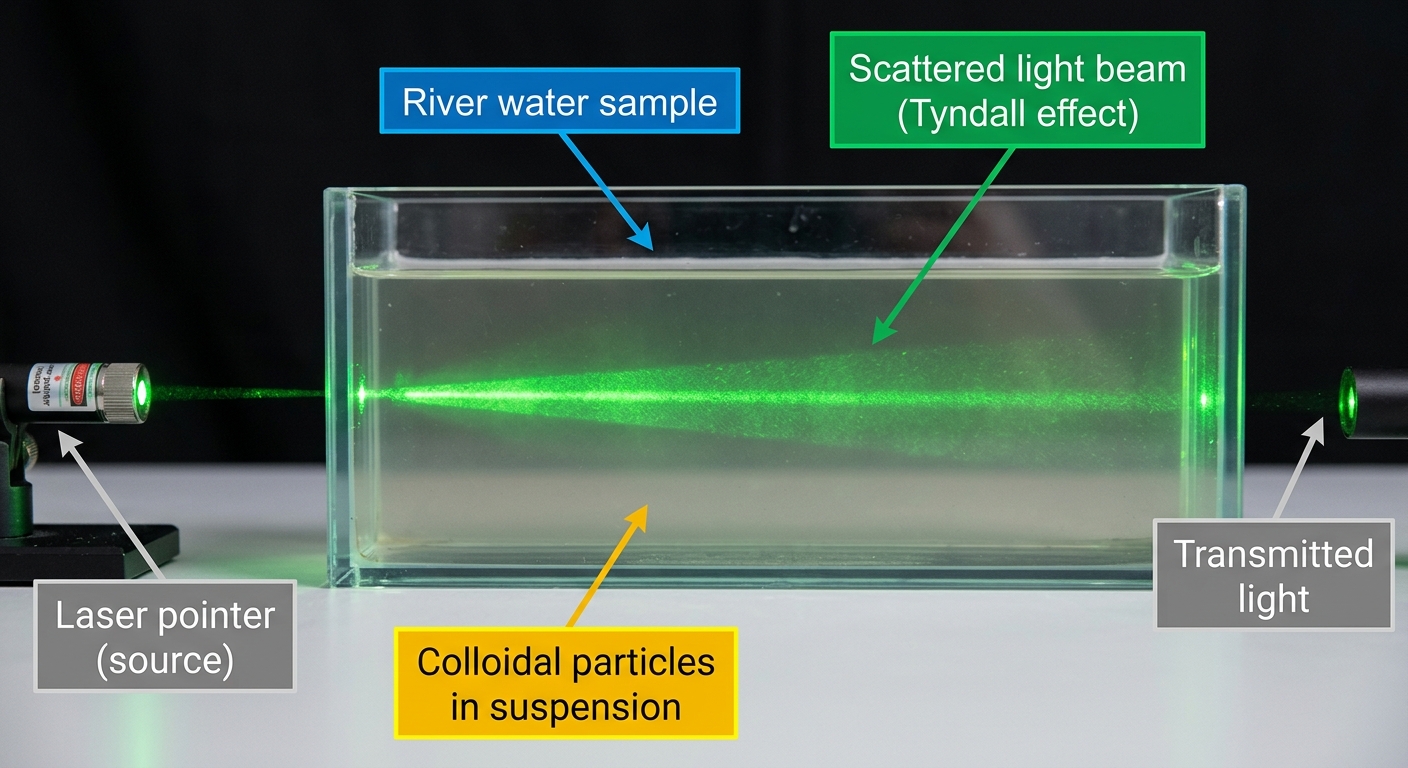
A student shines a green laser pointer through three water samples collected from a local river: one taken upstream of an industrial site, one at the site, and one downstream. A visible beam appears in the at-site and downstream samples but not in the upstream sample.
a
Identify the type of mixture present in the at-site and upstream samples, based on the laser observations. [1]
b
Explain how the presence or absence of a visible laser beam in each sample indicates whether colloidal pollutants are present. [2]
c
Analyse the limitations of using the Tyndall effect alone to determine whether the colloidal particles detected at the industrial site pose a risk to human health. [3]
Solutions
That's every free question here — 4 of 76.
+72 more questions, plus Mock Papers & Worksheets, are waiting in Premium.