You're viewing free preview questions — 4 questions previewing here — subscribe to unlock 73 more, plus the Full Question Bank, Mock Papers & Worksheets.Upgrade
Calculating relative formula mass — Free MYP5 Chemistry Practice Questions

1QuestionConcept of relative atomic mass (Ar) from periodic tableAssessment Practice
2 marks~3 minCriterion D
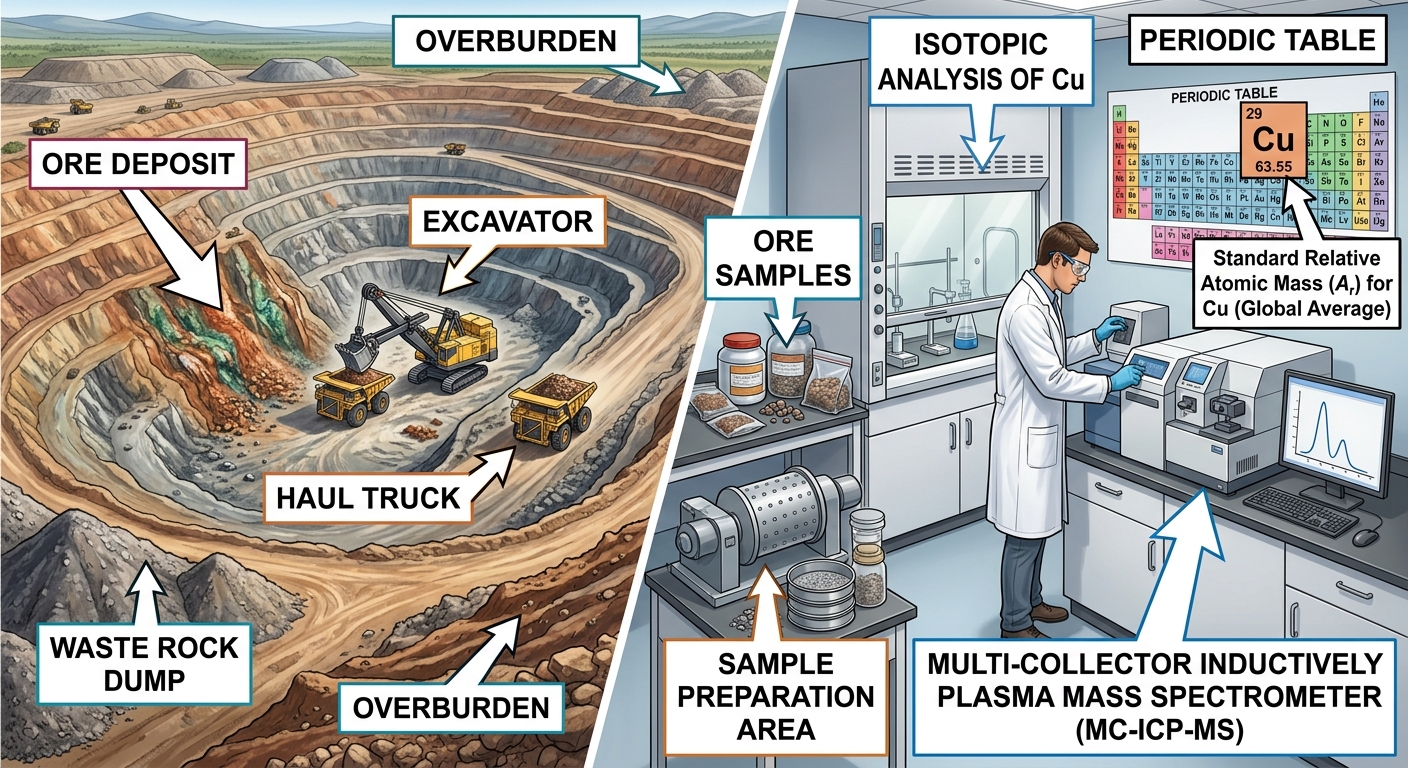
A mining company analyses a copper ore deposit in Chile. The local ore contains a higher proportion of Cu than the global average. The periodic table lists the relative atomic mass of copper as .
a
State what the value represents in terms of copper's two naturally occurring isotopes, Cu and Cu. [1]
b
Explain why using to estimate the mass of copper extractable from this Chilean deposit may lead to an inaccuracy in the mining company's yield calculations. [1]

Solutions
2QuestionMr calculations for ionic vs covalent compoundsAssessment Practice
6 marks~9 minCriterion C
Data
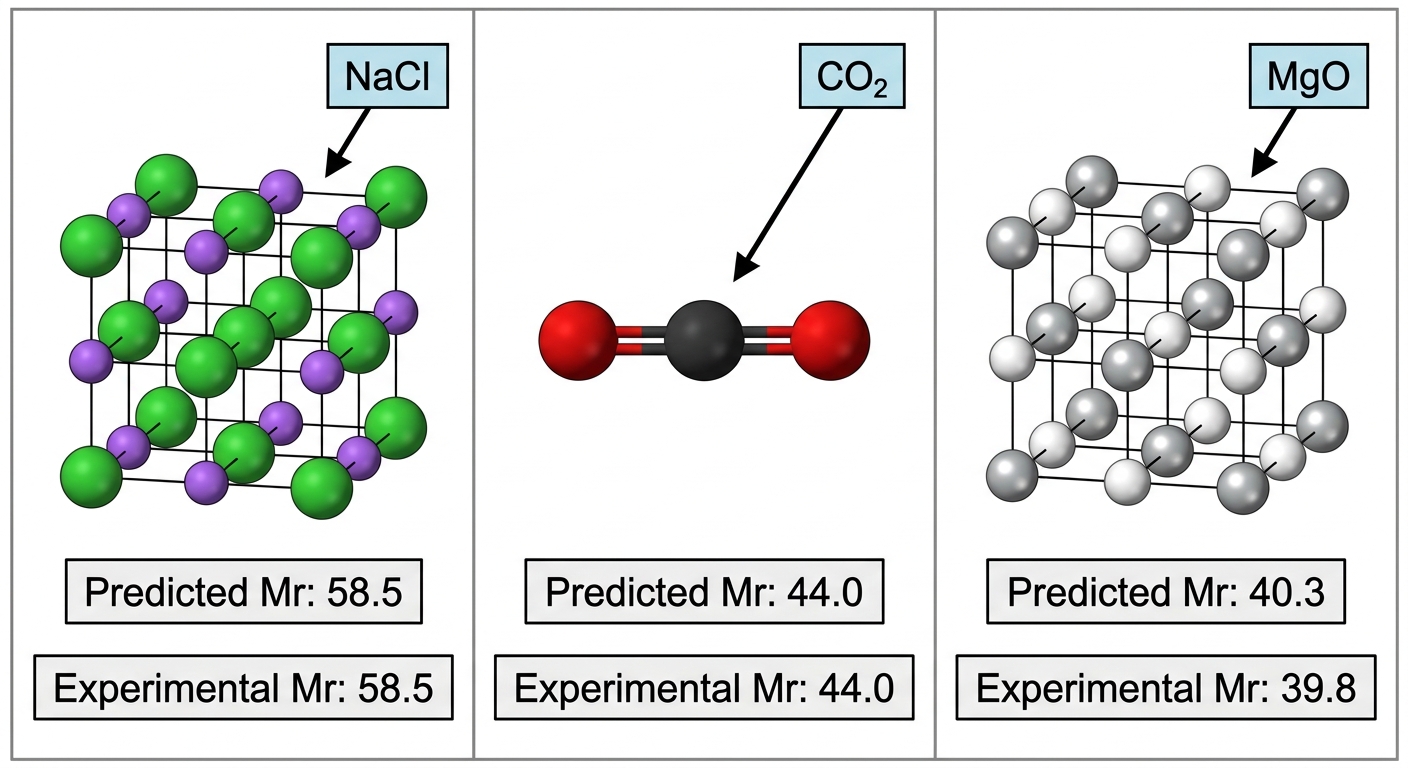
| NaCl — predicted | experimental : | |
|---|---|---|
| — predicted | experimental : | |
| MgO — predicted | experimental : |
A student proposes the hypothesis: "The relative formula mass () calculated from atomic masses is equally accurate for ionic and covalent compounds." Mass spectrometry gives the following
a
Calculate the percentage discrepancy between the predicted and experimental values for MgO. [1]
b
Explain why the experimental values for NaCl and match their predicted values, while MgO shows a discrepancy. [3]
c
Evaluate whether the experimental evidence supports the hypothesis, and justify whether calculations are equally reliable for ionic and covalent compounds. [2]
Solutions
3QuestionMr calculations for ionic vs covalent compoundsAssessment Practice
12 marks~18 minCriterion A
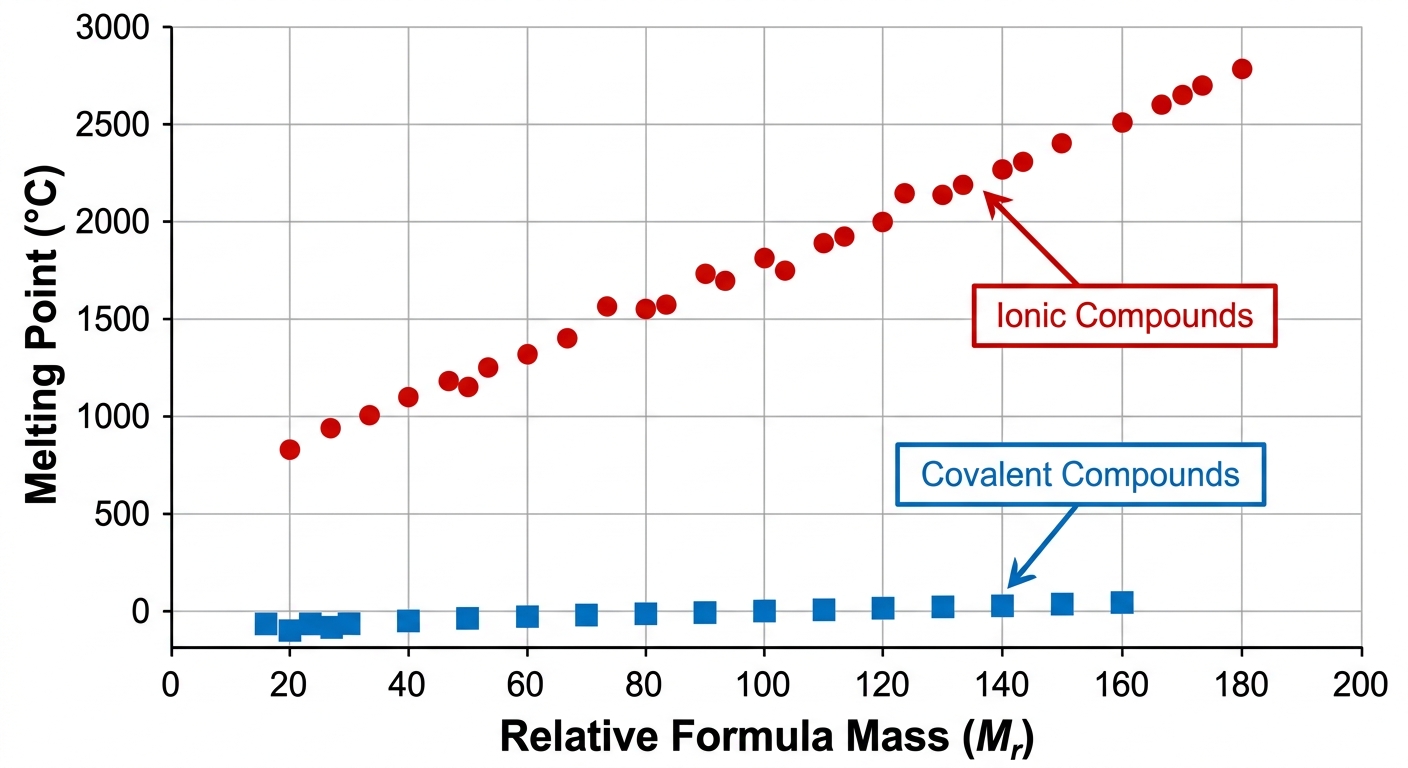
The graph below shows the relationship between relative formula mass () and melting point for a series of ionic and covalent compounds.
a
Describe the trend shown in the graph for ionic compounds and for covalent compounds. [2]
b
The of magnesium oxide (MgO) is 40 g/mol and the of carbon dioxide (CO2) is 44 g/mol. Justify which compound has the higher melting point, referring to bonding and structure. [4]
c
Consider the two reactions below.
Evaluate which reaction is more likely to proceed at room temperature. In your answer, refer to the trend identified in part (a), the nature of the ionic lattice in MgO, and the concept of lattice energy. [6]
Evaluate which reaction is more likely to proceed at room temperature. In your answer, refer to the trend identified in part (a), the nature of the ionic lattice in MgO, and the concept of lattice energy. [6]
Solutions
4QuestionMr calculations for ionic vs covalent compoundsAssessment Practice
3 marks~5 minCriterion B
Four ionic compounds are listed below.
| Compound | NaCl | MgO | CaCl | AlO |
|---|---|---|---|---|
| 58.5 | 40.3 | 111 | 102 | |
| Melting point (°C) | 801 | 2852 | 772 | 2072 |
a
Deduce whether a linear relationship exists between and melting point, using two specific examples from the data. [1]
b
Explain why melting point in ionic compounds depends on ionic charge and ionic radius rather than . [1]
c
Analyse why MgO (melting point 2852°C) has a significantly higher melting point than CaCl (melting point 772°C), despite CaCl having a much larger . [1]
Solutions
That's every free question here — 4 of 77.
+73 more questions, plus Mock Papers & Worksheets, are waiting in Premium.