You're viewing free preview questions — 4 questions previewing here — subscribe to unlock 61 more, plus the Full Question Bank, Mock Papers & Worksheets.Upgrade
Concentration of Solutions — Free MYP5 Chemistry Practice Questions

1QuestionDilution concept and simple dilution calculationsConcept Practice
2 marks~3 minCriterion A
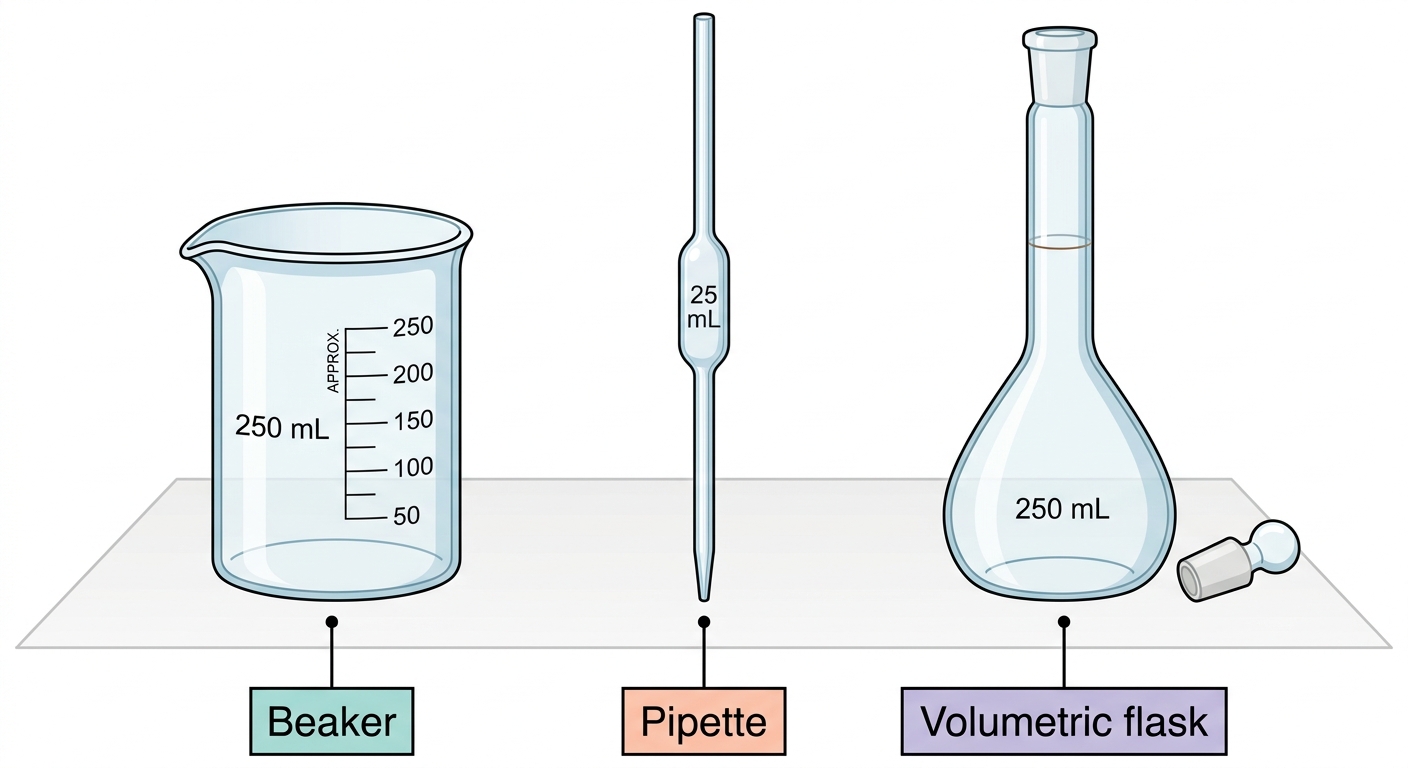
Three pieces of laboratory glassware are shown in the diagram: a beaker, a pipette, and a volumetric flask.
a
Identify the volumetric flask from the diagram. [1]
b
Explain why the volumetric flask, rather than the beaker, is used to prepare a diluted solution of precisely known concentration. [1]

Solutions
2QuestionCalculating moles from concentration and volumeAssessment Practice
4 marks~6 minCriterion D
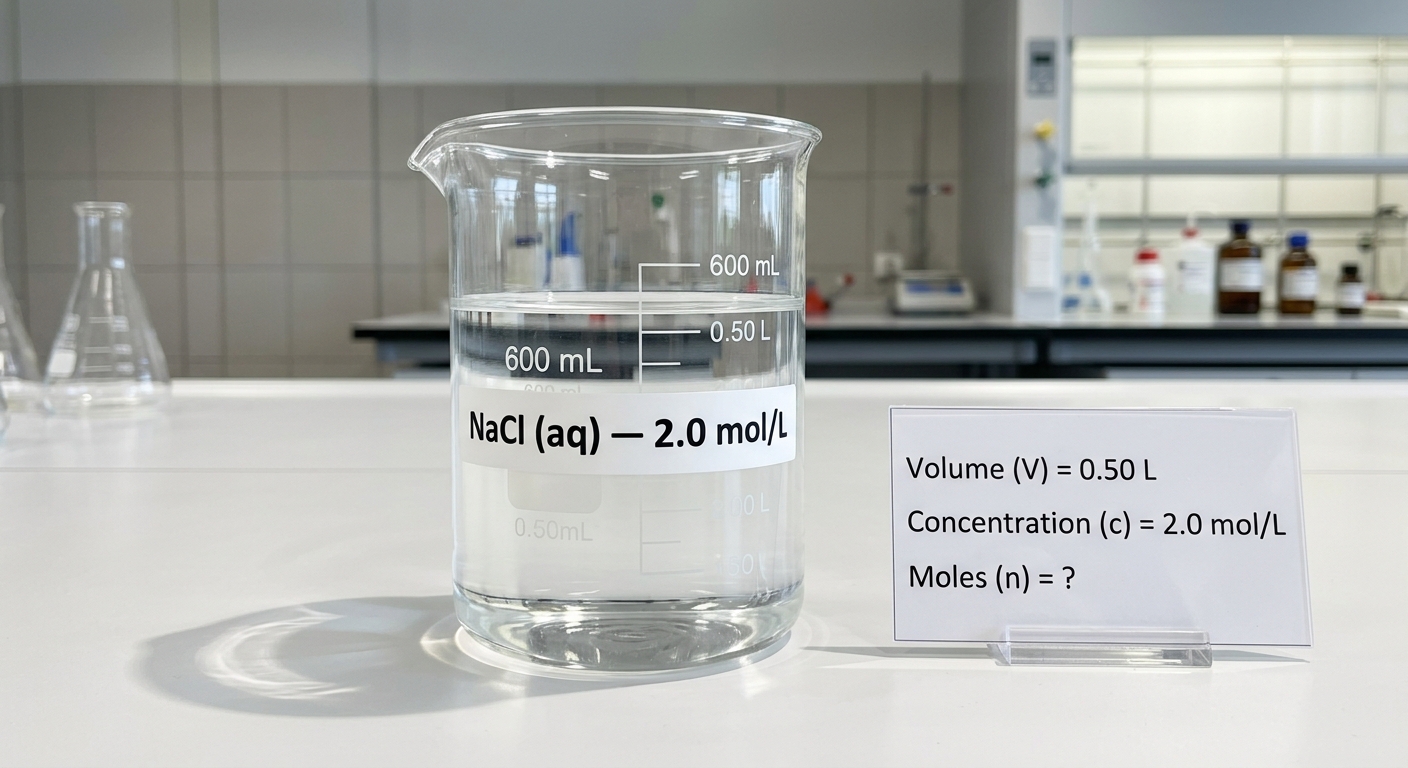
A technician prepares a saline drip solution for a hospital ward. The solution contains sodium chloride (NaCl) dissolved in water. The volume of the solution is and its concentration is .
a
Calculate the number of moles of NaCl in the solution using . [1]
b
A second bag contains of a NaCl solution with the same concentration. Deduce the total moles of NaCl across both bags. [1]
c
The recommended maximum daily intake of NaCl is . Evaluate whether the combined NaCl from both bags poses a health concern, justifying your answer with a calculation. [2]
Solutions
3QuestionDefinition of concentration (mol/dm³ or g/dm³)Assessment Practice
5 marks~8 minCriterion C
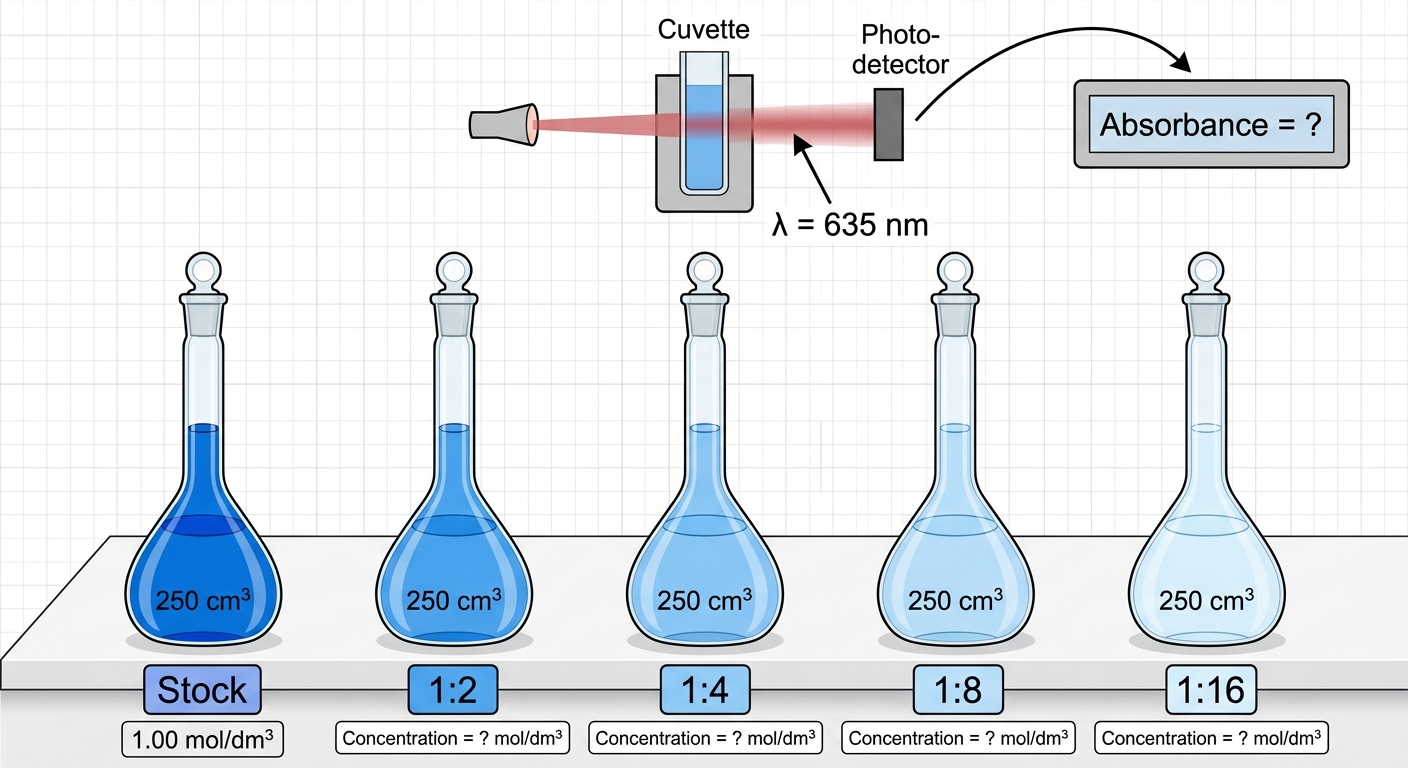
A student prepares five copper(II) sulfate () solutions by serial dilution of a stock solution. Absorbance is measured at .
| Concentration () | |||||
|---|---|---|---|---|---|
| Absorbance |
a
Calculate the expected absorbance for each diluted solution, assuming absorbance is directly proportional to concentration. [2]
b
Identify the anomalous data point and explain, using the definition of concentration in , why the measured absorbance indicates the actual concentration differs from the intended value. [2]
c
Evaluate whether the anomaly is more likely caused by an error in volume measurement or mass measurement during the dilution, justifying your reasoning. [1]
Solutions
4QuestionDilution concept and simple dilution calculationsAssessment Practice
3 marks~5 minCriterion B
A student dilutes 10 cm³ of a 1.0 mol dm⁻³ copper(II) sulfate solution by adding distilled water to reach four different final volumes.
| Final volume (cm³) | 20 | 40 | 60 | 80 |
|---|---|---|---|---|
| Concentration (mol dm⁻³) | 0.50 | 0.25 | 0.17 | 0.13 |
a
Calculate the number of moles of copper(II) sulfate present in the original 10 cm³ sample. [1]
b
Explain why the concentration decreases as the final volume increases. [1]
c
A student claims that doubling the final volume always halves the concentration. Evaluate this claim using the data provided. [1]
Solutions
That's every free question here — 4 of 65.
+61 more questions, plus Mock Papers & Worksheets, are waiting in Premium.