You're viewing free preview questions — 4 questions previewing here — subscribe to unlock 66 more, plus the Full Question Bank, Mock Papers & Worksheets.Upgrade
Moles, mass and molar relationships — Free MYP5 Chemistry Practice Questions

1QuestionMole ratios from balanced chemical equationsConcept Practice
2 marks~3 minCriterion A
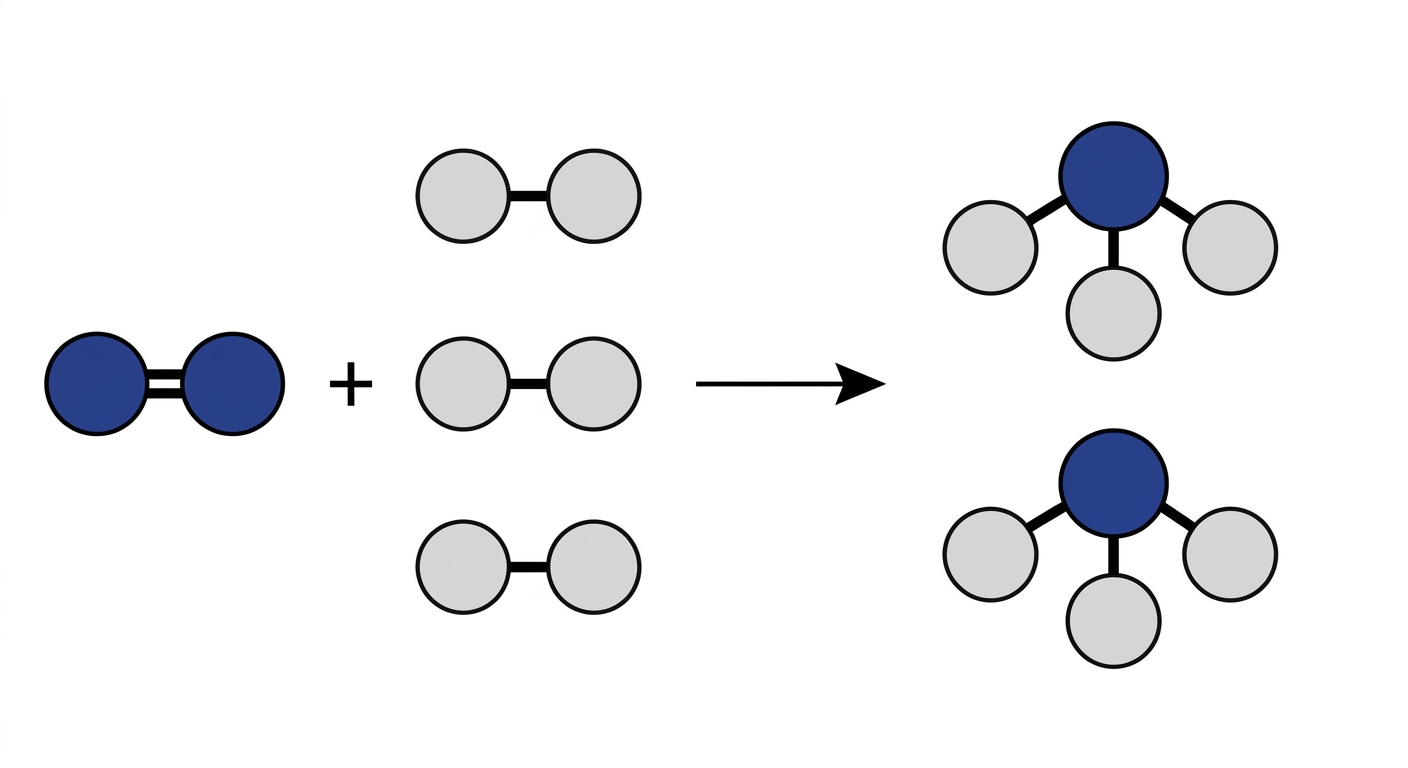
The Haber process synthesises ammonia according to the following balanced equation:
Industrial plants use this reaction continuously, so precise mole ratios determine how much of each reactant is fed into the reactor.
Industrial plants use this reaction continuously, so precise mole ratios determine how much of each reactant is fed into the reactor.
a
State the mole ratio of to in this reaction. [1]
b
A reactor is supplied with 12 mol of . Deduce the maximum number of moles of that can be produced, assuming is in excess. [1]

Solutions
2QuestionMole ratios from balanced chemical equationsAssessment Practice
8 marks~12 minCriterion D
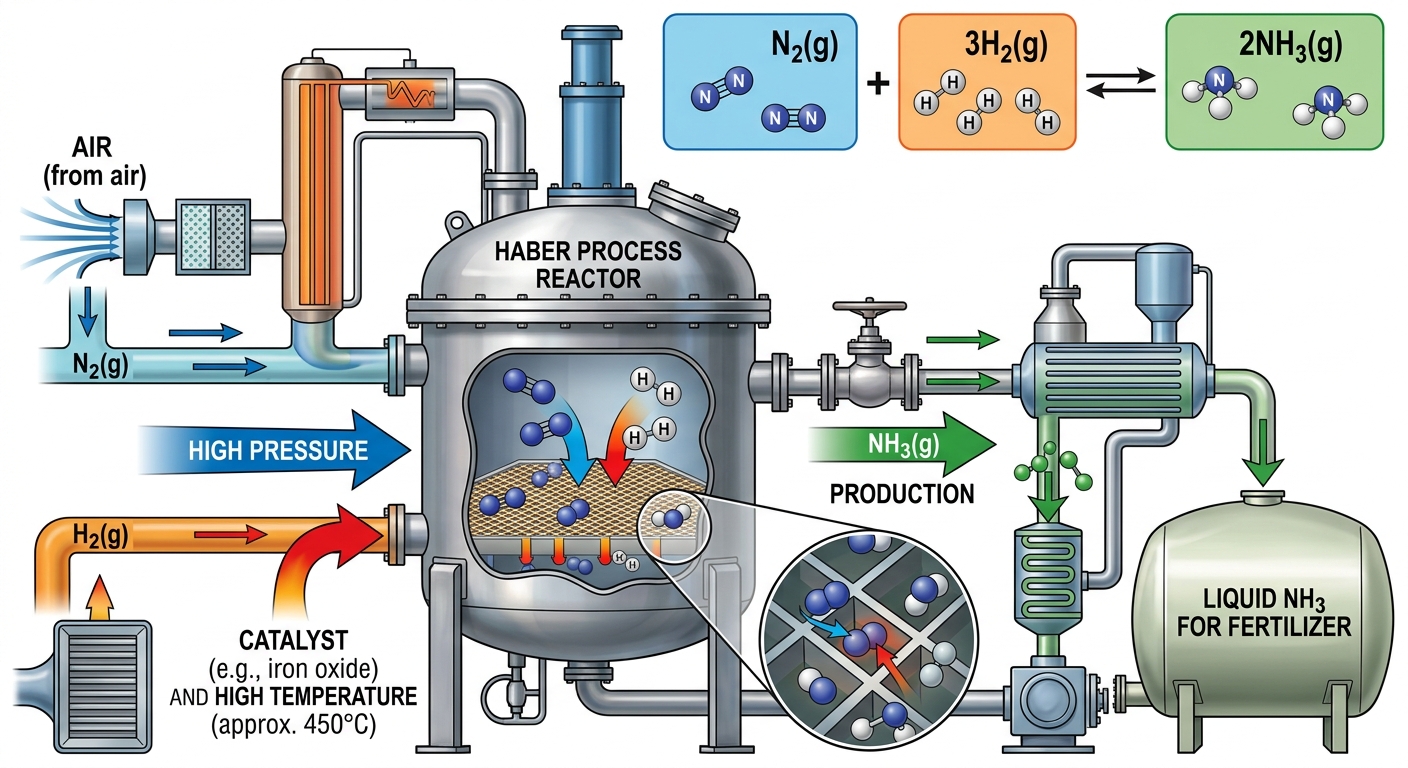
The Haber-Bosch process synthesises ammonia () for agricultural fertilizers:
For every mole of produced, approximately 0.5 mol of methane () is consumed to generate hydrogen, releasing 1.2 kg of . A farmer requires 340 kg of per hectare per year for optimal crop yields. Molar mass of = 17 g mol.
For every mole of produced, approximately 0.5 mol of methane () is consumed to generate hydrogen, releasing 1.2 kg of . A farmer requires 340 kg of per hectare per year for optimal crop yields. Molar mass of = 17 g mol.
a
Calculate the minimum moles of required to produce 340 kg of . [2]
b
Deduce the total emissions (in kg) from producing this quantity of . [2]
c
Evaluate the societal and environmental trade-offs of using the Haber-Bosch process for fertilizer production, using your calculated data to support your conclusion. [4]
Solutions
3QuestionInterpreting coefficients in chemical equationsConcept Practice
2 marks~3 minCriterion C
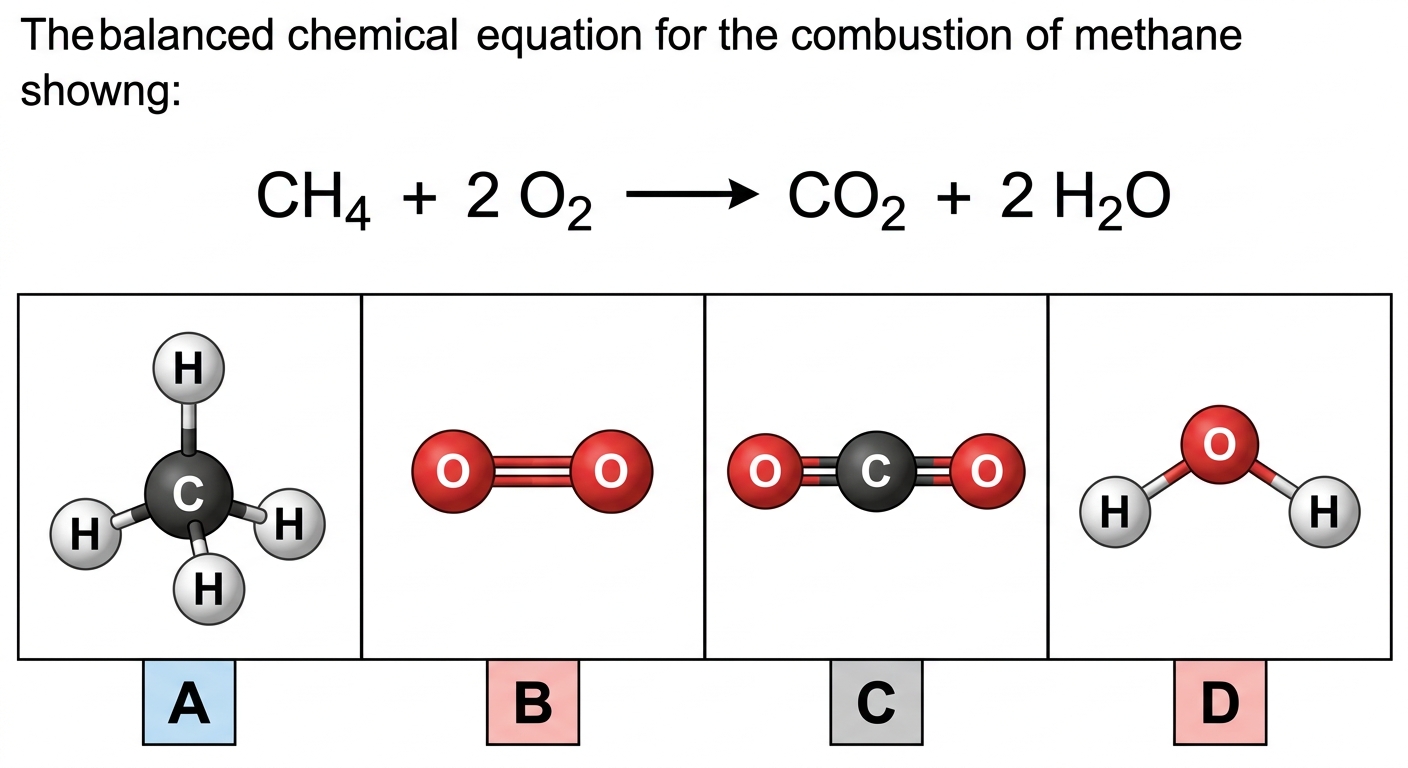
The combustion of methane is represented by the equation:
The molecular models below show the four species involved, each labelled A–D. In these models, carbon atoms are black, oxygen atoms are red, and hydrogen atoms are white.
(a) Deduce which labelled molecule represents water (), and justify your answer by referring to both the molecular formula of water and the balanced equation. [2]
The molecular models below show the four species involved, each labelled A–D. In these models, carbon atoms are black, oxygen atoms are red, and hydrogen atoms are white.
(a) Deduce which labelled molecule represents water (), and justify your answer by referring to both the molecular formula of water and the balanced equation. [2]
Solutions
4QuestionUsing formula: moles = mass ÷ molar massConcept Practice
2 marks~3 minCriterion B
The table below shows the first five straight-chain alkanes and their molar masses.
| Alkane | Methane | Ethane | Propane | Butane | Pentane |
|---|---|---|---|---|---|
| Molecular formula | |||||
| Molar mass (g/mol) | 16 | 30 | 44 | 58 | 72 |
a
Deduce the molar mass of hexane, , without a periodic table, showing your reasoning. [1]
b
Explain why each successive alkane in this series has a molar mass exactly 14 g/mol greater than the previous one. [1]
Solutions
That's every free question here — 4 of 70.
+66 more questions, plus Mock Papers & Worksheets, are waiting in Premium.