You're viewing free preview questions — 4 questions previewing here — subscribe to unlock 55 more, plus the Full Question Bank, Mock Papers & Worksheets.Upgrade
Reacting mass calculations and limiting reagents — Free MYP5 Chemistry Practice Questions

1QuestionExcess reagent conceptConcept Practice
2 marks~3 minCriterion C
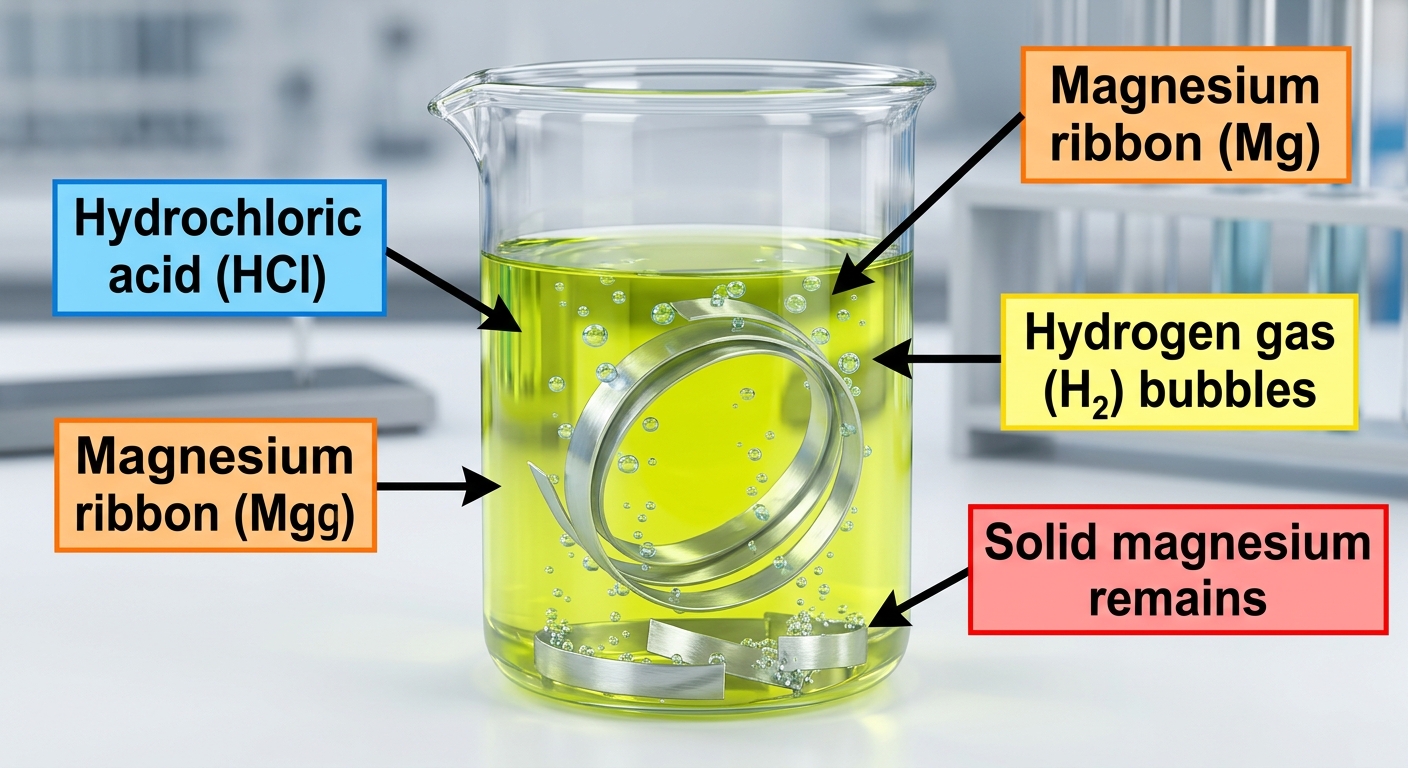
A student reacts magnesium ribbon () with hydrochloric acid () in a beaker. The balanced equation is:
After the reaction is complete, solid magnesium is still visible at the bottom of the beaker.
After the reaction is complete, solid magnesium is still visible at the bottom of the beaker.
a
Identify the excess reagent in this reaction. [1]
b
Deduce which reagent was completely consumed, and explain how the observation described in the stem supports this conclusion. [1]

Solutions
2QuestionUsing balanced equations for mass calculationsAssessment Practice
3 marks~5 minCriterion A
A student investigates the reaction between calcium carbonate () and hydrochloric acid (). She adds excess to 50 cm³ of 1.0 mol dm in a flask on a balance. Carbon dioxide () escapes as it forms, causing a measurable mass loss. The graph shows mass loss rising steeply from 0 g, then levelling off at approximately 2.2 g after 150 seconds.
a
Describe the change in reaction rate shown by the graph. [1]
b
Identify the limiting reagent and explain why it controls the total mass of produced. [1]
c
Explain how the consumption of the limiting reagent causes the rate to decrease and eventually reach zero. [1]
Solutions
3QuestionUsing balanced equations for mass calculationsConcept Practice
3 marks~5 minCriterion B
Three combustion reactions are carried out in sealed (closed) containers.
Reaction A:
Reactants: 80.0 g — Products: 80.0 g
Reaction B:
Reactants: 142.0 g — Products: 142.0 g
Reaction C:
Reactants: 204.0 g — Products: 204.0 g
Reaction A:
Reactants: 80.0 g — Products: 80.0 g
Reaction B:
Reactants: 142.0 g — Products: 142.0 g
Reaction C:
Reactants: 204.0 g — Products: 204.0 g
a
State the total mass of products in Reaction B. [1]
b
Identify the pattern shown by the mass data across all three reactions. [1]
c
Analyse why conducting these reactions in a closed system is essential for the pattern in (b) to be observed experimentally. [1]
Solutions
4QuestionUsing balanced equations for mass calculationsAssessment Practice
8 marks~12 minCriterion D
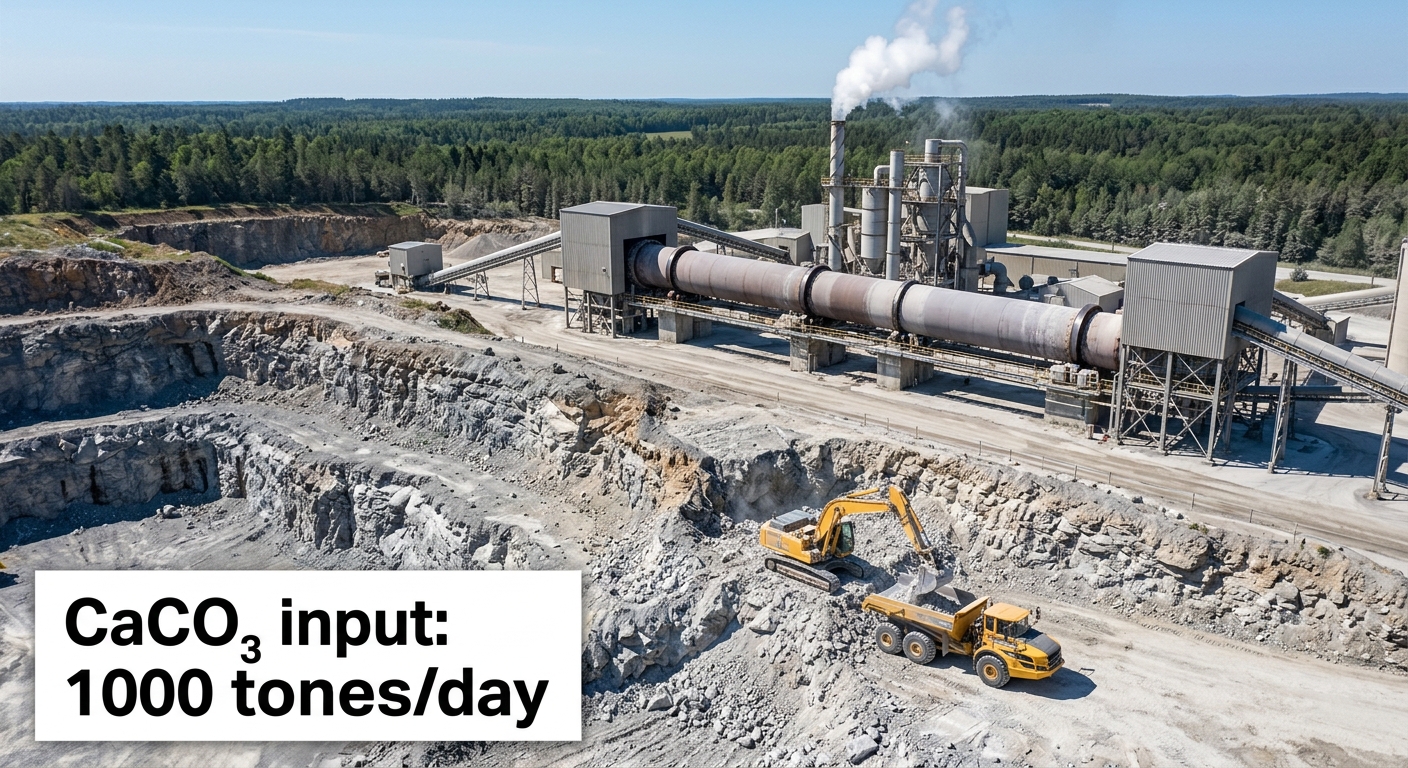
A cement plant thermally decomposes calcium carbonate () from a limestone quarry according to:
The plant processes 1000 tonnes of per day (assumed 100% pure, complete reaction). The quarry provides 200 local jobs and improved infrastructure but destroys a 5-hectare forest and releases .
Molar masses: g/mol, g/mol, g/mol.
The plant processes 1000 tonnes of per day (assumed 100% pure, complete reaction). The quarry provides 200 local jobs and improved infrastructure but destroys a 5-hectare forest and releases .
Molar masses: g/mol, g/mol, g/mol.
a
Calculate the mass of , in tonnes, released per day. [2]
b
The plant introduces carbon capture technology, reducing emissions by 90%. Deduce the mass of still released per day, and explain why the actual total emissions from the plant are likely higher than this value. [3]
c
Evaluate whether the economic and environmental trade-offs of this quarry and cement plant make it sustainable overall. In your answer, discuss the assumptions in the stoichiometric model and how they affect the reliability of the calculated emissions figure. [3]
Solutions
That's every free question here — 4 of 59.
+55 more questions, plus Mock Papers & Worksheets, are waiting in Premium.