You're viewing free preview questions — 4 questions previewing here — subscribe to unlock 87 more, plus the Full Question Bank, Mock Papers & Worksheets.Upgrade
The Mole Concept and Avogaro's constant — Free MYP5 Chemistry Practice Questions

1QuestionConverting between moles and number of particles (atoms, molecules, ions)Concept Practice
2 marks~3 minCriterion A
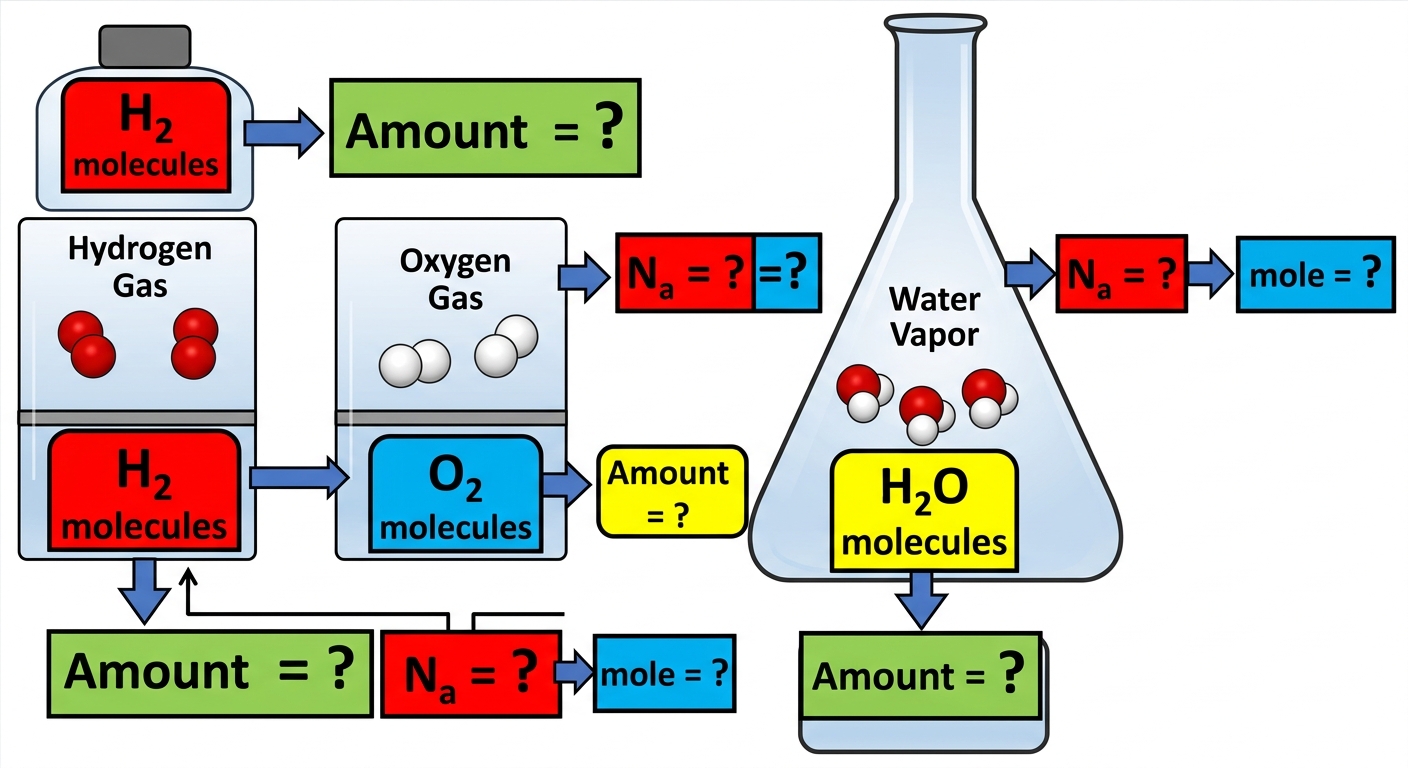
Hydrogen gas reacts with oxygen gas to produce water vapour in a combustion reaction studied in industrial fuel-cell technology.
a
Construct the balanced chemical equation for this reaction, including state symbols. [1]
b
Explain how Avogadro's constant connects the number of water molecules produced to the amount of water in moles. [1]

Solutions
2QuestionRelationship between molar mass and one mole of substanceAssessment Practice
4 marks~6 minCriterion C
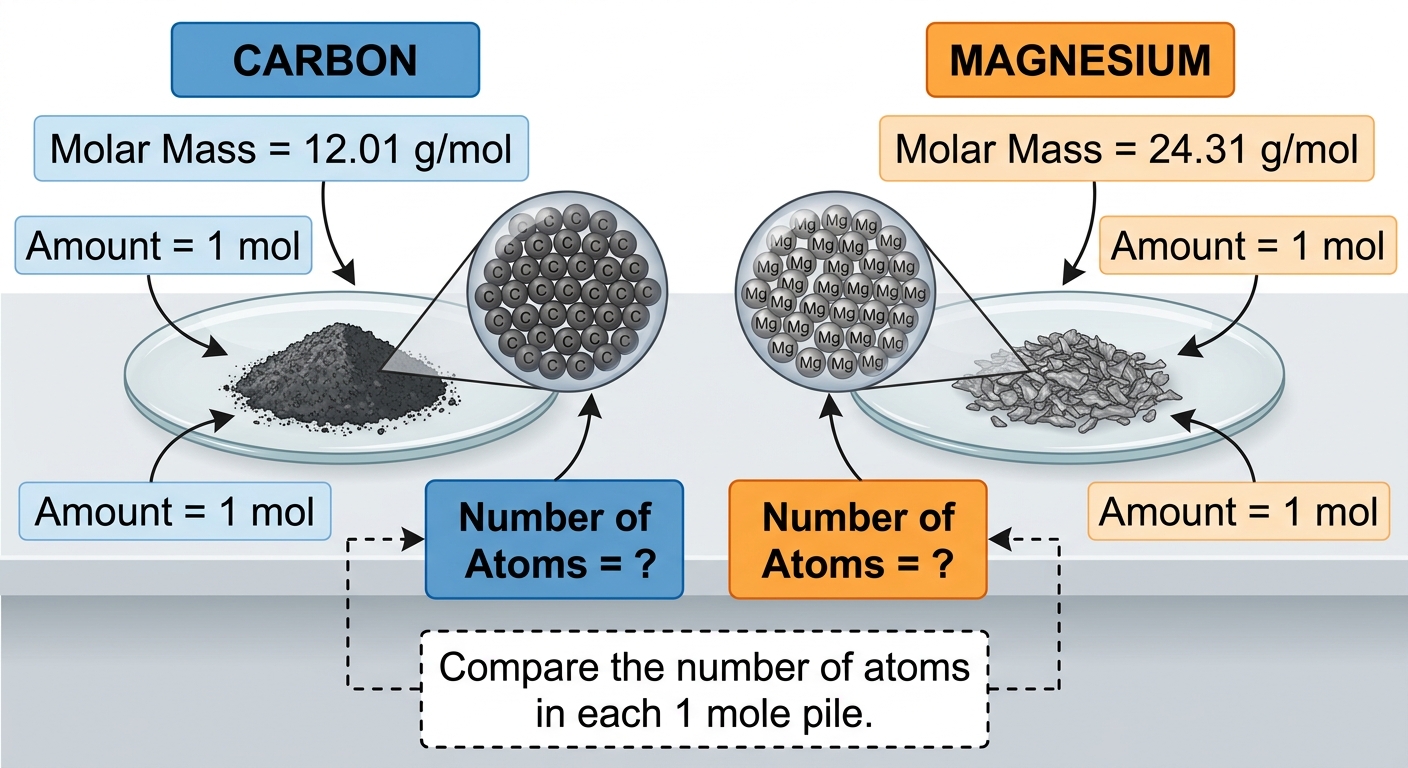
A laboratory balance shows two separate samples: one pile of 1 mole of carbon atoms (molar mass ) and one pile of 1 mole of magnesium atoms (molar mass ).
a
State the number of atoms present in each pile and identify the constant this number represents. [1]
b
Explain why the two piles contain equal numbers of atoms despite having different masses. [2]
c
A student claims: "Because magnesium atoms are heavier, 1 mole of magnesium must contain more atoms than 1 mole of carbon." Evaluate this claim. [1]
Solutions
3QuestionDefinition of a mole and amount of substanceConcept Practice
3 marks~5 minCriterion B
The table below shows data for one mole of four substances.
Substance — Mass of one mole (g) — Number of particles
Carbon (C) — 12.0 —
Water (HO) — 18.0 —
Sodium chloride (NaCl) — 58.5 —
Oxygen (O) — 32.0 —
Substance — Mass of one mole (g) — Number of particles
Carbon (C) — 12.0 —
Water (HO) — 18.0 —
Sodium chloride (NaCl) — 58.5 —
Oxygen (O) — 32.0 —
a
State what the data shows about the number of particles present in one mole of each substance. [1]
b
Identify the pattern in molar mass shown by the four substances. [1]
c
Explain what the relationship between molar mass and number of particles reveals about the definition of a mole. [1]
Solutions
4QuestionRelationship between molar mass and one mole of substanceAssessment Practice
8 marks~12 minCriterion D
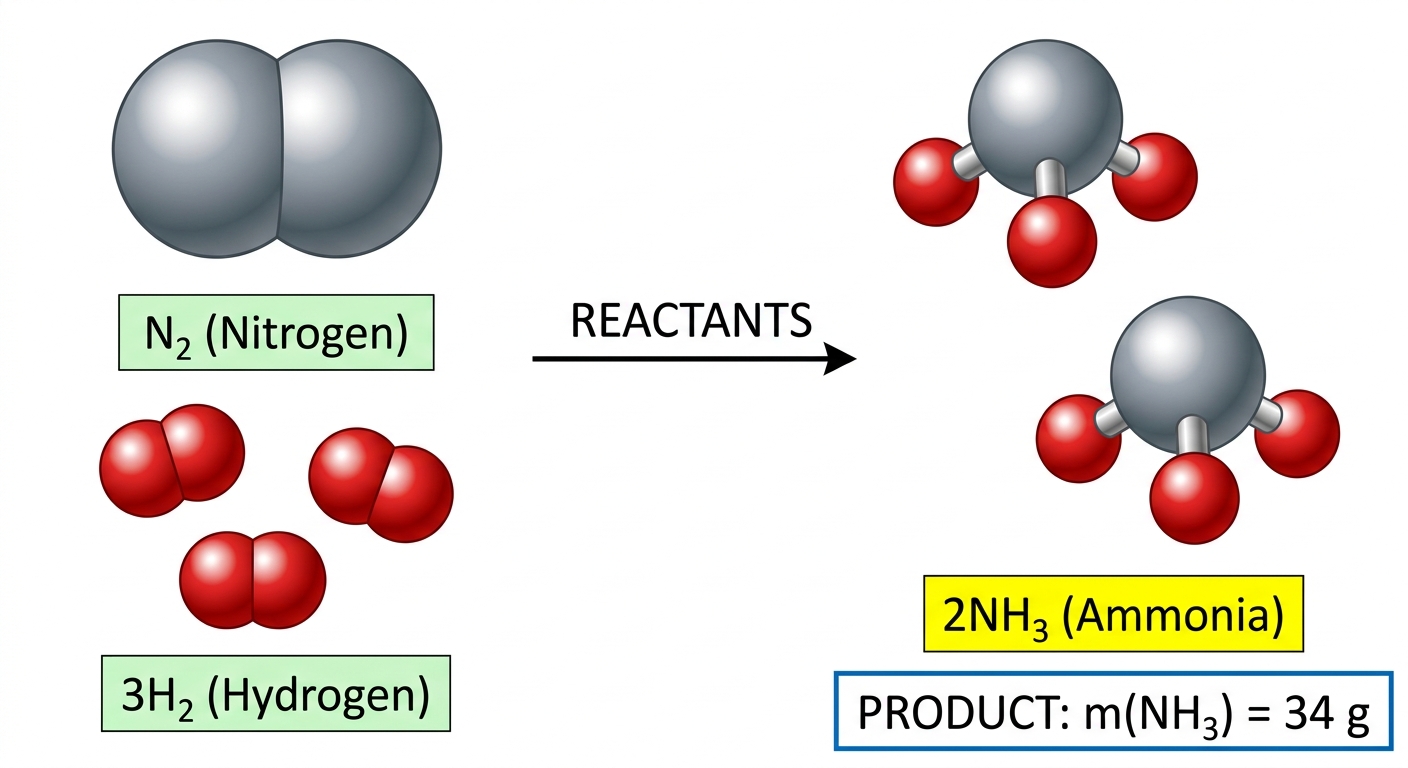
The Haber-Bosch process produces ammonia (NH3) for fertilisers:
Molar masses: N2 = 28 g/mol, H2 = 2 g/mol, NH3 = 17 g/mol.
Global ammonia production relies on hydrogen derived from natural gas, generating approximately 1.9 tonnes of CO2 per tonne of NH3 produced.
Molar masses: N2 = 28 g/mol, H2 = 2 g/mol, NH3 = 17 g/mol.
Global ammonia production relies on hydrogen derived from natural gas, generating approximately 1.9 tonnes of CO2 per tonne of NH3 produced.
a
Calculate the total mass of reactants needed to produce 34 g of NH3, and calculate the mass efficiency, defined as:
[2]
[2]
b
Evaluate the societal benefits of the Haber-Bosch process against its environmental costs, using the CO2 emission data provided. [3]
c
Discuss the limitations of using molar mass and mass efficiency as the sole indicators of the sustainability of the Haber-Bosch process, identifying additional factors that should be considered. [3]
Solutions
That's every free question here — 4 of 91.
+87 more questions, plus Mock Papers & Worksheets, are waiting in Premium.