You're viewing free preview questions — 4 questions previewing here — subscribe to unlock 62 more, plus the Full Question Bank, Mock Papers & Worksheets.Upgrade
Exponents Powers and Roots — Free MYP5 Mathematics (Extended) Practice Questions

1QuestionLaws of Exponents for Integer PowersAssessment Practice
6 marks~9 minCriterion D
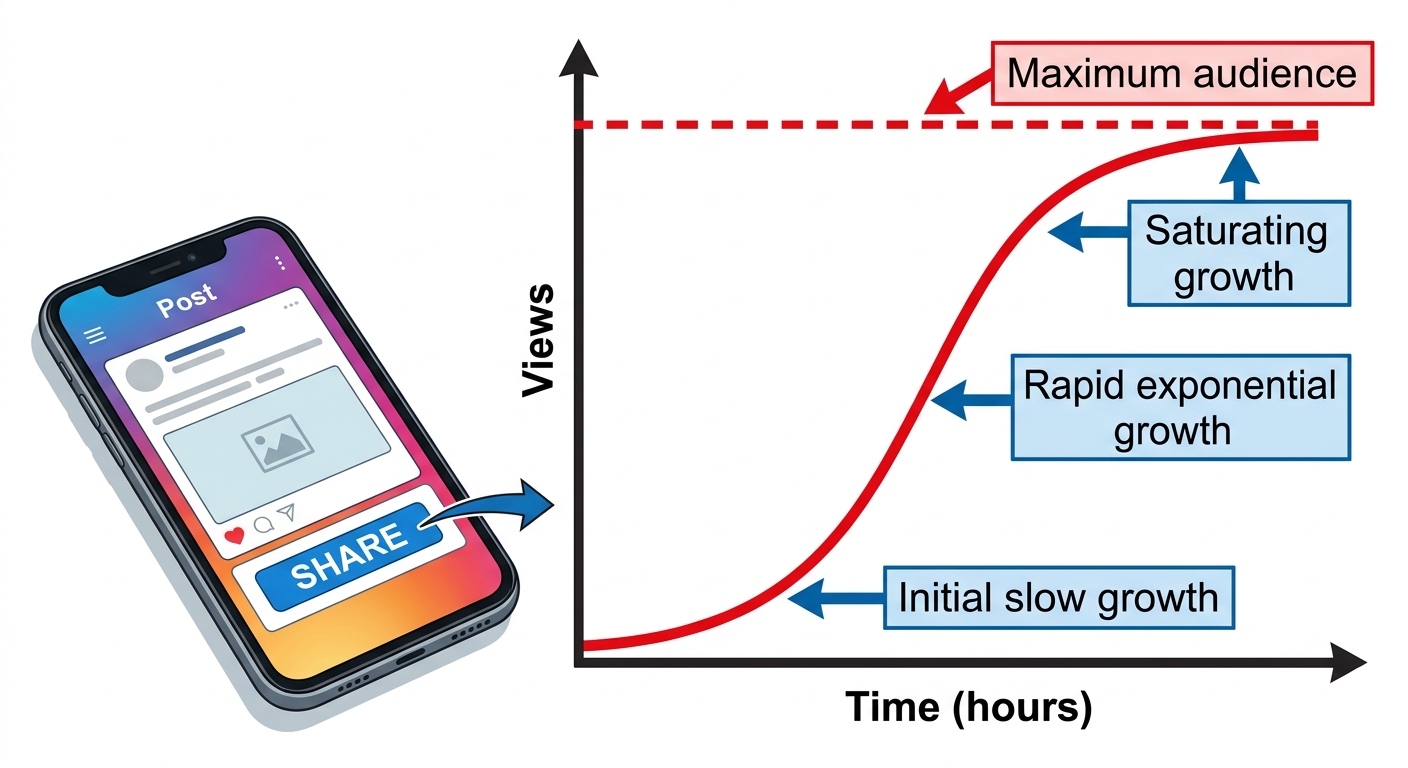
A viral social media post is shared. The number of views after hours is modelled by
A content creator claims the post will exceed 40 000 views within the first 4 hours.
A content creator claims the post will exceed 40 000 views within the first 4 hours.
a
Show that , applying the laws of exponents in your working. [2]
b
Discuss two real-world limitations that could cause the actual number of views to differ from the value predicted by this model. [2]
c
The creator uses to conclude the post is "growing without limit" and plans to scale up advertising spend indefinitely. Advise the creator whether this conclusion is justified, and suggest one mathematical modification to the model that better reflects real sharing behaviour. [2]

Solutions
2QuestionLaws of Exponents for Integer PowersAssessment Practice
3 marks~5 minCriterion B
The intensity of light decreases as it travels from a source. A photographer measures the relative intensity of a lamp at several distances.
Distance (m):
Relative intensity:
Distance (m):
Relative intensity:
a
Express each relative intensity as a power of 2. [1]
b
Express each distance as a power of 2, then deduce the relationship between the exponent of the distance and the exponent of the relative intensity. [1]
c
A subject is positioned 32 m from the lamp. The photographer requires a relative intensity of at least for a usable photograph. Using laws of exponents, calculate the relative intensity at 32 m and advise the photographer whether the subject should be moved closer. [1]
Solutions
3QuestionLaws of Exponents for Integer PowersAssessment Practice
4 marks~6 minCriterion C
A biologist models two bacterial populations. Population A grows according to , where is the population size (thousands) and is time in hours. Population B decays and is modelled by .
a
Show that , stating the law of exponents used. [1]
b
Describe the geometric transformation that maps the graph of onto the graph of , explaining how the change in exponent produces this transformation. [2]
c
At hours, Population A has reached 8 thousand. Calculate the size of Population B at the same time, then justify whether this value is a realistic prediction for a decaying bacterial culture. [1]
Solutions
4QuestionSimplifying Expressions with ExponentsAssessment Practice
6 marks~9 minCriterion A
A materials scientist models the thermal conductivity of a composite alloy using the expression
where , , , represent measurable physical parameters, all positive and non-zero.
where , , , represent measurable physical parameters, all positive and non-zero.
a
Show that the expression simplifies to , stating each law of exponents you apply. [4]
b
The scientist states: "Because the outer exponent is negative, the simplified expression must always be less than 1." Critique this claim, justifying your reasoning with a specific numerical counterexample. [2]
Solutions
That's every free question here — 4 of 66.
+62 more questions, plus Mock Papers & Worksheets, are waiting in Premium.