You're viewing free preview questions — 4 questions previewing here — subscribe to unlock 75 more, plus the Full Question Bank, Mock Papers & Worksheets.Upgrade
Operations with Fractions and Decimals — Free MYP5 Mathematics (Extended) Practice Questions

1QuestionOrder of Operations with Mixed Numbers and DecimalsConcept Practice
2 marks~3 minCriterion C
A student purchases 4 cinema tickets at dollars each and applies a dollar voucher to the total bill.
a
Calculate the amount the student pays, showing the correct order of operations. [1]
b
The student's friend argues that the voucher should be subtracted from one ticket price before multiplying. Justify whether the friend's interpretation is mathematically valid, referring to the real-world transaction. [1]


Solutions
2QuestionAddition and Subtraction of FractionsAssessment Practice
6 marks~9 minCriterion D
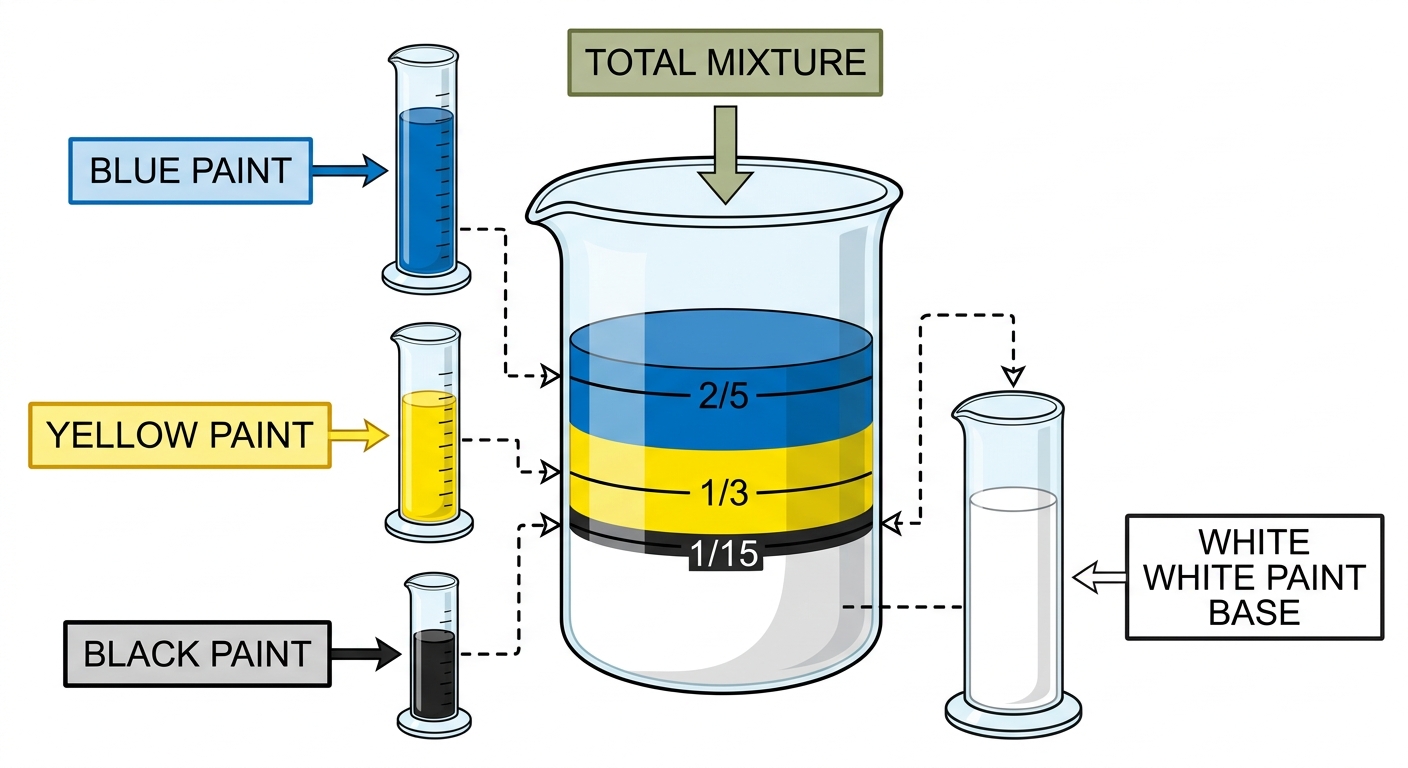
A painter is mixing a custom shade of green for a large mural. The recipe specifies of the total mixture as blue paint, as yellow paint, and as black paint; the remainder is white paint.
a
Calculate the fraction of the total mixture that is white paint. [2]
b
The blue paint measurement has a possible error of up to of the total mixture. Analyse the effect of this error on the shade of green, considering both the case where more blue is used and the case where less blue is used. [2]
c
The painter considers measuring each colour by volume rather than as a fraction of the total mixture. Given that the paints have different densities, advise the painter whether this alternative method is appropriate for achieving consistent colour across the mural. [2]
Solutions
3QuestionConverting Between Fractions Decimals and PercentagesConcept Practice
3 marks~5 minCriterion A
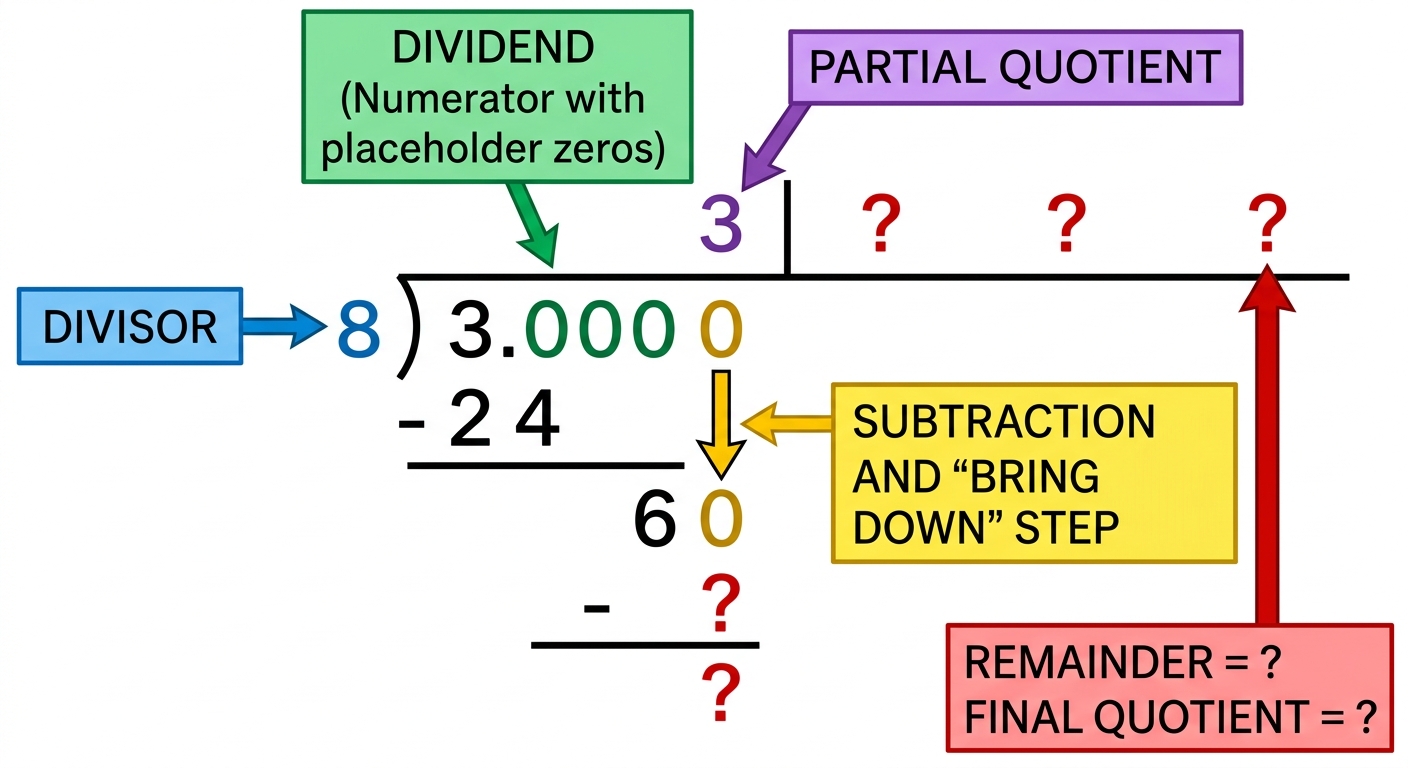
A factory quality-control report states that of a batch of components failed inspection. The supervisor needs the failure rate expressed as a decimal to enter it into a digital monitoring system that does not accept fractions.
a
Explain what mathematical operation represents, identifying the role of the numerator and denominator. [1]
b
Show that by completing the long division of , presenting each step clearly. [1]
c
The monitoring system flags any batch with a failure rate above . Advise the supervisor whether this batch requires further action, justifying your answer with reference to the decimal result. [1]
Solutions
4QuestionConverting Between Fractions Decimals and PercentagesAssessment Practice
12 marks~18 minCriterion B
Prime numbers can produce recurring decimals when used as the denominator of a unit fraction (numerator = 1). This question investigates the relationship between a prime denominator and the length of the recurring block .
a
Calculate the decimal form of each unit fraction. Show your long-division working. [4]
b
Deduce the length of the recurring block for each decimal in part (a), and record your results.
| Denominator () | ___ | ___ | ___ | ___ |
|---|---|---|---|---|
| Length of recurring block () | ___ | ___ | ___ | ___ [2] |
c
Analyse the values in part (b) to formulate a rule for the maximum possible length of the recurring block in terms of . Express your rule as an equation and justify why the actual length may sometimes be shorter than this maximum. [4]
d
A computer-science student claims that knowing the recurring-block length of tells you the minimum number of digits a computer must store to represent exactly. Calculate the decimal form of , determine its recurring-block length, and assess whether the student's claim is supported for this fraction, referring to your rule from part (c). [2]
Solutions
That's every free question here — 4 of 79.
+75 more questions, plus Mock Papers & Worksheets, are waiting in Premium.