You're viewing free preview questions — 4 questions previewing here — subscribe to unlock 84 more, plus the Full Question Bank, Mock Papers & Worksheets.Upgrade
Density Mass and Volume Problems — Free MYP5 Mathematics (Standard) Practice Questions

1QuestionChanging Units in Density ProblemsAssessment Practice
4 marks~6 minCriterion C
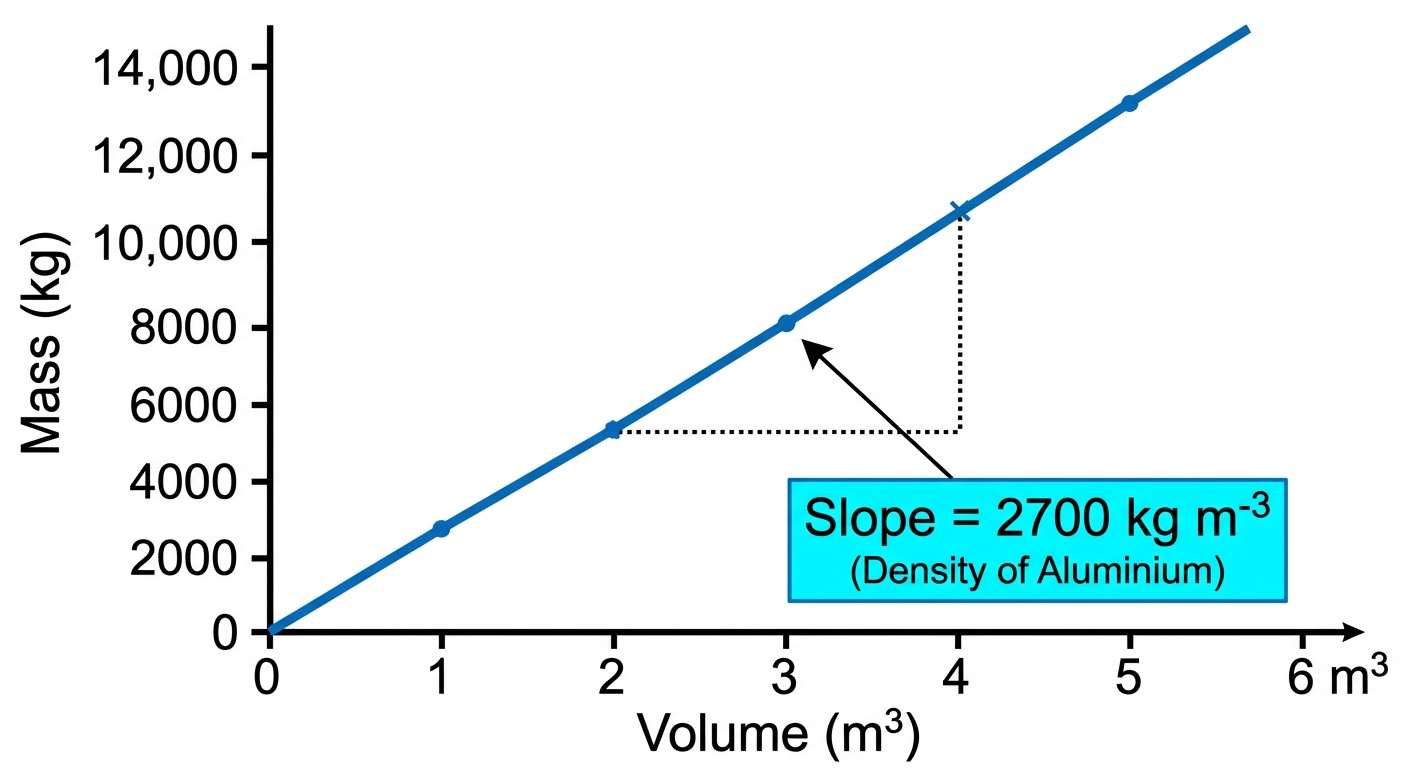
A graph of mass (kg) against volume (m³) for a sample of aluminium produces a straight line through the origin. The gradient of the line is .
a
State the conversion factors needed to change kg to g and m³ to cm³. [1]
b
Show that , and hence calculate the density of aluminium in g/cm³. [2]
c
A student claims that because the numerical value decreased from 2700 to 2.7, the density itself has decreased. Critique this claim. [1]

Solutions
2QuestionCalculating Unknowns in the Density FormulaAssessment Practice
4 marks~6 minCriterion D
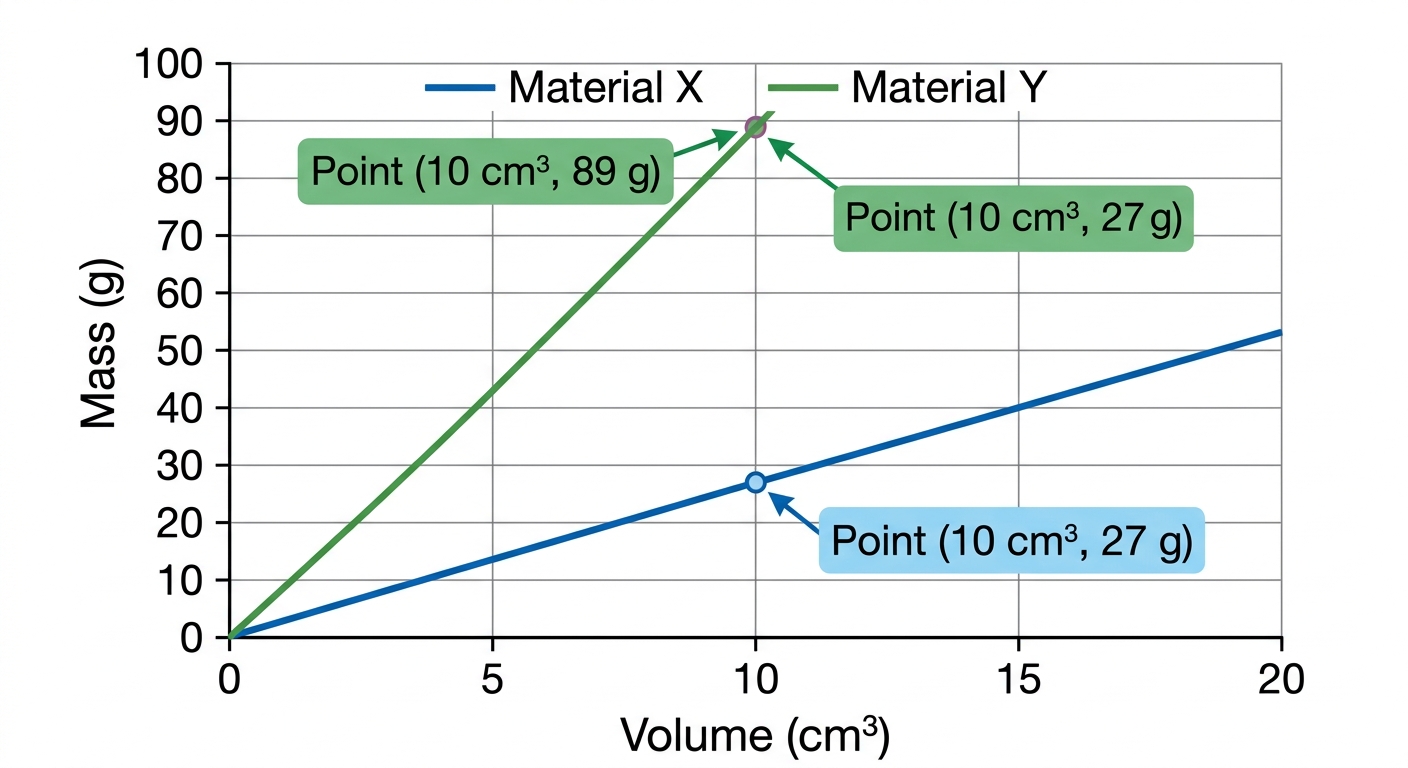
A materials engineer is identifying two unknown metals using a mass–volume graph. Line X passes through and . Line Y passes through and .
a
Explain how the gradient of each line gives the density of the material. [1]
b
Calculate the density of material X and the density of material Y. [2]
c
A component requires a metal with density greater than . The engineer has of material Y available. Justify whether material Y should be selected for this component, and determine the mass of the component that could be made. [1]
Solutions
3QuestionMulti-Step Problems with Density and VolumeAssessment Practice
4 marks~6 minCriterion A
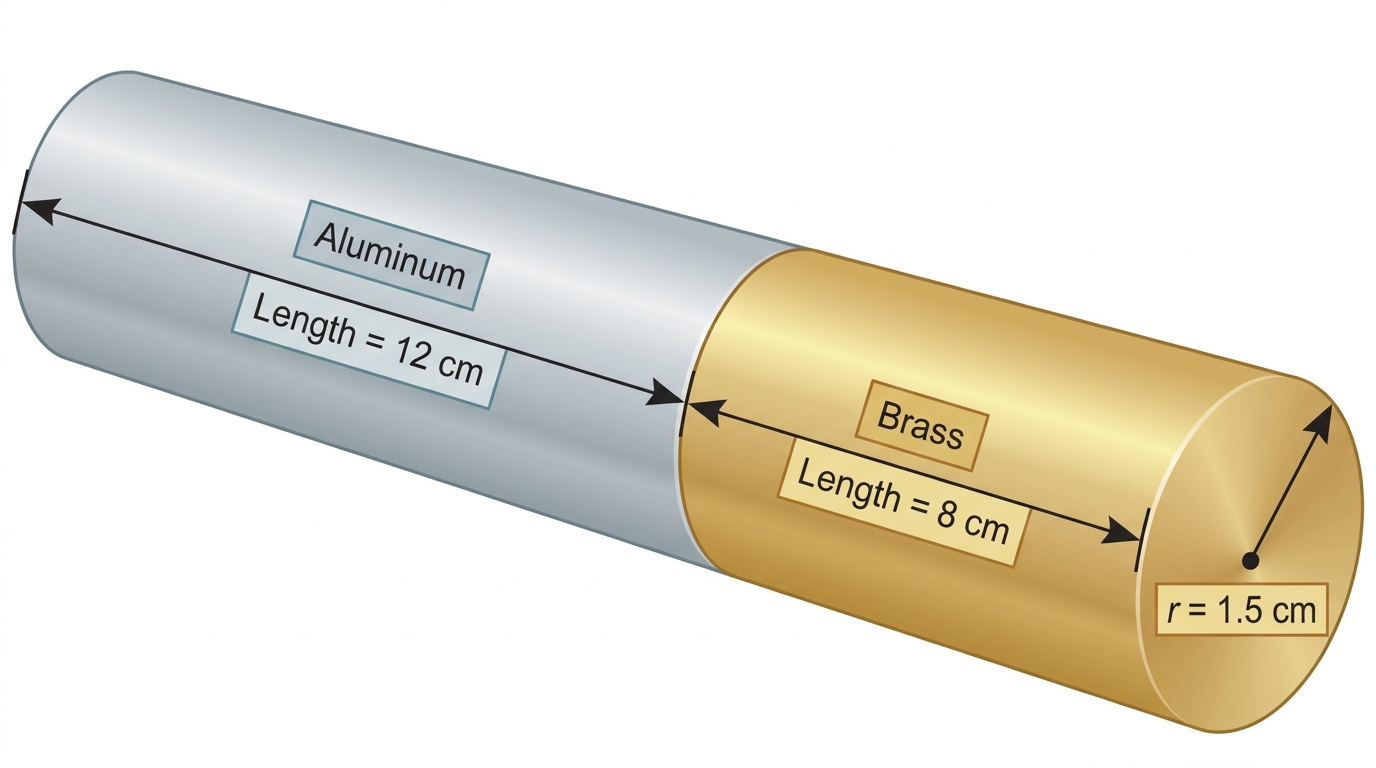
A cylindrical rod is made by fusing a 12 cm aluminium section to an 8 cm brass section. Both sections have radius 1.5 cm. The density of aluminium is 2.70 g/cm³ and the density of brass is 8.50 g/cm³. An engineer requires the composite rod to have an overall density greater than 4.50 g/cm³ to meet a structural specification.
a
Calculate the total volume of the composite rod. [1]
b
Calculate the total mass of the composite rod. [2]
c
Advise the engineer whether the rod meets the structural specification, justifying your answer with the calculated overall density. [1]
Solutions
4QuestionChanging Units in Density ProblemsAssessment Practice
6 marks~9 minCriterion B
A materials engineer is selecting a foam for a buoyancy device. The foam must have a density below to float with sufficient clearance.
Density data for four substances:
Density in :
Density in :
Density data for four substances:
Density in :
Density in :
a
Deduce the conversion factor from to . [2]
b
Construct a general formula that converts a density in to density in . [2]
c
The foam has a density of . Use your formula to find its density in , then advise the engineer whether this foam should be selected for the buoyancy device. [2]
Solutions
That's every free question here — 4 of 88.
+84 more questions, plus Mock Papers & Worksheets, are waiting in Premium.