You're viewing free preview questions — 4 questions previewing here — subscribe to unlock 64 more, plus the Full Question Bank, Mock Papers & Worksheets.Upgrade
Perimeter and Area of 2D Shapes — Free MYP5 Mathematics (Standard) Practice Questions

1QuestionUsing Compound Shapes in Area CalculationsConcept Practice
3 marks~5 minCriterion C
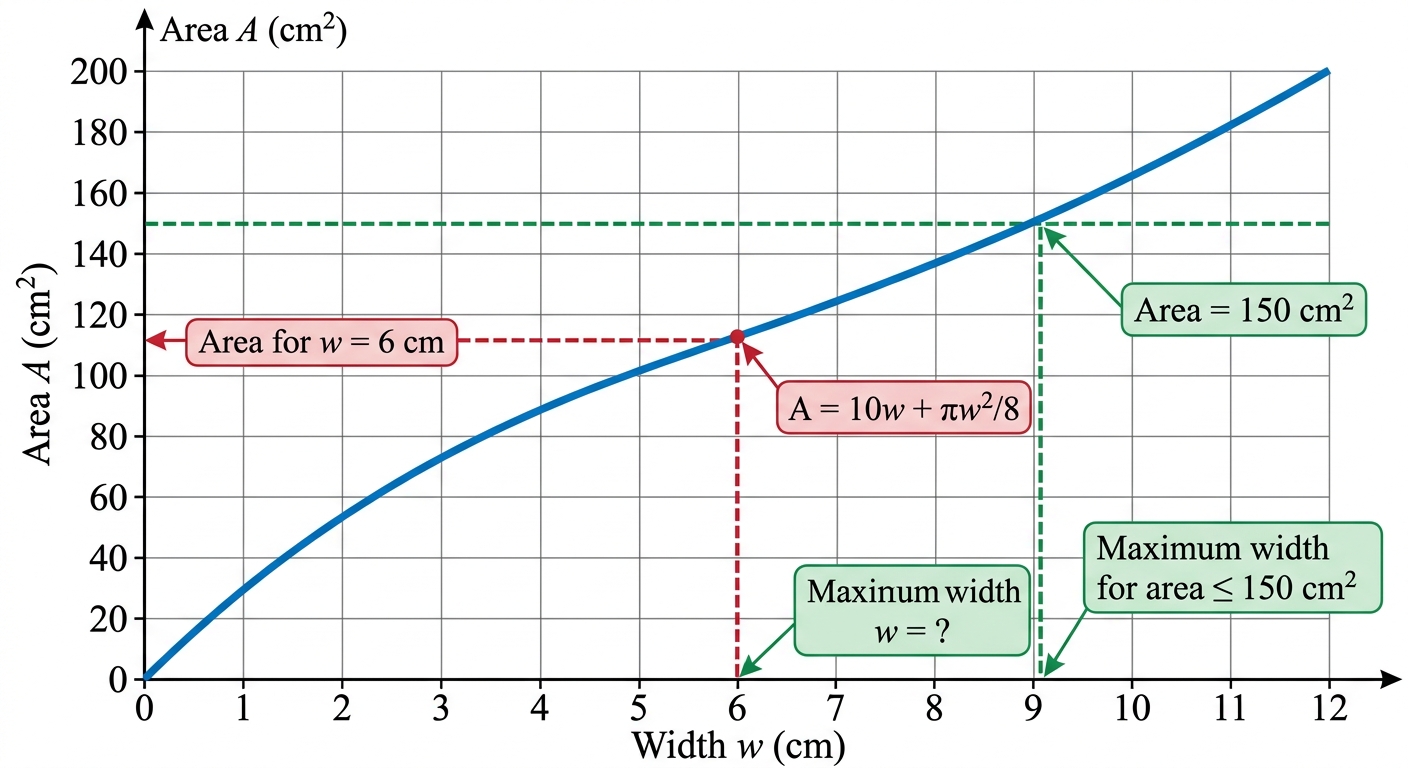
A compound shape consists of a rectangle of fixed length 10 cm and variable width cm, with a semicircle of diameter attached to one of the longer sides. The total area is given by
The graph shows (cm²) against (cm) for .
The graph shows (cm²) against (cm) for .
a
Use the graph to estimate the total area when cm. [1]
b
Calculate the exact total area when cm. [1]
c
A designer requires the total area to be no greater than 150 cm². Use the graph to find the maximum possible width , then advise the designer on whether a width of 11 cm satisfies the constraint. [1]

Solutions
2QuestionArea of Trapeziums and RhombusesAssessment Practice
5 marks~8 minCriterion B
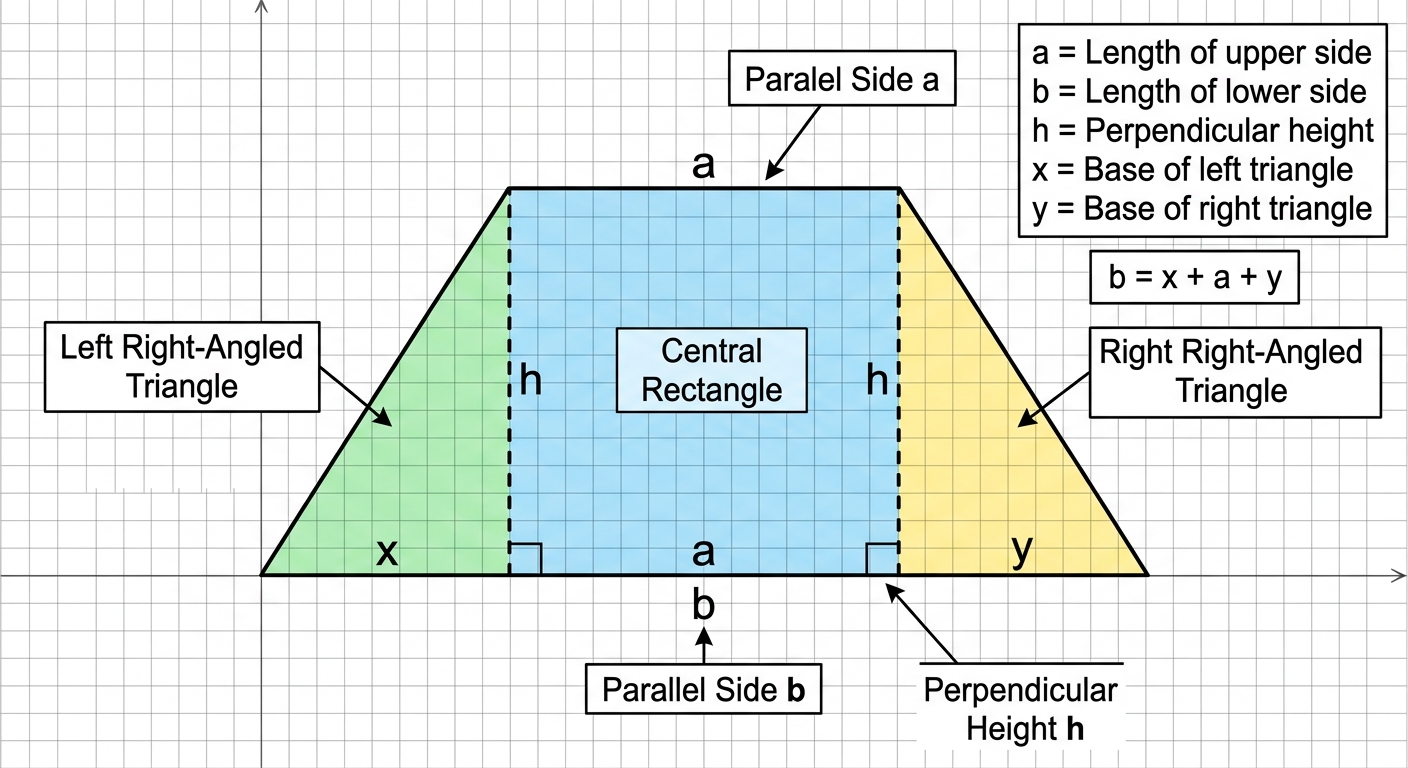
A landscape architect is designing a trapezoidal flower bed with parallel sides of length (top) and (bottom), where , and perpendicular height .
a
Construct a clearly labelled diagram showing the trapezium decomposed into one rectangle and two right-angled triangles. Label the parallel sides and , the height , and the horizontal bases of the two triangles (left) and (right). [1]
b
Using your diagram, justify that , write algebraic expressions for the area of each component shape, and show that their sum simplifies to . [3]
c
The architect states that a trapezoidal bed with m, m, and m has sufficient area to plant 20 lavender bushes, each requiring at least m² of space. Assess whether the architect's claim is correct. [1]
Solutions
3QuestionArea of Trapeziums and RhombusesConcept Practice
4 marks~6 minCriterion A
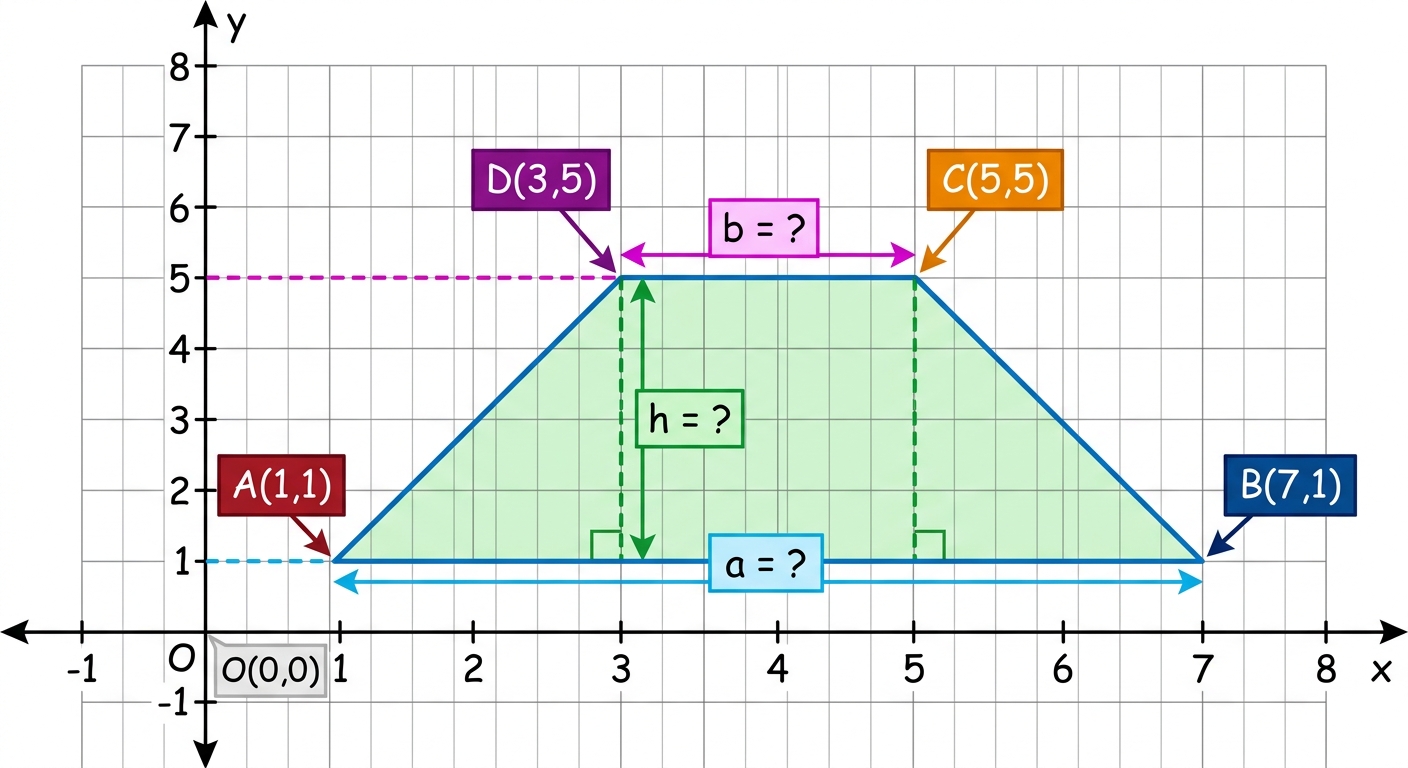
A landscape architect is designing a trapezoidal garden bed. On a coordinate grid (1 unit = 1 m), the bed is modelled by trapezium with vertices , , , and , where .
a
Calculate the lengths of and , and the perpendicular height of the trapezium. [2]
b
Using , calculate the area of the garden bed. [1]
c
The architect states that a garden bed smaller than 18 m² is too small for the planned planting scheme. Advise the architect whether this garden bed is suitable for the planting scheme. [1]
Solutions
4QuestionArea of Rectangles Triangles and ParallelogramsAssessment Practice
5 marks~8 minCriterion D
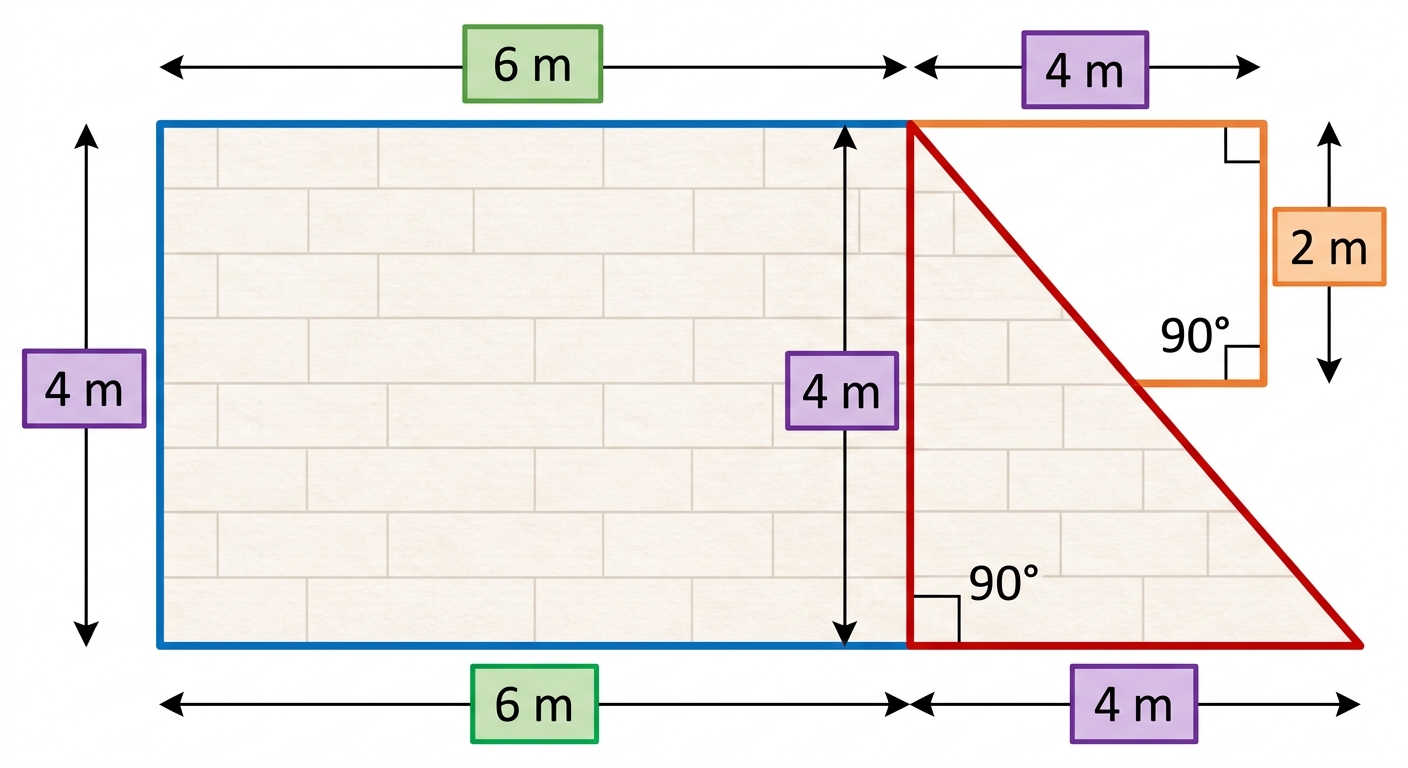
A homeowner plans to tile a rectangular deck measuring 6 m by 4 m, with a right-angled triangular extension attached to one of the 4 m sides. The triangle has a base of 4 m and a perpendicular height of 2 m. The homeowner purchases exactly 28 m² of tiles, based on the total deck area alone.
The tile installer states that a 5% waste factor for cutting and breakage must be added to any area calculation before purchasing.
The tile installer states that a 5% waste factor for cutting and breakage must be added to any area calculation before purchasing.
a
Calculate the total area of tiles that should have been purchased, including the 5% waste factor. [2]
b
Advise the homeowner whether the 28 m² purchased is sufficient for this tiling project, justifying your answer with reference to both the mathematics and the practical limitations of the area model used. [3]
Solutions
That's every free question here — 4 of 68.
+64 more questions, plus Mock Papers & Worksheets, are waiting in Premium.