You're viewing free preview questions — 4 questions previewing here — subscribe to unlock 83 more, plus the Full Question Bank, Mock Papers & Worksheets.Upgrade
General Term nth Term of a Sequence — Free MYP5 Mathematics (Standard) Practice Questions

1QuestionApplications in Tables and GraphsAssessment Practice
4 marks~6 minCriterion D
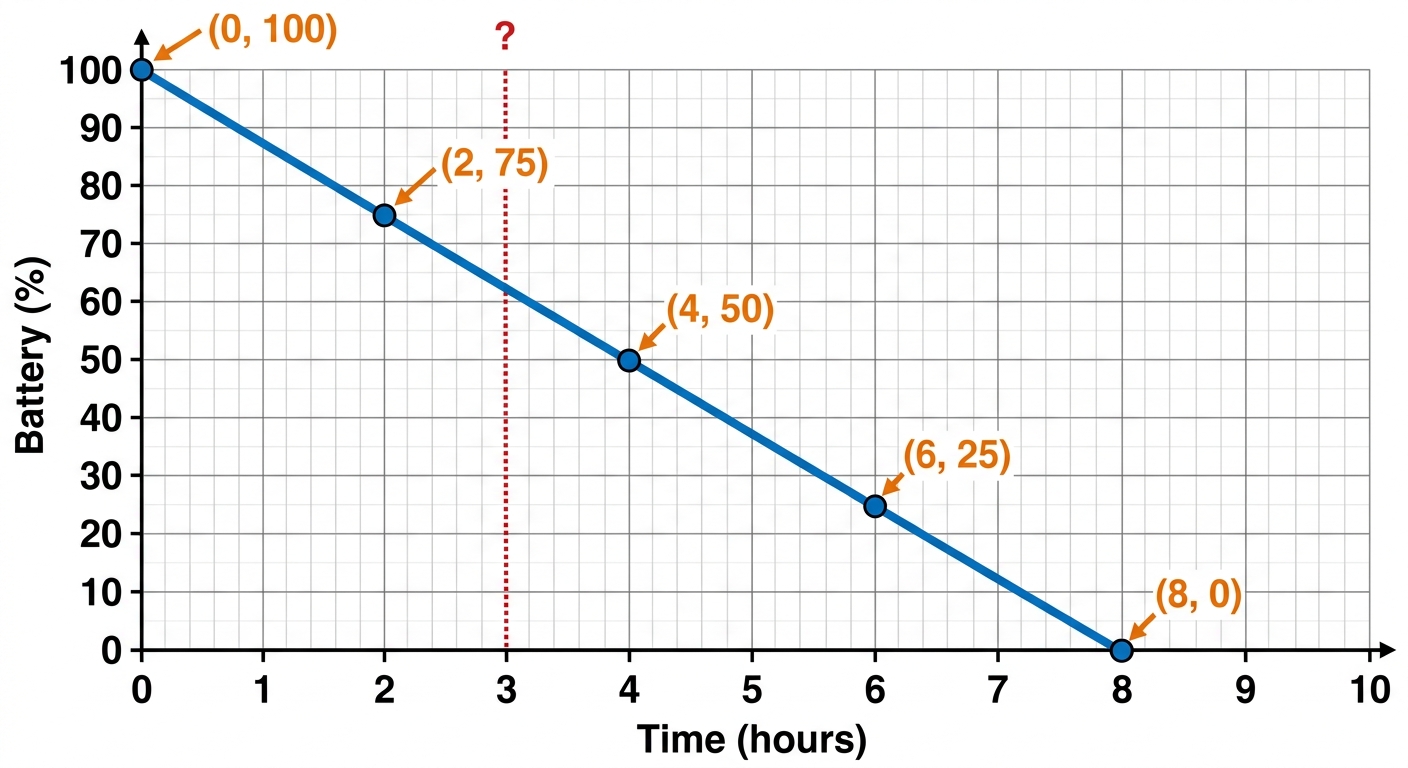
A student records the battery percentage of a smartphone during continuous video playback.
The student models battery drain using:
where is the battery percentage and is the time in hours.
| Time (hours) | 0 | 2 | 4 | 6 | 8 |
|---|---|---|---|---|---|
| Battery (%) | 100 | 75 | 50 | 25 | 0 |
The student models battery drain using:
where is the battery percentage and is the time in hours.
a
Calculate the predicted battery percentage after 3 hours. [1]
b
The student claims the model can be used to schedule a 90-minute video call starting at hours. Using the model, determine whether the battery will last the full call, then advise the student whether the linear model is reliable for this scheduling decision. [3]

Solutions
2QuestionApplications in Tables and GraphsAssessment Practice
6 marks~9 minCriterion A
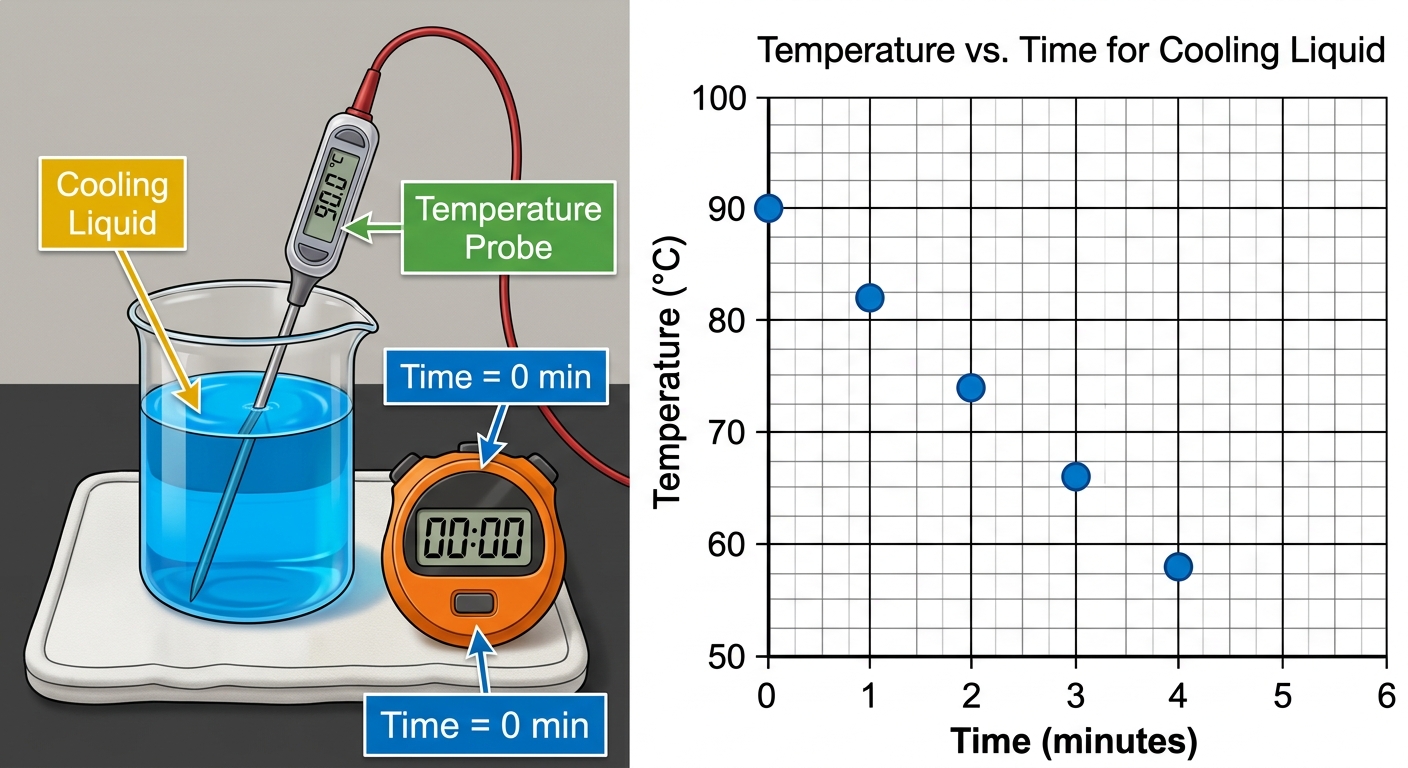
A scientist records the temperature of a cooling liquid every minute. The temperatures in degrees Celsius are: 90, 82, 74, 66, 58.
a
Find the nth term rule for this sequence.
b
Use your rule to predict the temperature after 10 minutes.
c
The liquid becomes unsafe at temperatures below 10°C. Use your model to determine when the temperature will first drop below 10°C.
d
Evaluate the appropriateness and impact of using this linear model for the cooling process. In your response, compare the predicted temperature at 10 minutes with the actual temperature if the cooling slows over time. Discuss at least two limitations of the model and explain the real-world impact of relying on this model for safety decisions.
Solutions
3QuestionApplications in Tables and GraphsAssessment Practice
4 marks~6 minCriterion B
A city's two water-storage tanks are monitored over time.
Tank A — volume recorded at hourly intervals:
(hours): 1, 2, 3, 4, 5
(litres): 3, 7, 11, 15, 19
Tank B — volume recorded at hourly intervals:
(hours): 1, 2, 3, 4, 5
(litres): 2, 6, 12, 20, 30
Tank A — volume recorded at hourly intervals:
(hours): 1, 2, 3, 4, 5
(litres): 3, 7, 11, 15, 19
Tank B — volume recorded at hourly intervals:
(hours): 1, 2, 3, 4, 5
(litres): 2, 6, 12, 20, 30
a
Calculate the first differences for Tank A. Justify whether the relationship between and is linear or quadratic. [1]
b
Deduce an expression for in terms of for Tank A. [1]
c
Calculate the first and second differences for Tank B. Justify whether the relationship between and is linear or quadratic. [1]
d
Deduce an expression for in terms of for Tank B. [1]
(e) Both tanks have a maximum capacity of 115 litres. Using your expressions, determine at which integer hour each tank first reaches or exceeds this capacity. Advise the city's water management team which tank requires priority monitoring, and why. [1]
(e) Both tanks have a maximum capacity of 115 litres. Using your expressions, determine at which integer hour each tank first reaches or exceeds this capacity. Advise the city's water management team which tank requires priority monitoring, and why. [1]
Solutions
4QuestionCreating a Rule for the nth TermAssessment Practice
6 marks~9 minCriterion C
A landscape architect designs a series of square garden terraces. The total paved area (in m²) after each terrace is added follows a quadratic sequence:
A student proposes the rule for the th term.
| 1 | 2 | 3 | 4 | 5 | |
| 2 | 6 | 12 | 20 | 30 |
A student proposes the rule for the th term.
a
Verify that the rule produces the correct values for . [2]
b
Deduce the total paved area after the 10th terrace is added. [1]
c
The architect has a maximum budget allowing 182 m² of paving. Advise the architect whether a 13th terrace can be added within this budget, justifying your answer using the proposed rule. [3]
Solutions
That's every free question here — 4 of 87.
+83 more questions, plus Mock Papers & Worksheets, are waiting in Premium.