You're viewing free preview questions — 4 questions previewing here — subscribe to unlock 71 more, plus the Full Question Bank, Mock Papers & Worksheets.Upgrade
Number Patterns and Arithmetic Sequences — Free MYP5 Mathematics (Standard) Practice Questions

1QuestionDeriving the nth Term of an Arithmetic SequenceConcept Practice
2 marks~3 minCriterion C
A theatre adds more seats to each row from the front to the back. The number of seats in successive rows forms the arithmetic sequence: 7, 11, 15, 19, …
a
Deduce the common difference of the sequence. [1]
b
A theatre manager claims that row 30 will have exactly 119 seats. Derive the formula for the th term of the sequence, then justify whether the manager's claim is correct. [1]
Solutions

2QuestionRecognizing and Continuing Arithmetic SequencesAssessment Practice
2 marks~3 minCriterion A
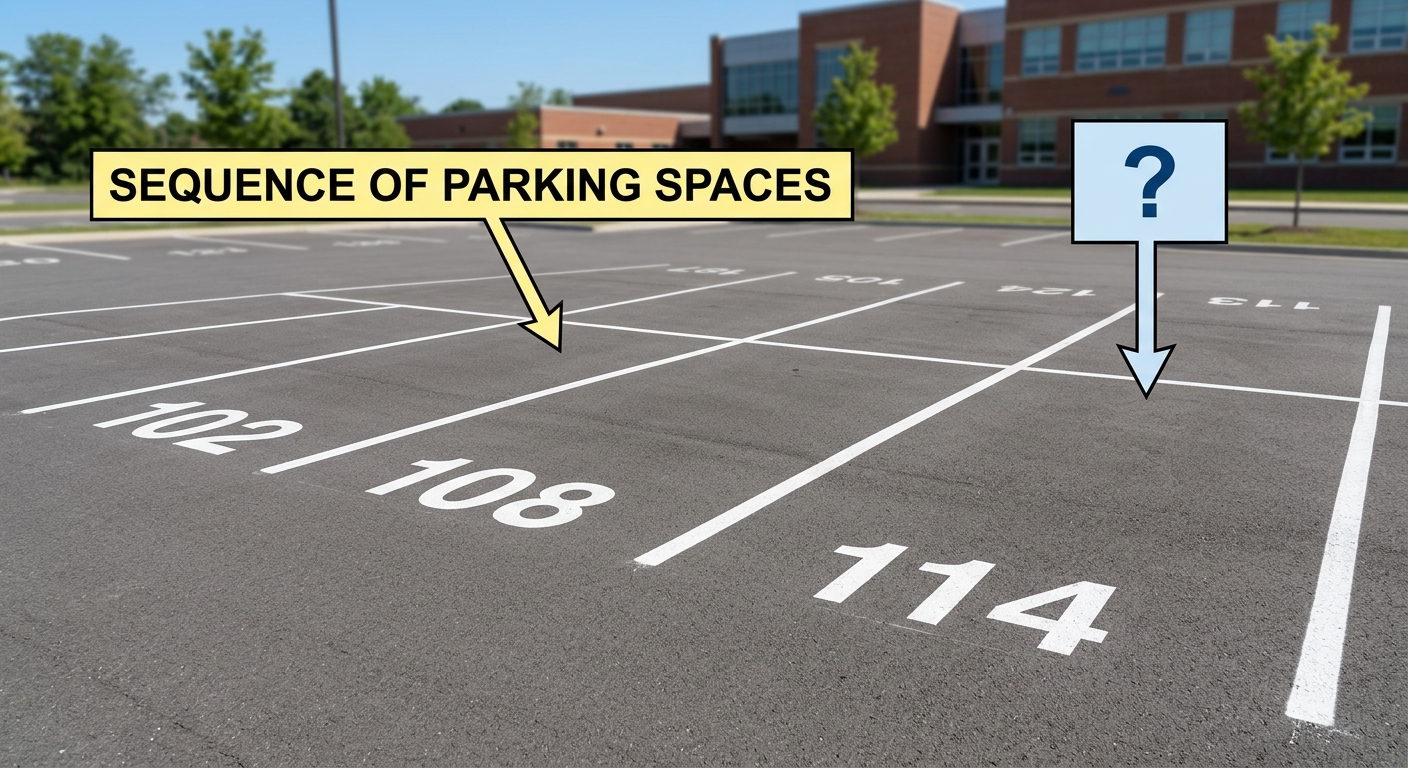
A multi-storey car park numbers its spaces using an arithmetic sequence. The first three spaces on a new floor are numbered 102, 108, and 114.
The floor has capacity for exactly 20 spaces, and the car park manager claims that space number 222 will appear on this floor.
The floor has capacity for exactly 20 spaces, and the car park manager claims that space number 222 will appear on this floor.
a
Deduce the number of the 4th parking space. [1]
b
Advise the car park manager whether space 222 will appear on this floor, supporting your advice with mathematical reasoning. [1]
Solutions
3QuestionSolving Problems Using Arithmetic SequencesAssessment Practice
12 marks~18 minCriterion D
A warehouse uses a system of stacked storage boxes. The heights of the boxes form an arithmetic sequence: Box 1 has a height of 50 cm, and each box above it is 3 cm shorter than the one below.
The sequence of box heights (cm) begins: 50, 47, 44, 41, …
The sequence of box heights (cm) begins: 50, 47, 44, 41, …
a
Calculate the heights of Box 4, Box 5, and Box 6. [2]
b
State the first term and common difference of the sequence, then deduce a formula for , the height (in cm) of the th box. [3]
c
Show that the 15th box has a height of 8 cm, and calculate the height of the 10th box. [3]
d
The total stacked height must not exceed 350 cm. Using the arithmetic series sum formula, determine the maximum number of boxes that can be stacked. Justify your answer. [4]
(e) The warehouse manager plans to extend the sequence to 20 boxes. Advise the manager whether this plan can be implemented, supporting your advice with both a mathematical calculation and a real-world explanation. [4]
(e) The warehouse manager plans to extend the sequence to 20 boxes. Advise the manager whether this plan can be implemented, supporting your advice with both a mathematical calculation and a real-world explanation. [4]
Solutions
4QuestionSolving Problems Using Arithmetic SequencesAssessment Practice
16 marks~24 minCriterion B
Communication: Arithmetic Series and Staircase Patterns
A staircase is being built using identical blocks. The number of blocks required for each step forms an arithmetic sequence.
The pattern begins as follows:
Step number: 1, 2, 3, 4, …
Blocks in step: 3, 5, 7, 9, …
Let represent the total number of blocks needed to build a staircase with steps.
Question
A staircase is being built using identical blocks. The number of blocks required for each step forms an arithmetic sequence.
The pattern begins as follows:
Step number: 1, 2, 3, 4, …
Blocks in step: 3, 5, 7, 9, …
Let represent the total number of blocks needed to build a staircase with steps.
Question
a
Calculate , , , and . Show clearly how each total is formed from the blocks in each step. [4 marks]
b
Predict a general formula for in terms of . Your answer should:
- Identify the pattern in the totals,
- Express the relationship using algebra,
- Clearly define what and represent. [4 marks]
- Identify the pattern in the totals,
- Express the relationship using algebra,
- Clearly define what and represent. [4 marks]
c
Justify your formula by showing that can be written as the sum of the first terms of an arithmetic series. In your response:
- Identify the first term ,
- Identify the common difference ,
- Write the th term of the sequence,
- Use the arithmetic series sum formula,
- Simplify your expression to match your formula from part (b). [6 marks]
- Identify the first term ,
- Identify the common difference ,
- Write the th term of the sequence,
- Use the arithmetic series sum formula,
- Simplify your expression to match your formula from part (b). [6 marks]
d
Derive the standard formula for the sum of an arithmetic series: . Use clear mathematical communication and explain each step of your derivation. [4 marks]
(e) Explain why clear notation is important when solving this problem, especially the difference between:
- Blocks in the th step,
- Total blocks in steps. [2 marks]
(e) Explain why clear notation is important when solving this problem, especially the difference between:
- Blocks in the th step,
- Total blocks in steps. [2 marks]
Solutions
That's every free question here — 4 of 75.
+71 more questions, plus Mock Papers & Worksheets, are waiting in Premium.