You're viewing free preview questions — 5 questions previewing here — subscribe to unlock 172 more, plus the Full Question Bank, Mock Papers & Worksheets.Upgrade
Atomic Structure, particles, chargers and masses — Free MYP5 Physics Practice Questions

1QuestionAtomic number (Z) and mass number (A)Concept Practice
3 marks~5 minCriterion A
The diagrams below show two simplified atomic models of carbon isotopes.
Diagram 1: nucleus with 6 protons and 6 neutrons; 6 electrons orbiting.
Diagram 2: nucleus with 6 protons and 7 neutrons; 6 electrons orbiting.
Diagram 1: nucleus with 6 protons and 6 neutrons; 6 electrons orbiting.
Diagram 2: nucleus with 6 protons and 7 neutrons; 6 electrons orbiting.
a
State the atomic number for both isotopes. [1]
b
Deduce the mass number for each isotope and identify each diagram as carbon-12 or carbon-13. [1]
c
Explain why these two atoms are isotopes of the same element, despite having different mass numbers. [1]

Solutions
2QuestionDalton’s modelAssessment Practice
2 marks~3 minCriterion D
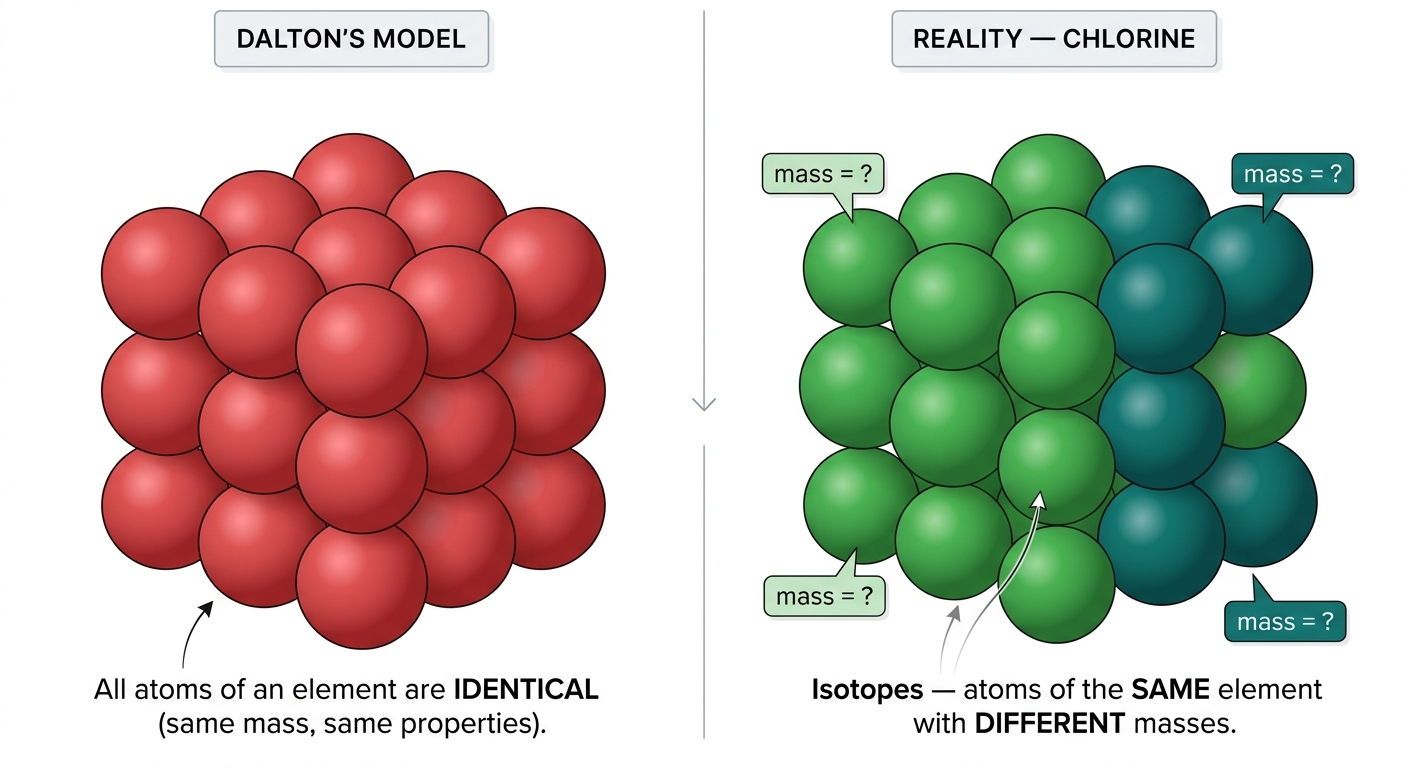
Dalton's atomic theory states that all atoms of a given element are identical in mass and properties.
a
Outline one real-world application of this assumption. [1]
b
Dalton's theory cannot fully account for the behaviour of chlorine in precise industrial chemical reactions. Discuss one limitation of his model that explains this, and state how it affects reaction accuracy. [1]
Solutions
3QuestionDalton’s modelAssessment Practice
5 marks~8 minCriterion C
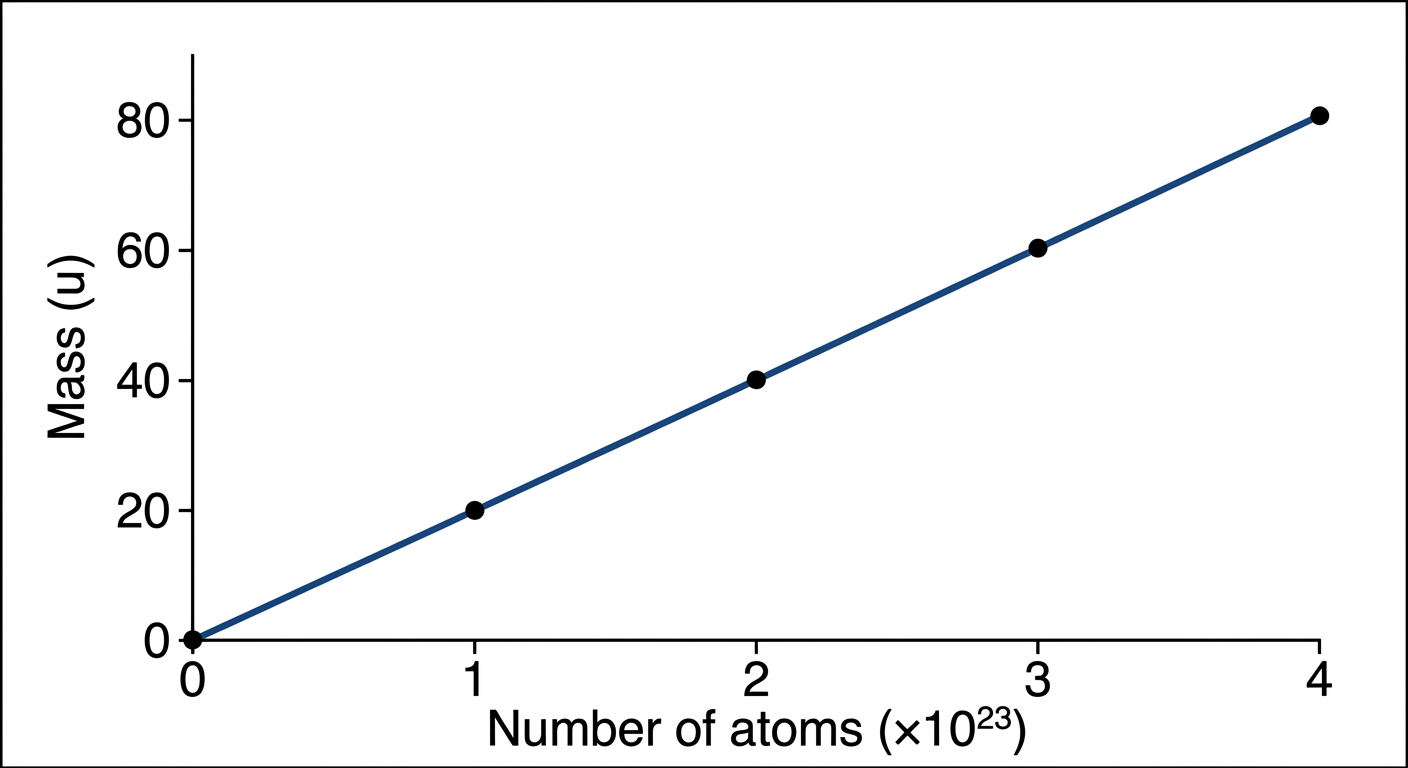
A pure sample of element X is analysed. The graph below shows mass (in atomic mass units, u) versus number of atoms for this sample.
Graph data — Number of atoms () : 0, 1, 2, 3, 4; Mass (u): 0, 20.18, 40.36, 60.54, 80.72
Graph data — Number of atoms () : 0, 1, 2, 3, 4; Mass (u): 0, 20.18, 40.36, 60.54, 80.72
a
Deduce the average mass of one atom of element X from the graph. Show your working. [2]
b
Explain why Dalton's atomic model would predict an integer value for the mass per atom, and identify what feature of the graph contradicts this prediction. [1]
c
Analyse how the existence of isotopes modifies Dalton's model to account for the non-integer mass you calculated in (a). [2]
Solutions
4QuestionBohr model (energy levels)Assessment Practice
8 marks~12 minCriterion A
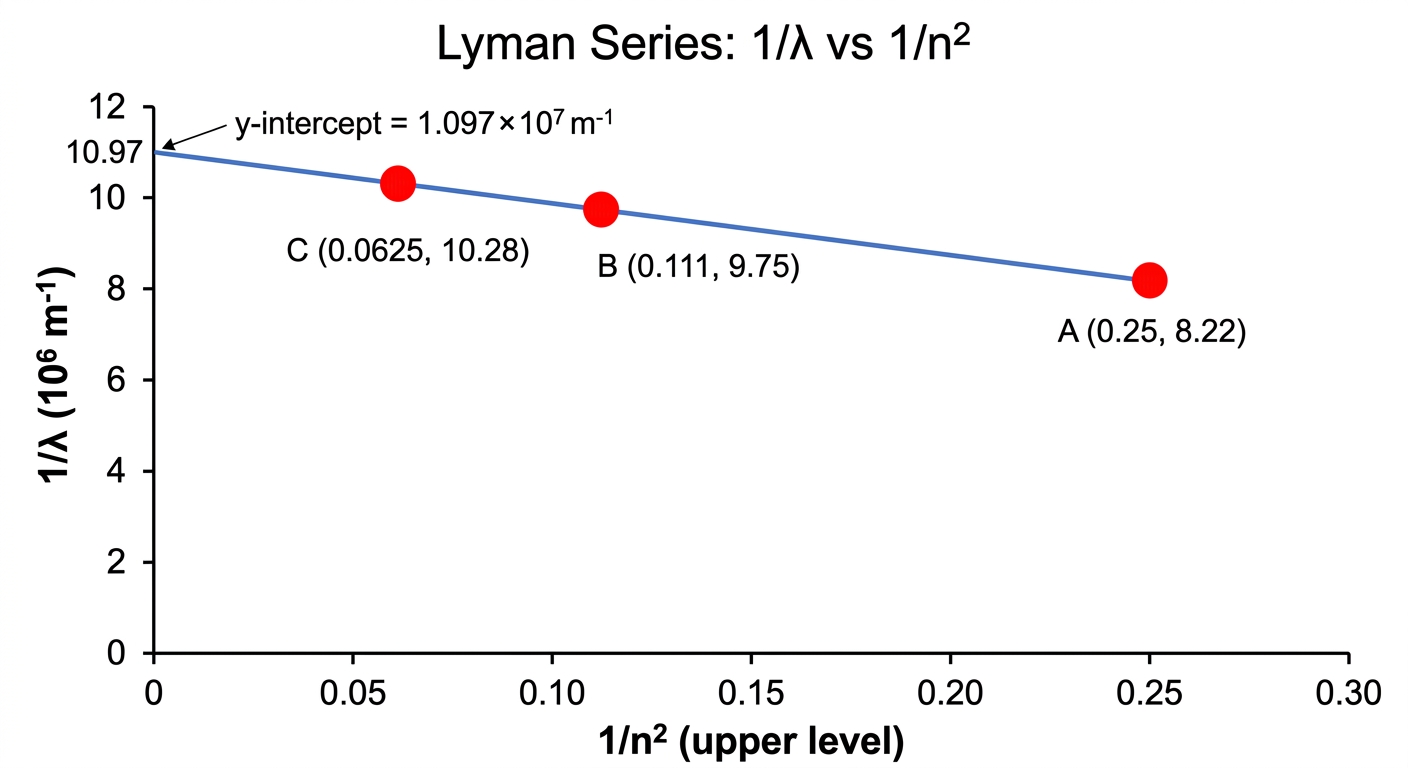
The Lyman series of hydrogen emission occurs when electrons fall to the ground state (). The first three lines have wavelengths:
:
:
:
A graph of (in ) against (upper level) is plotted, giving a linear trend with -intercept .
Use: , , , , .
:
:
:
A graph of (in ) against (upper level) is plotted, giving a linear trend with -intercept .
Use: , , , , .
a
Explain why the series limit corresponds to the -intercept of this graph. [2]
b
Deduce the series limit wavelength in nm. [3]
c
Evaluate the ionisation energy of hydrogen in eV using , and assess the reliability of the experimental data by comparing your result with the accepted value of . [3]
Solutions
5QuestionBohr model (energy levels)Assessment Practice
8 marks~12 minCriterion D
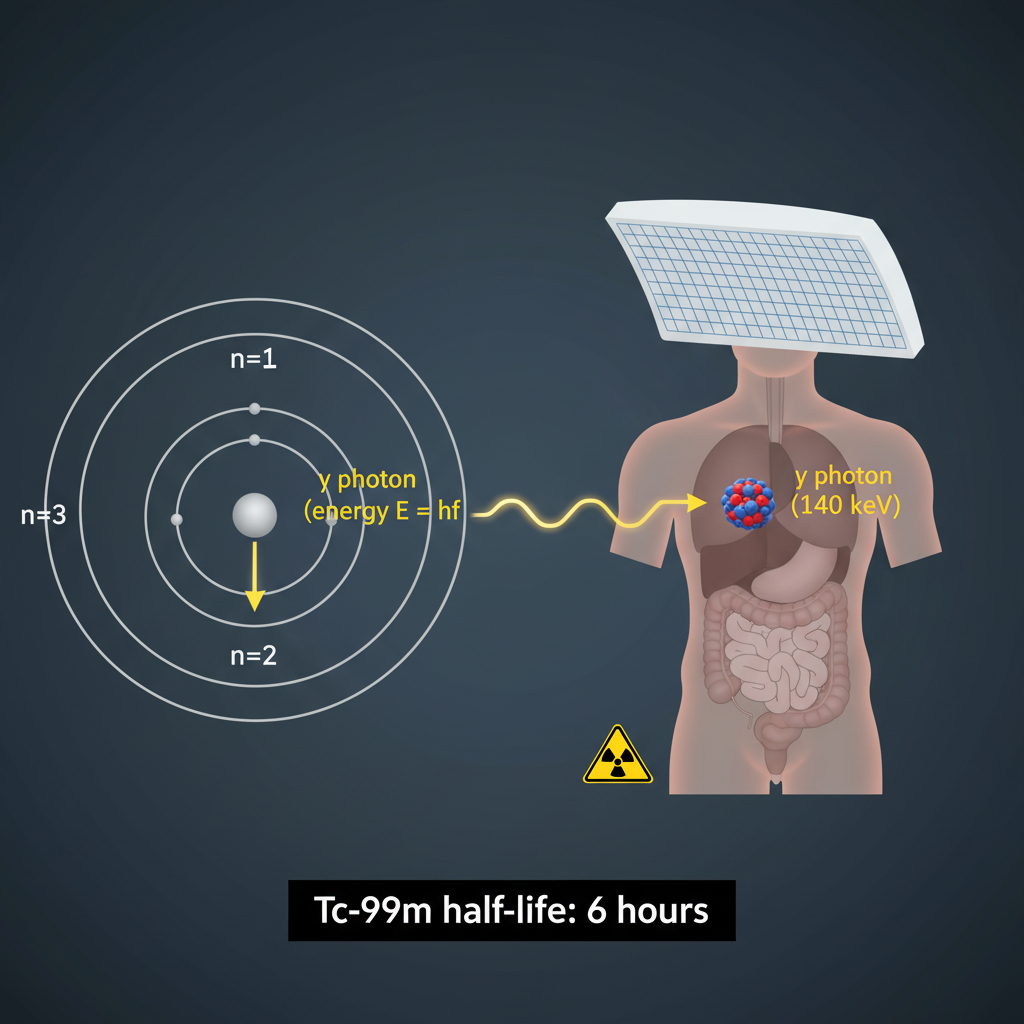
Technetium-99m (Tc-99m) is a radioactive isotope widely used in hospitals for imaging internal structures. It emits gamma radiation, detected by specialised cameras to diagnose conditions such as cancer. Tc-99m has a half-life of 6 hours. The energy of an emitted gamma photon is given by , where J s. Some patients require up to 3 scans per year throughout their lives.
a
Explain how a gamma photon is emitted from an excited Tc-99m nucleus, using the Bohr model of energy levels. [2]
b
A gamma photon emitted by Tc-99m has a frequency of Hz. Calculate the energy of this photon in joules. [2]
c
Evaluate the ethical justification for exposing a patient to repeated Tc-99m scans (3 per year). In your answer, state one assumption that underpins your evaluation. [4]
Solutions
That's every free question here — 5 of 177.
+172 more questions, plus Mock Papers & Worksheets, are waiting in Premium.