You're viewing free preview questions — 6 questions previewing here — subscribe to unlock 154 more, plus the Full Question Bank, Mock Papers & Worksheets.Upgrade
Back

Atomic structure: particles, charges and masses — Free MYP5 Physics Practice Questions

Free questions

Open in full, with answers, mark scheme and examiner insights.

Question 1Criterion A · Band 1-4 · Easy · 6 marksrevisionprep.com

Definition of an atom

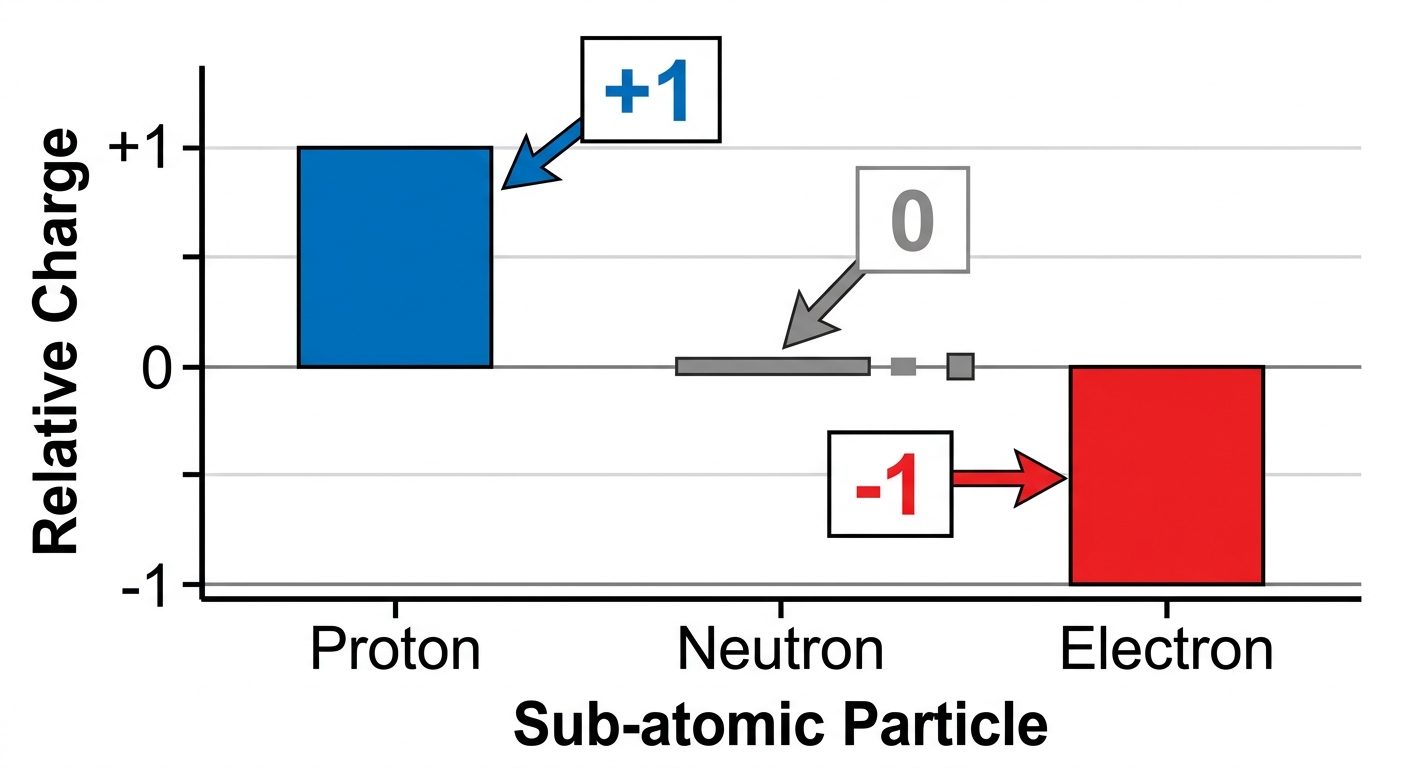
The bar chart shows the relative charge of each type of particle found in atoms.

A particle X contains 8 protons, 8 neutrons and 10 electrons.
Question diagram
(a)
Use the bar chart to write down the relative charge of a proton, a neutron and an electron. [1]Criterion A (ii) · Level 1-2
(b)
Calculate the total relative charge of the protons and the total relative charge of the electrons in X. [2]Criterion A (ii) · Level 3-4
(c)
Deduce the overall relative charge of X and state whether X is an atom or an ion. [2]Criterion A (ii) · Level 3-4
(d)
State why the neutrons in X do not affect your answer to (c). [1]Criterion A (i) · Level 1-2

revisionprep.com

Summary Answer

Not available for this question.

Model Answer

Not available for this question.

Marking Scheme

Not available for this question.

Examiner Insights

Not available for this question.

Question 2Criterion A · Band 1-2 · Easy · 5 marksrevisionprep.com

Bohr model (energy levels)

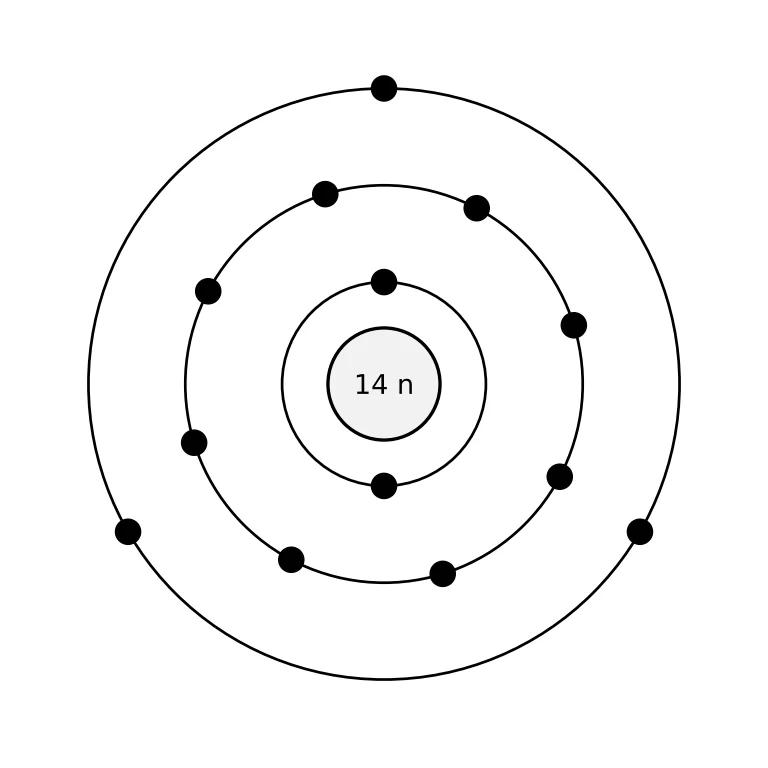
The diagram shows the Bohr model of a neutral atom. The nucleus contains 14 neutrons.
Question diagram
(a)
State the number of electrons in the atom. [1]Criterion A (ii) · Level 1-2
(b)
Write down the electron arrangement of the atom. [1]Criterion A (ii) · Level 1-2
(c)
Deduce the number of protons in the nucleus and identify the element. [2]Criterion A (ii) · Level 1-2
(d)
Calculate the mass number of the atom. [1]Criterion A (ii) · Level 1-2

revisionprep.com

Summary Answer

Not available for this question.

Model Answer

Not available for this question.

Marking Scheme

Not available for this question.

Examiner Insights

Not available for this question.

Question 3Criterion A · Band 1-6 · Medium · 4 marksrevisionprep.com

Thomson’s plum pudding model

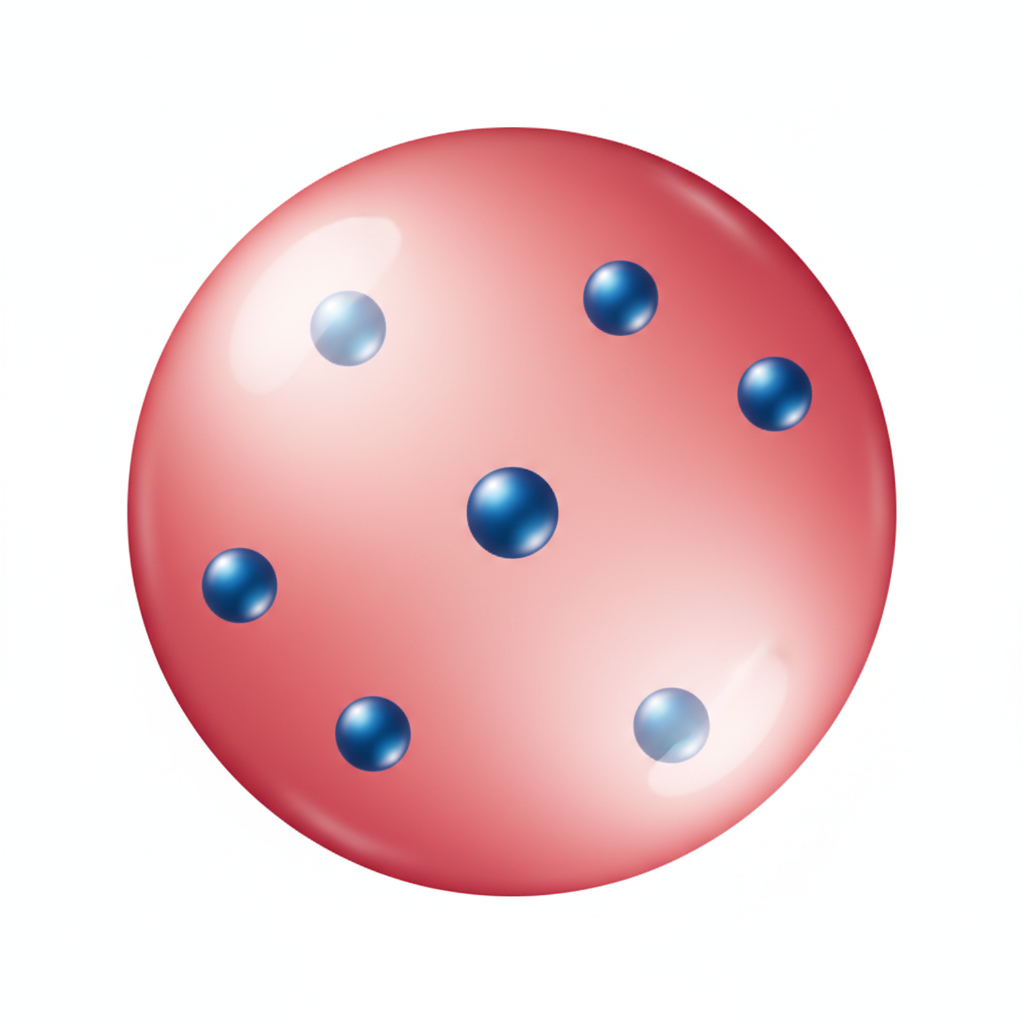
The diagram shows Thomson's model of the atom, published in 1904.
Question diagram
(a)
State the evidence that led Thomson to include electrons inside atoms. [1]Criterion A (i) · Level 1-2
(b)
Thomson's model was accepted from 1904 until about 1911. Explain why a scientific model is accepted for a time and later replaced. [2]Criterion A (iii) · Level 5-6
(c)
Suggest one observation that this model cannot explain. [1]Criterion A (iii) · Level 3-4

revisionprep.com

Summary Answer

Not available for this question.

Model Answer

Not available for this question.

Marking Scheme

Not available for this question.

Examiner Insights

Not available for this question.

Question 4Criterion C + A · Band 3-6 · Medium · 8 marksrevisionprep.com

Structure of atom: Nucleus and electron cloud
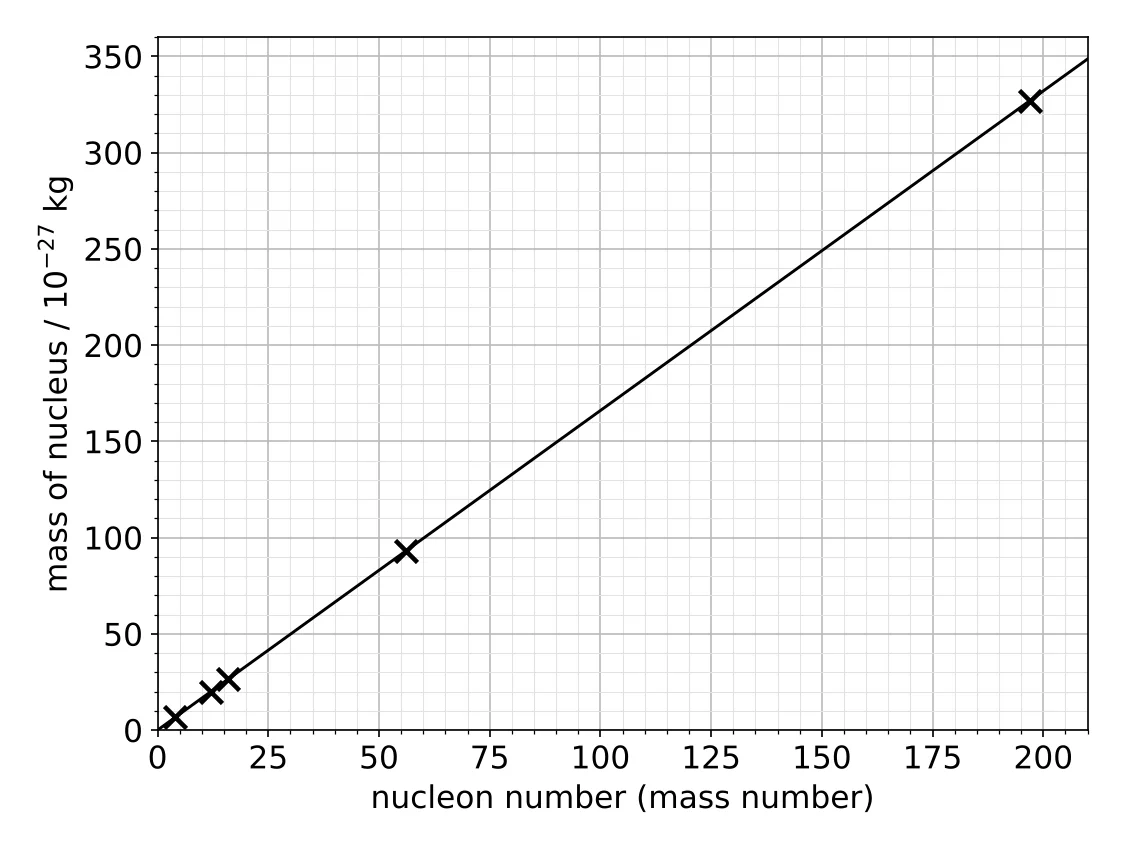
The graph shows the mass of the nucleus plotted against nucleon number for five nuclei: helium-4, carbon-12, oxygen-16, iron-56 and gold-197.
Question diagram
(a)
Describe the relationship shown by the graph. [2]Criterion C (ii) · Level 3-4
(b)
Determine the gradient of the line. [2]Criterion C (i) · Level 3-4
(c)
Explain what the gradient represents. [2]Criterion C (ii) · Level 5-6
(d)
A nucleus has a mass of 5.0×10−265.0 \times 10^{-26} kg. Use your answer to (b) to deduce the number of nucleons in it. [2]Criterion A (ii) · Level 3-4

revisionprep.com

Summary Answer

Not available for this question.

Model Answer

Not available for this question.

Marking Scheme

Not available for this question.

Examiner Insights

Not available for this question.

Question 5Criterion B · Band 5-8 · Challenge · 10 marksrevisionprep.com

Dalton’s model

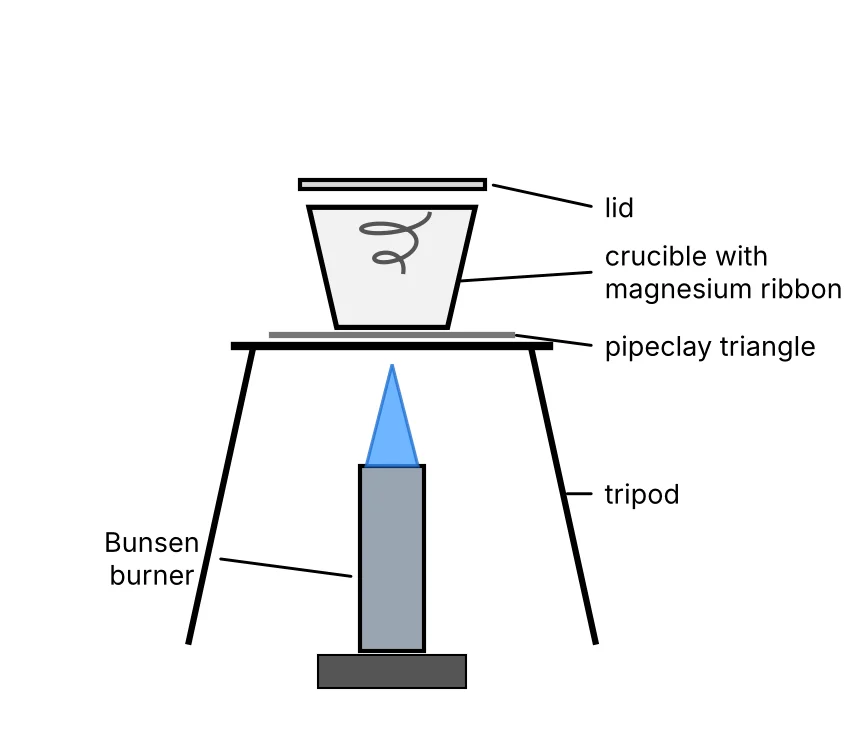
Dalton's model predicts that atoms combine in fixed ratios, so a student plans to test the hypothesis that magnesium always combines with oxygen in the same mass ratio. Magnesium ribbon is heated strongly in a crucible with a lid, as shown. It burns with a bright white flame and forms white magnesium oxide. The lid is lifted briefly from time to time to let air in.

In a pilot trial the student used three masses of magnesium and weighed the oxide formed.
mass of magnesium / g0.501.001.50mass of magnesium oxide / g0.781.512.22\begin{array}{|l|c|c|c|}\hline \text{mass of magnesium / g} & 0.50 & 1.00 & 1.50 \\ \hline \text{mass of magnesium oxide / g} & 0.78 & 1.51 & 2.22 \\ \hline\end{array}
Question diagram
(a)
Formulate a hypothesis for the investigation and explain it using Dalton's model. [2]Criterion B (ii) · Level 5-6
(b)
Identify the independent variable, the dependent variable and one control variable. State how the control variable is kept constant. [3]Criterion B (iii) · Level 5-6
(c)
Explain why the crucible should be heated and reweighed until its mass no longer changes, and state one safety precaution. [2]Criterion B (iv) · Level 5-6
(d)
The student expected the ratio (mass of oxide ÷\div mass of magnesium) to stay the same. Use the pilot results to evaluate whether the method as planned can fairly test the hypothesis, and describe one change to the method with a reason. [3]Criterion B (iii), B (iv) · Level 7-8

revisionprep.com

Summary Answer

Not available for this question.

Model Answer

Not available for this question.

Marking Scheme

Not available for this question.

Examiner Insights

Not available for this question.

Question 6Criterion D + A · Band 3-8 · Challenge · 10 marksrevisionprep.com

Rutherford’s nuclear model

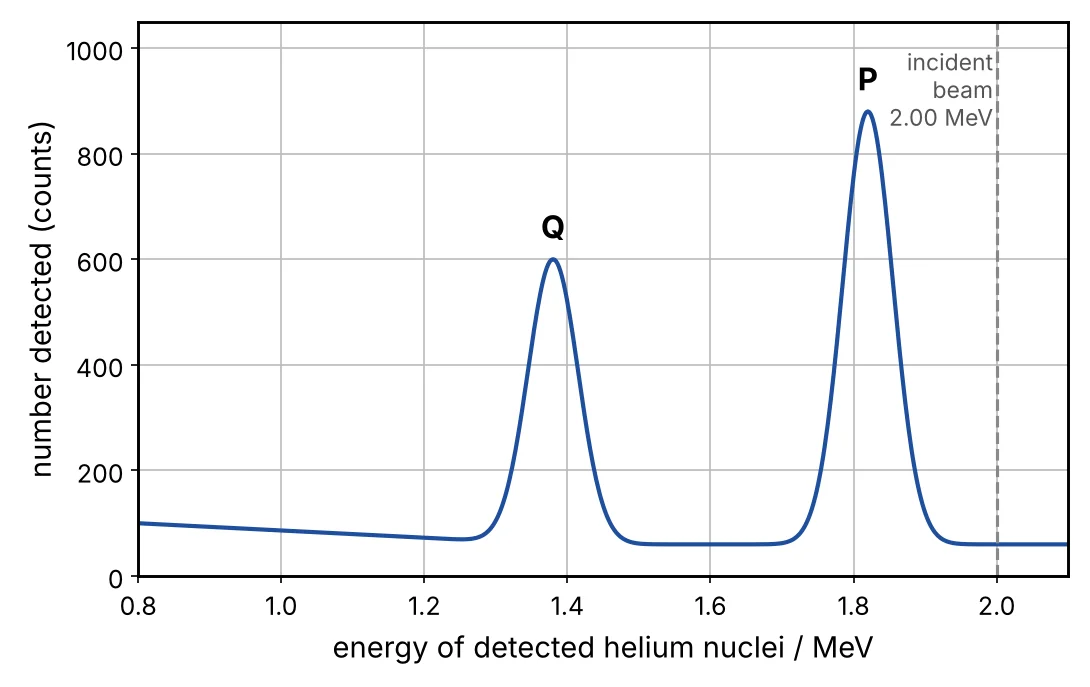
Museum scientists use Rutherford backscattering to examine the glaze of a painted bowl without damaging it. A beam of helium nuclei of energy 2.00 MeV is fired at the surface and a detector records the nuclei that bounce straight back. A helium nucleus that bounces off a heavier nucleus keeps a larger fraction of its energy. Of 8.0×1068.0 \times 10^{6} helium nuclei fired, 2.4×1032.4 \times 10^{3} are detected. The graph shows the energies of the detected nuclei; peaks P and Q come from two different elements in the glaze.
Question diagram
(a)
Identify which peak comes from the heavier element and calculate the percentage of its original energy that a helium nucleus keeps at peak P. [2]Criterion D (i) · Level 3-4
(b)
Calculate the percentage of the fired helium nuclei that are detected. Use the nuclear model of the atom to explain why it is so small. [3]Criterion A (ii) · Level 5-6
(c)
State one advantage of this method over removing a small sample of the glaze for analysis. [1]Criterion D (i) · Level 3-4
(d)
The museum is deciding whether to analyse a 3000-year-old bowl by backscattering or by removing a few milligrams of its glaze. Backscattering needs a particle accelerator at a laboratory and analyses only the top few micrometres of the surface. Evaluate the two options, considering at least two different perspectives (for example scientific, cultural, economic or ethical), and give a justified conclusion. [4]Criterion D (ii), D (iii) · Level 7-8

revisionprep.com

Summary Answer

Not available for this question.

Model Answer

Not available for this question.

Marking Scheme

Not available for this question.

Examiner Insights

Not available for this question.

That's every free question here — 6 of 160.

+154 more questions, plus Mock Papers & Worksheets, are waiting in Premium.

Upgrade