You're viewing free preview questions — 5 questions previewing here — subscribe to unlock 156 more, plus the Full Question Bank, Mock Papers & Worksheets.Upgrade
Dangers of Radiation & Safety Measures — Free MYP5 Physics Practice Questions

1QuestionBiological effects in Cell damage/ Cancer risk/ DNA mutationConcept Practice
2 marks~3 minCriterion A
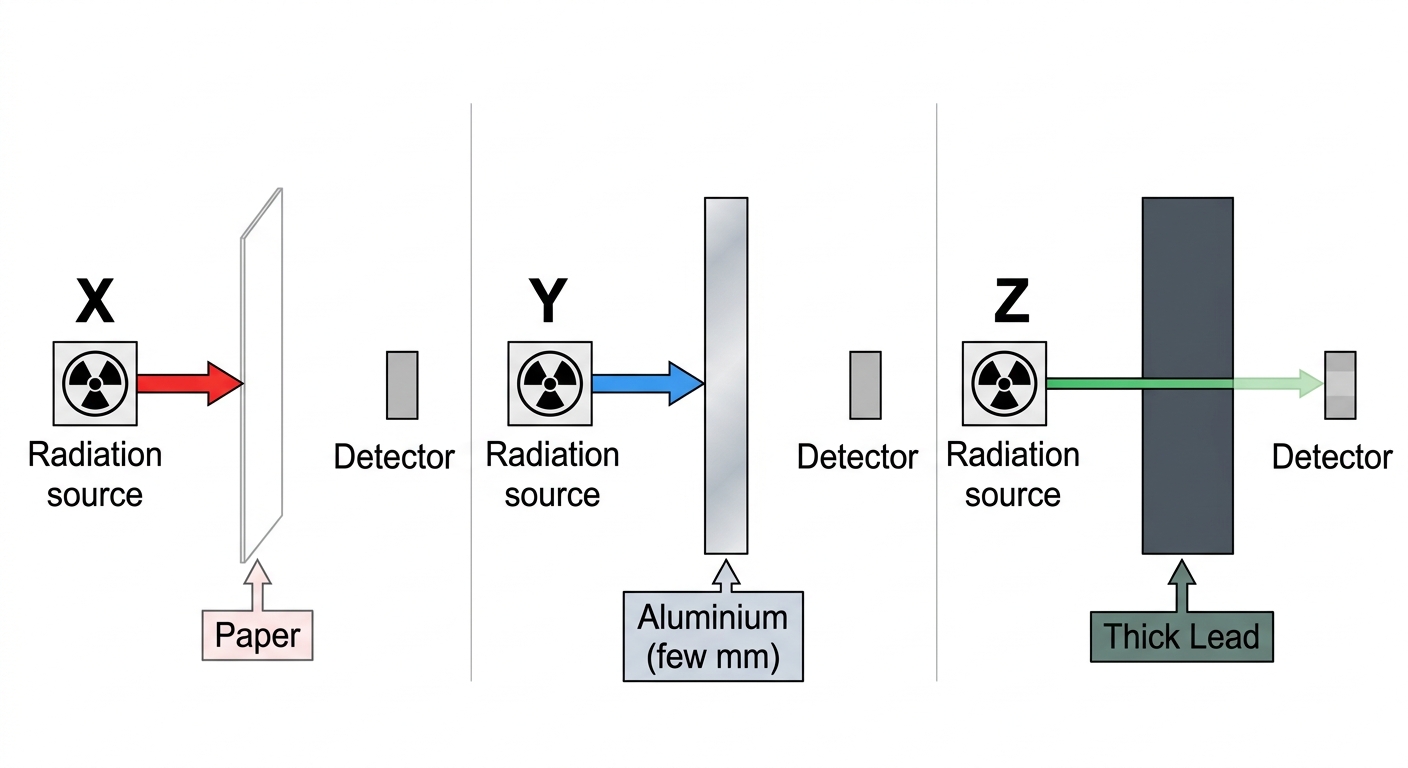
The diagram below shows three types of ionising radiation, labelled X, Y, and Z, each stopped by a different material. Radiation X is stopped by paper, radiation Y is stopped by a few millimetres of aluminium, and radiation Z requires thick lead to be significantly attenuated.
a
Identify which label (X, Y, or Z) represents gamma radiation. [1]
b
Explain why gamma radiation requires thick lead to stop it, while alpha radiation is stopped by paper. [1]

Solutions
2QuestionNuclear accidents (case awareness)Assessment Practice
5 marks~8 minCriterion C
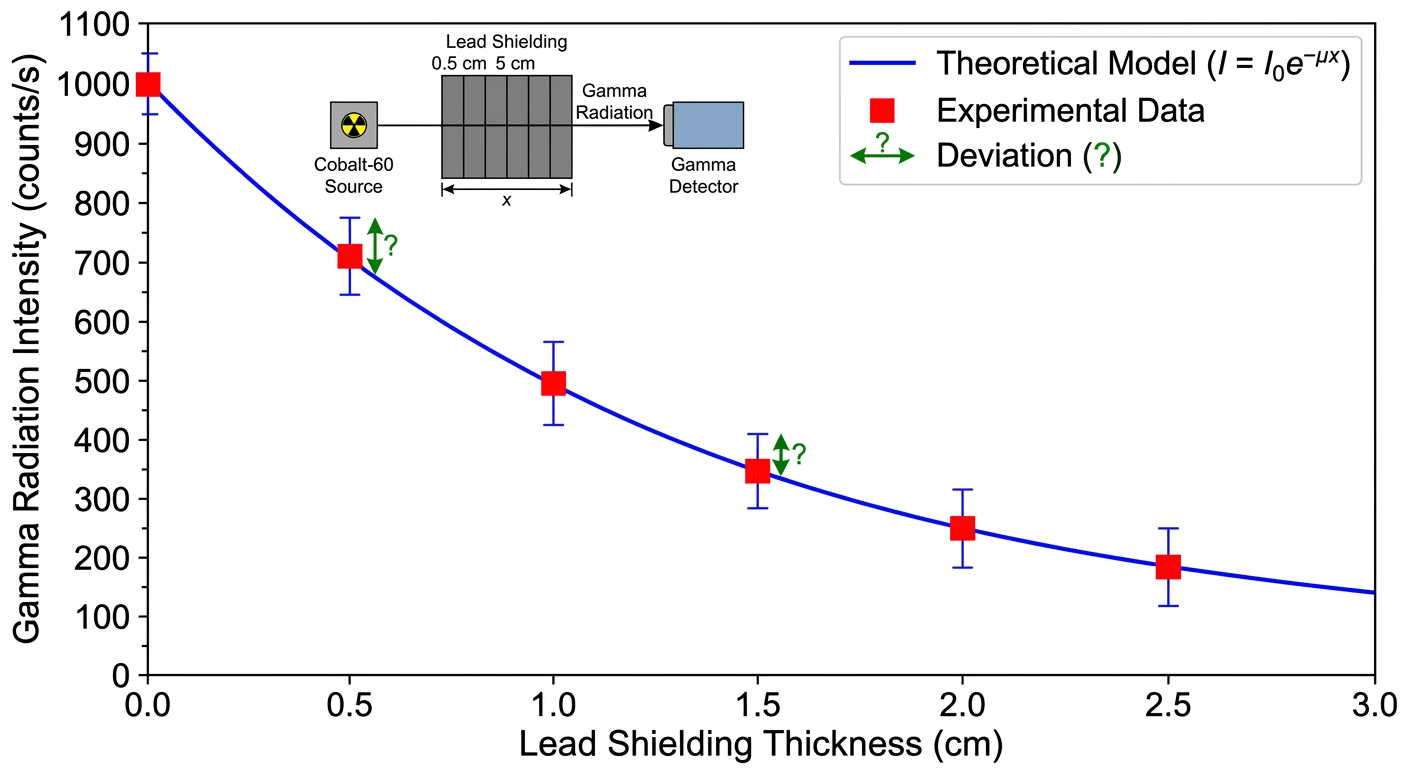
During a simulated nuclear accident, a detector measures the count rate of gamma radiation transmitted through increasing thicknesses of lead shielding. The theoretical count rate is predicted by the exponential attenuation model:
where counts/s and .
where counts/s and .
| Lead thickness (cm) | 0.0 | 0.5 | 1.0 | 1.5 | 2.0 | 2.5 |
|---|---|---|---|---|---|---|
| Experimental count rate (counts/s) | 1000 | 720 | 500 | 350 | 250 | 180 |
| Theoretical count rate (counts/s) | 1000 | 707 | 500 | 353 | 250 | 177 |
a
Calculate the percentage deviation for each data point using:
[2]
[2]
b
Discuss the pattern of deviations and identify their likely physical cause. [1]
c
Evaluate whether the experimental data supports the exponential attenuation model as a valid description of gamma radiation shielding by lead. [2]
Solutions
3QuestionDisposal of radioactive waste (basic idea)Concept Practice
2 marks~3 minCriterion D
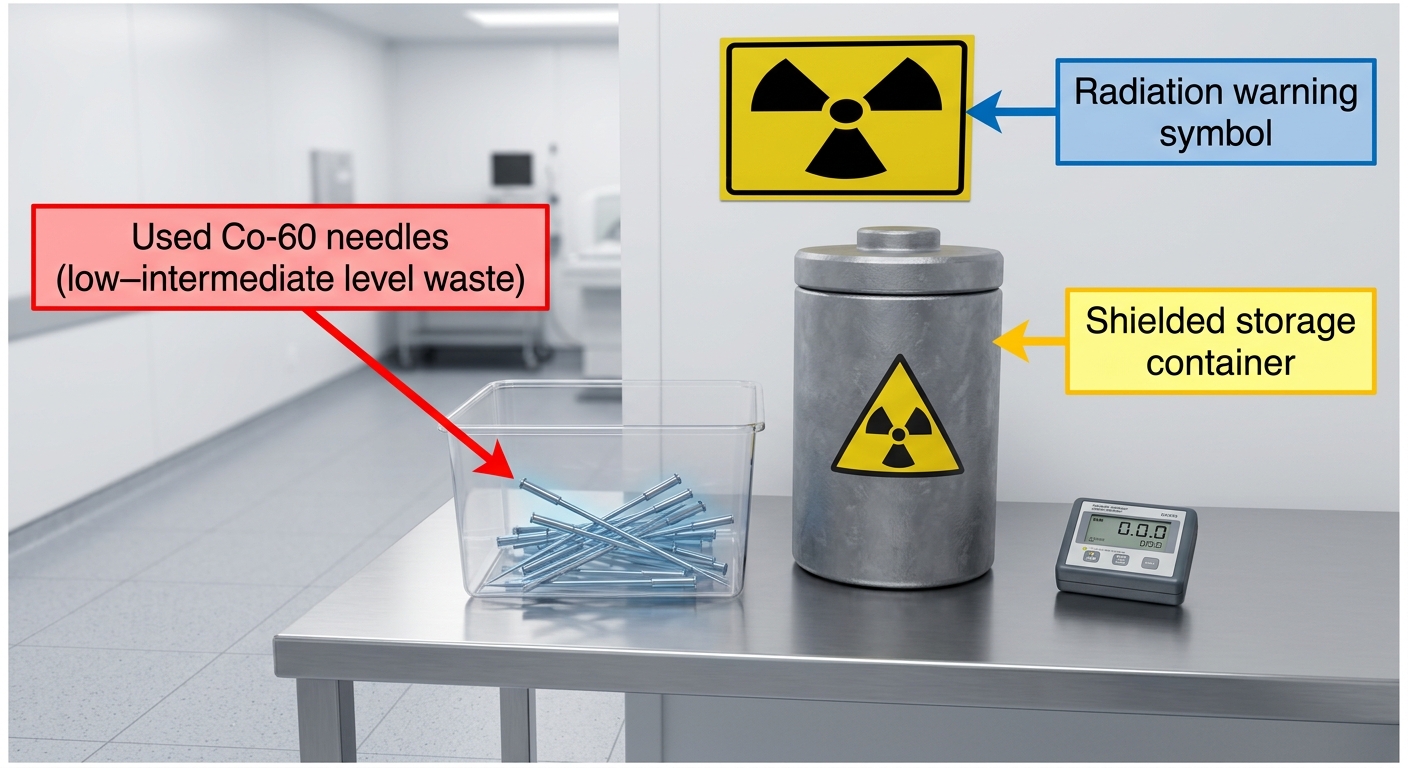
Used cobalt-60 needles from hospitals are classified as low- to intermediate-level radioactive waste. After the source activity falls below safe operational limits, the needles must be disposed of safely.
a
State one method used to dispose of low- to intermediate-level radioactive waste from hospitals. [1]
b
Discuss one societal impact arising from the long storage time required for this type of radioactive waste. [1]
Solutions
4QuestionDisposal of radioactive waste (basic idea)Assessment Practice
8 marks~12 minCriterion C
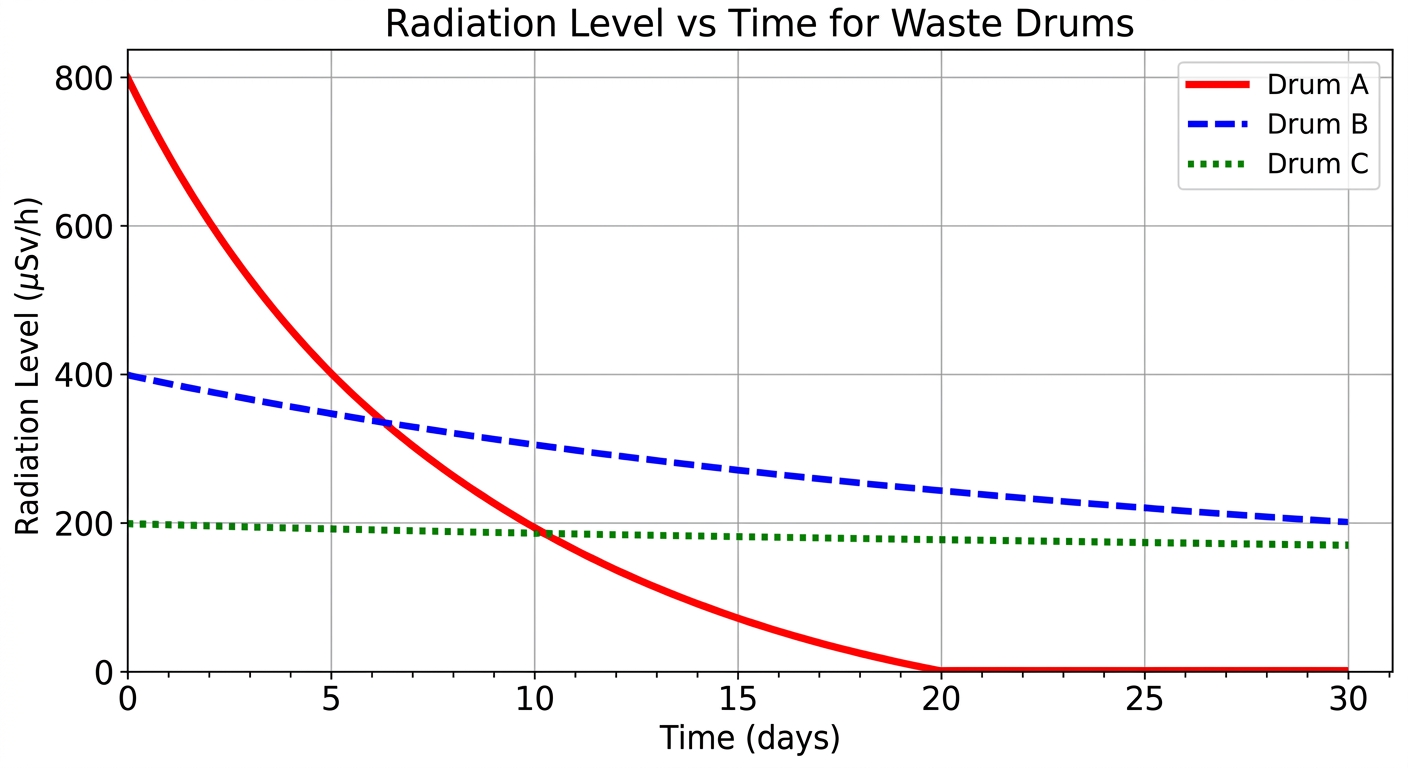
Three identical sealed waste drums — Drum A, Drum B, and Drum C — each contain a different radioactive isotope. A Geiger counter recorded the radiation level at the surface of each drum every 5 days for 30 days. The results are shown in the graph below.
Drum A: starts at 800 μSv/h, falls to near 0 by day 20.
Drum B: starts at 400 μSv/h, falls to 200 μSv/h by day 30.
Drum C: starts at 200 μSv/h, falls to approximately 180 μSv/h by day 30.
Drum A: starts at 800 μSv/h, falls to near 0 by day 20.
Drum B: starts at 400 μSv/h, falls to 200 μSv/h by day 30.
Drum C: starts at 200 μSv/h, falls to approximately 180 μSv/h by day 30.
a
Deduce which drum contains the isotope with the shortest half-life and which contains the isotope with the longest half-life. [2]
b
The monitoring period ends at day 30. Calculate the expected radiation level of Drum B at day 60, and explain how the concept of half-life supports your answer. [3]
c
A worker states that Drum A is safe to handle without shielding after day 60, because its radiation level is negligible. The isotope in Drum A decays into a daughter product with a half-life of 50 years. Evaluate the worker's claim. [3]
Solutions
5QuestionBiological effects in Cell damage/ Cancer risk/ DNA mutationAssessment Practice
8 marks~12 minCriterion D
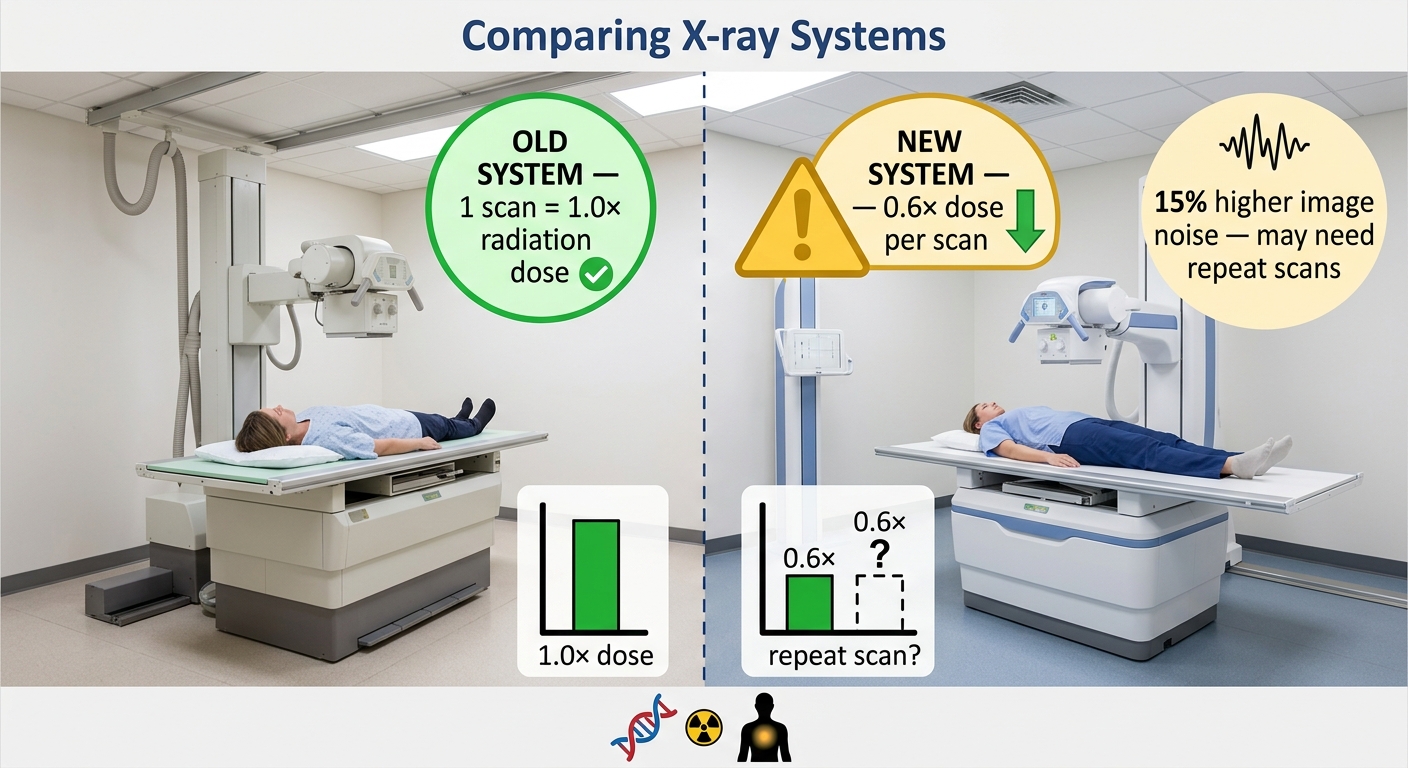
A hospital is considering replacing its X-ray system with a newer model. The new system emits 40% less radiation per scan but produces 15% higher image noise, which may require repeat scans in some cases.
a
Explain how ionizing radiation from X-rays damages DNA and increases the risk of cancer. [2]
b
A patient requires one repeat scan with the new system. Show that the patient's cumulative radiation dose is 1.2 times the original single-scan dose, and discuss why this means the reduction in radiation per scan may not proportionally reduce overall cancer risk. [3]
c
Evaluate the usefulness of the linear no-threshold (LNT) model for estimating cancer risk from low-dose medical X-ray exposures. [3]
Solutions
That's every free question here — 5 of 161.
+156 more questions, plus Mock Papers & Worksheets, are waiting in Premium.