You're viewing free preview questions — 6 questions previewing here — subscribe to unlock 82 more, plus the Full Question Bank, Mock Papers & Worksheets.Upgrade
Back

Forms of radiation: properties, detection and uses — Free MYP5 Physics Practice Questions

Free questions

Open in full, with answers, mark scheme and examiner insights.

Question 1Criterion A · Band 1-4 · Easy · 4 marksrevisionprep.com

Penetrating power, ionising power and biological damage

Nuclear radiations differ in how far they can travel through materials.
(a)
Define penetrating power. [1]Criterion A (i) · Level 1-2
(b)
Identify the radiation with the greatest penetrating power. [1]Criterion A (i) · Level 1-2
(c)
Explain why this radiation is the most penetrating. [2]Criterion A (i) · Level 3-4

revisionprep.com

Summary Answer

Not available for this question.

Model Answer

Not available for this question.

Marking Scheme

Not available for this question.

Examiner Insights

Not available for this question.

Question 2Criterion A · Band 1-2 · Easy · 3 marksrevisionprep.com

Background radiation: Natural sources (cosmic, rocks), Artificial sources
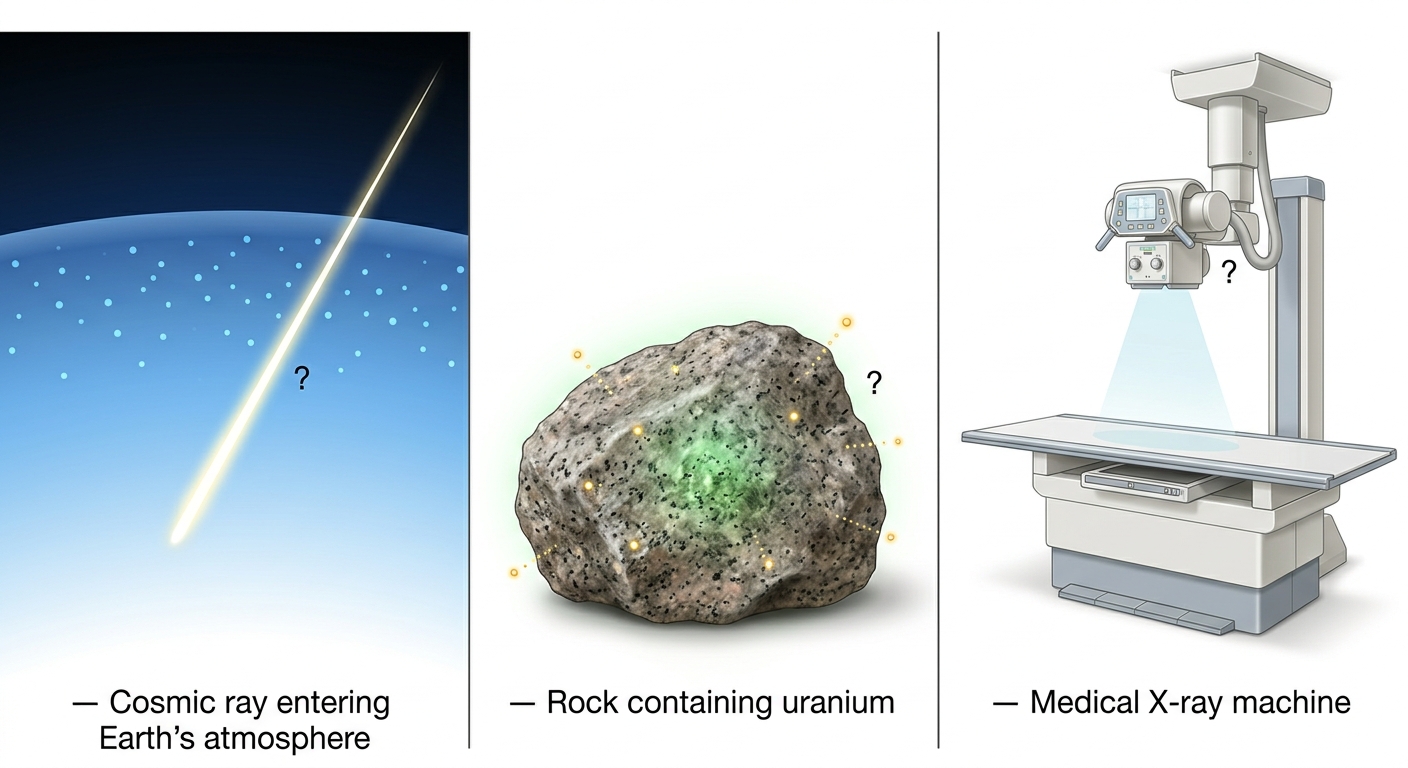
The diagram shows three sources of radiation: a cosmic ray entering the Earth's atmosphere, a rock containing uranium and a medical X-ray machine.
Question diagram
(a)
Identify the two natural sources of radiation shown in the diagram. [1]Criterion A (i) · Level 1-2
(b)
Identify the artificial source shown in the diagram. [1]Criterion A (i) · Level 1-2
(c)
State one other natural source of background radiation that is not shown. [1]Criterion A (i) · Level 1-2

revisionprep.com

Summary Answer

Not available for this question.

Model Answer

Not available for this question.

Marking Scheme

Not available for this question.

Examiner Insights

Not available for this question.

Question 3Criterion A + C · Band 1-6 · Medium · 6 marksrevisionprep.com

Nature of each radiation: Mass, charge, speed
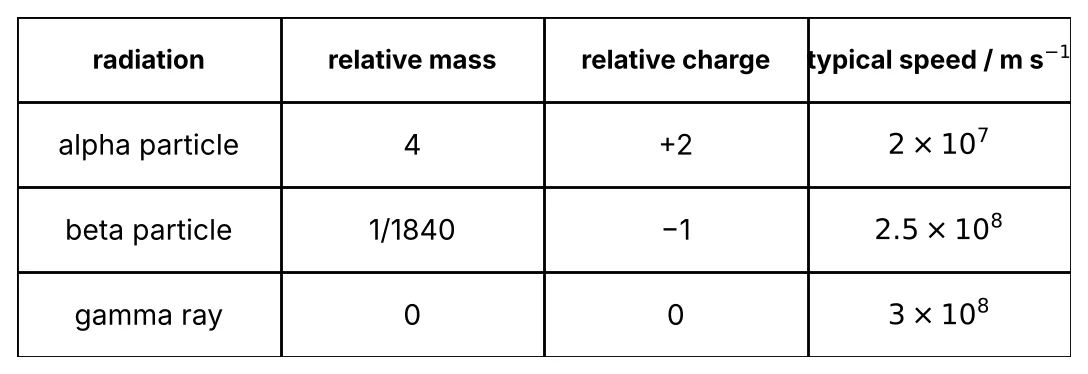
The table shows the relative mass, relative charge and typical speed of the three types of nuclear radiation. The speed of light is 3×1083 \times 10^{8} m s⁻¹.
Question diagram
(a)
Calculate the typical speed of an alpha particle as a percentage of the speed of light. [2]Criterion A (ii) · Level 3-4
(b)
State the trend in typical speed as relative mass decreases. [1]Criterion A (iii) · Level 1-2
(c)
Outline why gamma radiation travels at the speed of light. [1]Criterion A (i) · Level 3-4
(d)
A student claims: "Gamma radiation is the fastest because it has no charge, so nothing slows it down." Evaluate this claim. [2]Criterion C (iii) · Level 5-6

revisionprep.com

Summary Answer

Not available for this question.

Model Answer

Not available for this question.

Marking Scheme

Not available for this question.

Examiner Insights

Not available for this question.

Question 4Criterion C + A · Band 3-6 · Medium · 8 marksrevisionprep.com

Detection methods: Geiger-Müller counter, Photographic film

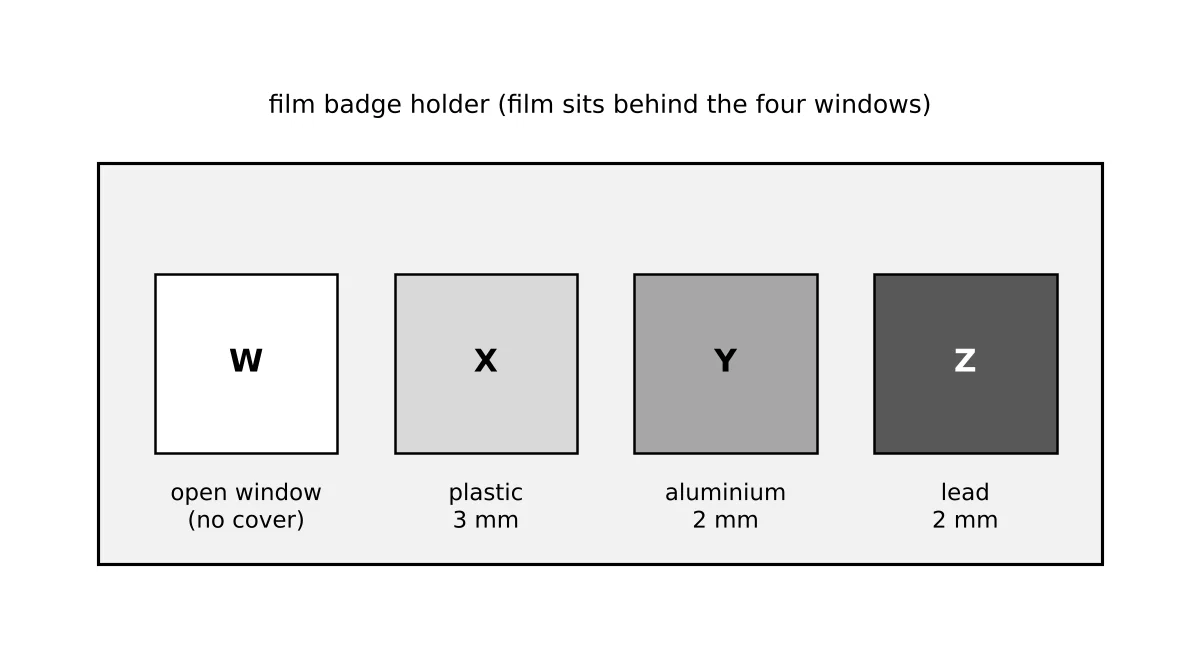
Hospital radiographers wear film badges. The diagram shows a badge holder with four windows, W to Z, in front of the film. After one month the films of two workers are developed.

Worker AW darkX mediumY not darkenedZ not darkened
Worker BW mediumX mediumY mediumZ light
Question diagram
(a)
Explain how the film detects ionising radiation. [2]Criterion A (i) · Level 3-4
(b)
Deduce the type of radiation that Worker A was exposed to. Justify your answer using the windows. [2]Criterion C (ii) · Level 5-6
(c)
Deduce the type of radiation that Worker B was exposed to. Justify your answer. [2]Criterion C (ii) · Level 5-6
(d)
Explain why the badge does not record alpha radiation, and why this does not matter for the workers' safety outside the body. [2]Criterion C (ii) · Level 5-6

revisionprep.com

Summary Answer

Not available for this question.

Model Answer

Not available for this question.

Marking Scheme

Not available for this question.

Examiner Insights

Not available for this question.

Question 5Criterion D + A · Band 5-8 · Challenge · 10 marksrevisionprep.com

Types of radiation :Alpha (α) particles, Beta (β) particles, Gamma (γ) rays
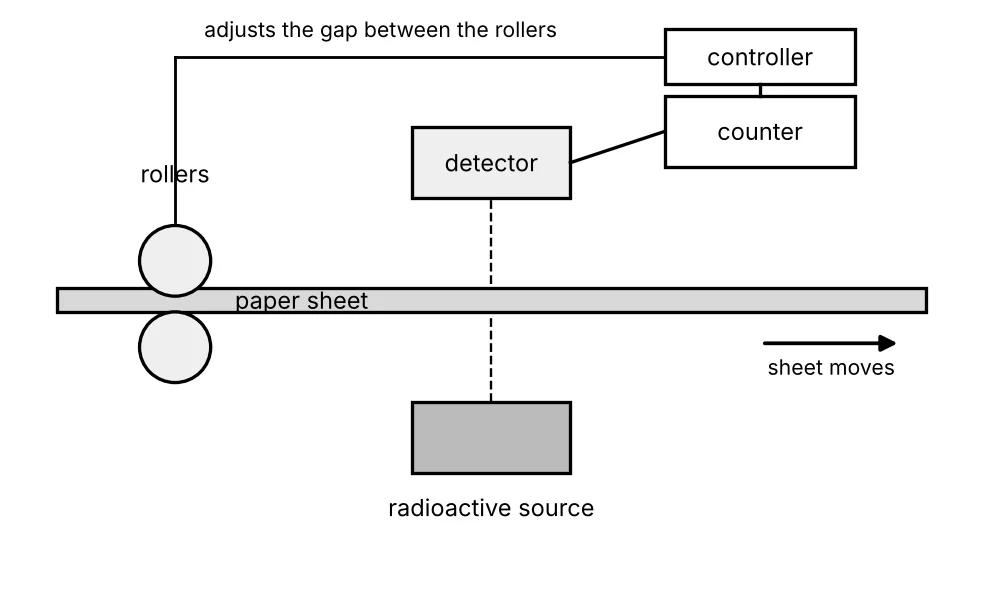
A paper mill measures the thickness of a moving sheet of paper with a radioactive source on one side of the sheet and a detector on the other. The counter reading depends on the thickness of the paper. The mill employs 40 workers. It must choose a type of source, and is also considering replacing the gauge with a laser gauge that costs three times as much.
Question diagram
(a)
Explain why a source of beta particles is more suitable for this gauge than a source of alpha particles or a source of gamma rays. [3]Criterion A (ii) · Level 5-6
(b)
Explain how the counter reading is used to keep the paper at a constant thickness. [2]Criterion D (i) · Level 5-6
(c)
Evaluate whether the mill should keep the radioactive gauge or buy the laser gauge. Refer to at least two perspectives, such as worker safety, waste, cost and reliability, and reach a justified conclusion. [5]Criterion D (ii), D (iii) · Level 7-8

revisionprep.com

Summary Answer

Not available for this question.

Model Answer

Not available for this question.

Marking Scheme

Not available for this question.

Examiner Insights

Not available for this question.

Question 6Criterion B + A · Band 5-8 · Challenge · 10 marksrevisionprep.com

Deflection in electric and magnetic fields
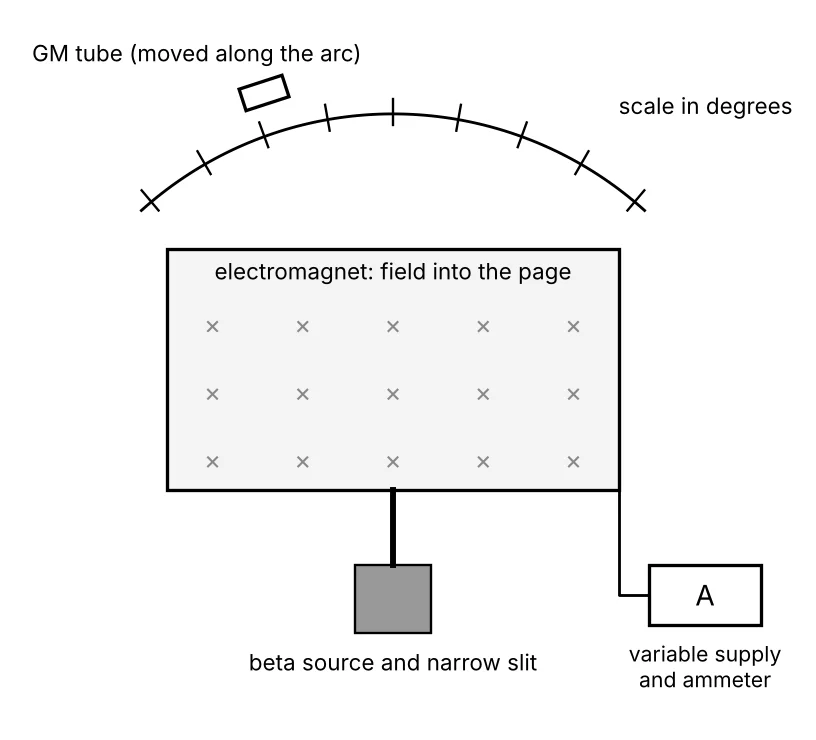
A student has an electromagnet whose magnetic field gets stronger when the current in its coil increases. A narrow beam of beta particles from a strontium-90 source passes through the field in a vacuum chamber. A GM tube can be moved along an arc marked in degrees to find the angle at which the count rate is greatest. She wants to test the hypothesis: 'the angle of deflection is directly proportional to the current in the coil'. In a pilot run she finds the angle of the peak count rate (uncertainty ±1°).

Current (A)0.51.01.52.02.5Angle of peak count rate (°)510141821\begin{array}{|l|c|c|c|c|c|}\hline \text{Current (A)} & 0.5 & 1.0 & 1.5 & 2.0 & 2.5 \\ \hline \text{Angle of peak count rate (°)} & 5 & 10 & 14 & 18 & 21 \\ \hline\end{array}
Question diagram
(a)
Formulate a hypothesis for how the count rate at a fixed angle of 10° will change if the current is doubled from 1.0 A to 2.0 A, and explain it. [2]Criterion B (ii) · Level 5-6
(b)
Identify the independent variable, the dependent variable and two control variables for the main investigation. Explain how one control variable is kept constant. [3]Criterion B (iii) · Level 5-6
(c)
Describe how she should find the angle of the peak count rate at each current, how she deals with background radiation and how she gets reliable data. State one safety precaution. [3]Criterion B (iv) · Level 5-6
(d)
Evaluate the hypothesis 'the angle of deflection is directly proportional to the current' using the pilot data and the uncertainty of ±1°. Suggest a physical reason for any deviation. [2]Criterion A (iii) · Level 7-8

revisionprep.com

Summary Answer

Not available for this question.

Model Answer

Not available for this question.

Marking Scheme

Not available for this question.

Examiner Insights

Not available for this question.

That's every free question here — 6 of 88.

+82 more questions, plus Mock Papers & Worksheets, are waiting in Premium.

Upgrade