You're viewing free preview questions — 5 questions previewing here — subscribe to unlock 93 more, plus the Full Question Bank, Mock Papers & Worksheets.Upgrade
Forms of Radiation: Properties, Uses & Detection — Free MYP5 Physics Practice Questions

1QuestionDetection methods: Geiger-Müller counter, Photographic filmAssessment Practice
3 marks~5 minCriterion C
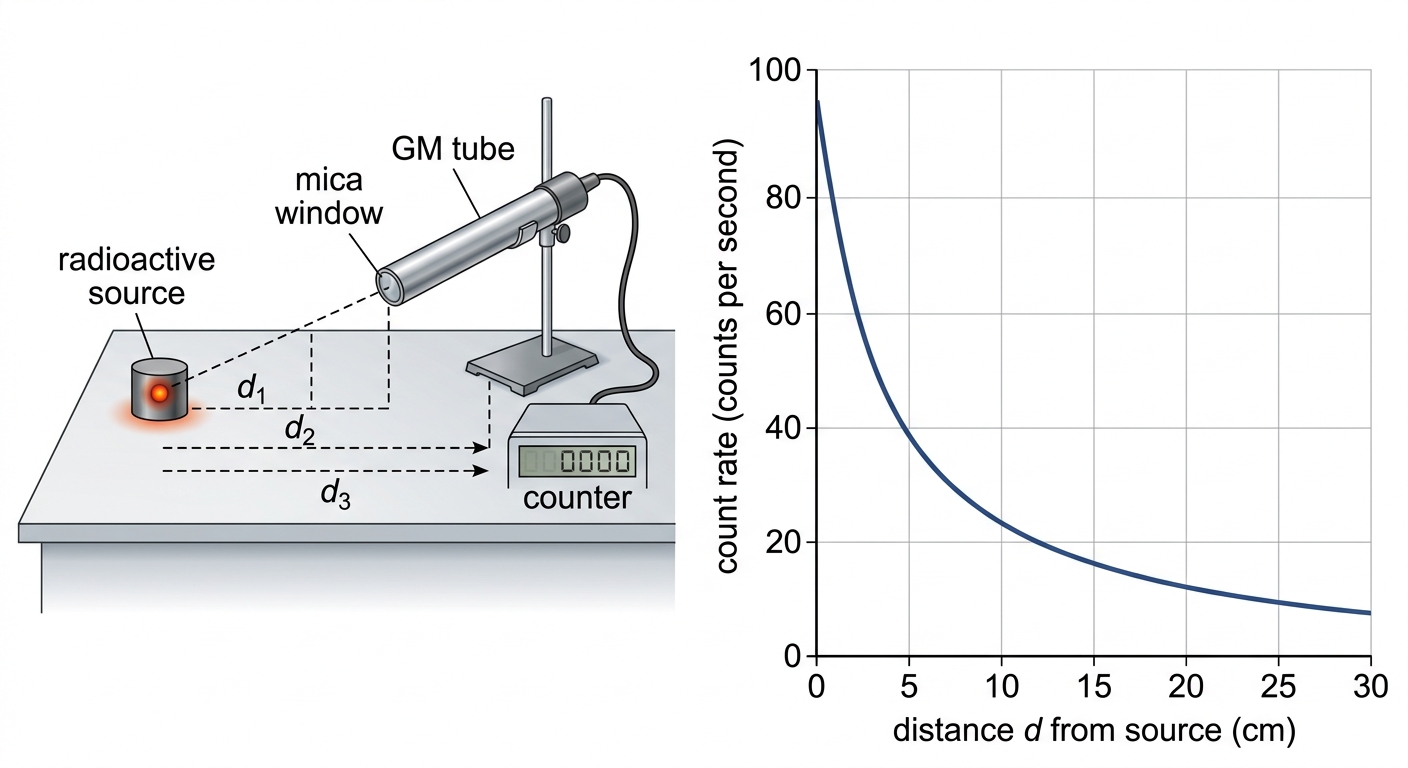
A Geiger–Müller (GM) tube is placed at increasing distances from a small radioactive source in air. The graph shows count rate (counts per second) plotted against distance from the source.
a
State the inverse-square law for radiation intensity from a point source. [1]
b
Explain why the count rate measured by the GM tube decreases as increases, linking the inverse-square law to the fixed detection area of the tube's window. [1]
c
A student claims that doubling the distance will halve the count rate. Evaluate this claim. [1]

Solutions
2QuestionDeflection in electric and magnetic fieldsAssessment Practice
3 marks~5 minCriterion C
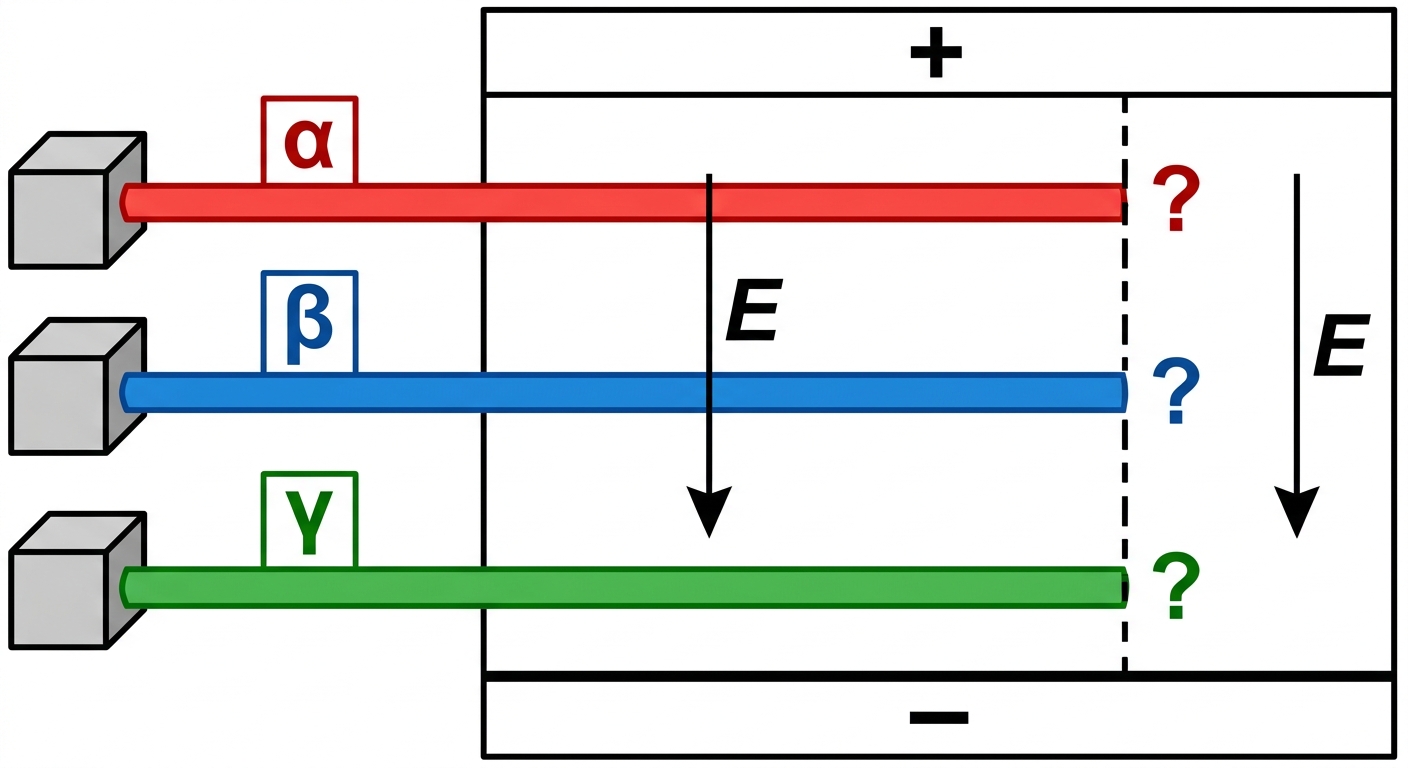
The diagram below shows the trajectories of alpha, beta, and gamma radiation entering a uniform electric field directed vertically downward.
a
State the charge of each type of radiation. [1]
b
Using the relationship , explain why alpha and beta particles deflect in opposite directions in this field. [1]
c
A student claims that a more massive alpha particle will always deflect less than a beta particle in the same electric field, regardless of their speeds. Justify whether this claim is correct. [1]
Solutions
3QuestionComparison of properties pentrating power/ionization power/ biological damageAssessment Practice
5 marks~8 minCriterion A
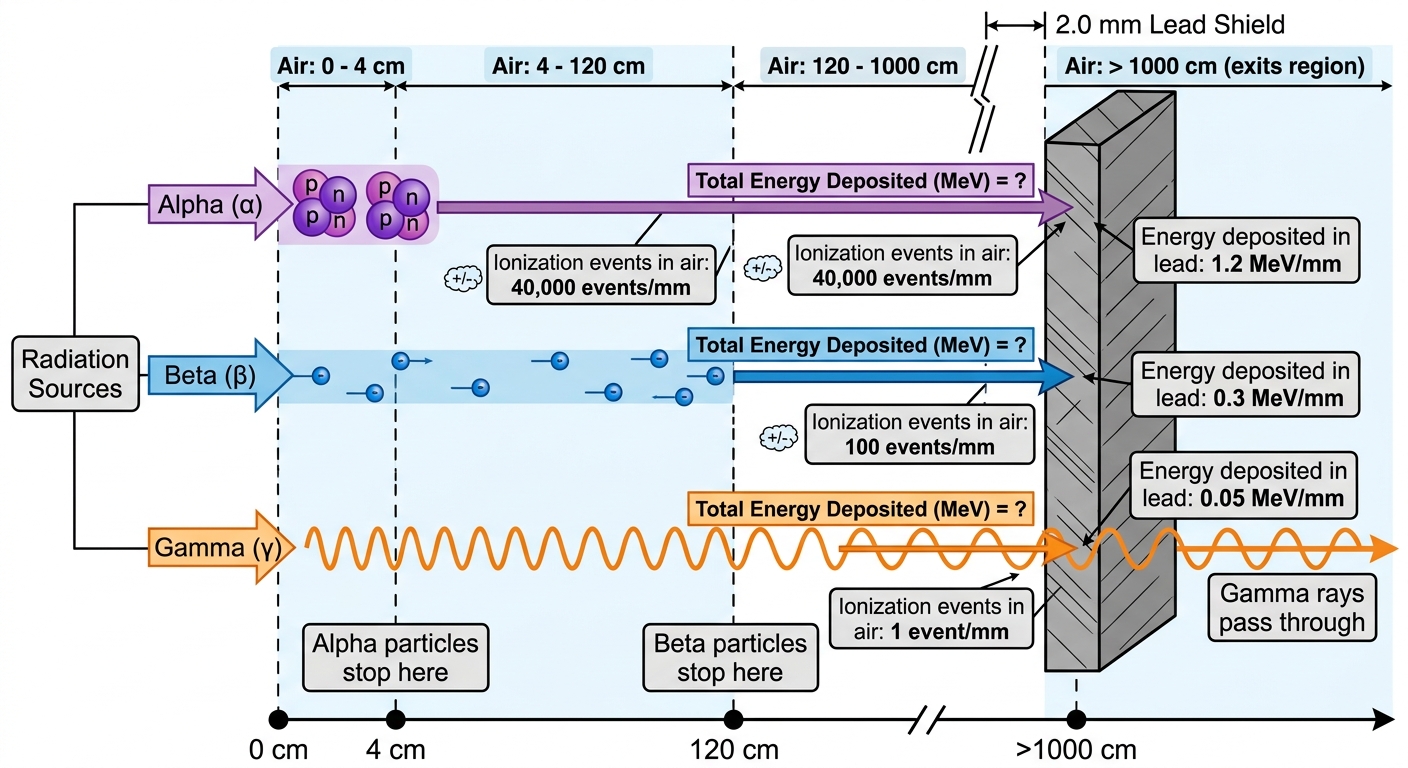
A radiation simulation records the following data for alpha, beta, and gamma radiation travelling through air before striking a 2.0 mm lead shield.
Distance travelled in air before reaching the shield (cm):
Alpha: 4.0 — Beta: 120 — Gamma: exits simulation (> 1000)
Energy deposited in lead (MeV per mm of lead):
Alpha: 1.2 — Beta: 0.3 — Gamma: 0.05
Ionisation events in air (events per mm of travel):
Alpha: 40 000 — Beta: 100 — Gamma: 1
Distance travelled in air before reaching the shield (cm):
Alpha: 4.0 — Beta: 120 — Gamma: exits simulation (> 1000)
Energy deposited in lead (MeV per mm of lead):
Alpha: 1.2 — Beta: 0.3 — Gamma: 0.05
Ionisation events in air (events per mm of travel):
Alpha: 40 000 — Beta: 100 — Gamma: 1
a
Calculate the total energy deposited by each radiation type in the 2.0 mm lead shield. [1]
b
Using the ionisation data and the distances travelled in air, explain the relationship between a particle's stopping distance and its rate of energy transfer to matter. [2]
c
Justify why alpha radiation causes the greatest biological damage despite having the least penetrating power. [2]
Solutions
4QuestionBackground radiation: Natural sources (cosmic, rocks), Artificial sourcesAssessment Practice
6 marks~9 minCriterion D
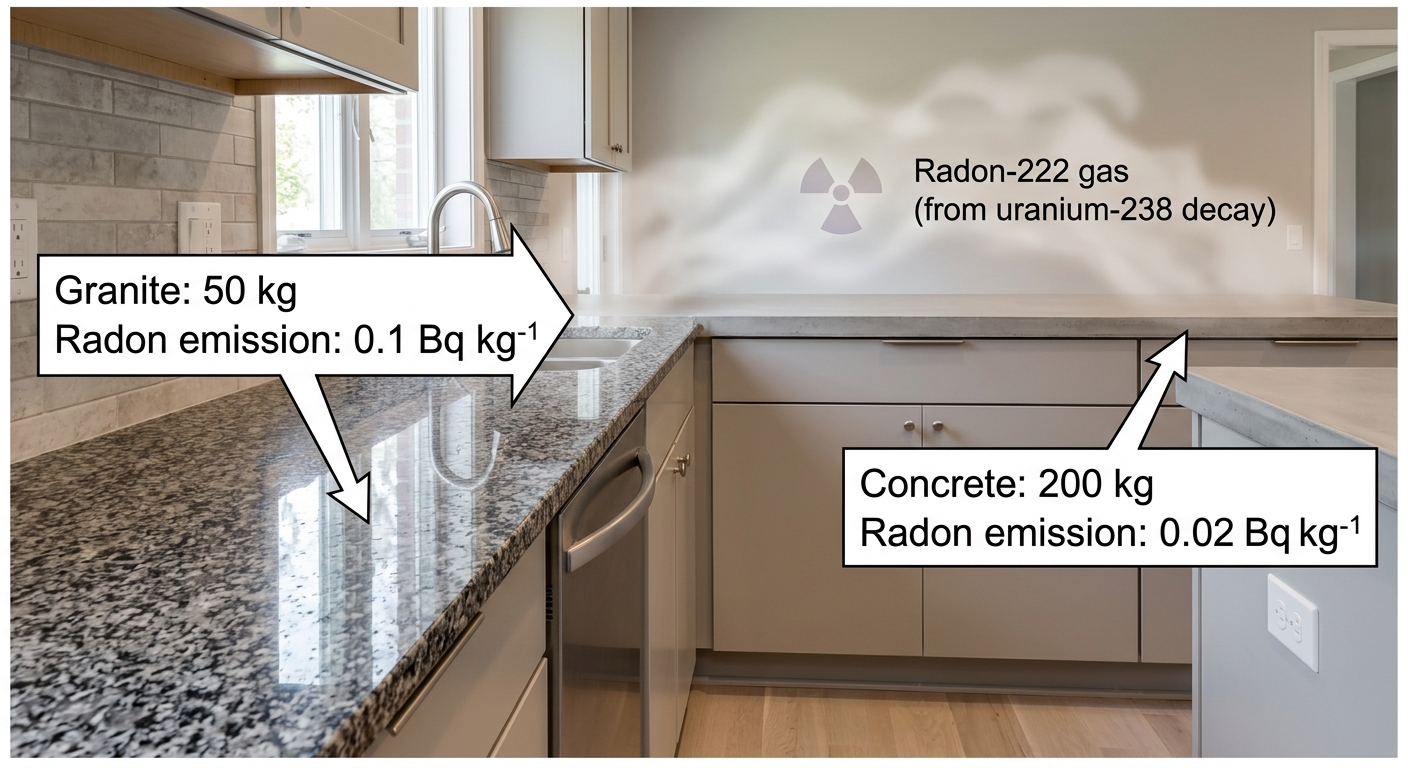
A family is choosing between granite countertops and standard concrete for their kitchen renovation. Granite contains trace amounts of uranium-238, which decays to produce radon-222 gas. The granite emits radon at ; the kitchen will contain of granite. Standard concrete emits radon at ; will be used. Inhaling radon delivers an annual dose of per of activity.
a
Calculate the annual radon dose for each material option. [2]
b
Deduce which material poses the greater radon health risk, and explain why the difference in calculated doses may not be meaningful in practice. [2]
c
Discuss the limitations of using only these calculated doses to decide which material is safer for the family. [2]
Solutions
5QuestionDeflection in electric and magnetic fieldsAssessment Practice
8 marks~12 minCriterion D
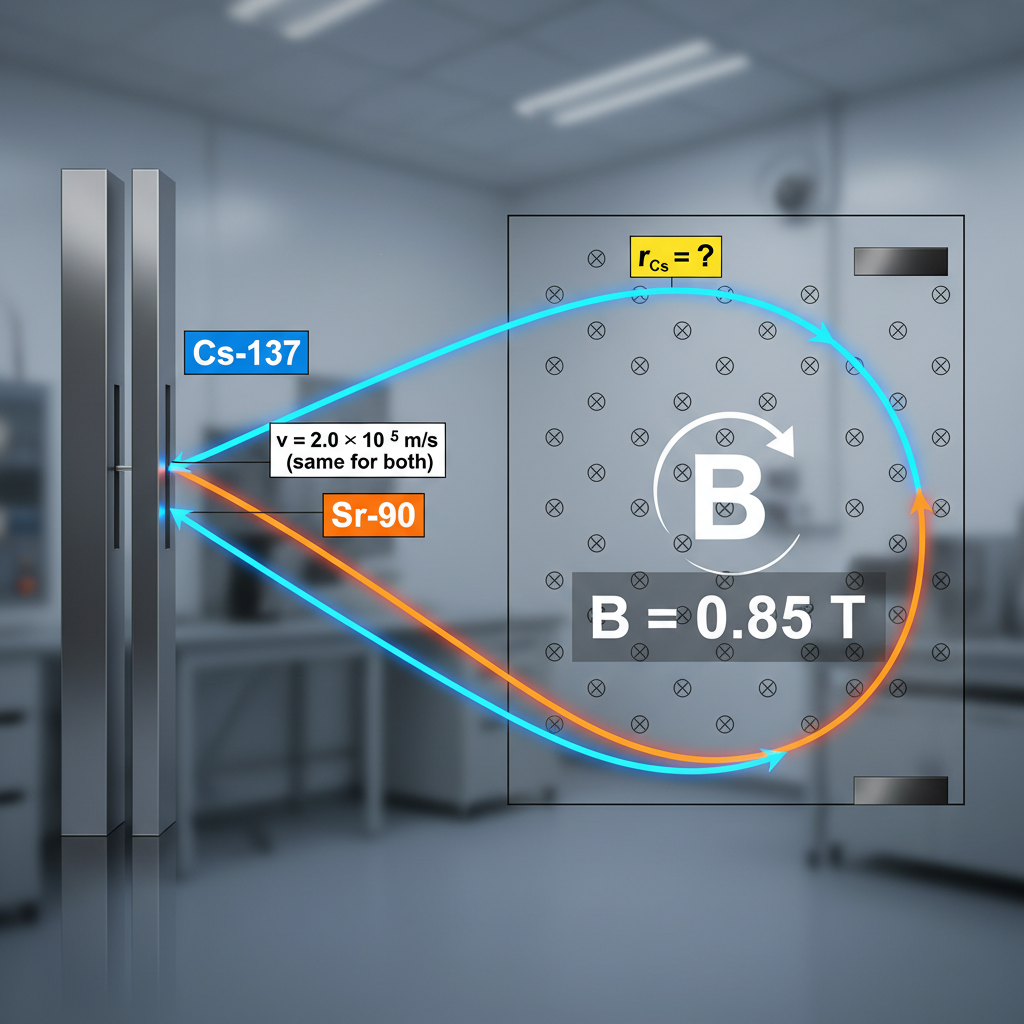
A nuclear reprocessing facility stores and in a storage pond. To reduce long-term waste, a mass spectrometer separates these isotopes: ions are accelerated to the same speed and enter a uniform magnetic field , where the magnetic force provides the centripetal force, causing each ion to follow a circular path. Both isotopes form singly charged ions ().
a
Deduce which isotope has the larger radius of curvature in the magnetic field. [2]
b
Explain how the separation of creates both a benefit for long-term waste management and a security risk. [3]
c
Evaluate the environmental limitations of using a mass spectrometer for large-scale isotope separation, discussing at least two distinct limitations. [3]
Solutions
That's every free question here — 5 of 98.
+93 more questions, plus Mock Papers & Worksheets, are waiting in Premium.