You're viewing free preview questions — 5 questions previewing here — subscribe to unlock 148 more, plus the Full Question Bank, Mock Papers & Worksheets.Upgrade
Nuclear Stability & Isotopes — Free MYP5 Physics Practice Questions

1QuestionConcept of nuclear forces: Strong nuclear force (basic idea)Concept Practice
2 marks~3 minCriterion A
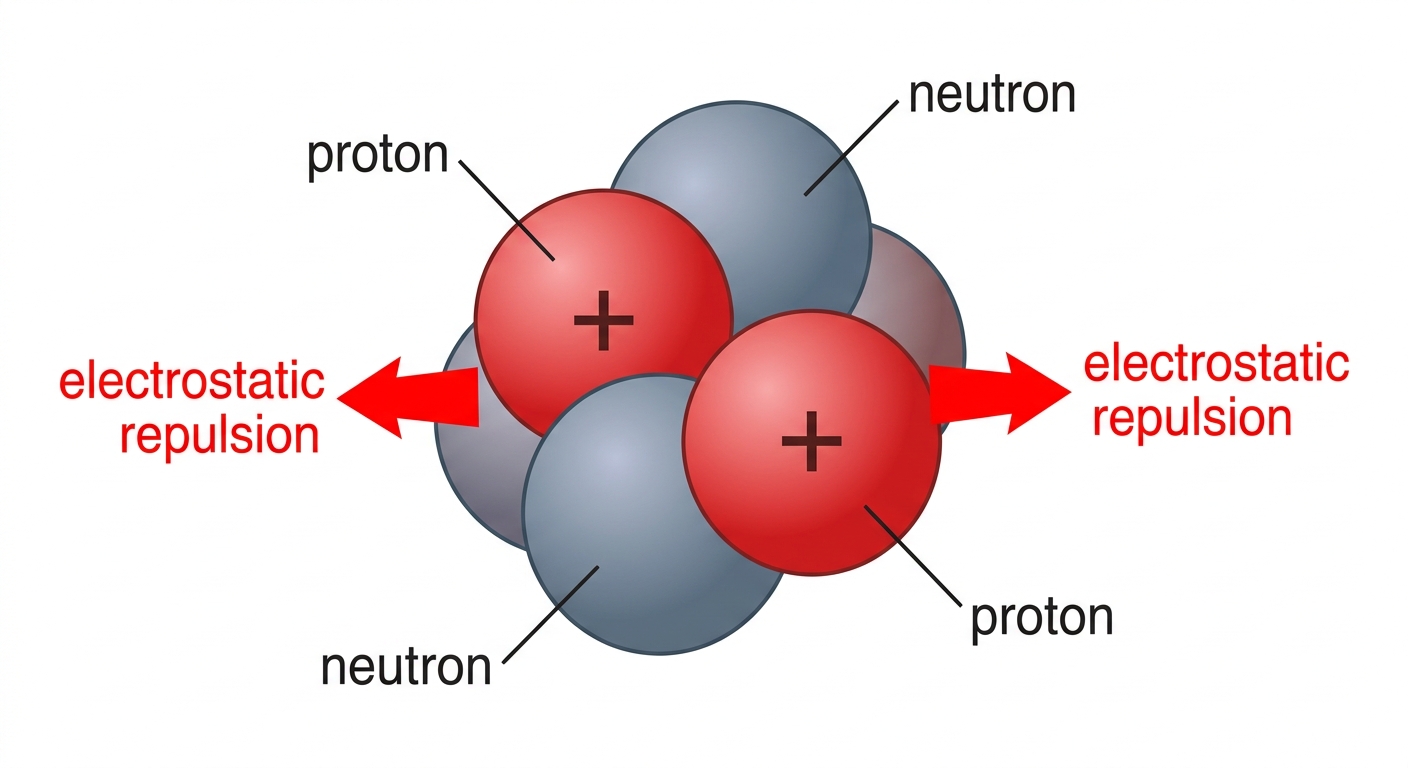
The diagram shows a helium-4 nucleus containing two protons and two neutrons. Arrows indicate the electrostatic repulsion acting between the two protons due to their positive charges.
a
Identify the force responsible for holding the nucleus together despite this repulsion. [1]
b
Explain why this force does not cause the entire nucleus of a large atom, such as uranium-238, to collapse into a single point. [1]

Solutions
2QuestionDefinition of isotopesAssessment Practice
2 marks~3 minCriterion D
Technetium-99m (Tc) is widely used in nuclear medicine imaging. It is produced in hospital generators from the decay of molybdenum-99 (Mo).
a
Identify the type of radiation emitted by Tc and explain why this nuclear property, together with its half-life of 6 hours, makes it suitable for diagnostic imaging. [1]
b
Evaluate one limitation of using Tc in clinical settings, considering both its nuclear properties and practical consequences for patient access. [1]

Solutions
3QuestionApplications of isotopes: Medical (tracers, cancer treatment), Industrial uses, Carbon dating (basic idea)Assessment Practice
2 marks~3 minCriterion A
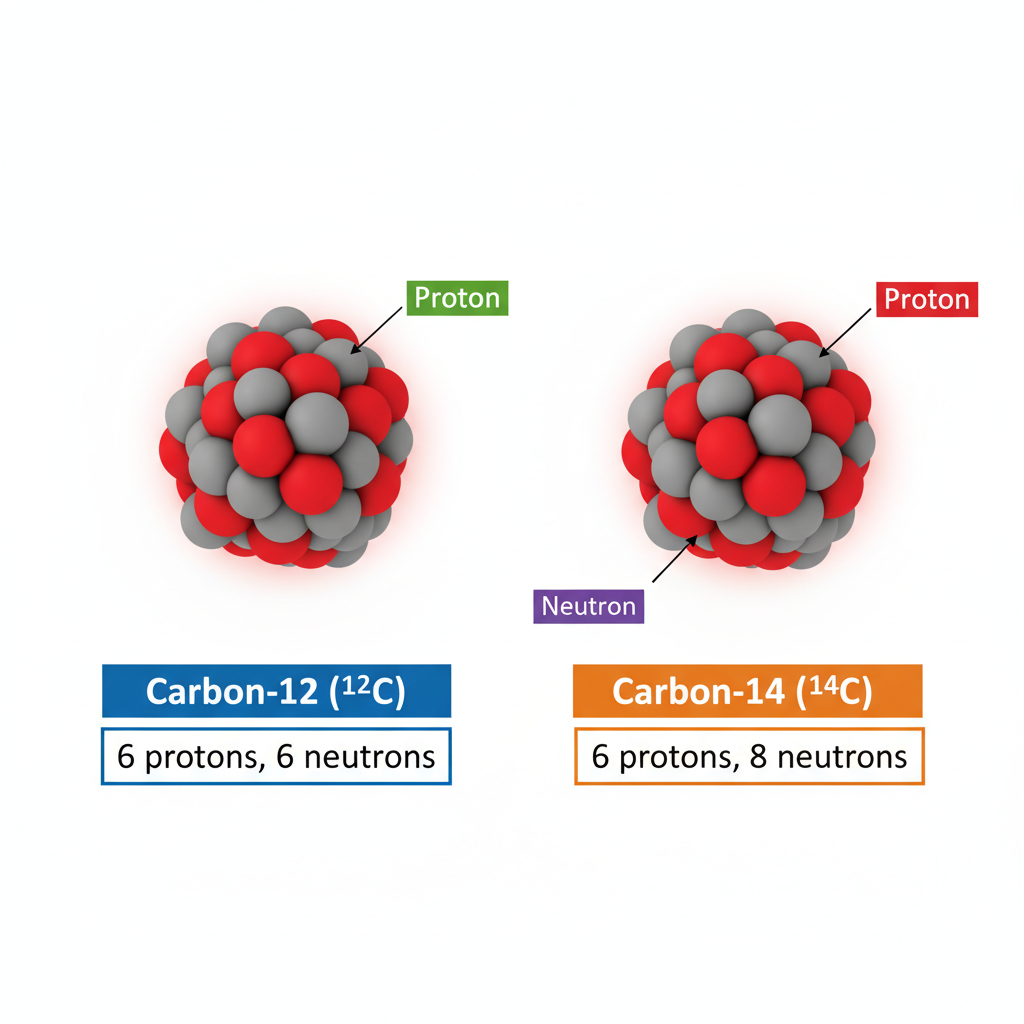
Carbon-14 (C) is used in radiocarbon dating of ancient organic material. Both carbon-12 (C) and carbon-14 (C) have 6 protons.
a
State which isotope is radioactive and identify the subatomic particle whose differing number causes this instability. [1]
b
A sample of ancient wood contains only C and C. Deduce why the ratio of C to C decreases over time, but the number of C atoms remains constant. [1]
Solutions
4QuestionApplications of isotopes: Medical (tracers, cancer treatment), Industrial uses, Carbon dating (basic idea)Assessment Practice
3 marks~5 minCriterion D
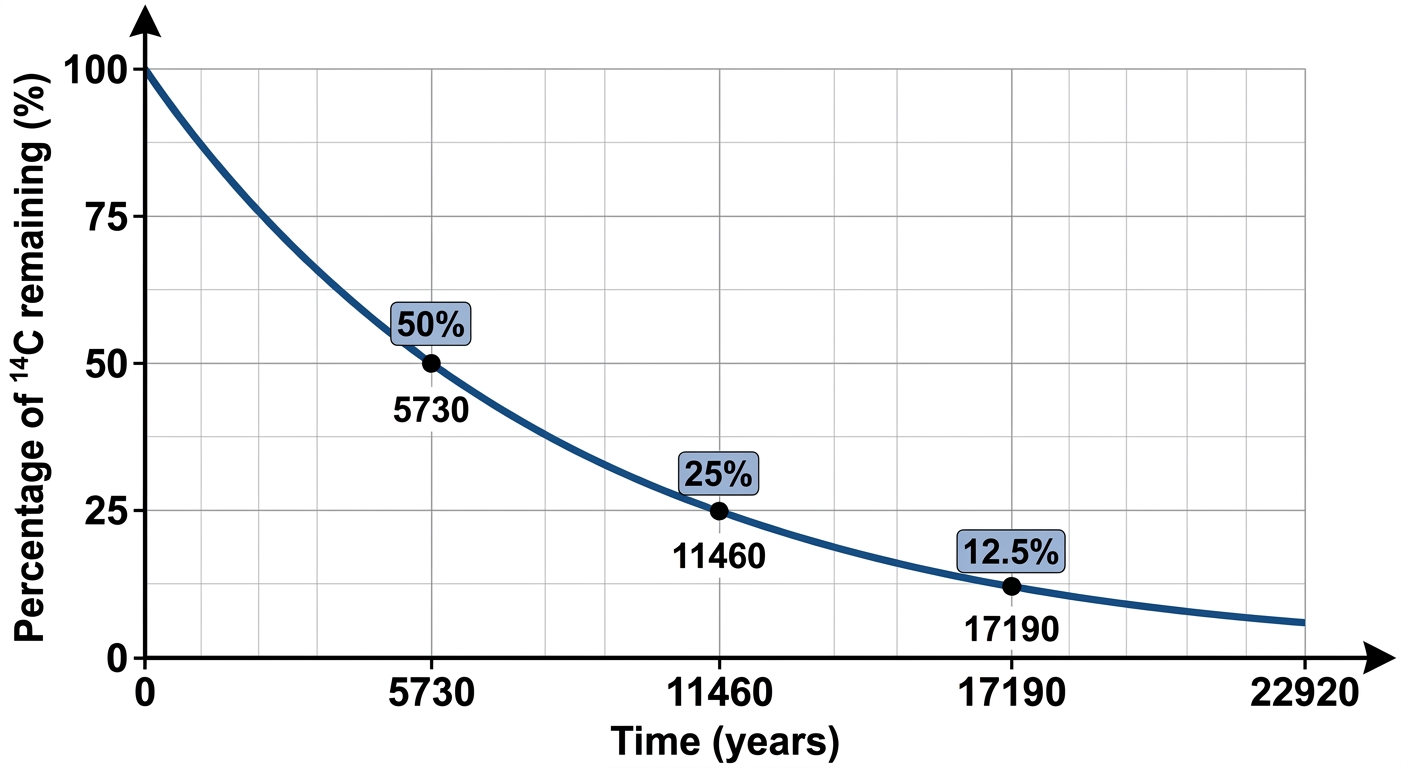
The graph shows the percentage of carbon-14 (C) remaining in an organic sample plotted against time (years). The curve begins at 100% at , falls to 50% at years, to 25% at years, and to 12.5% at years.
a
Use the graph to deduce the half-life of carbon-14. [1]
b
Explain the relationship between time elapsed and the percentage of C remaining shown by the graph. [1]
c
A piece of ancient wood contains 25% of its original carbon-14. Deduce the age of the wood and justify why carbon-14, rather than a isotope with a much shorter half-life, is more suitable for dating objects thousands of years old. [1]
Solutions
5QuestionNotation of isotopes (e.g., ¹⁴C)Assessment Practice
4 marks~6 minCriterion D
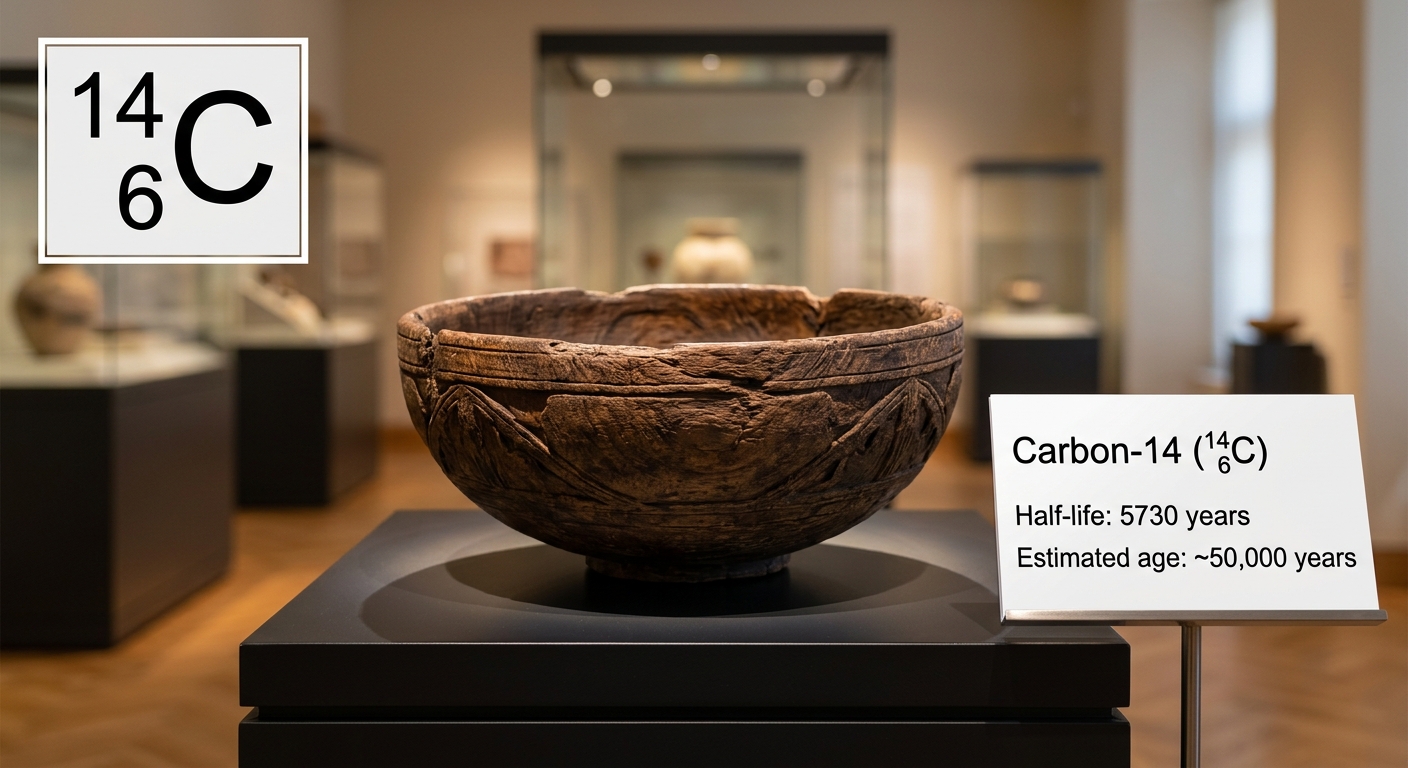
A museum uses carbon-14 dating to estimate the age of a wooden artifact. Carbon-14 is represented by the notation , where the half-life of is 5730 years. Analysis indicates the artifact is approximately 50,000 years old.
a
State two assumptions that must be made for carbon-14 dating to yield an accurate age. [2]
b
The artifact is claimed to be 50,000 years old. Discuss why this age estimate is likely to be unreliable, referring to the half-life of and the impact on measurement accuracy. [2]
Solutions
That's every free question here — 5 of 153.
+148 more questions, plus Mock Papers & Worksheets, are waiting in Premium.