You're viewing free preview questions — 6 questions previewing here — subscribe to unlock 70 more, plus the Full Question Bank, Mock Papers & Worksheets.Upgrade
Back

Balanced and unbalanced forces — Free MYP5 Physics Practice Questions

Free questions

Open in full, with answers, mark scheme and examiner insights.

Question 1Criterion A · Band 1-2 · Easy · 4 marksrevisionprep.com

Identifying Balanced and Unbalanced Force Scenarios
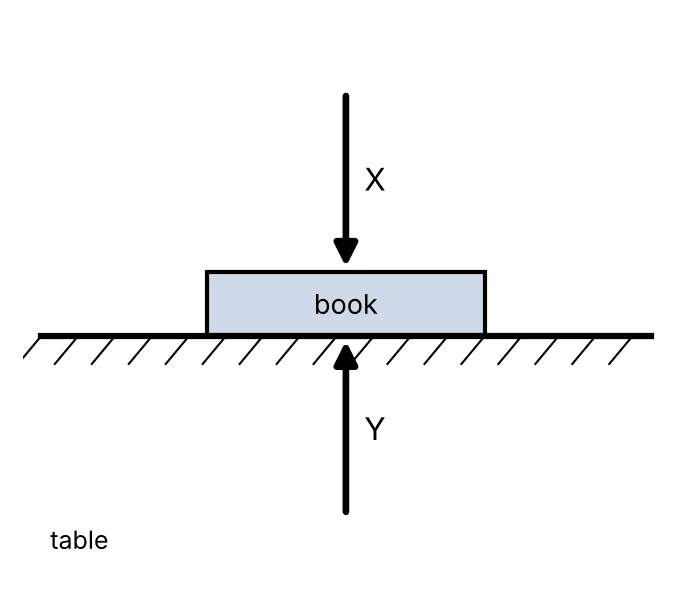
The diagram shows a textbook of mass 1.2 kg resting on a horizontal desk. Two forces, X and Y, act on the book. Take g=9.8 N kg−1g = 9.8\ \text{N kg}^{-1}.
Question diagram
(a)
Identify forces X and Y and state the object that exerts each force. [2]Criterion A (i) · Level 1-2
(b)
Calculate the size of each force. [1]Criterion A (ii) · Level 1-2
(c)
State why X and Y are not a Newton's third law pair. [1]Criterion A (ii) · Level 1-2

revisionprep.com

Summary Answer

Not available for this question.

Model Answer

Not available for this question.

Marking Scheme

Not available for this question.

Examiner Insights

Not available for this question.

Question 2Criterion A · Band 3-4 · Easy · 4 marksrevisionprep.com

Calculating resultant force

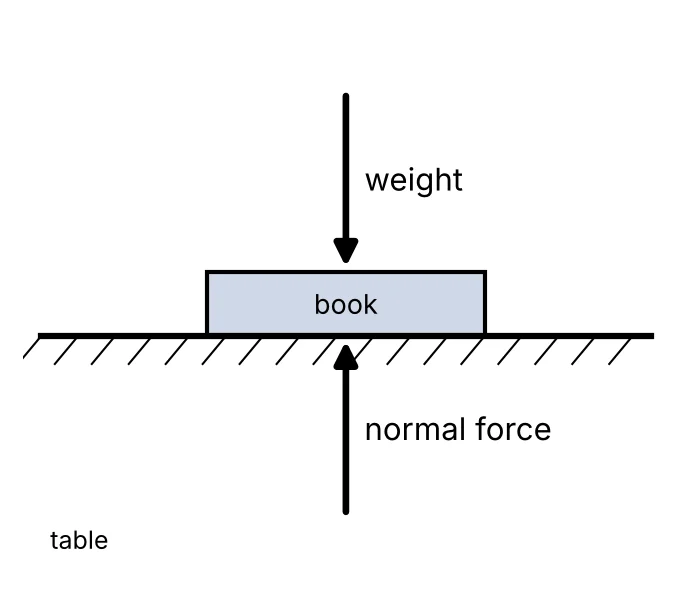
The diagram shows a textbook of mass 1.2 kg at rest on a horizontal table, with the two forces on it labelled. Take g=9.8 N kg−1g = 9.8\ \text{N kg}^{-1}.
Question diagram
(a)
A student presses down on the book with a vertical force of 5.0 N. Calculate the normal force on the book. [2]Criterion A (ii) · Level 3-4
(b)
The student instead pulls upwards on the book with a vertical force of 5.0 N. Calculate the normal force on the book. [1]Criterion A (ii) · Level 3-4
(c)
Explain why the normal force changes in (a) and (b) but the book stays at rest. [1]Criterion A (iii) · Level 3-4

revisionprep.com

Summary Answer

Not available for this question.

Model Answer

Not available for this question.

Marking Scheme

Not available for this question.

Examiner Insights

Not available for this question.

Question 3Criterion A + D · Band 3-6 · Medium · 11 marksrevisionprep.com

Motion of Objects Under Balanced Forces
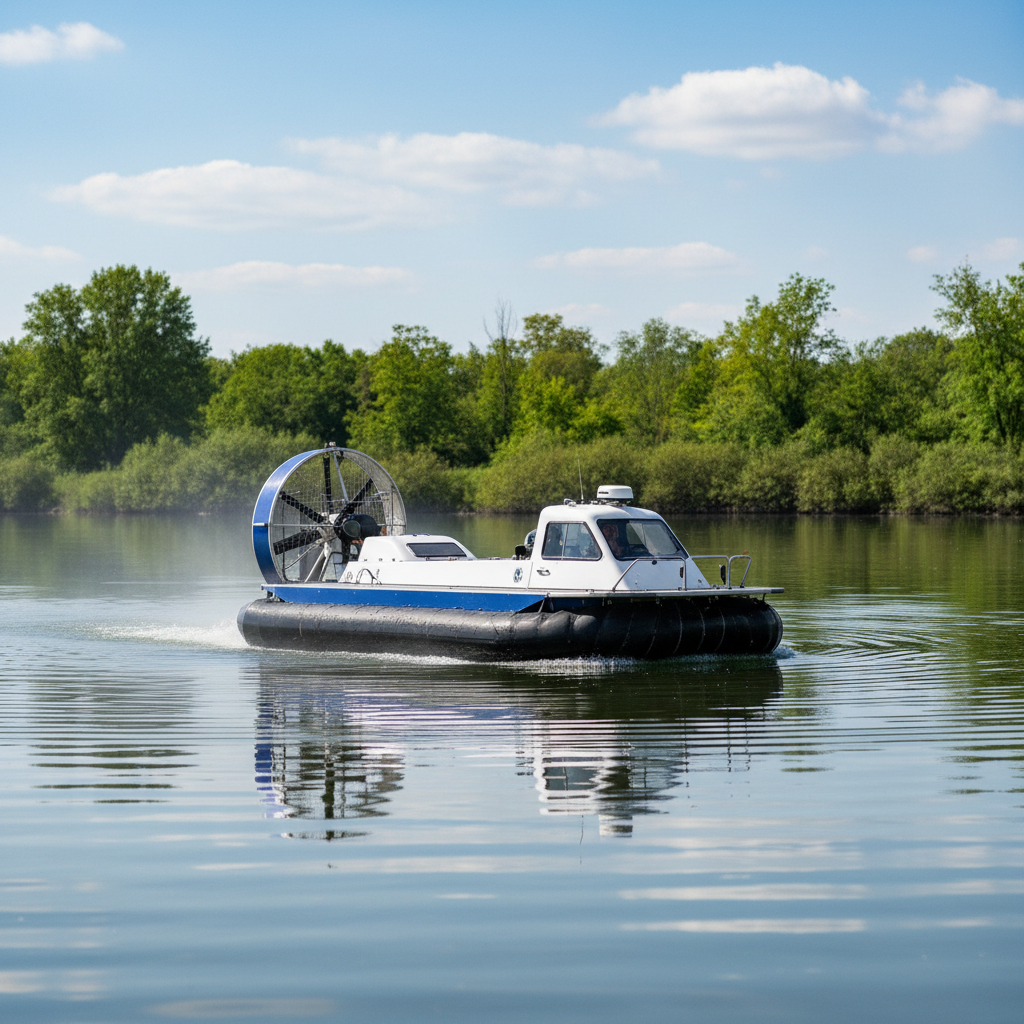
The photograph shows a hovercraft of mass 2000 kg crossing a calm lake at a constant velocity. Its fan provides a forward thrust of 1200 N.
Question diagram
(a)
Explain why the hovercraft moves at constant velocity even though its fan is running. [2]Criterion A (i) · Level 3-4
(b)
Explain how the cushion of air under the hovercraft reduces the resistive forces on it. [1]Criterion A (i) · Level 3-4
(c)
The thrust is increased to 1500 N. Calculate the initial acceleration of the hovercraft. [2]Criterion A (ii) · Level 3-4
(d)
Explain why the hovercraft later moves at a new, higher constant velocity even though the thrust stays at 1500 N. [2]

(e) Hovercraft are used as passenger ferries on some short sea crossings. Discuss the implications of using hovercraft instead of conventional ferries. [4]
Criterion A (iii) · Level 5-6

revisionprep.com

Summary Answer

Not available for this question.

Model Answer

Not available for this question.

Marking Scheme

Not available for this question.

Examiner Insights

Not available for this question.

Question 4Criterion C · Band 3-6 · Medium · 7 marksrevisionprep.com

Effect of Unbalanced Forces on Motion

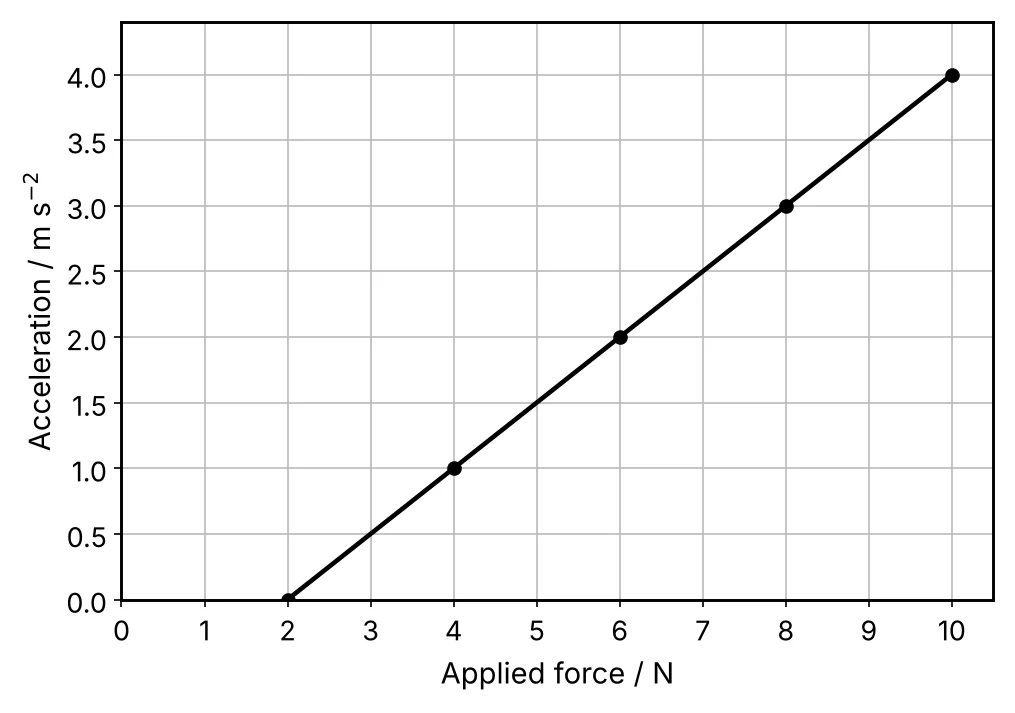
A wooden block of mass 2.0 kg is pulled across a rough horizontal surface. The graph shows how its acceleration varies with the applied force.
Question diagram
(a)
State the applied force at which the block starts to accelerate, and what this tells you about the friction force on the moving block. [2]Criterion C (ii) · Level 3-4
(b)
Determine the gradient of the graph and show that it is consistent with a mass of 2.0 kg. [3]Criterion C (ii) · Level 5-6
(c)
Predict the acceleration of the block when the applied force is 12 N. [2]Criterion C (ii) · Level 3-4

revisionprep.com

Summary Answer

Not available for this question.

Model Answer

Not available for this question.

Marking Scheme

Not available for this question.

Examiner Insights

Not available for this question.

Question 5Criterion B + C · Band 5-8 · Challenge · 10 marksrevisionprep.com

Identifying Balanced and Unbalanced Force Scenarios
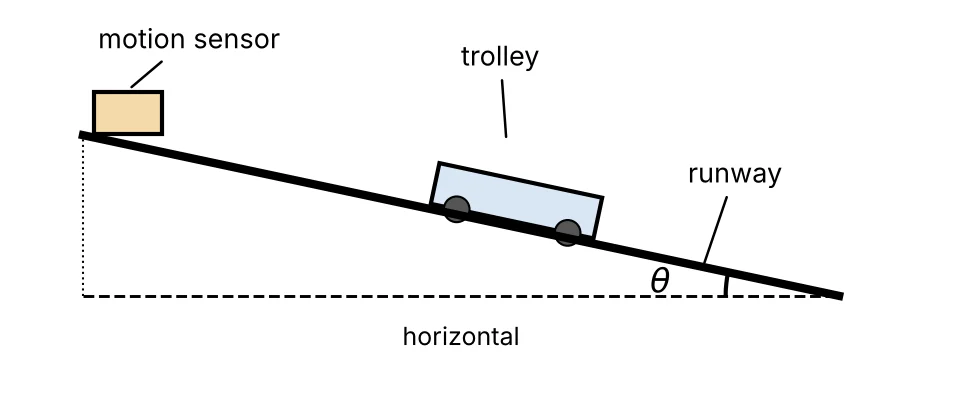
A student wants to find the tilt of a runway at which a trolley, given a gentle push, rolls down at constant velocity. At that tilt the forces on the trolley are balanced. A motion sensor at the top of the runway records the velocity of the trolley, and she reads the angle θ\theta of the runway with a protractor. She wants to find out whether adding mass to the trolley changes the angle needed. The trolley has a mass of 0.50 kg and she has four 0.25 kg masses.

Added mass (kg)00.250.500.751.00Angle θ (°)4.14.33.94.24.0\begin{array}{|l|c|c|c|c|c|}\hline \text{Added mass (kg)} & 0 & 0.25 & 0.50 & 0.75 & 1.00 \\ \hline \text{Angle $\theta$ (°)} & 4.1 & 4.3 & 3.9 & 4.2 & 4.0 \\ \hline\end{array}
Question diagram
(a)
Formulate a hypothesis for how the angle θ\theta will change as mass is added to the trolley. Explain your hypothesis using scientific reasoning. [2]Criterion B (ii) · Level 5-6
(b)
Identify the independent variable, the dependent variable and two control variables. State how she will decide that the trolley is moving at constant velocity. [3]Criterion B (iii) · Level 5-6
(c)
Describe how she should collect enough data to test the hypothesis and make the results reliable. [2]Criterion B (iv) · Level 5-6
(d)
The table shows her results. The protractor can be read to the nearest 0.5°. Evaluate whether the results support your hypothesis in (a), and give one reason why this method might not show a small effect of mass. [3]Criterion C (iii), C (iv) · Level 7-8

revisionprep.com

Summary Answer

Not available for this question.

Model Answer

Not available for this question.

Marking Scheme

Not available for this question.

Examiner Insights

Not available for this question.

Question 6Criterion D + A · Band 3-8 · Challenge · 10 marksrevisionprep.com

Friction and Its Role in Balance

A council must decide how to keep a hill road safe in winter. A car of mass 1100 kg drives on the road. The greatest friction force between the tyres and the road is F=μNF = \mu N, where NN is the normal force from the road and μ\mu depends on the road surface. The table shows hypothetical values of μ\mu. Take g=9.8 N kg−1g = 9.8\ \text{N kg}^{-1}.

Road surfaceFriction coefficientDry road0.70Wet road0.40Ice0.10Ice with grit0.30\begin{array}{|l|c|}\hline \text{Road surface} & \text{Friction coefficient} \\ \hline \text{Dry road} & 0.70 \\ \hline \text{Wet road} & 0.40 \\ \hline \text{Ice} & 0.10 \\ \hline \text{Ice with grit} & 0.30 \\ \hline\end{array}
(a)
The road is level. Calculate the greatest friction force on the car on a dry road and on ice. [2]Criterion A (ii) · Level 3-4
(b)
Calculate the time the car takes to stop from 15 m s⁻¹ with the greatest braking on ice and on ice with grit. [2]Criterion D (i) · Level 5-6
(c)
Explain, using the idea of friction as the force that stops the car, why braking on ice is dangerous and how grit reduces the danger. [3]Criterion D (i) · Level 5-6
(d)
The council can (1) spread grit, (2) cut the speed limit to 8 m s⁻¹ in icy weather, or (3) close the road. Evaluate these options from two different perspectives, such as safety, cost, social or environmental, and recommend one. [3]Criterion D (ii), D (iii) · Level 7-8

revisionprep.com

Summary Answer

Not available for this question.

Model Answer

Not available for this question.

Marking Scheme

Not available for this question.

Examiner Insights

Not available for this question.

That's every free question here — 6 of 76.

+70 more questions, plus Mock Papers & Worksheets, are waiting in Premium.

Upgrade