You're viewing free preview questions — 5 questions previewing here — subscribe to unlock 98 more, plus the Full Question Bank, Mock Papers & Worksheets.Upgrade
Balanced vs Unbalanced Forces — Free MYP5 Physics Practice Questions

1QuestionCentral of mass and stability of objectsConcept Practice
2 marks~3 minCriterion A
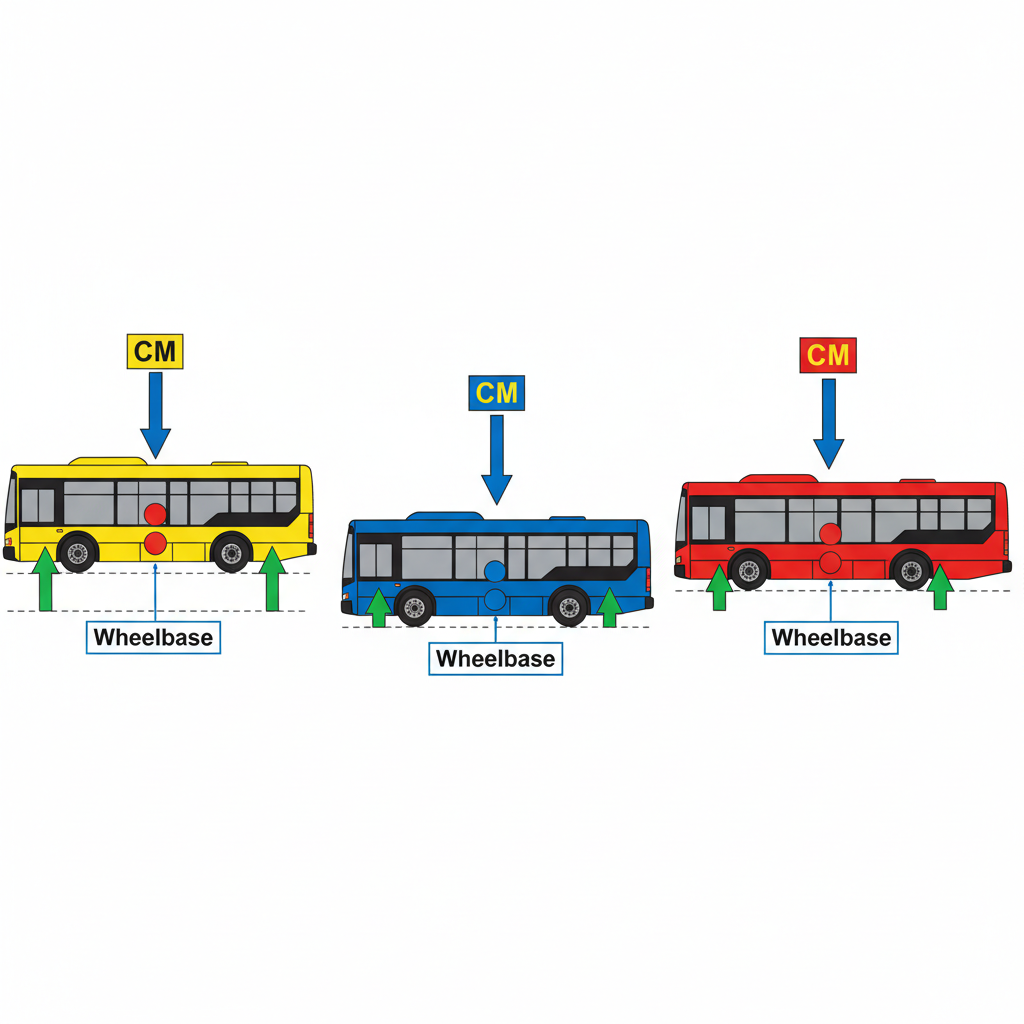
Double-decker buses have a high passenger deck, raising the centre of mass significantly above the road surface.
Identify one design feature engineers use to lower the centre of mass of a double-decker bus. [1]
Explain how this feature reduces the risk of the bus tipping over when cornering. [1]
Identify one design feature engineers use to lower the centre of mass of a double-decker bus. [1]
Explain how this feature reduces the risk of the bus tipping over when cornering. [1]

Solutions
2QuestionHooke's Law and turning effectAssessment Practice
9 marks~14 minCriterion C
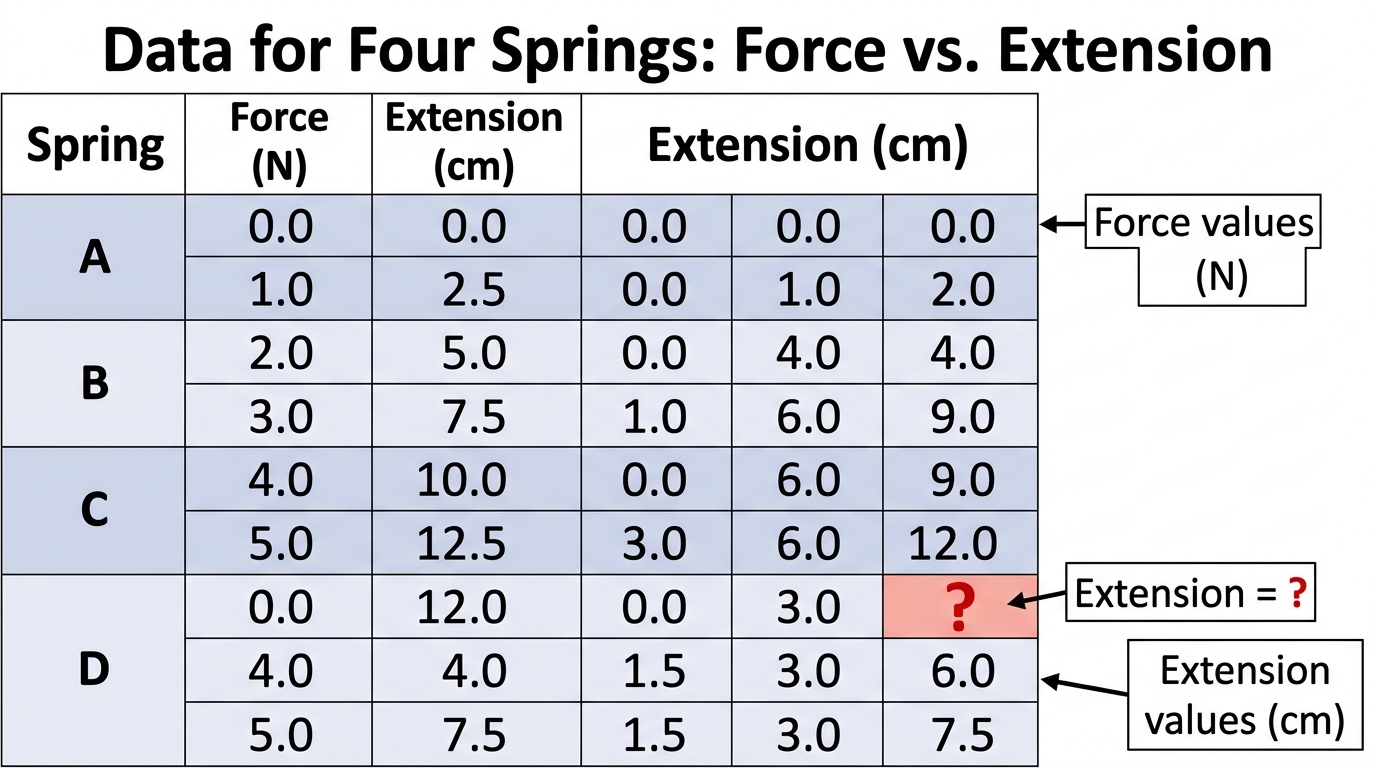
A student investigates how four springs (A, B, C, D) stretch under applied forces by hanging masses and measuring extension with a ruler.
Spring A — Force (N): 0.0, 1.0, 2.0, 3.0, 4.0, 5.0 | Extension (cm): 0.0, 2.5, 5.0, 7.5, 10.0, 12.5
Spring B — Force (N): 0.0, 1.0, 2.0, 3.0, 4.0, 5.0 | Extension (cm): 0.0, 1.0, 4.0, 9.0, 16.0, 25.0
Spring C — Force (N): 0.0, 1.0, 2.0, 3.0, 4.0, 5.0 | Extension (cm): 0.0, 3.0, 6.0, 9.0, 12.0, 15.0
Spring D — Force (N): 0.0, 1.0, 2.0, 3.0, 4.0, 5.0 | Extension (cm): 0.0, 1.5, 3.0, ?, 6.0, 7.5
Spring A — Force (N): 0.0, 1.0, 2.0, 3.0, 4.0, 5.0 | Extension (cm): 0.0, 2.5, 5.0, 7.5, 10.0, 12.5
Spring B — Force (N): 0.0, 1.0, 2.0, 3.0, 4.0, 5.0 | Extension (cm): 0.0, 1.0, 4.0, 9.0, 16.0, 25.0
Spring C — Force (N): 0.0, 1.0, 2.0, 3.0, 4.0, 5.0 | Extension (cm): 0.0, 3.0, 6.0, 9.0, 12.0, 15.0
Spring D — Force (N): 0.0, 1.0, 2.0, 3.0, 4.0, 5.0 | Extension (cm): 0.0, 1.5, 3.0, ?, 6.0, 7.5
a
Construct a graph of extension (cm) against force (N) for springs A, B, and C on the same axes. [3]
b
Identify which springs obey Hooke's law () and explain, using your graph, why Spring B does not. [2]
c
Calculate the spring constant (in N/cm) for Spring C. Show your working. [2]
d
Deduce the missing extension for Spring D at 3.0 N. Justify whether Spring D obeys Hooke's law, using both the completed data set and your findings from parts (b) and (c). [2]
Solutions
3QuestionIdentifying Balanced and Unbalanced Force ScenariosAssessment Practice
12 marks~18 minCriterion A
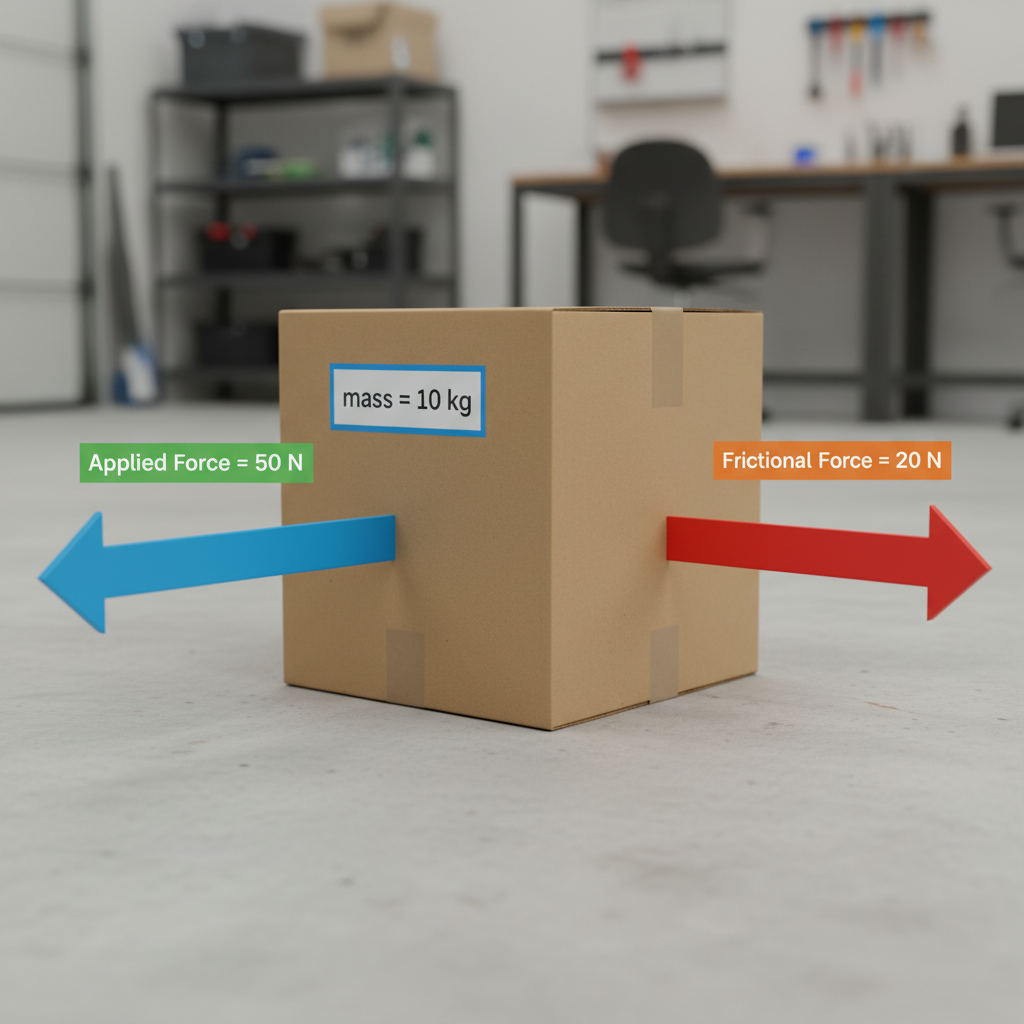
A 10 kg storage crate is pushed horizontally across a warehouse floor. Two horizontal forces act on it:
- Applied force to the right
- Frictional force to the left
The crate starts from rest.
- Applied force to the right
- Frictional force to the left
The crate starts from rest.
a
Deduce the net horizontal force acting on the crate, including its direction. [2]
b
Calculate the acceleration of the crate during the first 3 seconds, stating the direction. [3]
c
Calculate the velocity of the crate at . [3]
d
At , the applied force is removed. Analyse how the motion of the crate changes, and justify your answer using Newton's laws and a calculation of the new acceleration. [4]
Solutions
4QuestionMotion of Objects Under Balanced ForcesAssessment Practice
12 marks~18 minCriterion D
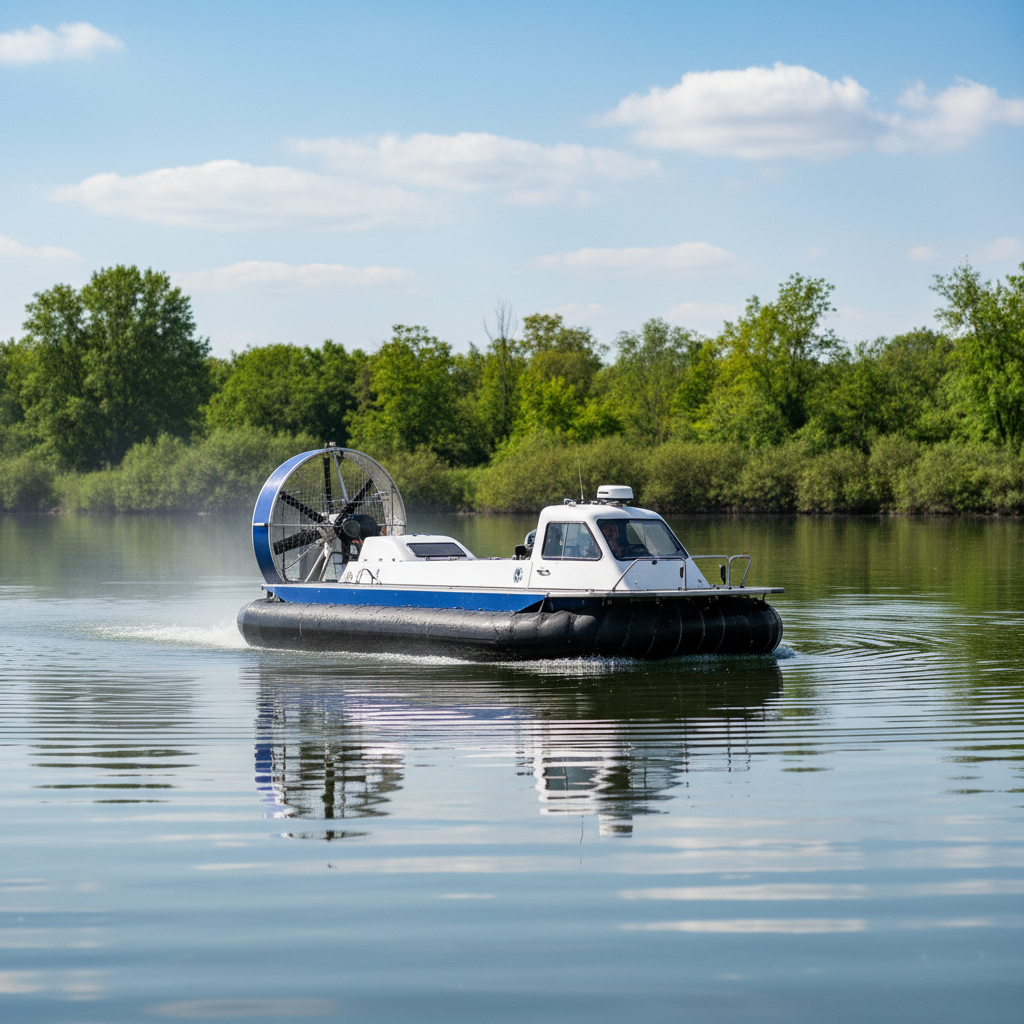
A hovercraft moves at constant velocity across a calm lake. Its thrust engine produces a forward force of 1200 N. The air cushion reduces surface friction to near zero, but air resistance (drag) still acts on the craft.
a
Explain why the hovercraft moves at constant velocity even though the engine is running. [2]
b
The hovercraft then crosses from the lake onto a marshy shoreline. Explain how the forces acting on the hovercraft change during this transition, and describe the effect on its motion. [4]
c
A sudden crosswind exerts a lateral force of 400 N on the hovercraft. Evaluate whether the hovercraft can maintain its intended straight-line path, and discuss ONE environmental consequence of the engine response required. [6]
Solutions
5QuestionHooke's Law and turning effectAssessment Practice
12 marks~18 minCriterion D
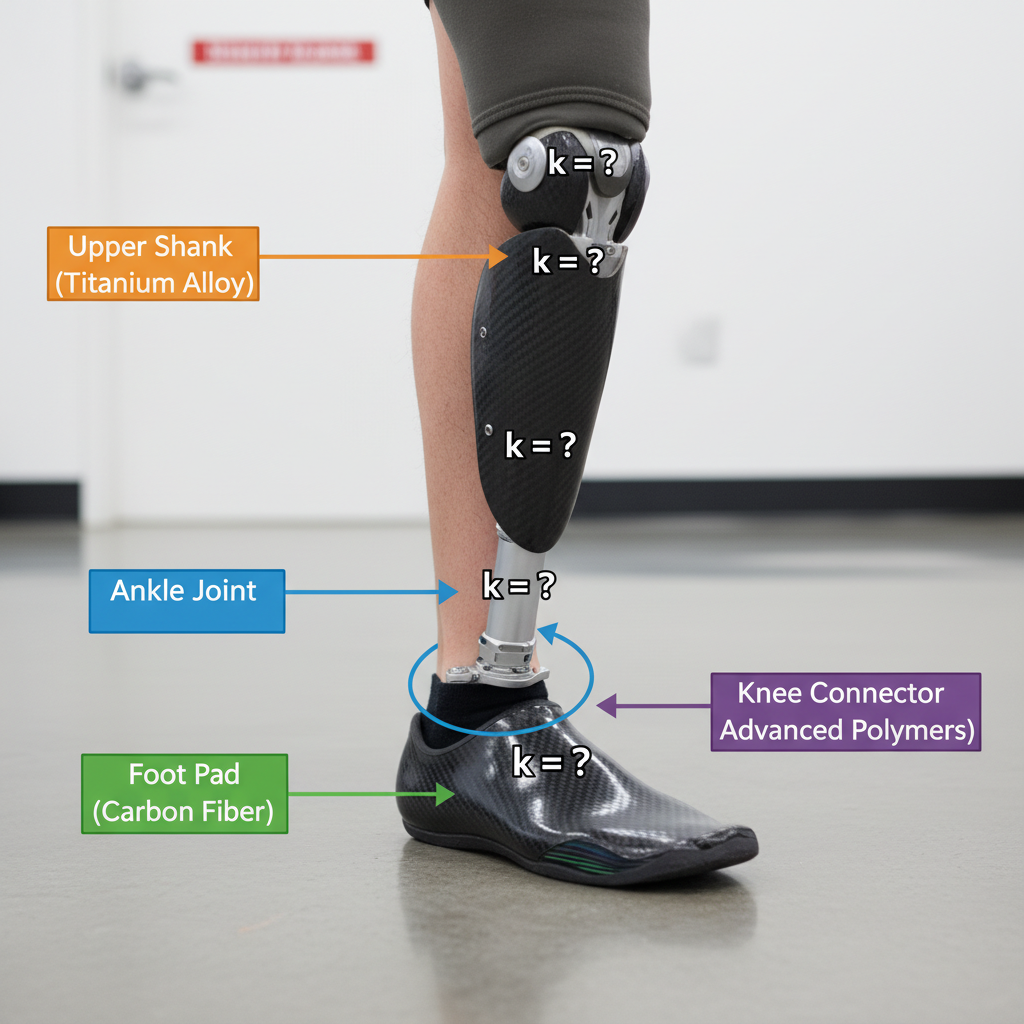
A sports-medicine engineer is designing a running blade prosthetic for a below-knee amputee. The blade is modelled as a spring with spring constant . During a stride, the blade compresses by under the athlete's weight.
Carbon-fibre blades cost approximately 15 000 dollars; polypropylene alternatives cost approximately 800 dollars but have a lower, less tunable .
Carbon-fibre blades cost approximately 15 000 dollars; polypropylene alternatives cost approximately 800 dollars but have a lower, less tunable .
a
State Hooke's Law and calculate the restoring force the blade exerts during compression. [2]
b
Analyse how the choice of spring constant influences both the biomechanical performance and the manufacturing cost of a prosthetic running blade. [4]
c
Evaluate the ethical and environmental implications of the cost gap between carbon-fibre and polypropylene prosthetic blades, considering equity of access and the environmental impact of each material across its full lifecycle. [6]
---
---
Solutions
That's every free question here — 5 of 103.
+98 more questions, plus Mock Papers & Worksheets, are waiting in Premium.