You're viewing free preview questions — 6 questions previewing here — subscribe to unlock 70 more, plus the Full Question Bank, Mock Papers & Worksheets.Upgrade
Back

Friction, air resistance, terminal velocity and stopping distance — Free MYP5 Physics Practice Questions

Free questions

Open in full, with answers, mark scheme and examiner insights.

Question 1Criterion A · Band 1-4 · Easy · 3 marksrevisionprep.com

Air Resistance and Streamlining

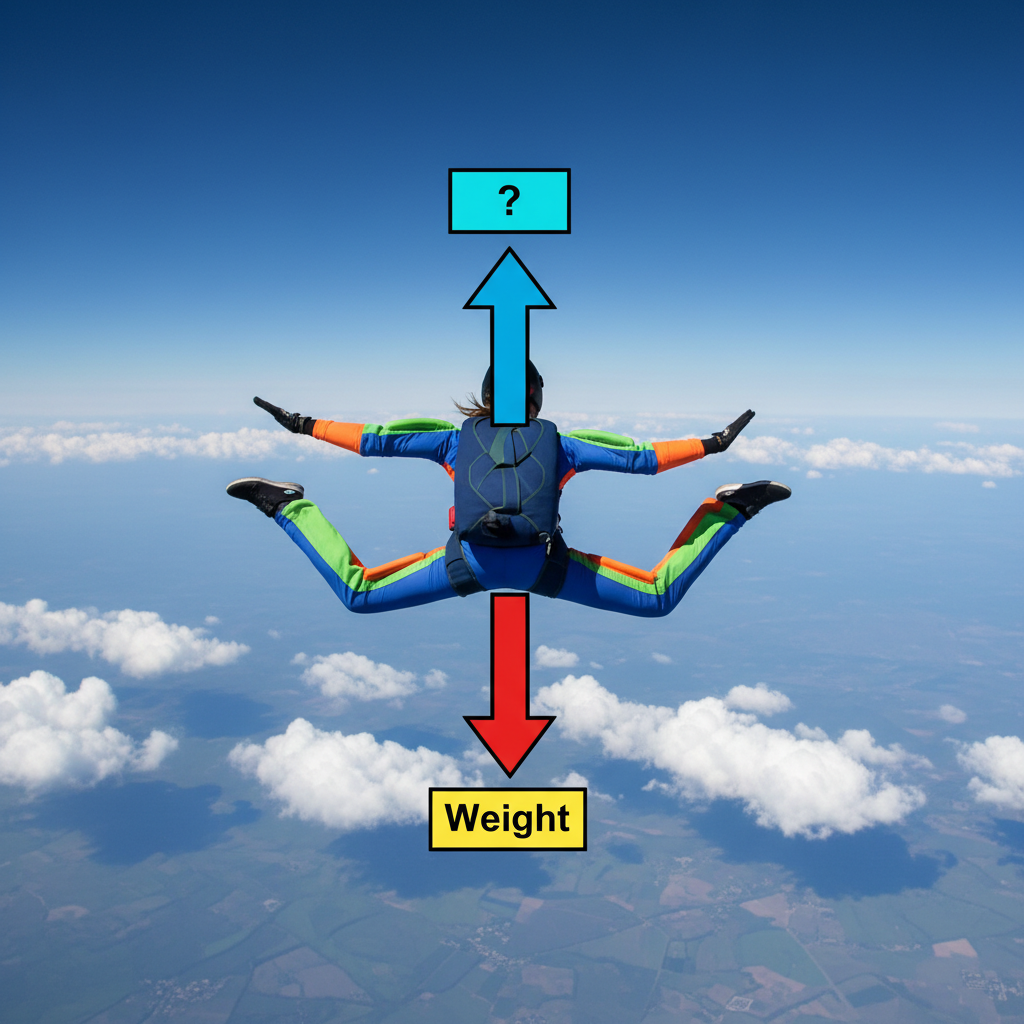
The diagram shows a skydiver falling vertically. Two forces act on her: her weight and a second force, shown by the arrow labelled ?.
Question diagram
(a)
Identify the force labelled ?. [1]Criterion A (i) · Level 1-2
(b)
The skydiver steps out of a hot-air balloon that is not moving. State the size of the force labelled ? at the instant she steps out, and explain your answer. [2]Criterion A (ii) · Level 3-4

revisionprep.com

Summary Answer

Not available for this question.

Model Answer

Not available for this question.

Marking Scheme

Not available for this question.

Examiner Insights

Not available for this question.

Question 2Criterion A · Band 1-4 · Easy · 6 marksrevisionprep.com

Applications in Engineering and Sports
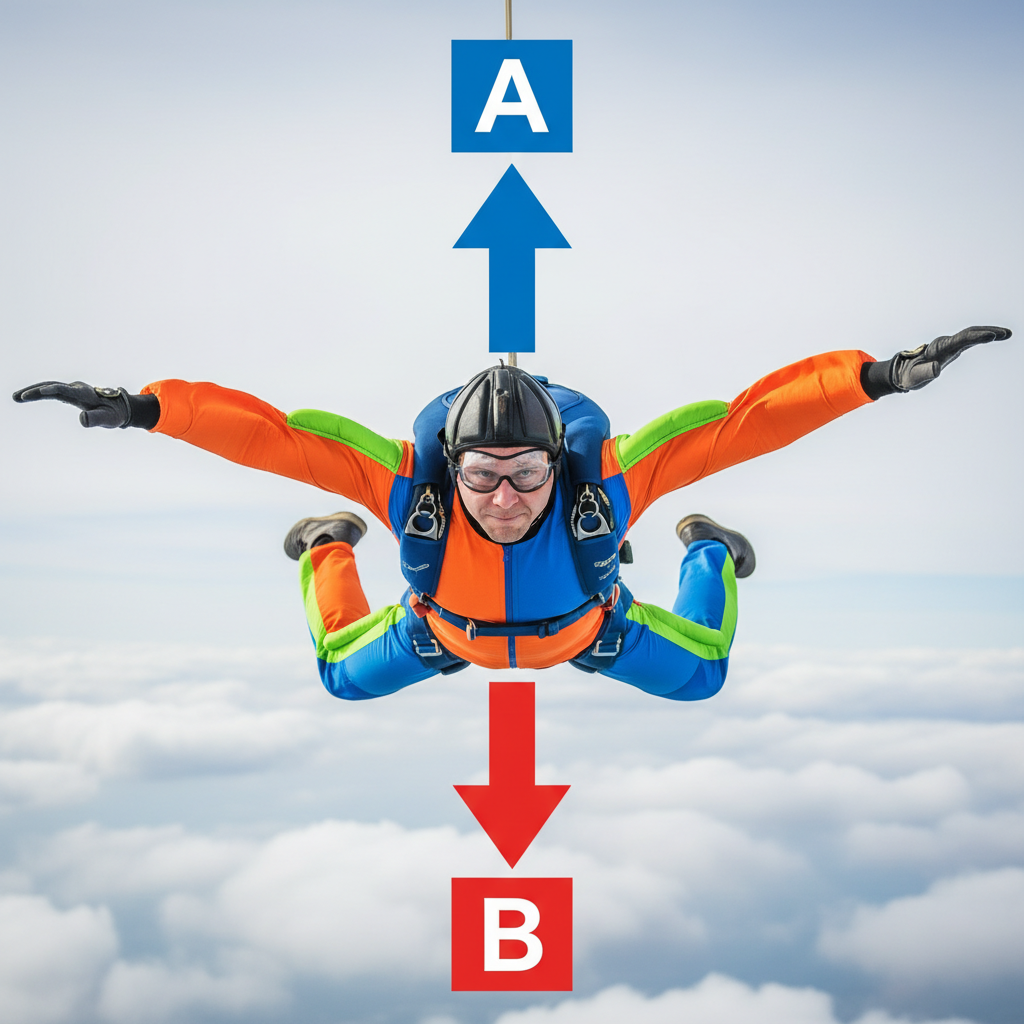
The diagram shows a skydiver falling at terminal velocity in a spread-out position. Arrows A and B show the two forces acting on her.
Question diagram
(a)
Identify forces A and B. [1]Criterion A (i) · Level 1-2
(b)
State how the sizes of A and B compare at terminal velocity, and explain why her velocity is constant. [2]Criterion A (ii) · Level 3-4
(c)
She changes to a head-down position with her arms by her sides. Describe and explain what happens to force A and to her speed from the moment she changes position until she reaches a new terminal velocity. [3]Criterion A (iii) · Level 3-4

revisionprep.com

Summary Answer

Not available for this question.

Model Answer

Not available for this question.

Marking Scheme

Not available for this question.

Examiner Insights

Not available for this question.

Question 3Criterion C + A · Band 1-6 · Medium · 8 marksrevisionprep.com

Friction: causes, benefits, drawbacks and reduction

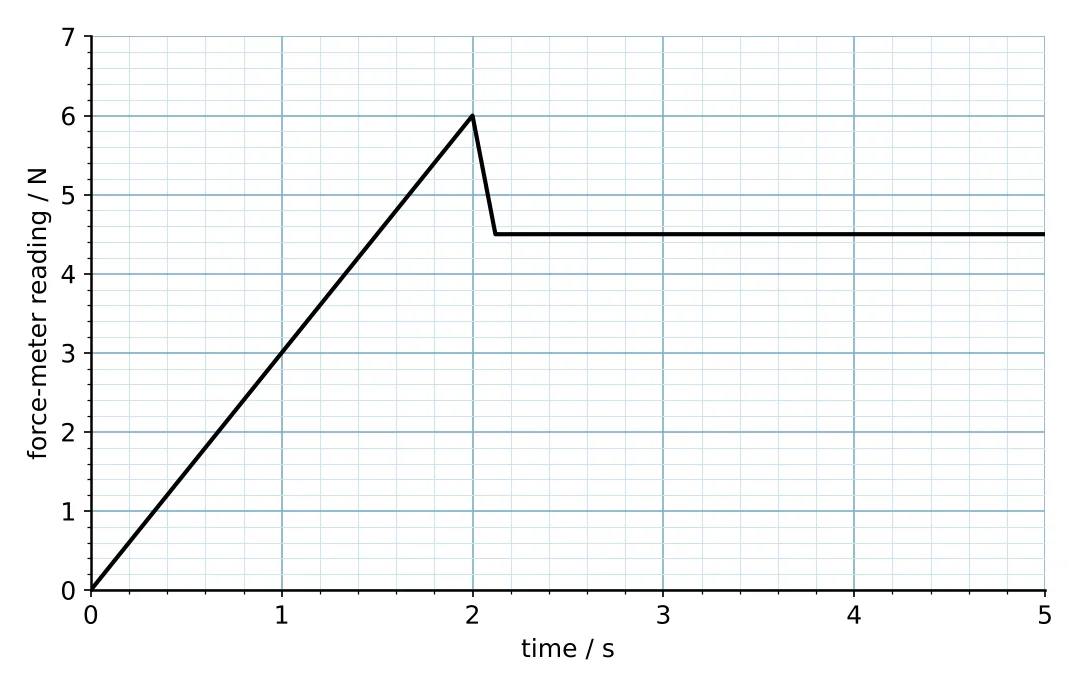
Amara pulls a wooden block of weight 15 N along a horizontal bench with a force meter. She increases her pull slowly from zero. The block starts to slide at 2.0 s, and she then keeps it moving at a constant speed.

The graph shows how the force-meter reading changes with time.
Question diagram
(a)
Write down the maximum value of the static friction force between the block and the bench. [1]Criterion A (ii) · Level 1-2
(b)
Explain why the force-meter reading drops when the block starts to slide and then stays constant. [2]Criterion A (i) · Level 3-4
(c)
The coefficient of friction is given by μ=FN\mu = \dfrac{F}{N}, where FF is the friction force and NN is the normal force. Calculate the coefficient of kinetic friction between the block and the bench. [2]Criterion C (ii) · Level 3-4
(d)
A 10 N weight is placed on top of the block and the experiment is repeated. Determine the maximum force-meter reading before the block slides and the reading while it slides at constant speed. Show your reasoning. [3]Criterion C (ii) · Level 5-6

revisionprep.com

Summary Answer

Not available for this question.

Model Answer

Not available for this question.

Marking Scheme

Not available for this question.

Examiner Insights

Not available for this question.

Question 4Criterion A · Band 1-6 · Medium · 8 marksrevisionprep.com

Terminal velocity

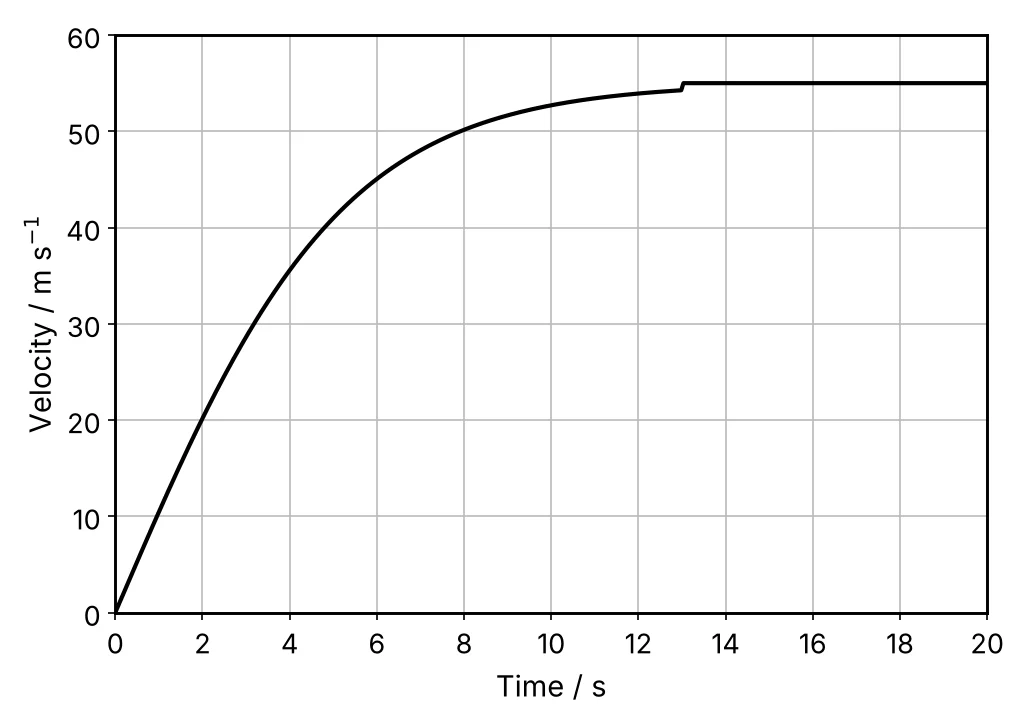
A skydiver of mass 70 kg jumps from a hovering helicopter. The graph shows how her velocity changes during the first 20 s, before she opens her parachute. Take g = 9.8 m s⁻².
Question diagram
(a)
Write down her terminal velocity. [1]Criterion A (ii) · Level 1-2
(b)
Determine the air resistance on her at 18 s. [2]Criterion A (ii) · Level 3-4
(c)
Use the graph to estimate her average acceleration during the first 2 s, and explain why it is close to g. [3]Criterion A (iii) · Level 3-4
(d)
Calculate the distance she falls between 14 s and 20 s. [2]Criterion A (ii) · Level 5-6

revisionprep.com

Summary Answer

Not available for this question.

Model Answer

Not available for this question.

Marking Scheme

Not available for this question.

Examiner Insights

Not available for this question.

Question 5Criterion B + C · Band 3-8 · Challenge · 10 marksrevisionprep.com

Friction: causes, benefits, drawbacks and reduction

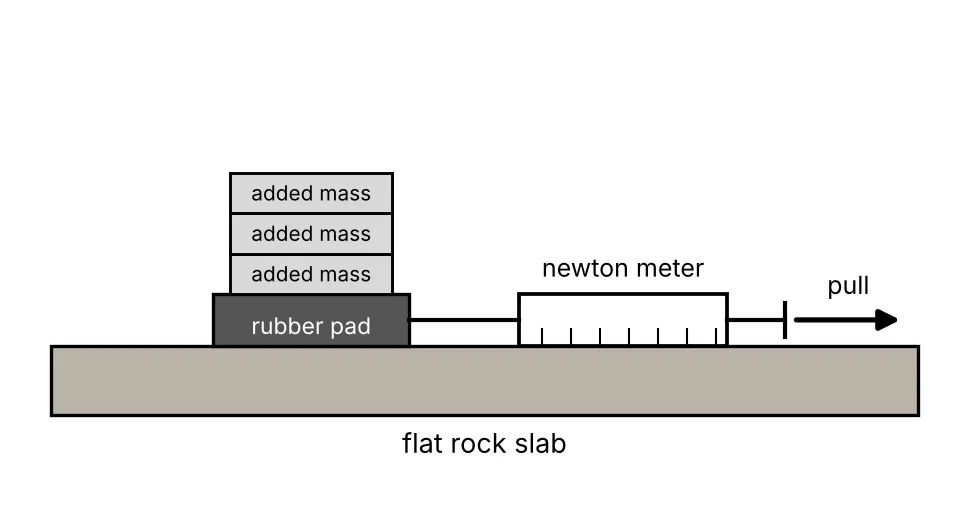
A climbing-shoe maker compares the grip of three rubber compounds, X, Y and Z, on a flat rock slab. The hypothesis is that compound Z has the largest coefficient of friction. A student cuts a square pad of each rubber, places it on the slab, loads it with masses and pulls it along the slab with a newton meter, reading the meter while the pad slides. The coefficient of friction is μ=F÷N\mu = F \div N, where FF is the friction force and NN is the normal contact force. Each pad has a mass of 0.10 kg. Take g = 9.8 N kg⁻¹.

The diagram shows the apparatus. The table shows her pilot results for compound X only (hypothetical data).
Load on pad / kgReading 1 / NReading 2 / NReading 3 / N0.54.65.84.91.08.99.112.01.513.013.413.2\begin{array}{|l|c|c|c|}\hline \text{Load on pad / kg} & \text{Reading 1 / N} & \text{Reading 2 / N} & \text{Reading 3 / N} \\ \hline 0.5 & 4.6 & 5.8 & 4.9 \\ \hline 1.0 & 8.9 & 9.1 & 12.0 \\ \hline 1.5 & 13.0 & 13.4 & 13.2 \\ \hline\end{array}
Question diagram
(a)
Identify the independent variable and the dependent variable for the full investigation of the three compounds. [2]Criterion B (iii) · Level 3-4
(b)
Use the pilot data to explain two problems with the way the readings were collected. [2]Criterion C (iv) · Level 5-6
(c)
Calculate the coefficient of friction for compound X at the 1.50 kg load, using the mean of the three readings. [2]Criterion C (i) · Level 3-4
(d)
Design an improved investigation that would show reliably which compound has the largest coefficient of friction. Describe the apparatus, the variables you control, how you collect enough data and reduce the uncertainty, how you process the results to compare the compounds, and what result would support the hypothesis. [4]Criterion B (iii), B (iv) · Level 7-8

revisionprep.com

Summary Answer

Not available for this question.

Model Answer

Not available for this question.

Marking Scheme

Not available for this question.

Examiner Insights

Not available for this question.

Question 6Criterion D + A · Band 1-8 · Challenge · 8 marksrevisionprep.com

Stopping distance: thinking and braking distance

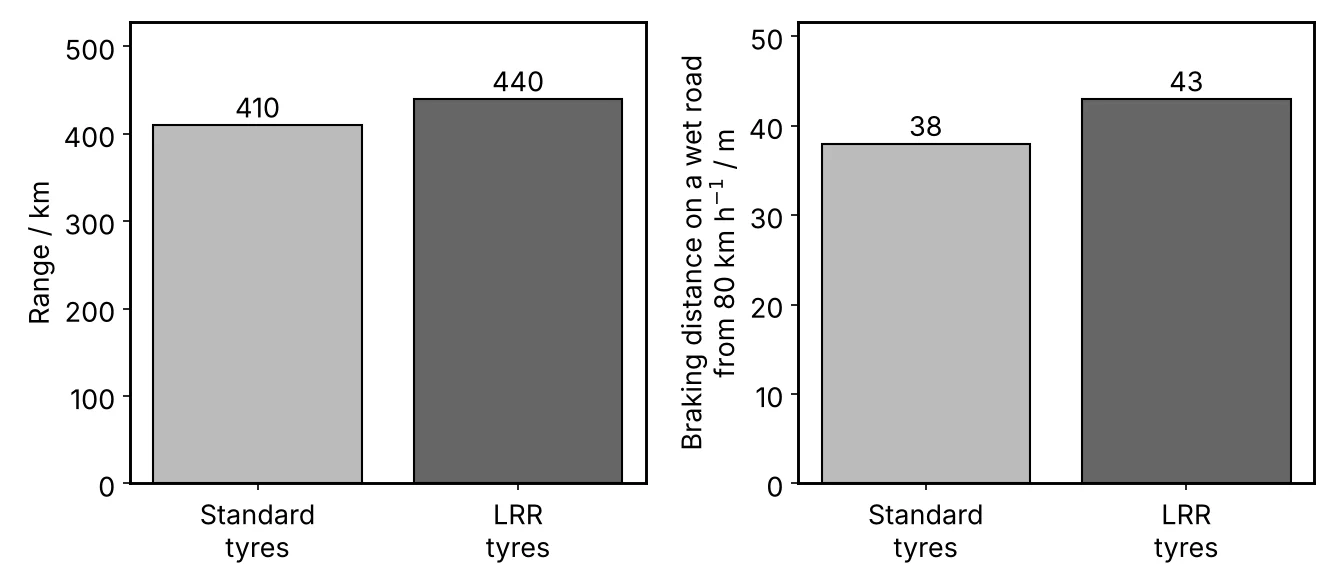
Many electric cars are fitted with low rolling resistance (LRR) tyres. These use a harder rubber and shallower tread, so less energy is lost as the tyre flexes. Tests on one car gave these results.

Standard tyres: range 410 km; braking distance on a wet road from 80 km h⁻¹: 38 m
LRR tyres: range 440 km; braking distance on a wet road from 80 km h⁻¹: 43 m

The bar charts show the same test results.
Question diagram
(a)
Calculate the percentage increase in range when LRR tyres are fitted. [2]Criterion A (ii) · Level 1-2
(b)
Explain why LRR tyres increase the range of the car. [2]Criterion D (i) · Level 3-4
(c)
A government is considering making LRR tyres compulsory on all new electric cars. Discuss this proposal, considering at least two implications (for example environmental, economic or safety), and give a conclusion. [4]Criterion D (ii), D (iii) · Level 7-8

revisionprep.com

Summary Answer

Not available for this question.

Model Answer

Not available for this question.

Marking Scheme

Not available for this question.

Examiner Insights

Not available for this question.

That's every free question here — 6 of 76.

+70 more questions, plus Mock Papers & Worksheets, are waiting in Premium.

Upgrade