You're viewing free preview questions — 6 questions previewing here — subscribe to unlock 88 more, plus the Full Question Bank, Mock Papers & Worksheets.Upgrade
Back

Electromagnetic Spectrum and Its Uses — Free MYP5 Physics Practice Questions

Free questions

Open in full, with answers, mark scheme and examiner insights.

Question 1Criterion A · Band 1-2 · Easy · 4 marksrevisionprep.com

Order and Properties of EM Waves

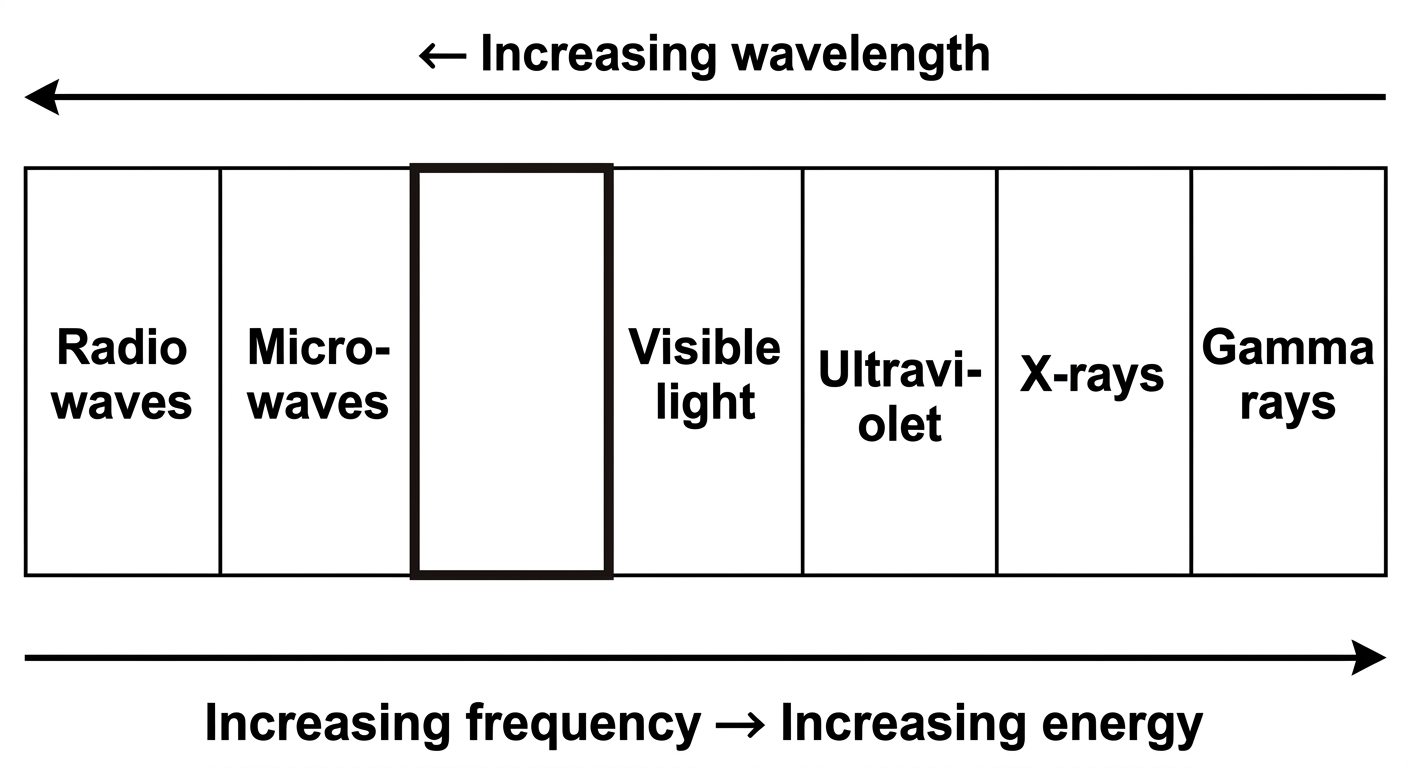
The diagram shows the electromagnetic spectrum with the name of one region missing.
Question diagram
(a)
Identify the type of wave in the empty box. [1]Criterion A (i) · Level 1-2
(b)
State how the wavelength of this wave compares with the wavelength of visible light. [1]Criterion A (i) · Level 1-2
(c)
Outline two uses of this type of wave. [2]Criterion A (i) · Level 1-2

revisionprep.com

Summary Answer

Not available for this question.

Model Answer

Not available for this question.

Marking Scheme

Not available for this question.

Examiner Insights

Not available for this question.

Question 2Criterion A + D · Band 1-4 · Easy · 7 marksrevisionprep.com

Uses of EM waves: radio to gamma

The diagram shows a communication satellite and a ground station on Earth. Microwaves with wavelengths between 1 cm and 30 cm carry signals up to the satellite and back down.
(a)
Identify one service that uses microwave satellite communication. [1]Criterion D (i) · Level 1-2
(b)
Explain why microwaves, rather than long-wavelength radio waves, are used to communicate with satellites. [2]Criterion A (ii) · Level 3-4
(c)
The satellite is geostationary: it orbits once every 24 hours above the equator. Explain why the ground station's dish can be fixed in one position. [2]Criterion A (ii) · Level 3-4
(d)
Heavy rain can interrupt satellite TV for a few minutes. Suggest why rain affects microwave signals. [2]Criterion A (iii) · Level 3-4

revisionprep.com

Summary Answer

Not available for this question.

Model Answer

Not available for this question.

Marking Scheme

Not available for this question.

Examiner Insights

Not available for this question.

Question 3Criterion C + A · Band 3-6 · Medium · 9 marksrevisionprep.com

Order and Properties of EM Waves

The table shows the percentage of each type of electromagnetic radiation arriving from space that passes through Earth's atmosphere to the ground.
(a)
Draw a bar chart of atmospheric transmission against type of radiation, with the types in order of increasing frequency. [3]Criterion C (i) · Level 3-4
(b)
Describe the general pattern shown by the data, and identify the type of radiation that does not fit the pattern. [2]Criterion C (ii) · Level 3-4
(c)
Explain why astronomers can use radio telescopes and optical telescopes on the ground but must put ultraviolet telescopes in space. [2]Criterion A (ii) · Level 5-6
(d)
Most of the infrared is absorbed by water vapour in the lowest part of the atmosphere. Suggest why infrared telescopes are often built on high, dry mountains. [2]Criterion C (ii) · Level 5-6

revisionprep.com

Summary Answer

Not available for this question.

Model Answer

Not available for this question.

Marking Scheme

Not available for this question.

Examiner Insights

Not available for this question.

Question 4Criterion A · Band 1-6 · Medium · 6 marksrevisionprep.com

Comparing EM waves: speed, wavelength and frequency
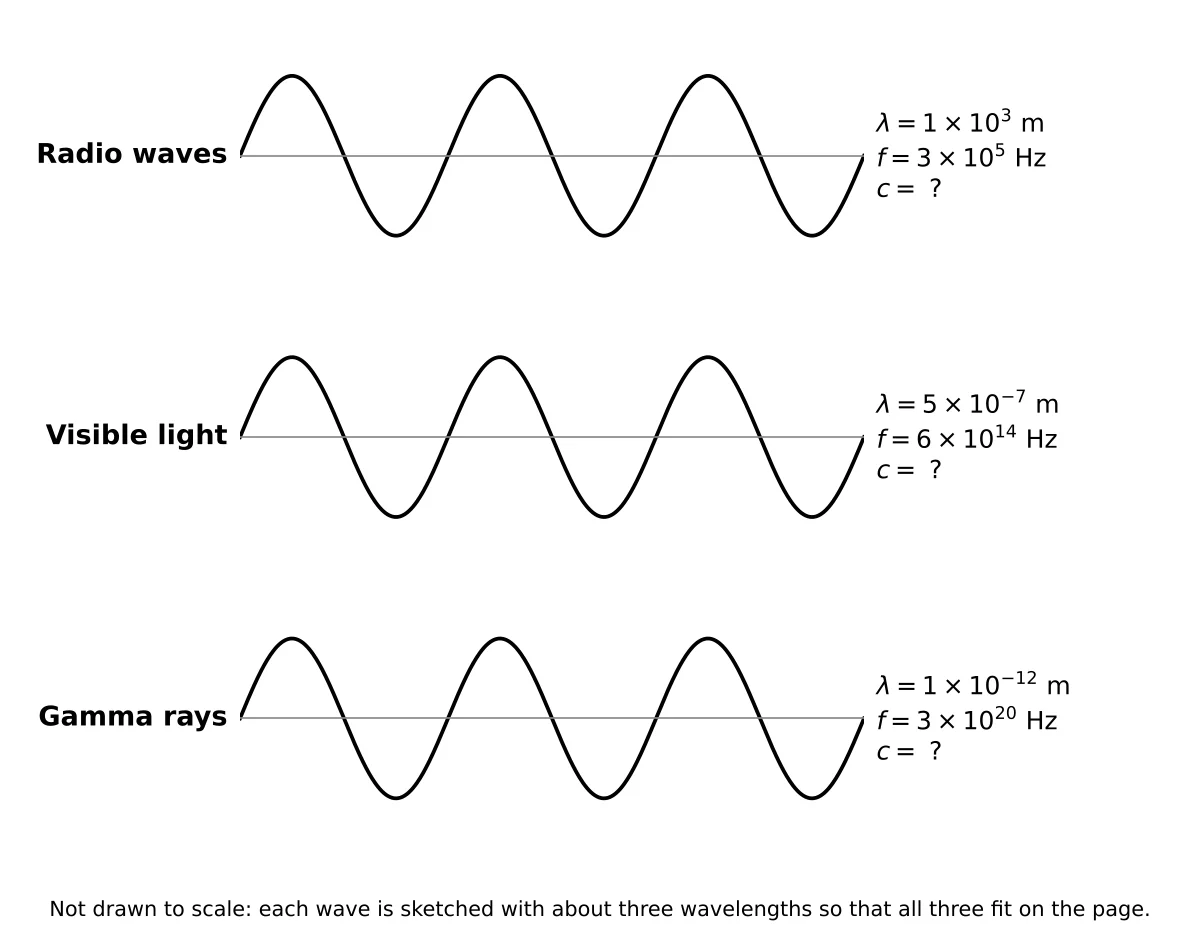
The diagram gives the wavelength and frequency of three electromagnetic waves travelling in a vacuum.
Question diagram
(a)
Use the values in the diagram to calculate the speed of each wave. [2]Criterion A (ii) · Level 3-4
(b)
State what your results show about electromagnetic waves. [1]Criterion A (i) · Level 1-2
(c)
Determine how many times greater the frequency of the gamma rays is than the frequency of the radio waves. [1]Criterion A (ii) · Level 3-4
(d)
In the diagram the radio wave and the gamma wave are drawn with similar wavelengths. Explain why they cannot be drawn to the same scale. [2]Criterion A (iii) · Level 5-6

revisionprep.com

Summary Answer

Not available for this question.

Model Answer

Not available for this question.

Marking Scheme

Not available for this question.

Examiner Insights

Not available for this question.

Question 5Criterion D + A · Band 3-8 · Challenge · 10 marksrevisionprep.com

Visible Light and Color Dispersion

Traffic lights used to have white filament bulbs behind red, amber and green glass filters. Most cities now use LED traffic lights, which emit only red, amber or green light.

Traffic lightPower / WLight emitted by the lampFilament lamp with filter75white lightLED10one colour only\begin{array}{|l|c|c|}\hline \text{Traffic light} & \text{Power / W} & \text{Light emitted by the lamp} \\ \hline \text{Filament lamp with filter} & 75 & \text{white light} \\ \hline \text{LED} & 10 & \text{one colour only} \\ \hline\end{array}
(a)
Explain why a red filter in front of a white filament bulb wastes most of the light the bulb produces. [2]Criterion D (i) · Level 3-4
(b)
A city has 2000 traffic lights, each lit 24 hours a day. Calculate the energy saved in one year by changing them all to LEDs, in kWh. [2]Criterion A (ii) · Level 3-4
(c)
In cities with snowy winters, LED traffic lights sometimes become covered in snow and ice, which rarely happened with filament lamps. Explain why. [2]Criterion D (i) · Level 5-6
(d)
Discuss whether cities with snowy winters should use LED traffic lights. Consider safety, economic and environmental factors. [4]Criterion D (ii), D (iii) · Level 7-8

revisionprep.com

Summary Answer

Not available for this question.

Model Answer

Not available for this question.

Marking Scheme

Not available for this question.

Examiner Insights

Not available for this question.

Question 6Criterion B · Band 3-8 · Challenge · 10 marksrevisionprep.com

Dangers and Precautions of EM Radiation
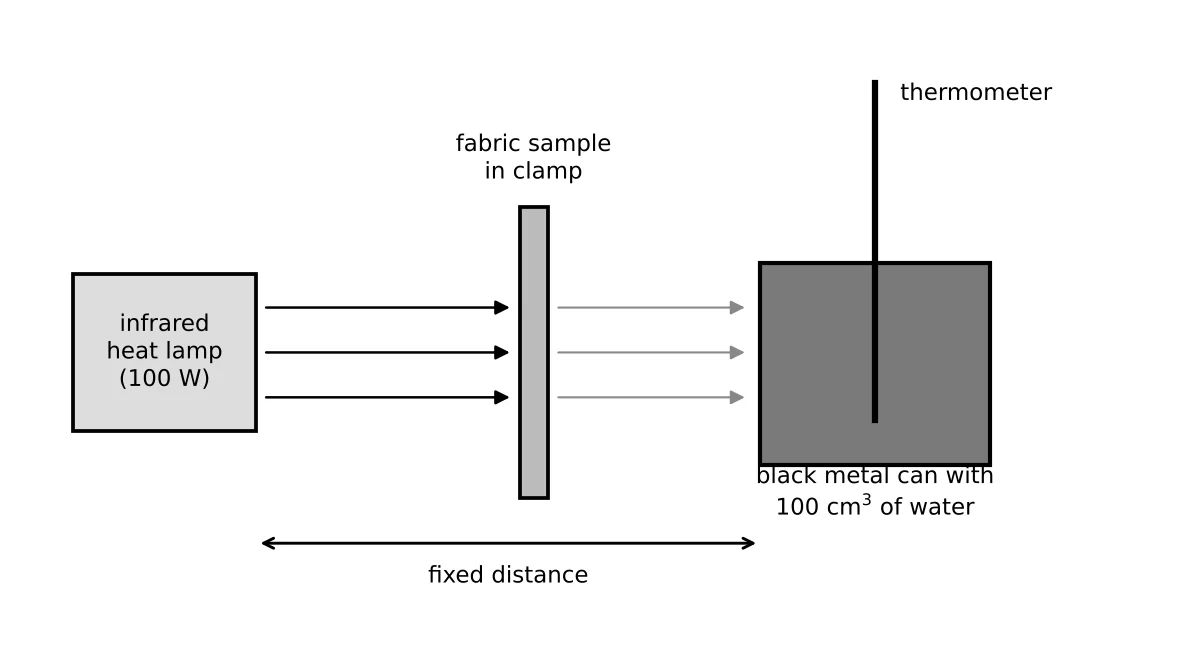
Fire-fighters wear suits that must protect them from the infrared given out by a fire. A student wants to compare four fabrics: aluminised foil cloth, cotton, wool and black polyester. She has a 100 W infrared heat lamp, a clamp stand to hold a sample of fabric, a black-painted metal can containing 100 cm³ of water, a thermometer with a resolution of 0.5 °C, a stopwatch and a metre rule. The apparatus is shown in the diagram.
Question diagram
(a)
State a focused research question for her investigation and name the independent and dependent variables. [2]Criterion B (i) · Level 3-4
(b)
Predict which fabric will give the smallest temperature rise and which the largest. Explain your prediction using ideas about reflection and absorption of infrared. [2]Criterion B (ii) · Level 5-6
(c)
Identify two variables that must be controlled and explain how she can control each. [2]Criterion B (iii) · Level 3-4
(d)
With a sample of cotton she gets a rise of 2.0 °C and with wool a rise of 2.5 °C, but repeat readings with the same fabric vary by 0.5 °C. Explain whether her data show that wool is a worse protection than cotton, and describe how she should change the method so that she can decide, including one safety precaution. [4]Criterion B (iii), B (iv) · Level 7-8

revisionprep.com

Summary Answer

Not available for this question.

Model Answer

Not available for this question.

Marking Scheme

Not available for this question.

Examiner Insights

Not available for this question.

That's every free question here — 6 of 94.

+88 more questions, plus Mock Papers & Worksheets, are waiting in Premium.

Upgrade