You're viewing free preview questions — 5 questions previewing here — subscribe to unlock 64 more, plus the Full Question Bank, Mock Papers & Worksheets.Upgrade
Light in Communication and Technology — Free MYP5 Physics Practice Questions

1QuestionApplications of Light and Sound in Modern TechConcept Practice
2 marks~3 minCriterion A
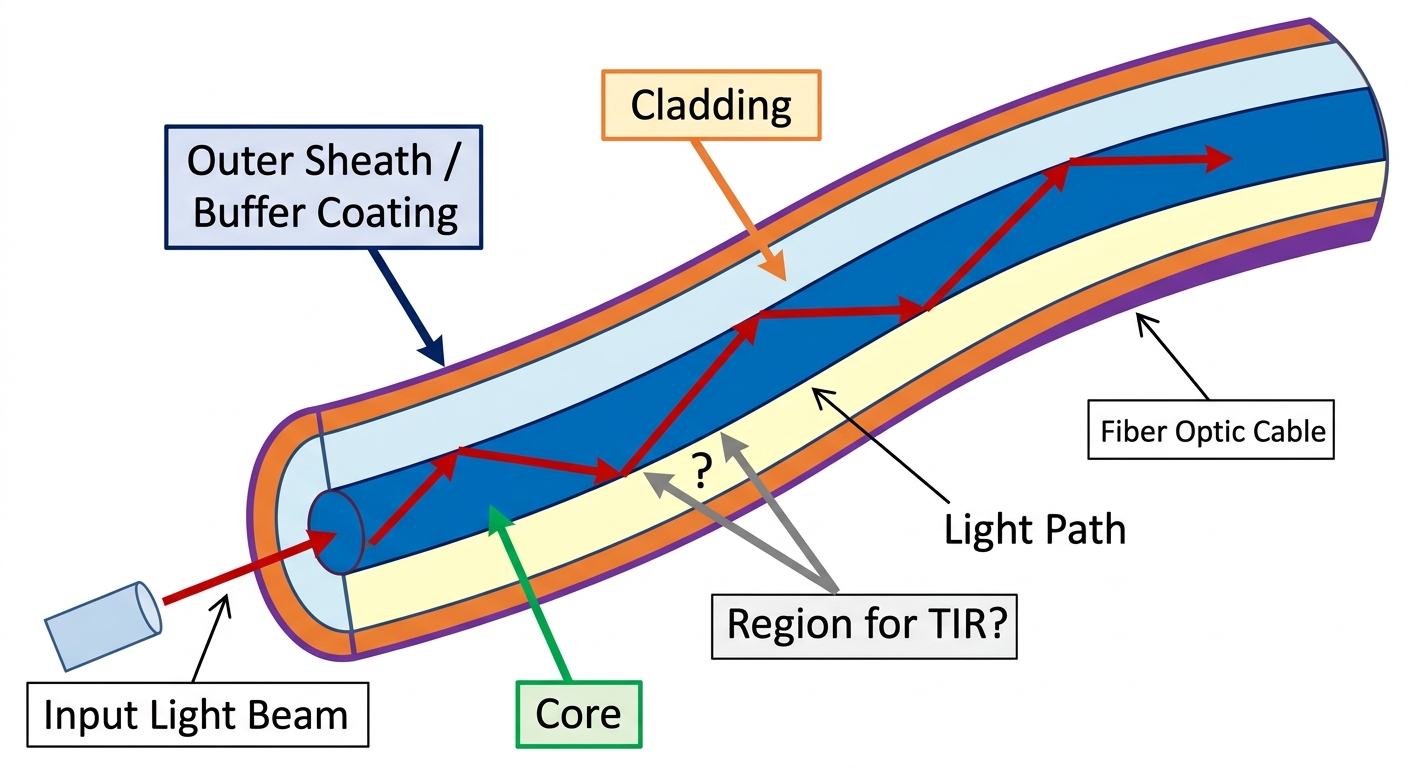
A fibre optic cable carries light signals over long distances. The cable has two main optical layers: a central core (refractive index ) surrounded by a cladding (refractive index ).
a
Identify the boundary at which total internal reflection occurs in the cable. [1]
b
The critical angle for this core–cladding boundary is given by . Explain why a light ray travelling in the core at an angle of incidence of 80° to the normal at this boundary remains confined within the core. [1]

Solutions
2QuestionApplications of Light and Sound in Modern TechAssessment Practice
6 marks~9 minCriterion D
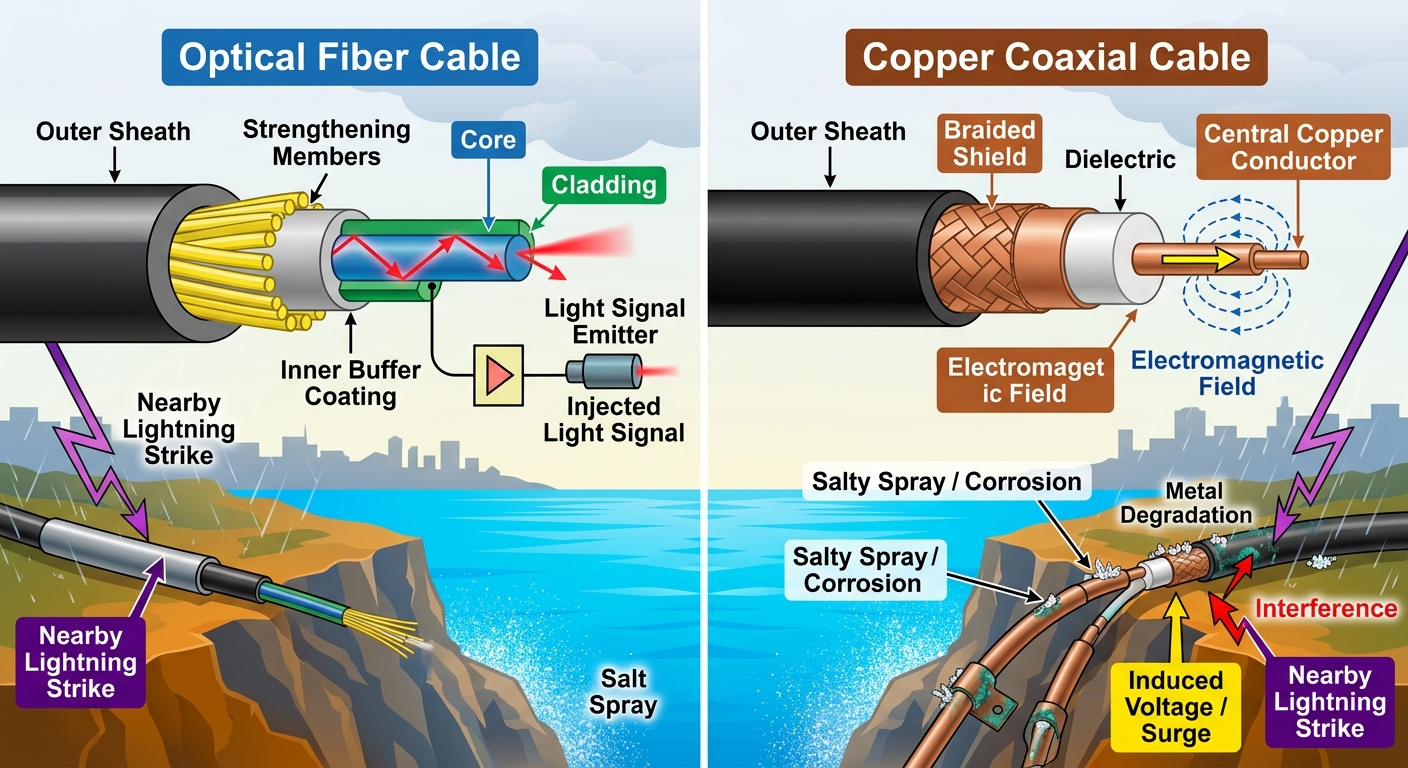
A tech company is planning to install a high-speed internet network in a coastal city that experiences frequent lightning storms and has salty, corrosive air. The company is deciding between optical fibre cables and copper cables.
a
Explain two physics principles that make optical fibre cables well-suited for data transmission in this coastal environment. [2]
b
Explain how the coastal environment creates two distinct physical risks for copper cables, linking each risk to an underlying physics principle. [2]
c
Discuss whether optical fibre or copper cable is the better overall choice for this city. In your answer, evaluate the benefits and limitations of each technology and consider real-world factors that may affect the decision. [2]
Solutions
3QuestionApplications of Light and Sound in Modern TechAssessment Practice
8 marks~12 minCriterion C
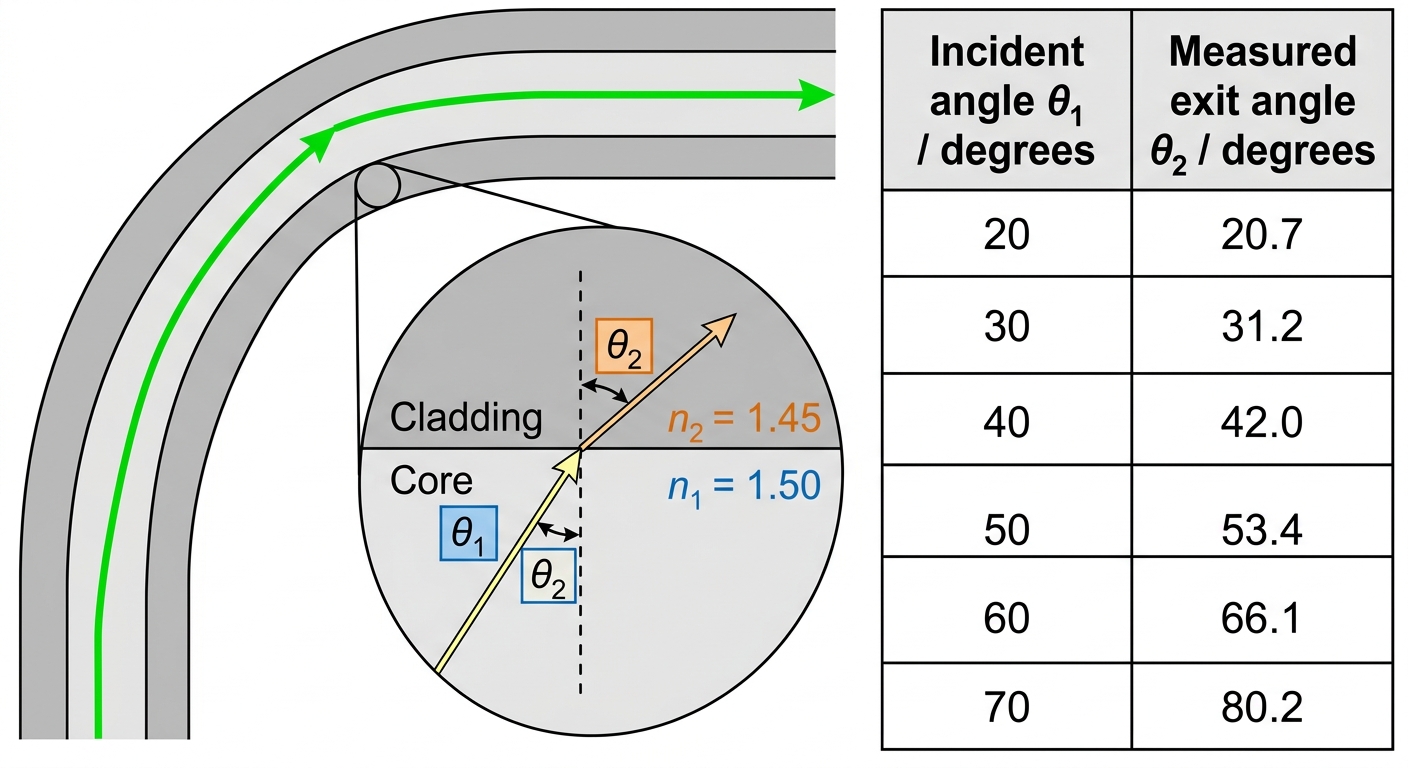
A fibre-optic cable transmits light at a bend, where light passes from the core (refractive index ) into the cladding (refractive index ). Snell's Law states . Measured exit angles for six incident angles are recorded below.
| (°) | 20 | 30 | 40 | 50 | 60 | 70 |
|---|---|---|---|---|---|---|
| measured (°) | 20.7 | 31.2 | 42.0 | 53.4 | 66.1 | 80.2 |
a
Calculate the predicted exit angle for each incident angle using Snell's Law. Give each answer to one decimal place. [3]
b
Calculate the percentage discrepancy between the measured and predicted exit angles for each incident angle using:
Give each answer to one decimal place. [2]
Give each answer to one decimal place. [2]
c
Evaluate the validity of the ray model for describing light propagation in this fibre-optic cable. Use your discrepancy values to support your judgement, and justify why the ray model becomes less reliable at larger incident angles. [3]
Solutions
4QuestionApplications of Light and Sound in Modern TechAssessment Practice
10 marks~15 minCriterion D
Autonomous vehicles use LiDAR (Light Detection and Ranging) sensors to detect objects and map their surroundings. LiDAR emits rapid laser pulses and records the time taken for each pulse to return after reflecting off an object. Manufacturing LiDAR sensors requires semiconductors, rare metals, and precision optical components. In adverse weather, water droplets in fog or heavy rain interact with laser pulses, reducing sensor performance.
a
Explain how LiDAR uses the time-of-flight principle to calculate the distance to an object. [2]
b
Explain two environmental costs arising from the manufacture of LiDAR sensors. [2]
c
A city proposes replacing all human-driven taxis with autonomous vehicles equipped with LiDAR. Evaluate whether the safety benefits of this proposal outweigh its environmental costs, referring to evidence from both parts (a) and (b). [4]
d
Analyse how the interaction between laser pulses and water droplets in fog limits the real-world deployment of autonomous vehicles, and suggest one engineering response to this limitation. [2]
Solutions
5QuestionDigital vs Analog Signals IntroductoryAssessment Practice
10 marks~15 minCriterion A
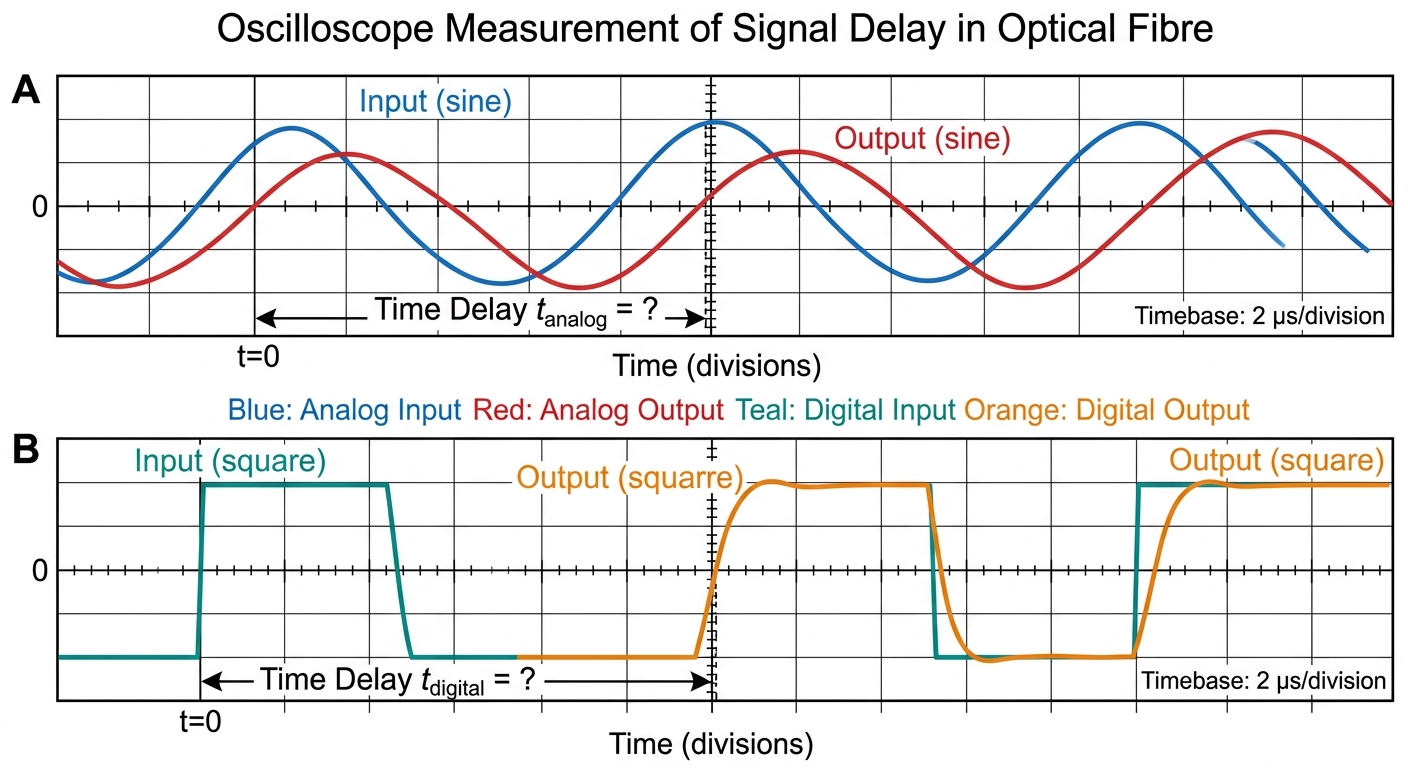
An oscilloscope displays the input and output signals of an analog sine wave and a digital square wave, each transmitted through the same optical fibre of length 12 km. The timebase is set to /division. Both input signals are aligned at . The output sine wave peak occurs at 4.2 divisions from the input; the output square wave leading edge occurs at 4.0 divisions from the input.
a
Calculate the propagation time delay for the analog signal. [2]
b
Using , calculate the speed of light in the fibre using the analog signal delay. Show your working clearly. [3]
c
The digital signal delay is shorter than the analog signal delay. Analyse what this difference reveals about how each signal type propagates through the fibre, and explain one consequence for the design of long-distance communication systems. [5]
Solutions
That's every free question here — 5 of 69.
+64 more questions, plus Mock Papers & Worksheets, are waiting in Premium.