You're viewing free preview questions — 6 questions previewing here — subscribe to unlock 172 more, plus the Full Question Bank, Mock Papers & Worksheets.Upgrade
Back

Wave properties and wave behaviour — Free MYP5 Physics Practice Questions

Free questions

Open in full, with answers, mark scheme and examiner insights.

Question 1Criterion A · Band 1-4 · Easy · 4 marksrevisionprep.com

Transverse vs Longitudinal Waves

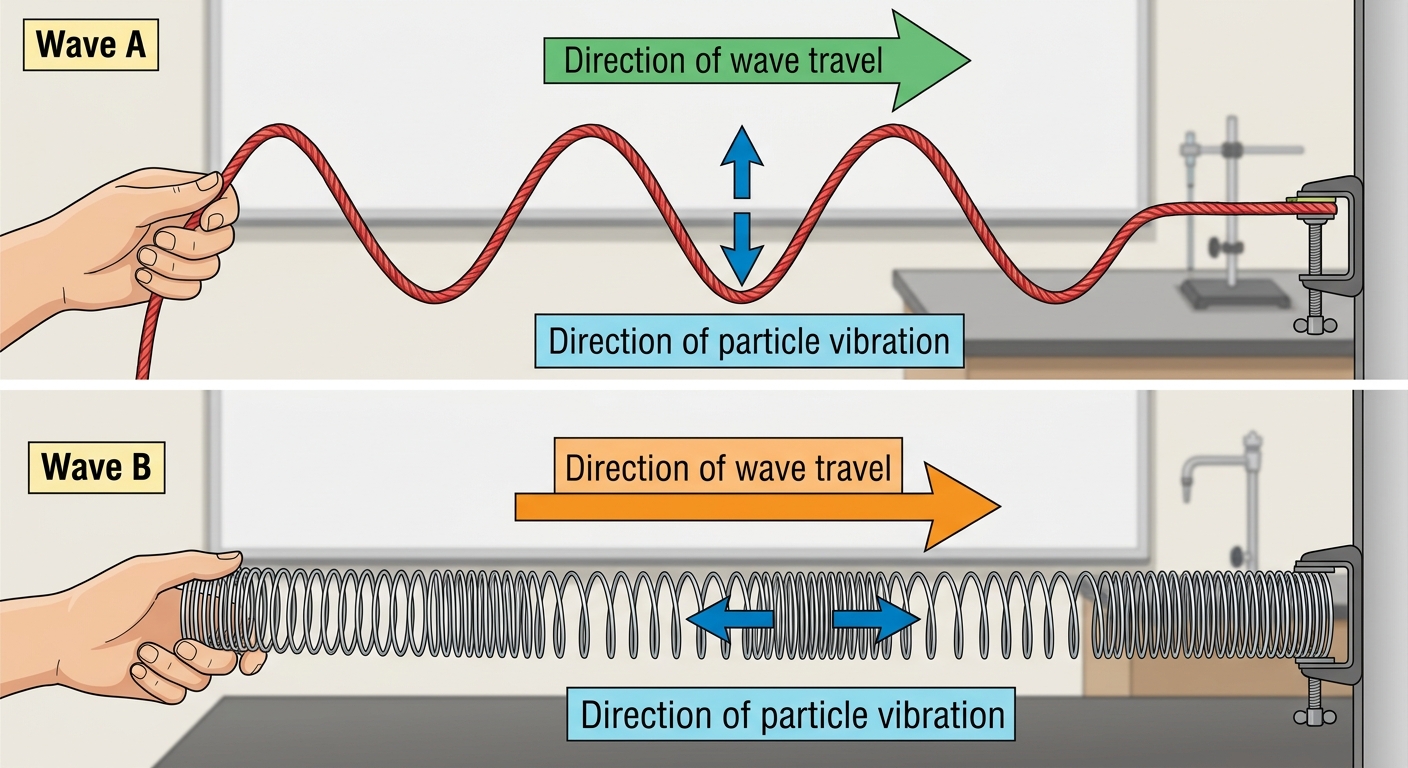
The diagram shows two waves in a classroom. Wave A is made by moving the end of a rope up and down. Wave B is made by pushing and pulling the end of a slinky along its length.
Question diagram
(a)
For each wave, describe the direction of vibration of the rope or coils compared with the direction of energy transfer. [2]Criterion A (i) · Level 3-4
(b)
Give one real example of each type of wave. [2]Criterion A (i) · Level 1-2

revisionprep.com

Summary Answer

Not available for this question.

Model Answer

Not available for this question.

Marking Scheme

Not available for this question.

Examiner Insights

Not available for this question.

Question 2Criterion A · Band 1-4 · Easy · 4 marksrevisionprep.com

Diffraction of Waves

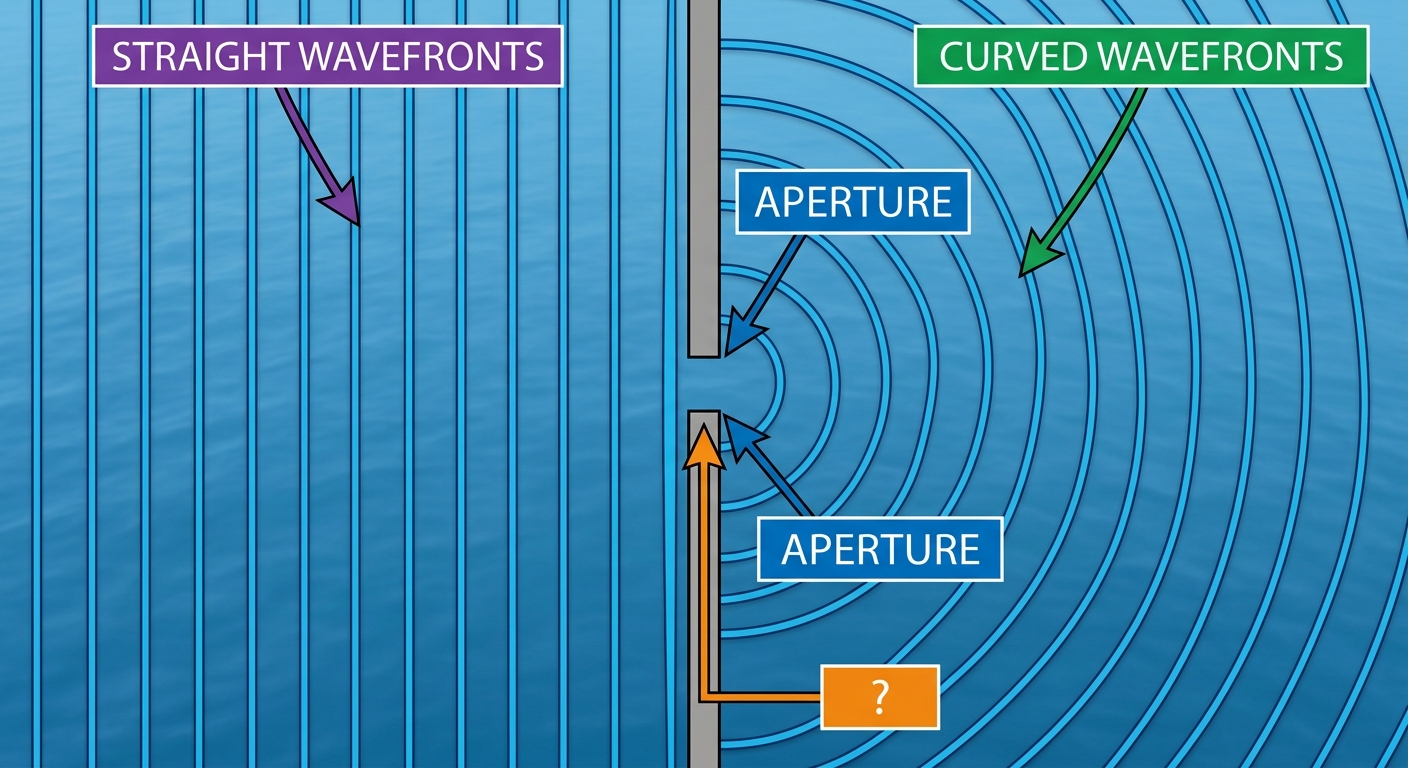
The diagram shows straight water waves in a ripple tank passing through a gap in a barrier.
Question diagram
(a)
State the name of the effect shown beyond the barrier. [1]Criterion A (i) · Level 1-2
(b)
State what happens to the wavelength of the waves as they pass through the gap. [1]Criterion A (i) · Level 1-2
(c)
The gap is made narrower, but stays wider than the wavelength. Explain how the waves beyond the barrier change. [2]Criterion A (ii) · Level 3-4

revisionprep.com

Summary Answer

Not available for this question.

Model Answer

Not available for this question.

Marking Scheme

Not available for this question.

Examiner Insights

Not available for this question.

Question 3Criterion C + A · Band 1-6 · Medium · 6 marksrevisionprep.com

Definition and Examples of Waves

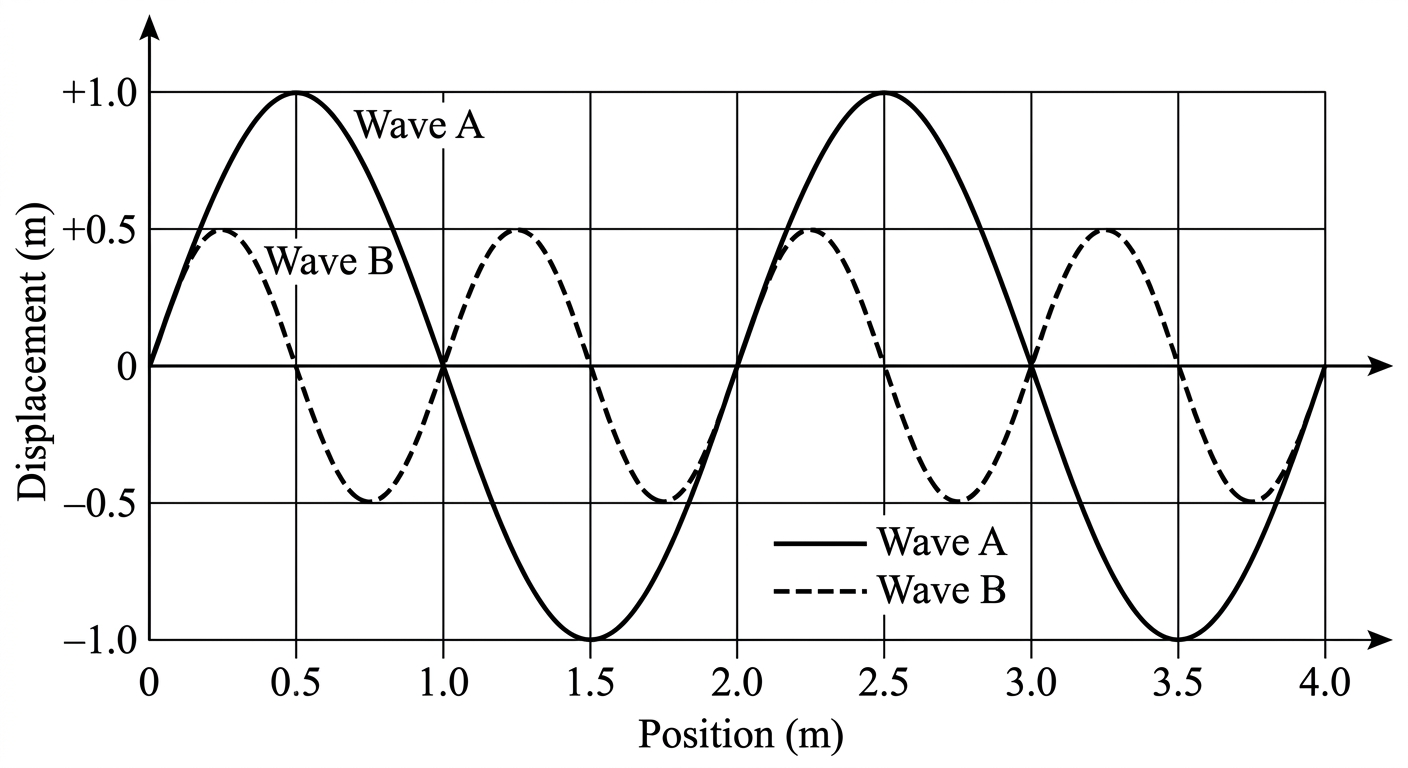
The displacement-distance graph shows two waves, A and B, travelling through the same medium at one instant. Wave A has a frequency of 2.0 Hz and wave B has a frequency of 4.0 Hz.
Question diagram
(a)
Use the graph to state the wavelength and the amplitude of each wave. [2]Criterion C (ii) · Level 1-2
(b)
Calculate the speed of each wave. [2]Criterion C (i) · Level 3-4
(c)
Explain why the two waves travel at the same speed even though their frequencies are different. [2]Criterion A (i) · Level 5-6

revisionprep.com

Summary Answer

Not available for this question.

Model Answer

Not available for this question.

Marking Scheme

Not available for this question.

Examiner Insights

Not available for this question.

Question 4Criterion D + A · Band 3-6 · Medium · 5 marksrevisionprep.com

Crest, trough, compression and rarefaction
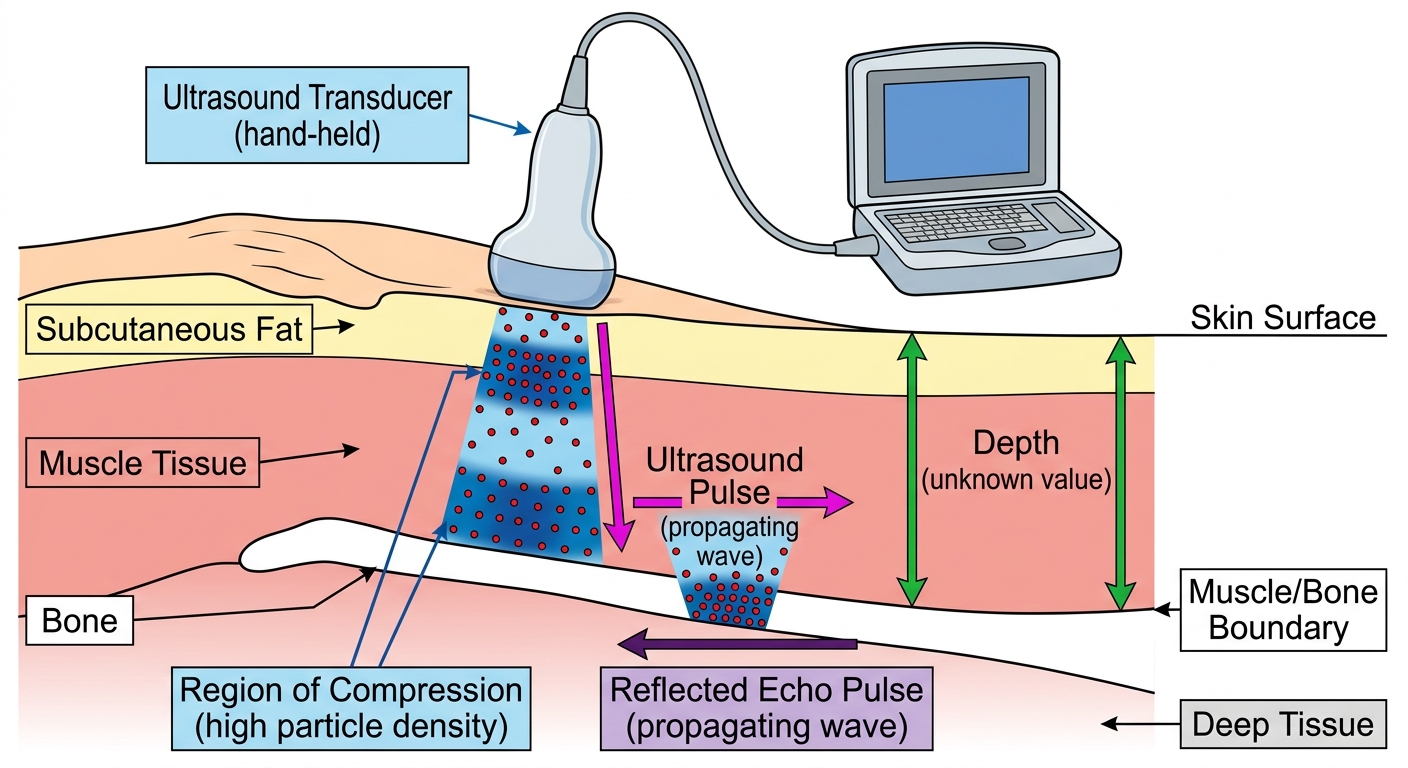
A portable ultrasound device sends a short pulse, a compression followed by a rarefaction, into the body and detects the echo from the boundary between muscle and bone, as shown. Ultrasound travels through tissue at 1540 m s⁻¹. The echo returns 130 µs after the pulse is sent.
Question diagram
(a)
Calculate the depth of the muscle-bone boundary below the probe. [2]Criterion A (ii) · Level 3-4
(b)
Doctors use ultrasound to check some bone injuries. Suggest one benefit and one limitation of using ultrasound instead of X-rays, and state what the time of the echo tells the doctor. [3]Criterion D (ii) · Level 5-6

revisionprep.com

Summary Answer

Not available for this question.

Model Answer

Not available for this question.

Marking Scheme

Not available for this question.

Examiner Insights

Not available for this question.

Question 5Criterion B + C · Band 5-8 · Challenge · 10 marksrevisionprep.com

Wavelength, frequency, amplitude and period
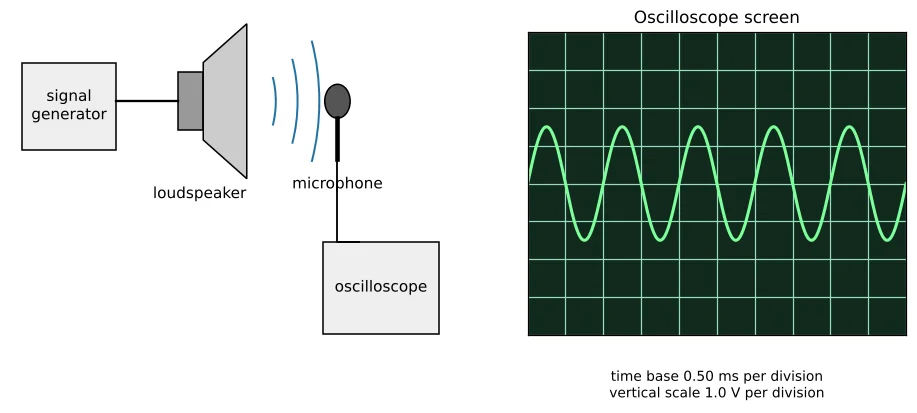
A student wants to find out whether making a sound louder changes its frequency. She connects a signal generator to a loudspeaker and places a microphone in front of it. The microphone is connected to an oscilloscope, as drawn. On the oscilloscope screen each horizontal division is 0.50 ms and each vertical division is 1.0 V. She can read the screen to within 0.1 division.
Question diagram
(a)
Formulate a hypothesis for how the frequency measured by the microphone depends on the loudness of the sound, and explain it using scientific reasoning. [2]Criterion B (ii) · Level 5-6
(b)
State the independent variable and the dependent variable, and explain how two other variables are controlled. [3]Criterion B (iii) · Level 5-6
(c)
Explain how she can find the frequency of the sound from the trace as accurately as possible. [2]Criterion B (iv) · Level 5-6
(d)
She repeats the investigation for five amplitudes. The table shows the number of divisions taken by one complete wave on the screen.

Amplitude / divisions0.51.01.52.02.5Divisions for one complete wave2.02.02.02.02.1\begin{array}{|l|c|c|c|c|c|}\hline \text{Amplitude / divisions} & 0.5 & 1.0 & 1.5 & 2.0 & 2.5 \\ \hline \text{Divisions for one complete wave} & 2.0 & 2.0 & 2.0 & 2.0 & 2.1 \\ \hline\end{array}

Calculate the frequency for each amplitude and evaluate your hypothesis. [3]
Criterion C (ii), C (iii) · Level 7-8

revisionprep.com

Summary Answer

Not available for this question.

Model Answer

Not available for this question.

Marking Scheme

Not available for this question.

Examiner Insights

Not available for this question.

Question 6Criterion A + D · Band 1-8 · Challenge · 8 marksrevisionprep.com

Wave speed: v = fλ

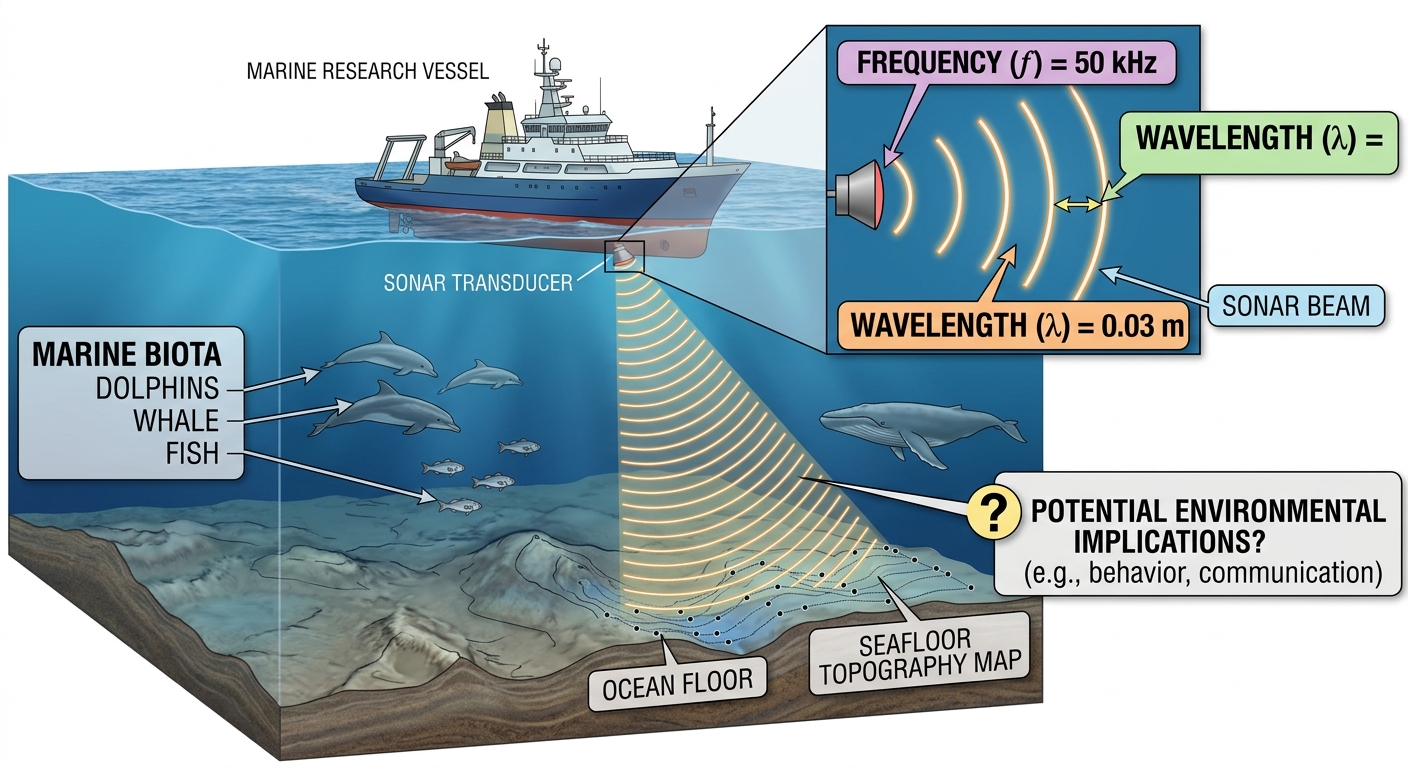
A research vessel maps the ocean floor using sonar. The sonar emits sound of frequency 50 kHz and wavelength 0.030 m in seawater.
Question diagram
(a)
Calculate the speed of the sonar waves in seawater. [2]Criterion A (ii) · Level 1-2
(b)
A pulse returns 1.2 s after it is sent. Calculate the depth of the sea floor. [2]Criterion A (ii) · Level 3-4
(c)
The crew switch to 20 kHz. Deduce the new wavelength and state whether the speed changes. [2]Criterion A (ii) · Level 3-4
(d)
Sonar surveys help ships navigate and help scientists find habitats, but loud sonar can disturb dolphins and whales. Suggest how the survey team could balance these needs. [2]Criterion D (ii) · Level 7-8

revisionprep.com

Summary Answer

Not available for this question.

Model Answer

Not available for this question.

Marking Scheme

Not available for this question.

Examiner Insights

Not available for this question.

That's every free question here — 6 of 178.

+172 more questions, plus Mock Papers & Worksheets, are waiting in Premium.

Upgrade