You're viewing free preview questions — 4 questions previewing here — subscribe to unlock 81 more, plus the Full Question Bank, Mock Papers & Worksheets.Upgrade
Habitats and Adaptations — Free MYP3 Sciences Practice Questions

1QuestionAdaptations for Survival in Extreme EnvironmentsConcept Practice
2 marks~3 minCriterion A
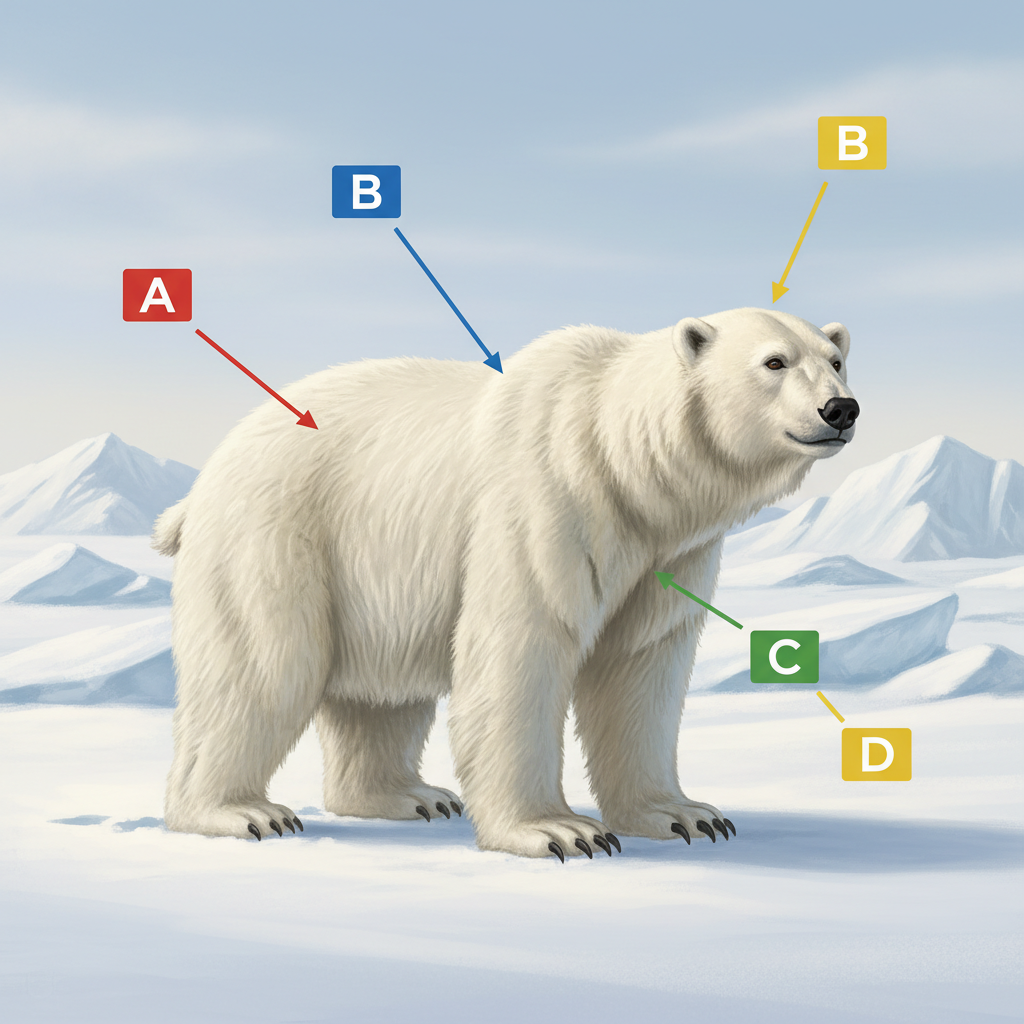
The diagram below shows a polar bear with four labeled parts:
A: large ears
B: thick white fur
C: sharp claws
D: small tail
A: large ears
B: thick white fur
C: sharp claws
D: small tail
a
Identify the labeled part that is an adaptation for maintaining warmth in the Arctic. Write the letter only. [1]
b
Explain how this adaptation helps the polar bear survive in the Arctic environment. [1]

Solutions
2QuestionAdaptations for Survival in Extreme EnvironmentsAssessment Practice
4 marks~6 minCriterion D
Conservationists in a hot desert place metal shade structures — metal sheets on wooden poles, 1 m above the ground — to help fennec foxes survive extreme heat. Fennec foxes naturally use underground burrows that stay cool and humid.
a
Describe one way in which the metal sheets may make the shaded area warmer than a natural burrow. [1]
b
Explain why the artificial structures are unlikely to provide the humidity conditions that fennec foxes need to survive. [2]
c
Identify one assumption the engineers made about the foxes' needs, and analyse how this assumption could reduce the effectiveness of the artificial structures as a conservation tool. [1]

Solutions
3QuestionStructural and Behavioral AdaptationsAssessment Practice
4 marks~6 minCriterion B
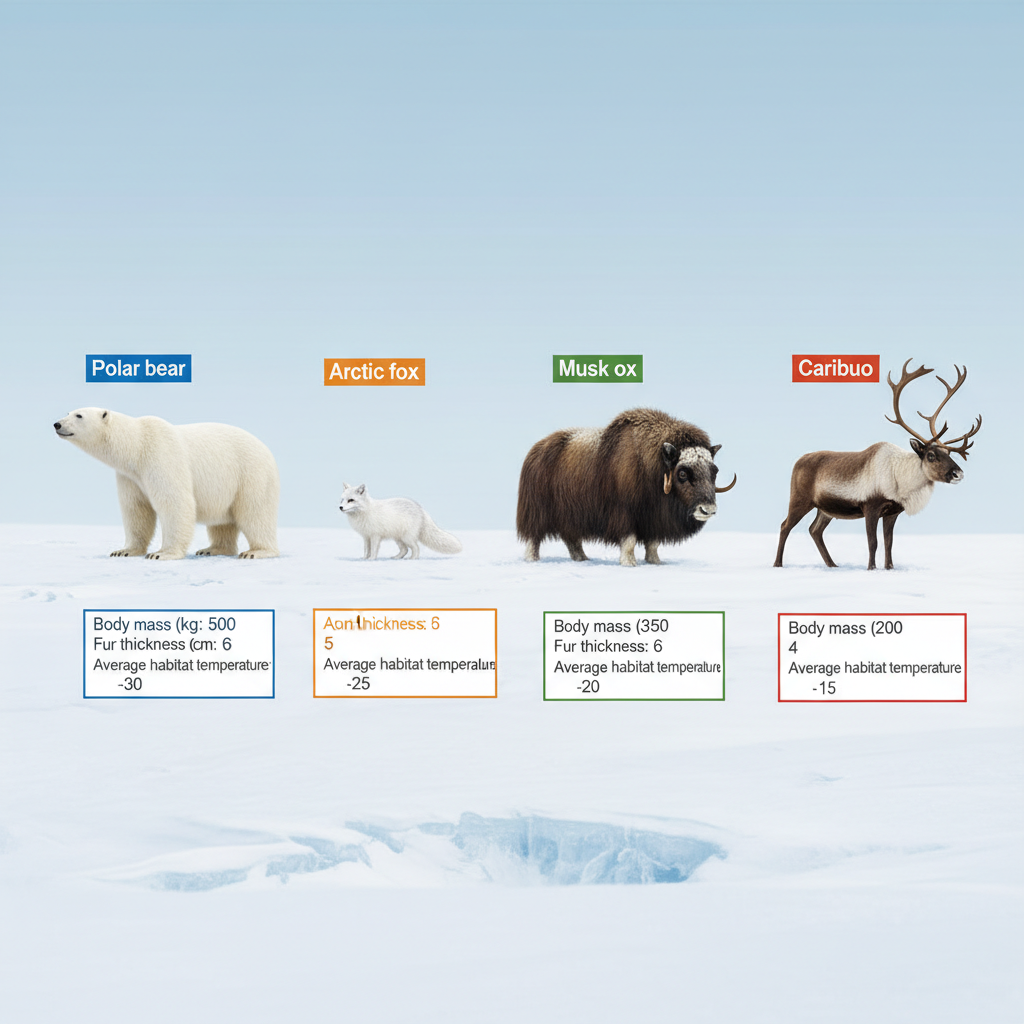
The data below shows fur thickness and average habitat temperature for four Arctic mammals.
| Mammal | Polar bear | Arctic fox | Musk ox | Caribou |
|---|---|---|---|---|
| Fur thickness (cm) | 10 | 6 | 8 | 4 |
| Average habitat temperature (°C) | −30 | −25 | −20 | −15 |
a
Describe the relationship between fur thickness and average habitat temperature using data from the table. [2]
b
The Arctic hare lives in areas with an average temperature of −28°C. Predict its fur thickness and explain your reasoning using the pattern you described. [2]
Solutions
4QuestionStructural and Behavioral AdaptationsAssessment Practice
5 marks~8 minCriterion C
A model bird pecks at paper moths placed against a green background. In each of 5 trials, the bird pecks for 30 seconds. The bird is trained to remain still before each trial. Results are recorded below.
| Trial 1 | brown captured: 8 | green captured: 3 |
|---|---|---|
| Trial 2 | brown captured: 7 | green captured: 4 |
| Trial 3 | brown captured: 9 | green captured: 2 |
| Trial 4 | brown captured: 6 | green captured: 5 |
| Trial 5 | brown captured: 10 | green captured: 1 |
a
Calculate the mean number of brown moths and the mean number of green moths captured per trial. [2]
b
Explain why the green moths survived better than the brown moths in this experiment. [1]
c
A student claims: "Remaining still is more important than body color for survival, because the bird captured more brown moths in every trial." Analyse whether the experimental data supports this claim. [2]

Solutions
That's every free question here — 4 of 85.
+81 more questions, plus Mock Papers & Worksheets, are waiting in Premium.