You're viewing free preview questions — 4 questions previewing here — subscribe to unlock 77 more, plus the Full Question Bank, Mock Papers & Worksheets.Upgrade
Combined Transformations — Free MYP4 Mathematics (Standard) Practice Questions

1QuestionDescribing Combined Transformations in Real-Life ContextsConcept Practice
4 marks~6 minCriterion A
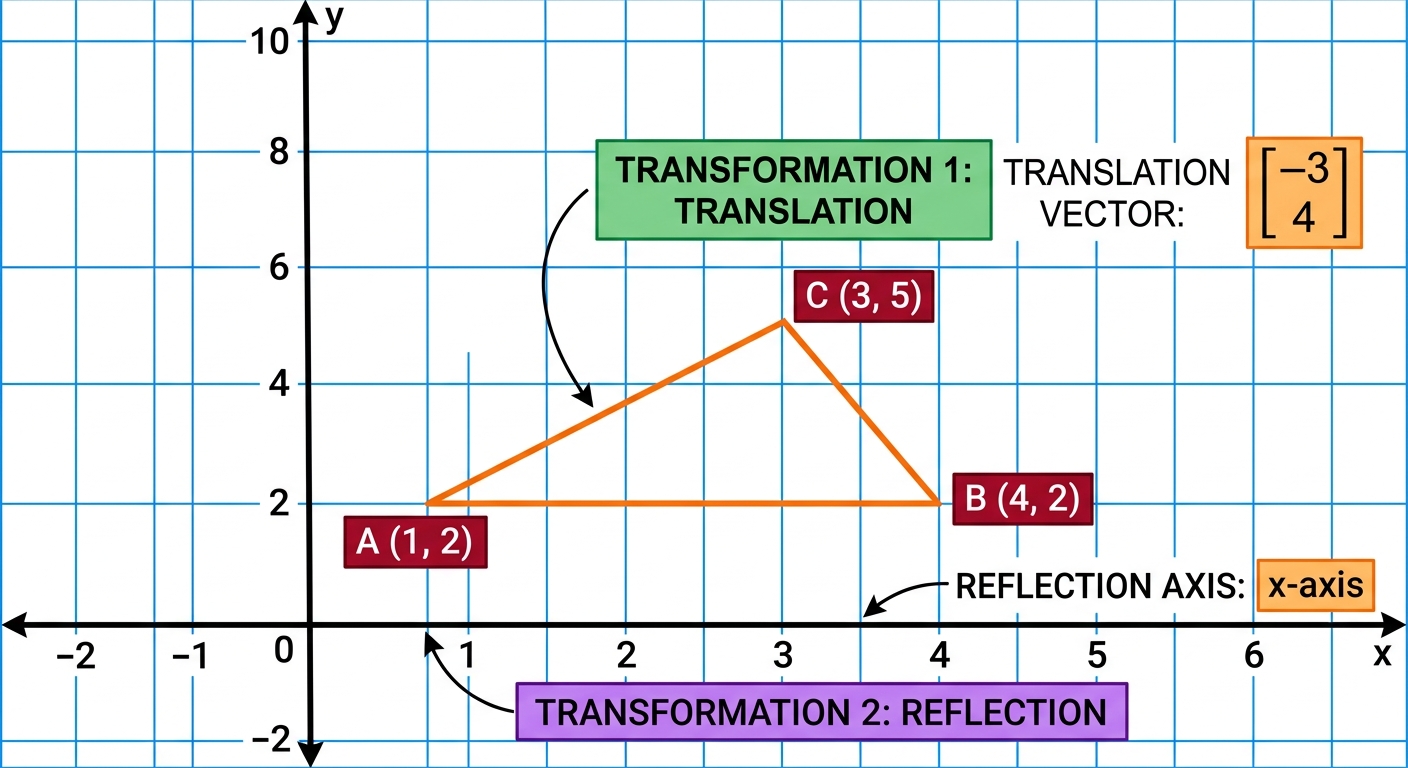
A graphic designer is mapping a logo onto a coordinate grid. The logo contains a triangle with vertices at , , and . The triangle is first translated by the vector , then reflected in the -axis to produce the final image.
a
Calculate the coordinates of , the image of after the translation. [1]
b
Deduce the coordinates of , the final image of after both transformations. [1]
c
The designer claims the final image of the triangle lies entirely below the -axis. Justify whether this claim is correct by applying both transformations to vertices and . [2]

Solutions
2QuestionIdentifying and Describing Single TransformationsAssessment Practice
4 marks~6 minCriterion D
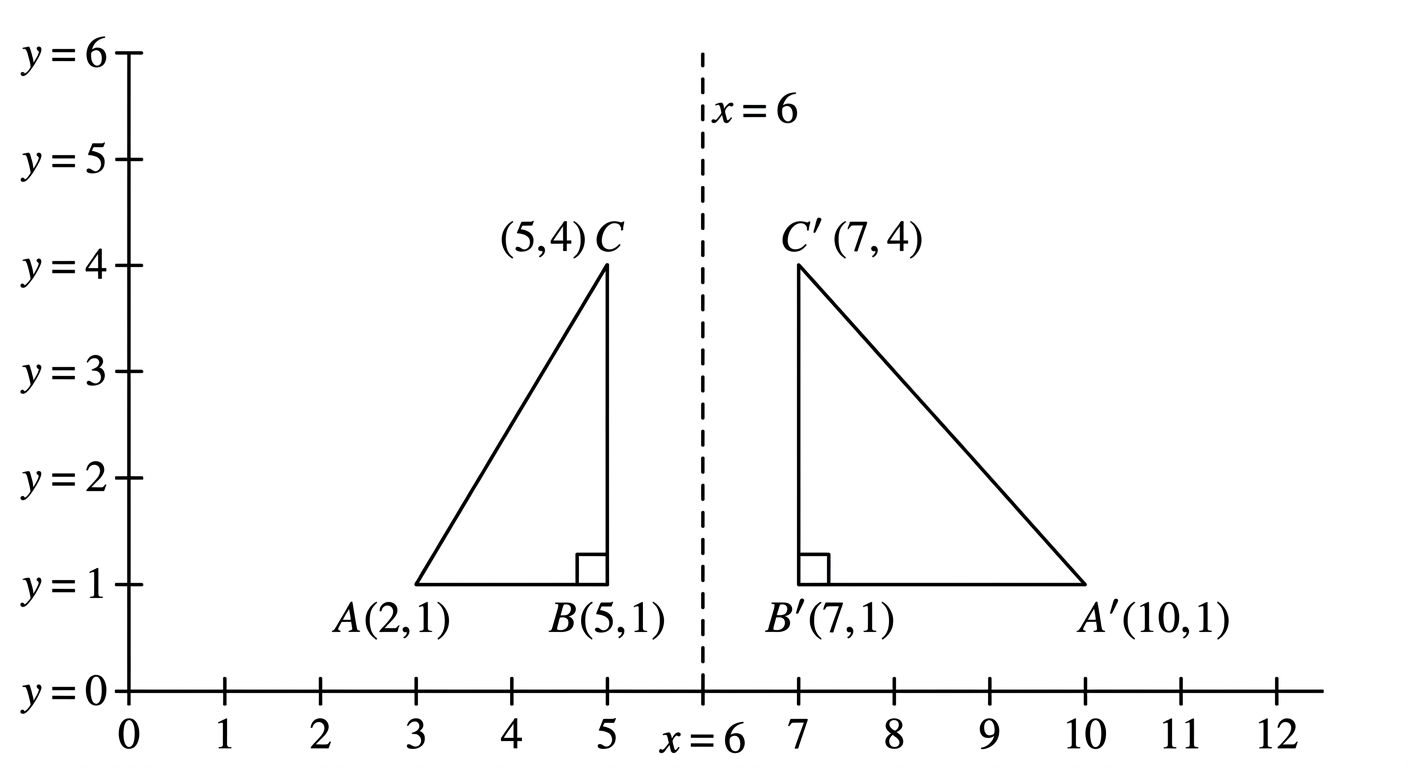
An architect designs a symmetrical building wing. The original section is a right-angled triangle with vertices at , , and on a coordinate grid (units in metres). The wing is reflected across the vertical line to create a mirror-image section.
a
Describe the single transformation that maps triangle to its image , stating the coordinates of , , and . [2]
b
A construction error causes the intended reflection axis to be rotated clockwise about the point . Explain how this error affects the position of the reflected section, and why the displacement is not the same for all three vertices. [1]
c
The architect claims the reflected design will remain a perfect mirror image of the original wing throughout the building's lifetime. Assess the validity of this claim, considering how real structures behave over time. [1]
Solutions
3QuestionFinding the Single Equivalent TransformationAssessment Practice
6 marks~9 minCriterion B
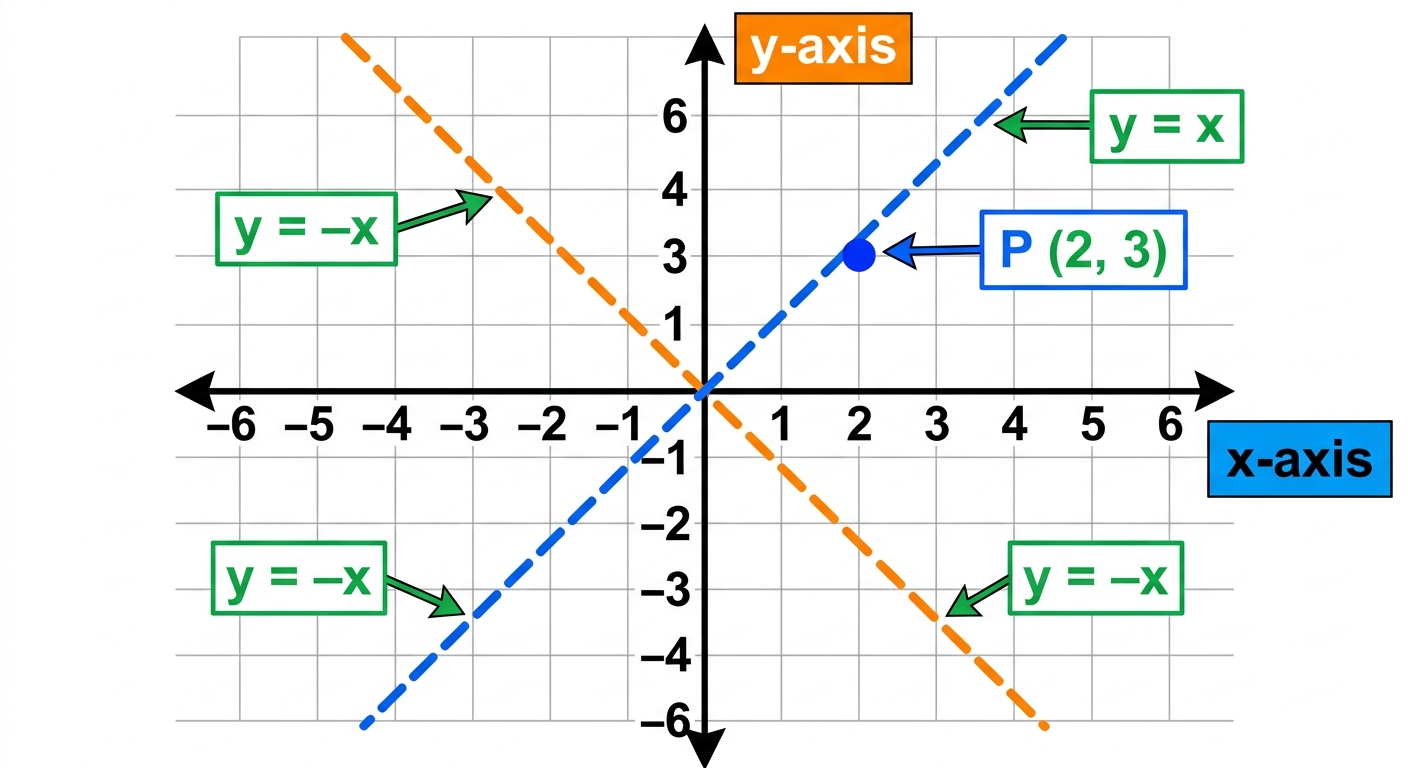
A graphic designer places a logo element at point on a coordinate grid. To reposition it, the designer applies two successive reflections: first across the line , then across the line .
a
Determine the coordinates of the image of after both reflections are applied in order. Show your working. [2]
b
Deduce the single rotation about the origin that produces the same final image as the two reflections combined. State the angle and justify why direction need not be specified. [2]
c
The designer claims this rotation model can guide the physical placement of a logo using two angled mirrors. Assess whether the model is reliable for a real printing process, identifying the key factors that could cause the actual logo position to differ from the predicted position. [2]
Solutions
4QuestionIdentifying and Describing Single TransformationsAssessment Practice
6 marks~9 minCriterion C
A graphic designer is creating a logo. A triangular element has vertices , , . After transformation, the image has vertices , , . The designer claims the transformation is a translation by vector .
a
Determine the displacement vector mapping each vertex to its image. Justify whether the designer's claim is correct. [3]
b
The original coordinates carry a measurement error of unit. Explain how such an error could cause the transformation to be misidentified as a reflection or rotation rather than a translation. [2]
c
Advise the designer whether coordinate geometry alone is sufficient for describing transformations in hand-drawn logo sketches. [1]
Solutions
That's every free question here — 4 of 81.
+77 more questions, plus Mock Papers & Worksheets, are waiting in Premium.