You're viewing free preview questions — 4 questions previewing here — subscribe to unlock 79 more, plus the Full Question Bank, Mock Papers & Worksheets.Upgrade
Isotopes and Relative Atomic Mass — Free MYP5 Chemistry Practice Questions

1QuestionCalculating Relative Atomic Mass RAMConcept Practice
2 marks~3 minCriterion A
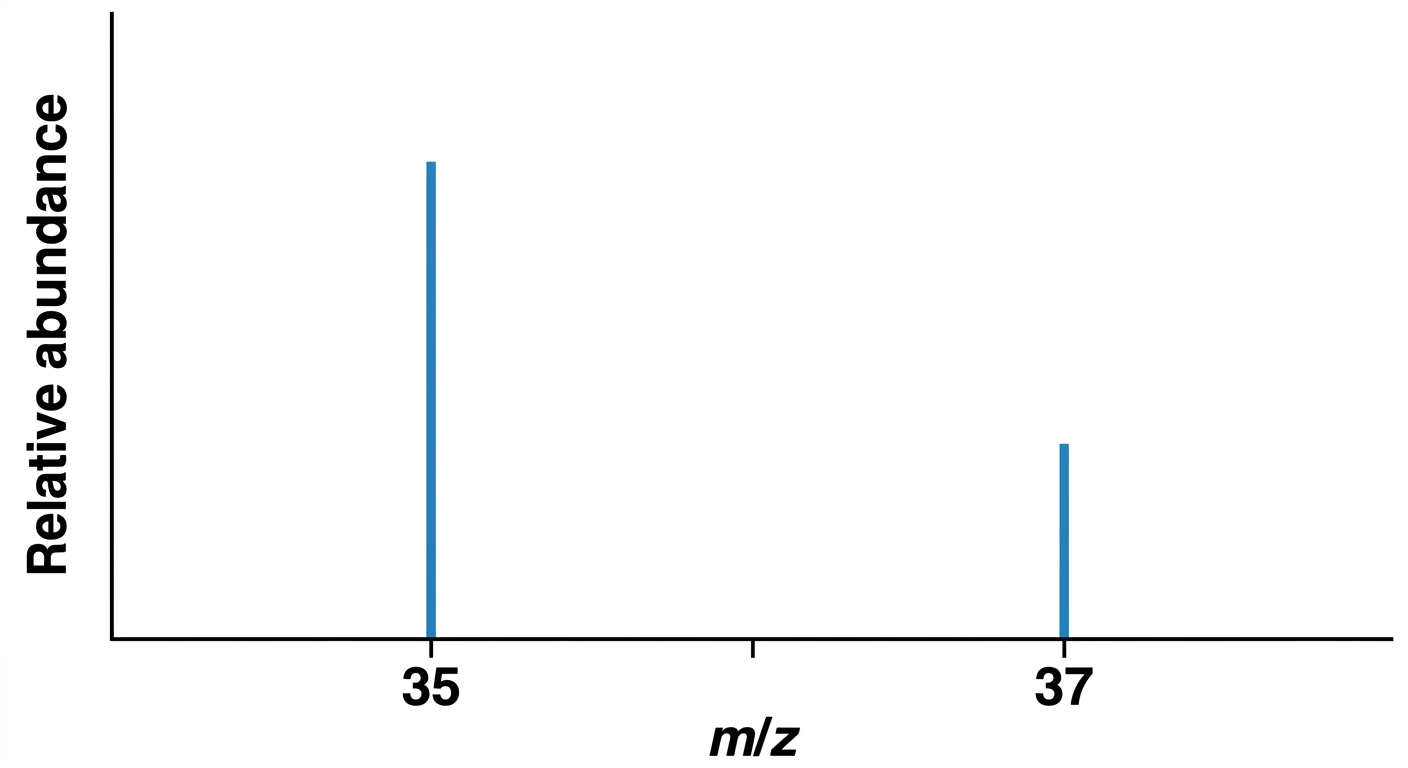
A mass spectrum of chlorine shows two peaks: one at with a relative abundance of 75.77% and one at with a relative abundance of 24.23%.
a
Deduce the identity of the isotope responsible for each peak, using correct isotopic notation. [1]
b
Using the data above, calculate the relative atomic mass (RAM) of chlorine. Give your answer to one decimal place. [1]

Solutions
2QuestionCalculating Relative Atomic Mass RAMAssessment Practice
5 marks~8 minCriterion D
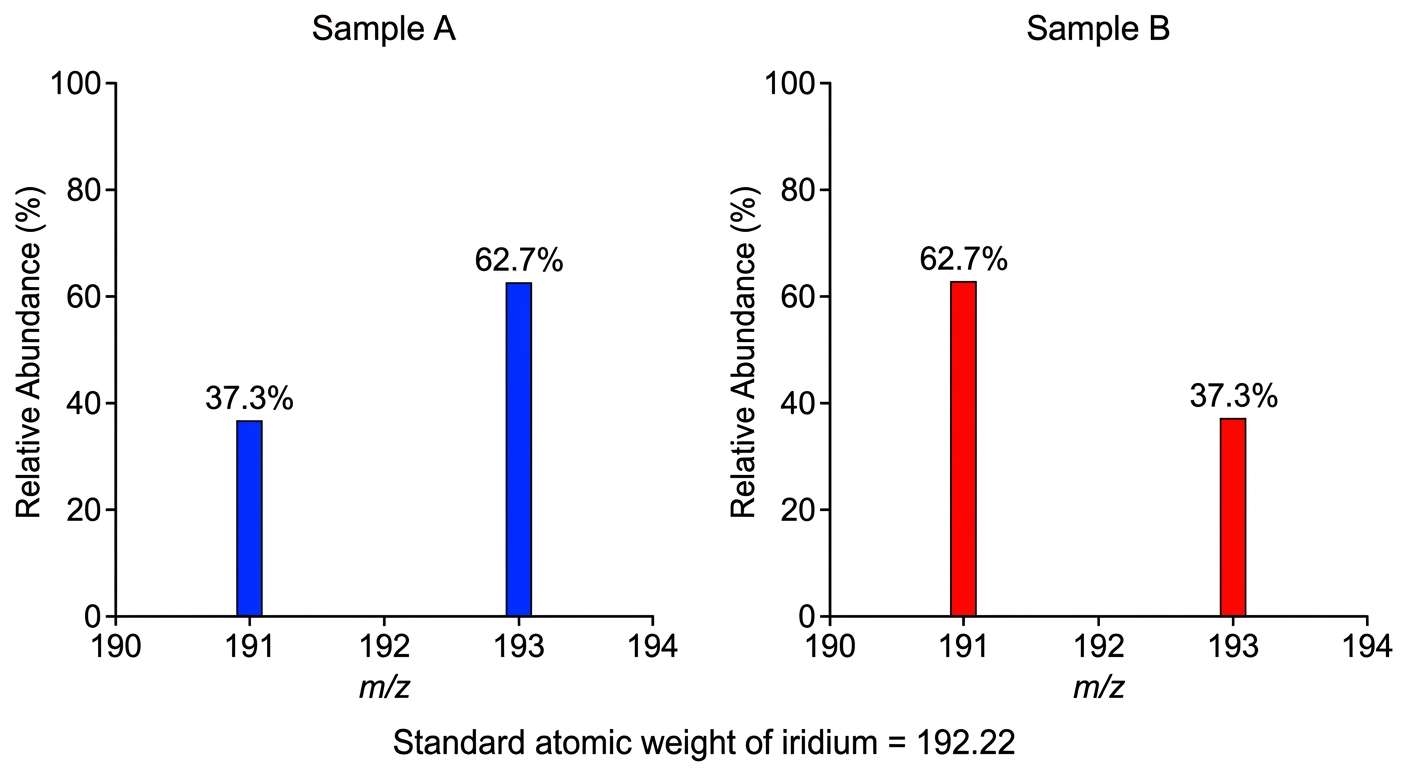
A mass spectrometer analyses two iridium samples. The data are:
Sample A: Ir: 37.3% abundance; Ir: 62.7% abundance
Sample B: Ir: 62.7% abundance; Ir: 37.3% abundance
The standard atomic weight of iridium is 192.22.
Use the formula:
where is the mass number and is the percentage abundance.
Sample A: Ir: 37.3% abundance; Ir: 62.7% abundance
Sample B: Ir: 62.7% abundance; Ir: 37.3% abundance
The standard atomic weight of iridium is 192.22.
Use the formula:
where is the mass number and is the percentage abundance.
a
Calculate for both Sample A and Sample B, showing all working. [2]
b
Compare your calculated values to the standard atomic weight and deduce which sample is from a terrestrial source. [1]
c
Justify why the other sample is likely to be of meteoritic origin, referring to isotopic composition and nucleosynthetic processes. [2]
Solutions
3QuestionStability of Isotopes and Radioactivity IntroAssessment Practice
8 marks~12 minCriterion C
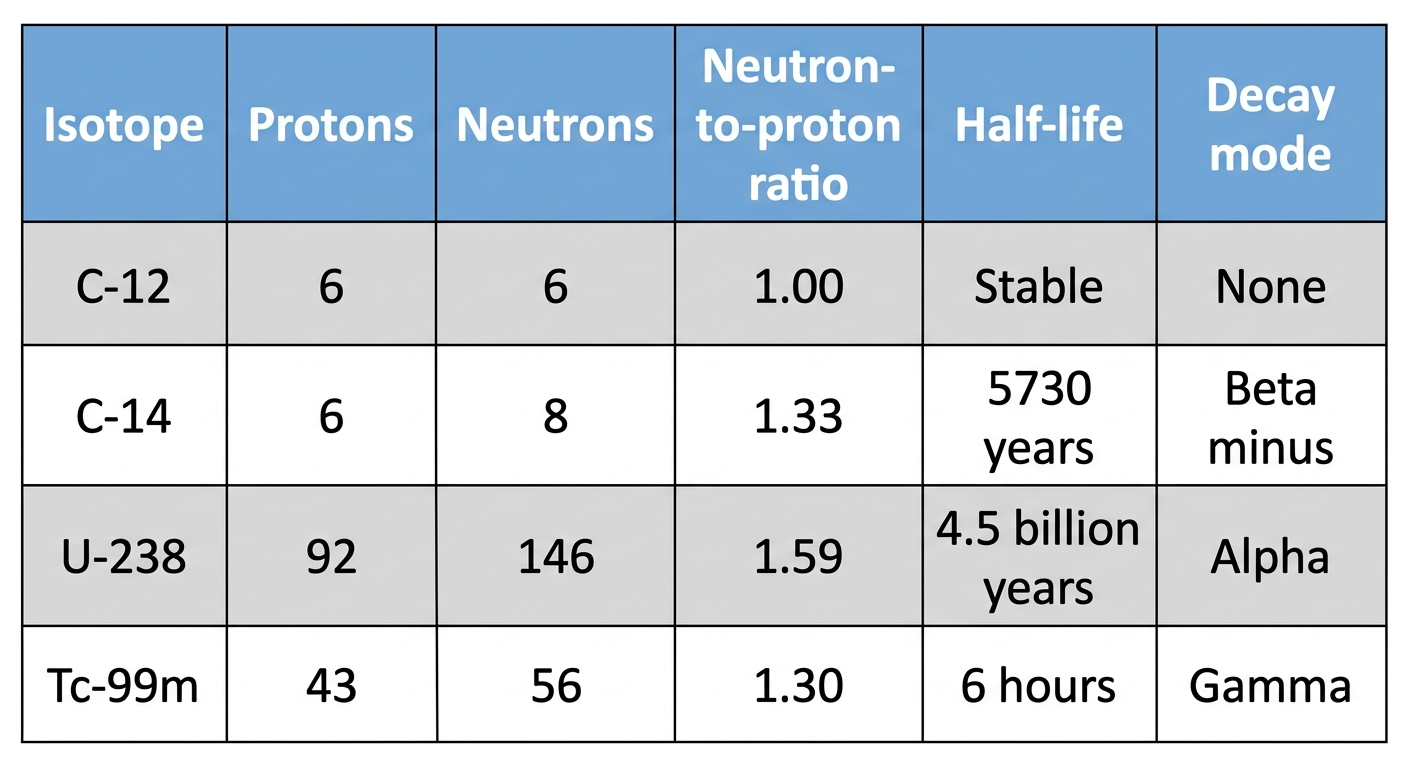
Four isotopes are listed below.
Consider the hypothesis: "All isotopes with more neutrons than protons are unstable."
| Isotope | C-12 | C-14 | U-238 | Tc-99m |
|---|---|---|---|---|
| Protons | 6 | 6 | 92 | 43 |
| Neutrons | 6 | 8 | 146 | 56 |
| Neutron-to-proton ratio | 1.00 | 1.33 | 1.59 | 1.30 |
| Half-life | Stable | 5730 years | 4.5 billion years | 6 hours |
| Decay mode | None | beta-minus | alpha | gamma |
Consider the hypothesis: "All isotopes with more neutrons than protons are unstable."
a
Identify which isotopes in the table support the hypothesis and which contradict it. Justify your answer using data from the table. [3]
b
Explain how the band of stability accounts for the stability of C-12 and the instability of C-14. [2]
c
Evaluate whether the data in the table are sufficient to confirm the hypothesis. In your answer, refer to isotopes not shown in the table. [3]
Solutions
4QuestionDefinition and Examples of IsotopesAssessment Practice
7 marks~11 minCriterion B
The table below shows isotopic data for three elements.
| Hydrogen-1 | 1 proton | 0 neutrons | stable |
|---|---|---|---|
| Hydrogen-2 | 1 proton | 1 neutron | stable |
| Hydrogen-3 | 1 proton | 2 neutrons | radioactive |
| Carbon-12 | 6 protons | 6 neutrons | stable |
|---|---|---|---|
| Carbon-13 | 6 protons | 7 neutrons | stable |
| Carbon-14 | 6 protons | 8 neutrons | radioactive |
| Uranium-235 | 92 protons | 143 neutrons | radioactive |
|---|---|---|---|
| Uranium-238 | 92 protons | 146 neutrons | radioactive |
a
Calculate the neutron-to-proton ratio for each isotope and identify the pattern linking this ratio to nuclear stability. [2]
b
Deduce a general rule, based on atomic number, that predicts whether an isotope is likely to be stable or radioactive from its neutron-to-proton ratio. [2]
c
Oxygen-16 has 8 protons and 8 neutrons; oxygen-18 has 8 protons and 10 neutrons. Oxygen-18 is in fact stable. Analyse whether your rule from (b) correctly predicts the stability of each isotope, and evaluate what this reveals about the limitations of a neutron-to-proton ratio rule. [3]
Solutions
That's every free question here — 4 of 83.
+79 more questions, plus Mock Papers & Worksheets, are waiting in Premium.