You're viewing free preview questions — 4 questions previewing here — subscribe to unlock 68 more, plus the Full Question Bank, Mock Papers & Worksheets.Upgrade
Periodic Trends and Element Properties — Free MYP5 Chemistry Practice Questions

1QuestionChemical Properties Based on PositionConcept Practice
2 marks~3 minCriterion A
The periodic table below shows a highlighted element at Group 2, Period 3.
a
Deduce the identity of the highlighted element. [1]
b
Explain one chemical property that can be inferred from its position in the periodic table. [1]


Solutions
2QuestionChemical Properties Based on PositionAssessment Practice
4 marks~6 minCriterion D
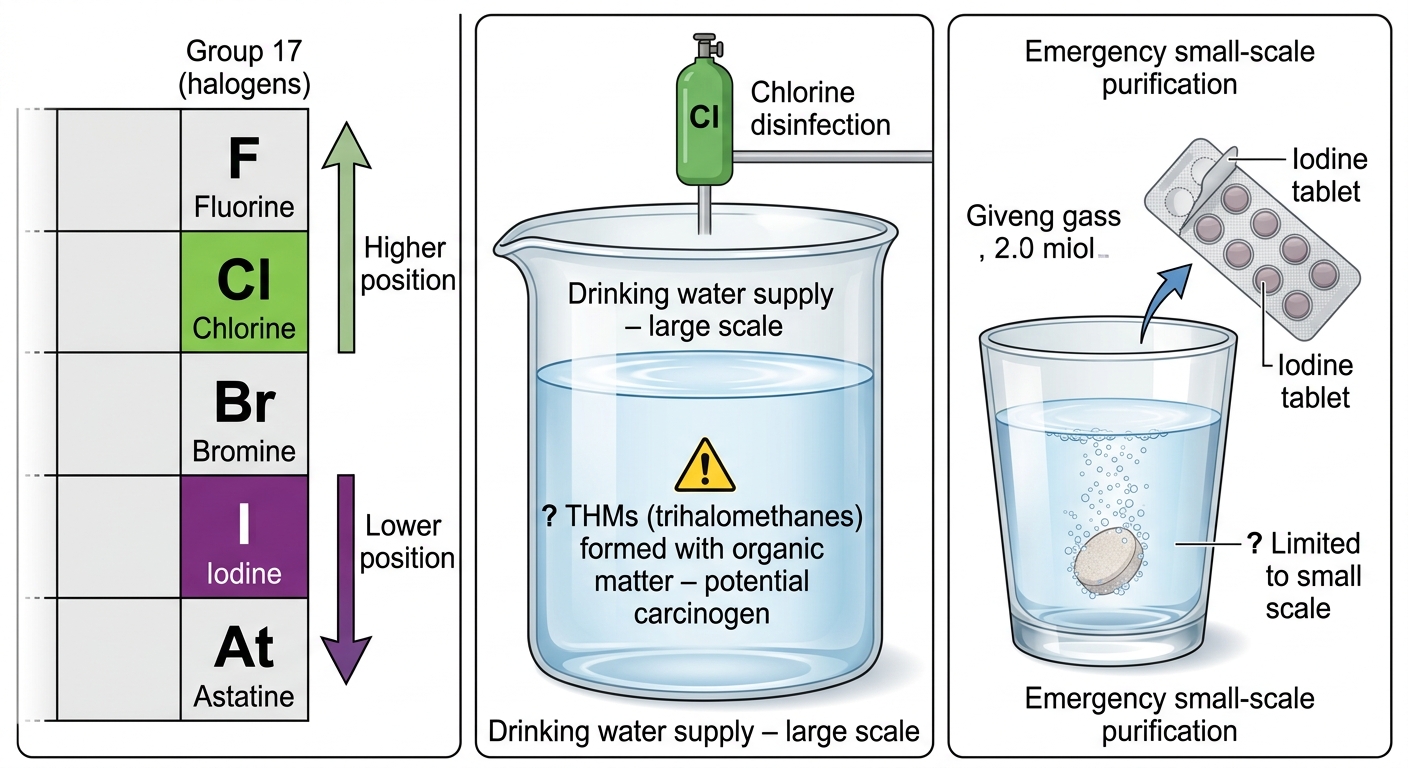
Chlorine (Period 3) and iodine (Period 5) are both Group 17 halogens used to disinfect water. Chlorine is widely used in municipal water treatment but reacts with organic matter to form trihalomethanes (THMs), which are potentially carcinogenic. Iodine is used in emergency purification tablets but is unsuitable for large-scale treatment. Prolonged iodine exposure can disrupt thyroid function.
a
State the periodic trend in reactivity down Group 17 and explain, in terms of atomic structure, why chlorine is more reactive than iodine. [1]
b
Using their positions in the periodic table, analyse one advantage and one disadvantage of each halogen for water disinfection. [2]
c
Evaluate the limitations of using periodic trends alone to assess the environmental and health safety of chlorine and iodine in water treatment. [1]
Solutions
3QuestionPredicting Properties of Unknown ElementsAssessment Practice
5 marks~8 minCriterion B
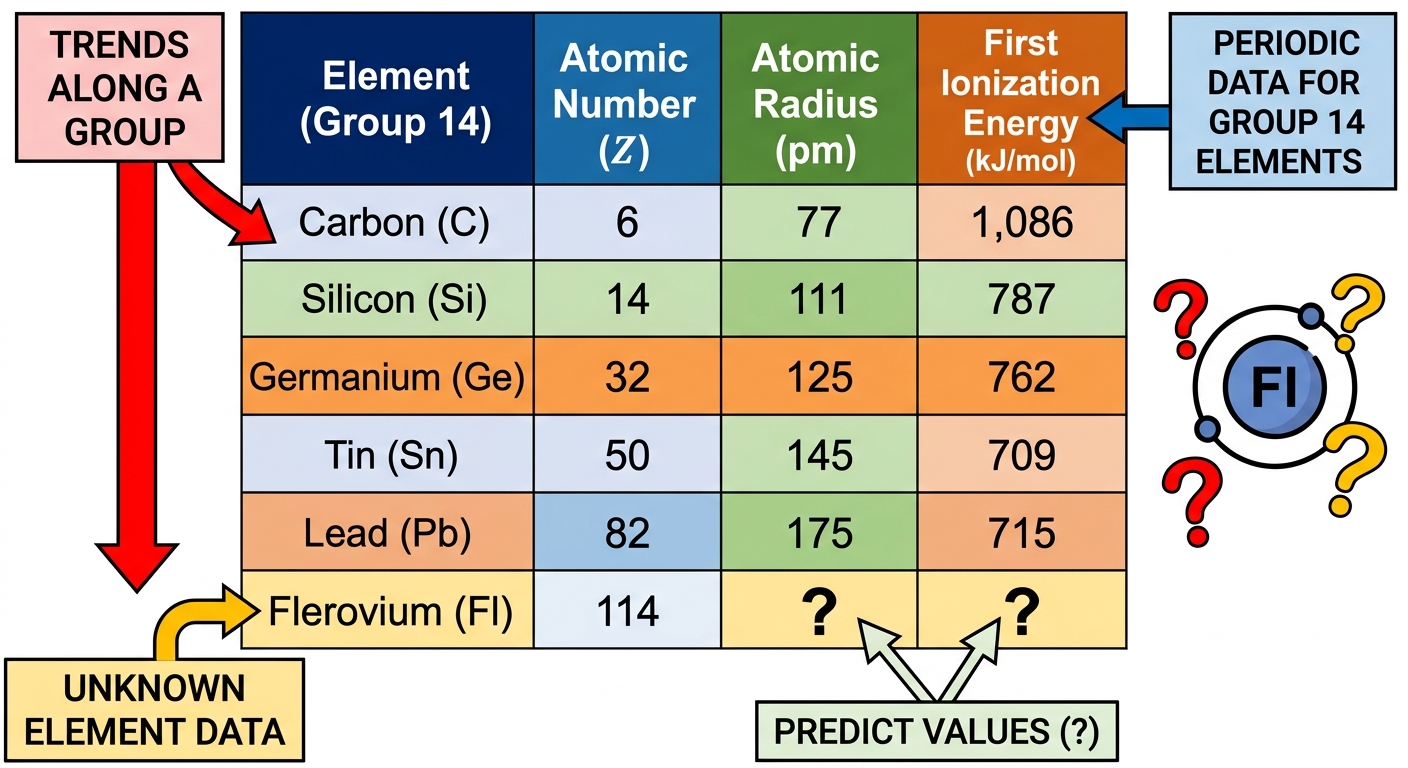
The table below shows atomic radius and first ionisation energy for Group 14 elements.
Flerovium (Fl, element 114) is a synthetic Group 14 element positioned below lead.
| Element | C | Si | Ge | Sn | Pb | Fl |
|---|---|---|---|---|---|---|
| Atomic radius (pm) | 77 | 111 | 125 | 145 | 175 | ? |
| First ionisation energy (kJ/mol) | 1086 | 787 | 762 | 709 | 715 | ? |
Flerovium (Fl, element 114) is a synthetic Group 14 element positioned below lead.
a
Explain the trend in atomic radius from C to Pb, and deduce the atomic radius of Fl. [2]
b
Explain the trend in first ionisation energy from C to Pb, and deduce the first ionisation energy of Fl. [2]
c
Construct a balanced chemical equation, with state symbols, for the reaction of Fl with oxygen. Justify the oxidation state you have assigned to Fl, referring to trends in Group 14. [1]
Solutions
4QuestionElectronegativity Across PeriodsAssessment Practice
8 marks~12 minCriterion C
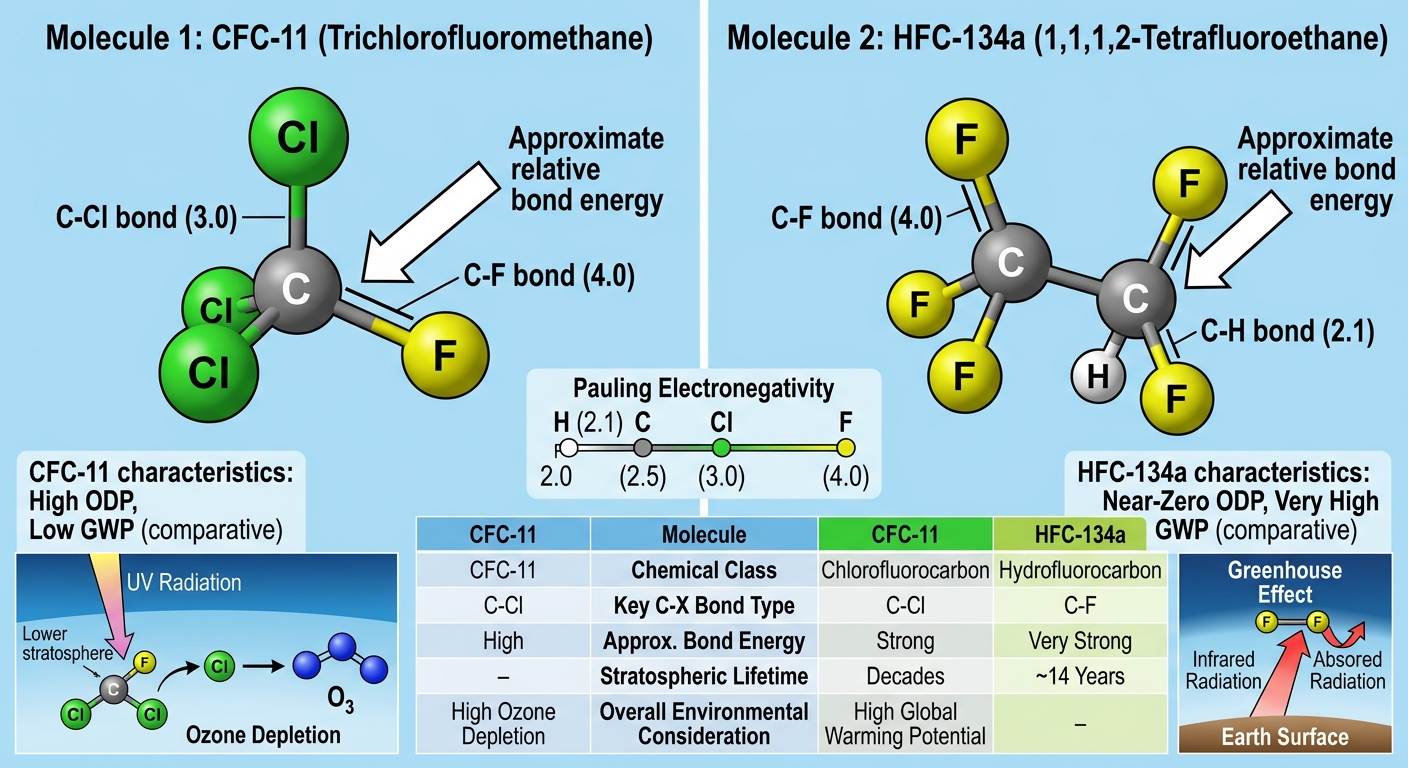
Evaluate the societal and environmental trade-offs of replacing chlorine-based refrigerants (e.g., CFCs) with fluorine-containing compounds (e.g., HFCs), using your understanding of electronegativity trends. Your evaluation should include:
a
[2 marks] Explain how the high electronegativity of fluorine (4.0 on the Pauling scale) compared to chlorine (3.0) affects the strength of carbon-halogen bonds, and how this relates to ozone depletion potential.
b
[3 marks] Discuss one societal benefit and one environmental cost of the widespread adoption of HFCs, referencing the role of bond strength in each case.
c
[3 marks] Reflect on the limitations of using electronegativity values alone to predict the overall environmental impact of a chemical technology. Consider factors such as atmospheric lifetime and infrared absorption.
Solutions
That's every free question here — 4 of 72.
+68 more questions, plus Mock Papers & Worksheets, are waiting in Premium.