
Maths: Why Every Root Tells a Factoring Story
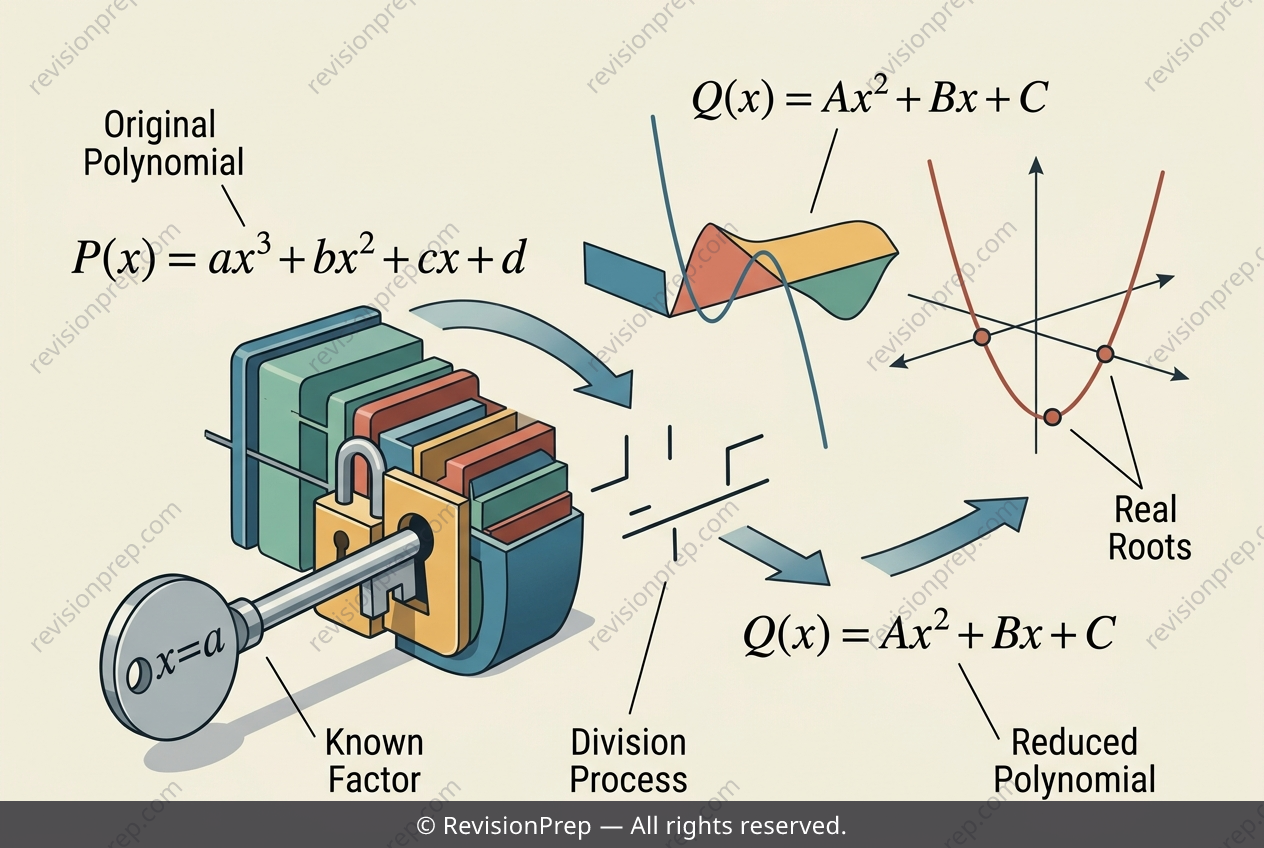
Polynomial factorization and root finding sit at the heart of Number and Algebra, linking algebraic structure to the geometry of curves. A root of P(x) is simply a value where the polynomial equals zero, so verifying that P(2) = 0 confirms (x − 2) as a factor. This is the Factor Theorem in action: a zero remainder signals a factor, and a factor reveals a root. From there, polynomial division reduces a cubic to a quadratic quotient, which can then be factorised into linear factors. Each linear factor corresponds to a root, and the degree of the polynomial tells us the maximum number of roots to expect. Understanding how substitution, division, and factorisation connect allows you to move fluidly between a polynomial's equation and its graph, revealing where it crosses the x-axis and how many distinct real roots it possesses.
Start practising IB questions today
150,000+ IB-styled questions, criteria-mapped and instantly accessible.