
Study sheets you can actually revise from — one page, one topic.
Handwritten revision sheets, diagrams and short explainers across MYP and the Diploma Programme, plus written guides on how to revise for each. Tap any sheet to view it full size.
# IB and MYP Exam Preparation: A Practical Guide : by an experienced educator.
IB and MYP Exam Preparation: A Practical Guide : by an experienced educator. Preparing for IB and MYP assessments requires more than reading notes. Students need focused revision, active practice, self-testing, and regular feedback. RevisionPrep provides practical IB and MYP exam preparation resources to help students practise concepts, identify weaknesses, and prepare more effectively for assessments. IB and MYP Exam Preparation Resources Different assessments require different preparation strategies. Unit and Classroom Tests Use topic summaries, practice questions, worked examples, self-tests, and application questions to strengthen understanding of individual topics. End-of-Year Exams Start with topic-based revision and gradually move towards mixed-topic practice, timed questions, and mock assessments. MYP Projects and Coursework Break long-term assignments into clear stages: Understand → Plan → Research → Complete → Review → Improve → Submit Review the relevant assessment criteria early rather than waiting until the final submission. How to Study Effectively Spaced Revision Revisit important topics regularly instead of studying everything immediately before an exam. Active Recall Close your notes and try to explain concepts, formulas, processes, or methods from memory. Practice Questions Use: Attempt → Check → Understand the mistake → Correct → Try Again The objective is not simply to complete more questions but to learn from mistakes. Self-Testing Regularly test yourself without notes and identify whether errors come from knowledge gaps, misunderstanding, calculation errors, or question interpretation. Using ATL Skills for Revision Approaches to Learning can support better preparation. Time management: Break large revision goals into specific tasks. Self-management: Create realistic study schedules and minimise distractions. Thinking skills: Practise applying concepts to unfamiliar situations. Research skills: Organise and evaluate information for projects. Communication skills: Practise explaining concepts clearly. Preparing for MYP Projects Long-term assignments are easier to manage when divided into milestones. Task → Criteria → Research → Plan → Draft → Review → Improve → Submit Use the assessment criteria as a checklist throughout the project. Choosing the Right Revision Resources A useful IB or MYP revision resource should provide: Clear explanations Topic-based practice Different question types Feedback Progress tracking Structured revision Students should be able to learn, practise, test, and improve within the same revision process. How RevisionPrep Helps RevisionPrep provides structured practice and revision resources for MYP 1–5 and the IB Diploma Programme. Students can use RevisionPrep for: Topic-wise practice Exam-style questions Mock assessments Self-testing Performance tracking Targeted revision The Road to 7 diagnostic approach can also help students identify strengths and weaknesses and focus their practice. Practise with purpose. Identify weaknesses. Improve consistently. A Simple Revision Routine Learn → Recall → Practise → Review mistakes → Revisit Starting early allows students to build understanding gradually rather than relying on last-minute revision. The goal is not simply to study more. The goal is to study strategically, practise effectively, and continuously improve. Important Disclaimer RevisionPrep is an independent educational platform and is not affiliated with, endorsed by, or otherwise associated with the International Baccalaureate Organization (IBO). "IB", "International Baccalaureate", "MYP", and "IB Diploma Programme" are trademarks of the International Baccalaureate Organization. RevisionPrep is not an official IB World School or an official IBO resource.
Read article
RevisionPrep vs Revision Village vs RevisionDojo: Which IB Revision Platform Is Right for You?
RevisionPrep vs Revision Village vs RevisionDojo: Which IB Revision Platform Is Right for You? RevisionPrep, Revision Village and RevisionDojo take different approaches to IB revision. RevisionPrep is structured around MYP 1–5 and selected DP subjects, while Revision Village and RevisionDojo offer broader DP subject coverage and additional tools. This comparison looks at coverage, question depth, mark schemes, diagnostics, pricing and coursework support so students can decide which platform fits their needs. All three are established platforms in the IB revision market. This article sets out what each one offers, why RevisionPrep may suit students looking for its particular MYP and DP structure, and the situations where another platform may suit you better. RevisionPrep vs Revision Village vs RevisionDojo at a glance RevisionPrep is structured for both DP and MYP. In DP, it covers Maths AA and AI, Physics, Chemistry, Biology and Economics at SL and HL, with questions supported by model answers, full mark schemes and examiner insights. In MYP, it provides year-by-year practice from MYP 1 to MYP 5, with questions tagged to criteria A to D. RevisionPrep covers both MYP and DP. MYP runs year by year from MYP 1 to MYP 5, with Maths and Sciences in MYP 1 to 3 and Maths, Physics, Chemistry and Biology in MYP 4 and 5. DP covers Maths AA and AI, Physics, Chemistry, Biology and Economics at SL and HL. The bank contains more than 150,000 exam-style questions, with answers, model answers, full mark schemes, examiner insights and an in-question AI tutor. RevisionPrep offers all of its current DP subjects under one 499 as per site, or 49 for a single subject). MYP 4 and 5 cost 69 for three months, and MYP 1 to 3 starts at 299 two-year plan. 1. Depth in the subjects you actually take RevisionPrep concentrates its DP questions on six courses, allowing substantial practice within each covered subject. When you filter to one subtopic, such as Reactivity 2 in Chemistry or Theme D Fields in Physics, you can practise within a focused area rather than working through a general subject bank. Every question is tagged by subject, level, topic, subtopic, command term and difficulty. Maths covers AA and AI at SL and HL, across all five topic areas, including HL Paper 3 practice. Sciences cover Chemistry, Biology and Physics at SL and HL. Economics covers SL and HL, organised by paper and command term. 2. You learn from the mark scheme, not just the answer Every RevisionPrep question provides several layers of support: the answer, a model answer, the marking scheme and examiner insights. The mark scheme shows where individual marks are earned, including relevant method, accuracy and reasoning marks. Examiner insights highlight common traps such as missing units, incorrect interpretation of a command term or other mistakes relevant to the question. When a model answer still does not click, the in-question AI tutor can provide additional explanation without leaving the question. 3. One price for every current DP subject RevisionPrep offers all of its current DP subjects under one 299 over two years. Revision Village may suit students who prioritise video solutions or need subjects that RevisionPrep does not currently cover. Which IB revision platform may suit DP students? For DP Maths AA or AI, Physics, Chemistry, Biology and Economics, RevisionPrep offers model answers, full mark schemes and examiner insights on its current syllabuses, alongside teacher-written mock papers and revision notes, for 299 two-year plan. Students should compare the total cost for the subjects they actually need and check whether a plan renews automatically. Can I use RevisionPrep alongside another platform? Yes. Students can combine platforms according to their needs—for example, using RevisionPrep for MYP or DP Maths, sciences and economics practice, and another platform for coursework or subjects not currently covered. Is RevisionPrep free for teachers? Verified IB teachers and coordinators can apply for free full access to one programme, MYP or DP, until 31 May 2027, subject to verification. Private tutors and academies can use the standard plans. Try before you decide Create a free RevisionPrep account to access 4,000+ questions and revision notes without entering a card, or review the available plans and pricing before choosing a subscription. RevisionPrep is an independent revision platform. It is not affiliated with, endorsed by, or connected to the International Baccalaureate Organization. “IB” and “International Baccalaureate” are registered trademarks of the IBO. Revision Village and RevisionDojo are trademarks of their respective owners and are referred to for identification and comparison only. Competitor information and pricing were checked against publicly available websites in September 2026 and may change. Students should verify current information directly with each platform before purchasing. From MYP 1 to DP 2 — one RevisionPrep journey MYP 1 → MYP 2 → MYP 3 → MYP 4 → MYP 5 → DP 1 → DP 2 150,000+ questions | Criteria A–D | Full mark schemes | Road to 7 | AI Tutor Start practising IB questions today 150,000+ IB-styled questions, criteria-mapped and instantly accessible. An independent IBDP & MYP question bank built by experienced educators for students, tutors and schools.
Read article
Real 150000+ IB Styled Questions
Inside the RevisionPrep IB question bank: 150,000+ questions from MYP 1 to DP The RevisionPrep IB question bank holds more than 150,000 exam-style questions spanning MYP Year 1 through to Diploma Programme HL. Every subject shows its own question count on the site, and the free version lets you check those numbers yourself before you pay anything. This article explains what sits behind the number, and how to judge any revision platform's claims. Don't take the number on trust — count it A question count means nothing unless you can verify it. Open the free version of RevisionPrep, pick any subject, and the platform shows how many questions sit under each topic. Not a homepage figure, but a subject-by-subject, topic-by-topic breakdown you can scroll through without signing up for a paid plan. That's deliberate. Question counts are the easiest thing in this market to inflate, and students have no way to audit a number printed on a landing page. So ours is printed where the questions are. Here's the coverage in plain terms: Stage What's covered MYP Years 1–3 Core subjects Maths and Sciences, mapped to criteria A–D, each marked 0–8 MYP Years 4–5 Extended and standard pathways, with Year 5 eAssessment-style practice DP sciences Current syllabus, first exams 2027 — Chemistry's Structure and Reactivity themes, Biology Themes A–D, Physics Themes A–E DP mathematics Maths AA and AI, SL and HL, across all five topic areas, including Paper 3 at HL DP humanities Economics and others, SL and HL, by paper and command term Most platforms begin at DP Year 1. Starting at MYP 1 is what makes the total what it is — and it's also the part students need earliest, since a gap opened in MYP 3 is what turns into a DP struggle three years later. Breadth only helps if the questions are mapped A large question bank without structure is just a large pile. Every RevisionPrep question is tagged by programme, year, subject, level, topic, sub-topic, command term, and difficulty, so a student revising one sub-topic gets exactly that — not a subject-wide shuffle. Breadth plus mapping is what makes 150,000 questions usable rather than intimidating. That mapping is what the rest of the platform is built on: Topic-by-topic worksheets — a printable set for a single sub-topic, the way a teacher would set homework. Mock papers — full papers in the correct structure and timing for each course, including MYP criteria-based papers and DP Papers 1, 2, and 3. Topic tests — shorter mixed sets for checking a unit before a class assessment. Road to 7 diagnostics — 20 mixed questions that tell you which topics to attack first. What you get with every question The question is the cheap part; the marking is where students actually learn. Each question on RevisionPrep opens into four separate layers: the answer, a full model answer, the marking scheme, and examiner insights. You can reveal them one at a time, so you aren't shown the full solution the moment you get stuck. Answer — the final result, for a quick self-check. Model answer — the full worked response, set out the way it should appear in a script. Marking scheme — where each mark is awarded, and what earns method marks even when the final answer is wrong. Examiner insights — the specific trap in this question: the missed unit, the misread command term, the step students routinely skip. Ask AI — an in-question tutor for when the model answer still doesn't click, so you're not stuck waiting until your next class. Questions are presented visually rather than as walls of text: proper mathematical notation, clean diagrams, readable data tables, and graphs drawn as they appear in a real paper. It sounds cosmetic. It isn't. A student who practises on badly rendered questions is practising on something that doesn't look like the exam. Where Road to 7 turns breadth into a plan 150,000 questions is a problem until something tells you which 40 to do this week. That's what Road to 7 does. It's a free 20-question diagnostic, live for every signed-up MYP and DP student, that produces an estimated grade band and sorts every topic sampled into strong, needs improvement, or weak — then links each weak topic to the matching notes and question sets. The sequence that works: diagnose, read the notes for your two weakest topics, drill those with mark schemes open, then re-diagnose in three to four weeks. Breadth serves the plan rather than replacing it. How to judge any IB revision platform's claims Whichever platform you choose, apply the same four tests. Revision Village and RevisionDojo are two of the best-known names in IB revision, and plenty of students use one of them alongside RevisionPrep — these tests are worth running on all of us. Can you see counts per subject, free? A single headline number with no breakdown can't be checked. Where does the coverage start? DP-only, or MYP as well? If you're in MYP, a DP-only platform has nothing for you this year. Is the syllabus current? Any science content still using pre-2023 topic names is out of date for exams from May 2025 onwards. What comes with a question? An answer alone teaches very little. A mark scheme teaches where marks live. Common mistakes with a big question bank Doing questions without mark schemes. You confirm what you already know and learn nothing about where the marks go. Filtering by subject instead of sub-topic. The filters exist so you can practise the exact thing you're weak in. Chasing volume. Forty questions across your two weakest sub-topics beats four hundred scattered across everything. Skipping the examiner insights. That's where the repeated, avoidable errors are named. Most lost marks are errors of habit. Starting DP-level practice in MYP 5 while MYP topics are still shaky. Work the year you're in first. FAQ How many questions are in the RevisionPrep IB question bank? More than 150,000 across MYP Years 1–5 and the Diploma Programme. Counts are displayed per subject and topic inside the platform, and the free version lets you view them before subscribing, so the figure can be checked rather than taken on trust. Does the question bank cover MYP as well as DP? Yes, from MYP Year 1 upward, mapped to criteria A–D, through to DP SL and HL. Starting at MYP 1 is unusual among IB revision platforms and is a large part of why the total count is what it is. Are past IB papers included? No. Every question is written by our own teaching team in exam style, matched to current syllabus content, command terms, and mark allocations. Official past papers are copyrighted by the IB and are not reproduced. What comes with each question? An answer, a full model answer, the marking scheme showing where each mark is awarded, and examiner insights naming the common trap. An in-question AI tutor is available when the model answer alone doesn't resolve the confusion. How does this compare with other IB revision platforms? Compare on coverage that matters to you: which years are supported, whether counts are visible per subject, whether the syllabus is current, and what accompanies each question. Students using Revision Village or RevisionDojo often add RevisionPrep for DP & MYP coverage and diagnostics. Every platform has it's own good quality, compare it before subscribing any platform as per your need and requirements and take a best judgement. Revisionprep questions are curated by teachers. Where should I start with 150,000 questions? With the free Road to 7 diagnostic. Twenty questions gives you an estimated grade band and a ranked list of weak topics, which turns a very large question bank into a short list of what to practise this week. See the numbers for yourself. Browse the RevisionPrep question bank free, subject by subject — or start with the Road to 7 diagnostic and let it tell you where to begin. Question counts reflect the RevisionPrep platform as of September 2026 and are displayed per subject within the platform. Road to 7 provides an indicative estimate based on the questions answered; it is not a predicted grade, not an official assessment, and no result guarantees any particular outcome. RevisionPrep is an independent revision platform. It is not affiliated with, endorsed by, or connected to the International Baccalaureate Organization, and "IB" and "International Baccalaureate" are registered trademarks of the IBO. Revision Village and RevisionDojo are trademarks of their respective owners, referred to here for identification only; RevisionPrep has no affiliation with either.
Read article
How to score a 7 in IB
How to score a 7 in IB: start by finding out where you actually stand How to score a 7 in IB comes down to one habit: spending your revision time on the topics that are costing you marks, not the ones you enjoy. Road to 7, now live on RevisionPrep for signed-up MYP and Diploma Programme students across all grades, is a 20-question diagnostic that shows you which topics those are — with an estimated grade band and a topic-by-topic breakdown. Why students aiming for a 7 misjudge their weak topics Most students revise the topics they feel weak in, and that feeling is unreliable. It's common to over-revise topics you already answer well — because practising those feels good — and to avoid the ones quietly costing marks. A diagnostic replaces the feeling with evidence: twenty questions sampled across the syllabus, turned into a topic-by-topic picture. The useful output isn't the grade. It's the ranking underneath it. Once you know which topics sit at the bottom, your next six revision sessions write themselves. How Road to 7 works: 20 questions, three signals Road to 7 samples across your course rather than drilling one unit, so the result reflects your coverage of the syllabus rather than one lucky topic. Sign in and pick your programme. MYP Years 1–5 or the Diploma Programme, then your subject and level (SL or HL). Answer 20 questions drawn from different topics, in exam-style formats using the command terms your mark schemes are built around. See your estimated grade band on the 1–7 scale — a band rather than a single number, because twenty questions is a snapshot, not a full paper. Read your topic graph, which sorts each topic sampled into strong, needs improvement, or weak. Follow the suggestions, which link to the matching RevisionPrep notes and question sets for your weakest topics. It takes roughly 20–25 minutes, and you can retake it later in the term to see whether the weak band has shrunk. How to read your report The three bands each call for a different response. Treating them the same is the fastest way to waste the result. Band What it means What to do next Strong You used the right method and reached the answer Leave it for now. Revisit under timed conditions closer to the exam Needs improvement Right idea, marks lost on execution, working, or the command term Highest return on effort. Do 5–10 exam-style questions, checking each against the mark scheme Weak The underlying concept isn't secure yet Go back to the notes before attempting questions. Practising an unsecured concept just rehearses the error The usual misreading: students panic about the weak band and skip the middle one. Needs-improvement topics are where the quickest marks are, because you already understand the content and are only losing marks on how the answer is presented. What to do in the seven days after your result Day 1: Take the diagnostic and note your two weakest topics. Just two. Days 2–3: Read the notes for the first one, then do five exam-style questions with the mark scheme open beside you. Days 4–5: Repeat for the second. Days 6: Do a timed set from your needs-improvement topics — these are execution problems, so practise them under pressure. Day 7: Review what you got wrong and why: wrong method, wrong command term, or arithmetic. Retake the diagnostic after three to four weeks of this. Any sooner and you're measuring noise. Where Road to 7 fits with other study platforms Most students aiming high already use a question bank. Revision Village and RevisionDojo are two of the best known, and both are widely used for Diploma Programme revision. Students who use them alongside RevisionPrep do well, and Road to 7 is designed to work with whatever practice platform you already have. It answers a different question. A question bank answers "what should I practise?" once you know your weak area. A diagnostic answers "which weak area?" — in about twenty minutes, rather than after a term of drilling. Two things make it worth starting here: It covers MYP as well as the Diploma Programme. Road to 7 runs for MYP Years 1–5 and every DP grade. MYP students are often overlooked by revision platforms, and Years 3 and 4 are exactly when a topic gap turns into a Year 5 problem. It's free for signed-up students. Nothing behind a paywall on the result, so you can take it in September, again in January, and again before mocks, and watch the weak band shrink. From there, each weak topic links into RevisionPrep's notes, exam-style questions with mark schemes, examiner insights, and an in-question AI tutor for when a solution doesn't click. The diagnostic points; the question bank fixes. Common mistakes on the road to a 7 Treating the estimated band as a predicted grade. Your school's predicted grade comes from full papers and coursework. Road to 7 estimates where you'd land today on the topics sampled — useful for direction, not for university applications. Taking it with notes open. An inflated result hides the exact topics you needed it to surface. Attacking every weak topic at once. Five topics at once means five half-learned topics. Two at a time, finished properly. Ignoring command terms. MYP work is assessed against criteria A–D, each marked 0–8, and DP mark schemes turn on command terms. Many "weak" results are really a student explaining when the question asked them to evaluate. Taking it once. One diagnostic is a photo. Three across a year is a trend — and the trend tells you whether your revision method is working. FAQ How do you score a 7 in IB? Consistently, by closing specific gaps rather than revising broadly. Identify your weakest topics with evidence, secure the concept before drilling questions, and check every answer against a mark scheme so you're practising the command term as well as the content. Test whether the gaps are closing every few weeks. Is the Road to 7 diagnostic free? Yes, for signed-up RevisionPrep students, MYP and Diploma Programme, at all grades and levels. You can retake it through the year, which is where most of its value sits: comparing attempts shows whether your weak topics are actually improving. How accurate is the estimated grade band? It's an indication, not a prediction, and no diagnostic can guarantee a final grade. Twenty mixed-topic questions give a useful read on relative strengths and weaknesses, while a full grade comes from complete papers, internal assessment, and coursework. Use the band for direction and the topic graph for planning. Does it work for MYP students? Yes — MYP Years 1–5, across subjects. Questions use criteria-style command terms and results map to the 1–7 scale. It's most useful in Years 3 and 4, before gaps carry into Year 5. How long does it take? Around 20–25 minutes for the 20 questions, with your report generated immediately. Sit it in one go, without notes. Splitting it across sessions or checking answers as you go distorts the topic bands. Can I use it alongside another revision platform? Yes. Road to 7 diagnoses; question banks drill. Students who use Revision Village or RevisionDojo often run the diagnostic first to decide where their practice time should go, then use RevisionPrep's notes and question sets for the weak topics. Find out where you stand. Take the free Road to 7 diagnostic on RevisionPrep — 20 questions, an estimated grade band, and a topic-by-topic plan in under half an hour. Road to 7 gives an indicative estimate based on the questions answered. It is not a predicted grade, not an official assessment, and no result guarantees any particular outcome. RevisionPrep is an independent revision platform. It is not affiliated with, endorsed by, or connected to the International Baccalaureate Organization, and "IB" and "International Baccalaureate" are registered trademarks of the IBO. Revision Village and RevisionDojo are trademarks of their respective owners, referred to here for identification only; RevisionPrep has no affiliation with either.
Read article
Best IB Revision Platform with affordable cost
IB Revision Platform Cost: What Families Actually Pay Last updated: September 2026 · Reviewed by the RevisionPrep IB teaching team The IB revision platform cost that catches families out isn't the sticker price — it's the per-subject multiplier. A platform at 299 all DP subjects (full two-year course) · 39 One-time payment, no auto-renewal MYP 1–5 and DP maths, physics, chemistry, biology, economics Private tutoring roughly 130 per hour Hourly Whatever you book. Please check the prices of other platforms for the same with your research and compare the quality of questions. That last row is the honest benchmark. Ten hours of tutoring — barely a term of weekly sessions in one subject — costs more than any platform on this list costs for two years. Platforms aren't competing with each other for your budget nearly as much as they're competing with the tutor. The per-subject arithmetic nobody does upfront Work out the cost per subject per year before you compare headline prices. It reorders the list almost every time. Take a DP1 student doing Physics HL, Chemistry SL and Maths AA HL, buying for both years: On a per-course model at 747 — unless you take the complete suite at 299 covers every DP subject we offer for the whole two-year course. Per subject, per year, that's under 109 for DP and 100–249 for a single course and 299 across the full two-year course, or 39. All prices checked September 2026. Is a question bank cheaper than a tutor? Substantially. Private IB tutoring runs roughly 130 an hour, so a term of weekly sessions in one subject costs more than two years of any platform here. The two aren't interchangeable, though — a tutor explains, a question bank drills. Most students who are already following lessons need the second. Are there free IB revision resources worth using? Yes. Official past papers through your school, the IB's own subject guides, and the free tiers of the major platforms. RevisionPrep's free account includes 4,000+ questions and the full revision notes with no card required, which is enough to judge the quality before paying. Does RevisionPrep renew automatically? No. Plans are one-time payments for a fixed term with no auto-renewal, so nothing recharges your card without you choosing to buy again. If you start on a three-month plan and upgrade, the amount already paid is credited against the longer term. What's the cheapest option for a family with two IB children? Look for a platform covering both programmes, since most cover DP only. If one child is in MYP and one in DP, separate plans on one platform — MYP from 109 for three months — usually beats two DP-only subscriptions plus nothing for the younger child. Try it before you pay for it. A free RevisionPrep account opens 4,000+ questions and every revision note — no card, no trial countdown.
Read article
IB Question Bank With Mark Schemes: How to Actually Use One
IB Question Bank With Mark Schemes: How to Actually Use One Last updated: September 2026 · Reviewed by the RevisionPrep IB teaching team An IB question bank with mark schemes is only worth what you do with the scheme. Most students check the final answer, see it matches, and move on — which skips the marks. The scheme isn't an answer key. It's a list of the specific things an examiner is paid to look for in your working. What an IB mark scheme is really telling you A mark scheme awards marks for named acts, not for being right overall. M marks go to method, A marks to accuracy, R marks to reasoning. That's why a student can reach the correct final number and still drop two of three marks — and why another student with a wrong answer can keep most of them. Here's a three-mark DP Physics question and its scheme, so you can see the machinery: A car of mass 1200 kg accelerates from rest to 25 m s⁻¹ in 8.0 s. Determine the average resultant force acting on the car. [3] Mark What earns it M1 Use of a = Δv / Δt A1 a = 3.1 m s⁻² A1 F = ma = 3.8 × 10³ N Write "3750 N" alone and you're arguing with an examiner who can only see one line. Show the acceleration step and the mark is banked whether or not the final arithmetic holds. This is also where ECF — error carried forward — saves you: get the acceleration wrong, substitute it correctly, and the last A1 still comes. A few conventions worth knowing before your next paper: OWTTE — "or words to that effect". The wording is flexible; the idea isn't. ECF — a wrong value used correctly downstream still scores. AG — "answer given". The result is printed in the question, so unsupported working earns nothing. Do not allow — the examiner is explicitly barred from accepting that phrasing. These lines are the most useful thing in any scheme. Model answer versus mark scheme — they do different jobs The mark scheme is the minimum that scores. The model answer is what a clean 7 looks like written out in full. You need both, because the scheme tells you what to include and the model shows you how much to write and in what order. Students routinely over-write. A four-mark "explain" question wants four creditable points, not four paragraphs — and time you spend padding is time taken off the last question on the paper. Compare your response to the model for shape: how long, how many points, where the working sits relative to the explanation. Then compare it to the scheme for content. Two different passes, two different questions: Against the scheme: did I say the thing that scores, in words the examiner can accept? Against the model: did I say it in roughly the right length and order? Why examiner insights change the grade Examiner insights sit above both. They tell you what the cohort got wrong on this type of question — the phrase that keeps being rejected, the unit that keeps being dropped, the sketch that keeps missing an axis label. That's the pattern you can't see from your own script. Take the classic Chemistry one. Asked what happens when you increase the pressure on an equilibrium, students write "the reaction increases". The scheme wants "the position of equilibrium shifts to the right" or "toward the side with fewer gaseous moles". Same understanding in the student's head, zero marks on the page. Nobody discovers that from checking answers — only from being told. On RevisionPrep every question carries all four layers: answer, model answer, full marking scheme and examiner insights, written by the IB subject teachers who built the bank. Nothing auto-grades your response. That's on purpose — a model guessing at your answer teaches you nothing about what the scheme accepts. How to run a practice session so the marks stick Doing 40 questions and checking 40 answers is the least efficient hour in revision. Ten questions marked properly beats it every time. Attempt the question fully written out, no notes, timed roughly at one minute per mark. Mark yourself against the scheme before you look at the model answer. Award marks line by line and be mean about it. For every mark you dropped, write one sentence saying why — wrong method, missing unit, imprecise wording, ran out of time. That sentence is the revision. Read the examiner insight. If it names your mistake, tag the subtopic and come back to it in three days. Redo one of the questions you lost marks on, from blank, later in the week. Step 3 is the one everyone skips and the one that moves grades. A dropped-mark log of thirty lines, sorted by cause, will tell you more about your grade than any mock. Common mistakes with mark schemes Reading the scheme before attempting the question. You'll recognise the method and mistake recognition for recall. Attempt first, always. Self-marking generously. If you wrote "it goes up" and the scheme says "increases proportionally", that's not a mark. Mark like someone who's never met you. Ignoring the "do not allow" lines. They exist because thousands of students wrote exactly that thing. Free information. Treating an AG question as a normal one. When the answer is printed in the question, the marks live entirely in the working. Show every step. Only practising to the final answer in maths. Paper 1 is non-calculator for Maths AA. Answers you can't reach by hand aren't practice. FAQ What does M1 A1 mean in an IB mark scheme? M1 is a method mark — awarded for using the right approach, even with wrong numbers. A1 is an accuracy mark, awarded for a correct value or statement. R1 is a reasoning mark. Method marks are independent, so showing your working protects you when the arithmetic slips. Is an IB question bank with mark schemes better than past papers? They do different jobs. A question bank gives you volume on one subtopic, which is how you build a skill. Past papers give you the real balance, timing and wording, which is how you calibrate. Use the bank through the year, papers in the final eight weeks. What is ECF in IB marking? ECF means error carried forward. If you get an early value wrong but then use it correctly in later steps, the later marks are still awarded. It's the single best reason to write out every stage of your working rather than jumping to an answer. Do RevisionPrep questions come with full mark schemes? Yes — every question in the 150,000+ bank carries the answer, a model answer, the full marking scheme and examiner insights, written by our team of 14 IB subject teachers. Mock papers come with a separate examiner markscheme in the same conventions as the real thing. How many practice questions should I do per topic? Fewer than you think, marked far more carefully than you currently do. Ten questions properly self-marked against the scheme beats forty skimmed. If you're getting 80% on a subtopic at Standard difficulty, move up a band rather than doing more of the same. Practise with the scheme open. Every question in the RevisionPrep IB question bank comes with a model answer, full mark scheme and examiner insights — 4,000+ questions free with a sign-up.
Read article
MYP Criteria Practice Questions
MYP Criteria Practice Questions: Practising by Criterion, Not Just by Topic Last updated: September 2026 · Reviewed by the RevisionPrep IB teaching team MYP criteria practice questions are the thing almost no resource gives you, and it's the reason so many MYP students plateau. Your report doesn't say "6 in maths". It says A: 6, B: 4, C: 7, D: 5. Revising "algebra" does nothing for a criterion B score. You have to practise the criterion. What each MYP criterion actually rewards All four criteria are marked 0–8 and then converted to the 1–7 grade. The names change by subject group, and so does the skill being tested — which is why a student can be genuinely strong at the content and still sit at a 4 in one column. Criterion MYP Mathematics MYP Sciences A Knowing and understanding Knowing and understanding B Investigating patterns Inquiring and designing C Communicating Processing and evaluating D Applying mathematics in real-life contexts Reflecting on the impacts of science Criterion A is the one that looks like a normal test. The other three are skills: finding and justifying a general rule, designing a fair method, processing data and judging it, connecting the science or the maths to a real situation. The practical consequence: if your weak column is B, doing more A-style questions is wasted effort. You need tasks that hand you a pattern and ask you to generalise it, then ask you to prove why the rule holds. Why practising by criterion beats revising by topic A topic tells you what the question is about. A criterion tells you what you have to do. Two questions on quadratic sequences can sit in completely different criteria — one asking you to solve, one asking you to derive and justify a general term — and they need different preparation. Look at how differently the same content behaves: Criterion A (Maths): solve, calculate, apply a known procedure to a familiar situation. Marks come from correctness. Criterion B (Maths): select and apply a method to find a pattern, describe it as a general rule, then justify it. Marks come from the reasoning, and the top band needs a proof or a justification — not just a spotted pattern. Criterion C (Maths): notation, forms of representation, coherent lines of reasoning. Marks come from how it's written down. Criterion D (Maths): identify the real-life elements, select a model, apply it, then comment on whether the answer is reasonable. That last sentence is where most students throw away a band. That criterion D closing comment is the most reliable free mark in MYP maths. "A speed of 340 km h⁻¹ is not realistic for a cyclist, so the model has overestimated" — one line, and it moves you up a band. Nobody writes it because nobody practises criterion D as its own thing. On RevisionPrep every MYP question is tagged to its criterion and to a difficulty band, across MYP Years 1 to 5, so you can filter to "Criterion B, Medium, sequences" and get exactly that. The MYP side of the bank holds roughly 80,000 questions, which is what makes filtering that narrow actually return something. Difficulty bands: start where you'll finish the question Difficulty filtering matters more in MYP than most students expect, because MYP questions vary far more in demand than DP ones do. Starting at the top band and failing repeatedly teaches you that you're bad at the topic. Starting low and climbing teaches you the topic. The RevisionPrep bands work like scaffolding that gets removed: Foundation — the question comes with an annotated hint diagram. Deliberately. The point here is comfort and method, not challenge. Standard — no hints, full working expected, the demand of a normal classroom summative. Higher — multi-step, less scaffolding in the wording, the level of an eAssessment or an Extended Maths task. Two sessions at Foundation, then move. If you're above 80% at a band, staying there is procrastination with a worksheet. Diagrams you can actually read Every figure in the bank is drawn to one house standard — same line weights, same labelling, same conventions — rather than scanned from a textbook or screenshotted from somewhere else. Axes are labelled, circuits are legible, force diagrams look like the ones in a real paper. This sounds like a small thing until you're revising on a phone at 10pm and the resistor could be anything. It matters more in MYP Sciences than anywhere else, because criterion C is partly about reading and processing data presentations — you can't learn to interpret a graph properly from a blurry one. Common mistakes in MYP revision Revising only criterion A. It's the comfortable one and it's usually already your best column. Check your last report and revise your worst letter. Spotting a pattern and stopping. Criterion B's higher bands want the general rule and a justification of why it works. "The numbers go up by 3" is a band 2 answer. Skipping the reasonableness comment in criterion D. One sentence, consistently worth a band. Writing the answer without the reasoning in criterion C. C is marked on communication — correct notation, a coherent chain, appropriate representation. Right answer, poor presentation, low mark. Assuming your teacher's rubric matches a generic one. Strand wording varies by subject, year and task. Use the task-specific clarification your teacher gives you; practise the skill with a bank. FAQ What are the four MYP criteria? Every MYP subject is assessed on four criteria, A to D, each marked 0–8 and combined into a 1–7 grade. In Mathematics they are knowing and understanding, investigating patterns, communicating, and applying mathematics in real-life contexts. In Sciences they are knowing and understanding, inquiring and designing, processing and evaluating, and reflecting on the impacts of science. How do I find MYP criteria practice questions for a specific criterion? You need a bank tagged at criterion level, not just topic level. RevisionPrep tags every MYP question in Years 1–5 by criterion A–D and by difficulty band, so you can filter to a single criterion within a single subtopic and get a full practice set with mark schemes. Which MYP criterion is hardest? For most students it's B — investigating patterns in maths, or inquiring and designing in sciences — because the top bands need justification rather than a correct answer. Criterion D runs it close, mostly because students finish the calculation and forget to evaluate whether the result makes sense. Does practising criteria help with MYP eAssessment? Yes. The on-screen eAssessment in Year 5 is built around the same criteria, so criterion-tagged practice through Years 4 and 5 is direct preparation. Practising at Higher difficulty is the closest match to eAssessment demand. Is there a question bank that covers MYP Years 1 to 3? Most IB platforms start at DP, and the few that cover MYP organise it by subject rather than by year. RevisionPrep covers MYP 1–3 maths and sciences, and MYP 4–5 maths, physics, chemistry and biology, with year-specific question sets. MYP plans start at $39 for three months. Filter to the column you're weakest in. Practise MYP criterion A–D questions by year and difficulty on RevisionPrep — 4,000+ questions and the full revision notes are free with a sign-up
Read article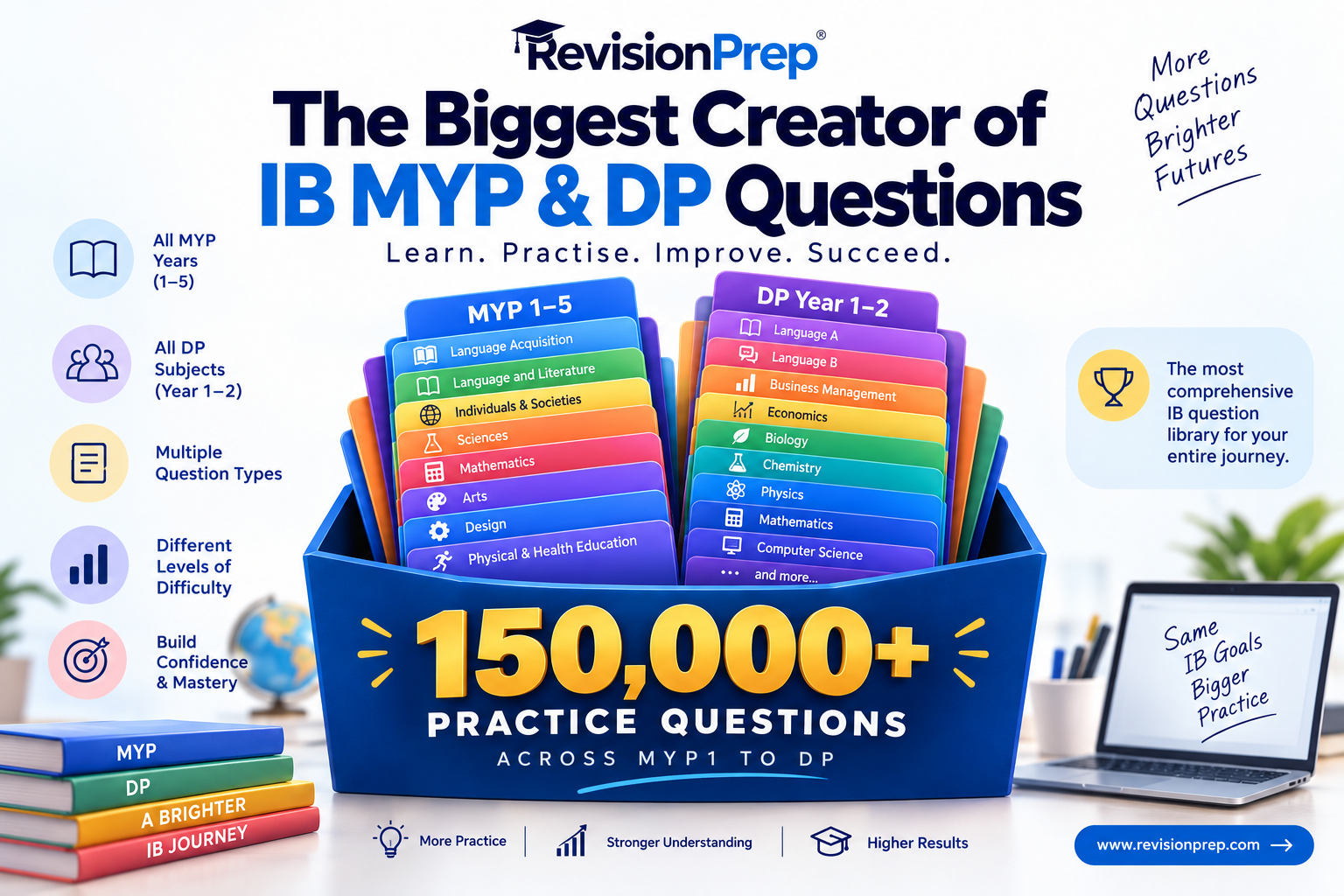
Best Practice Platform with Real Questions Breadth
RevisionPrep Has 150,000+ Practice Questions Across MYP1 to DP There has been some discussion online about the number of questions available on different IB preparation platforms, including suggestions that RevisionPrep's question numbers may be inflated. We want to clarify this directly. RevisionPrep has more than 150,000 practice questions across MYP1 through the IB Diploma Programme (DP). That number represents the breadth of our practice-question inventory across subjects, topics, levels, and skills—not simply a small collection of questions presented under different labels. 150,000+ Questions Across MYP1 to DP RevisionPrep is built to support students throughout their IB journey. Our question bank spans: MYP 1 MYP 2 MYP 3 MYP 4 MYP 5 DP Year 1 DP Year 2 Across these levels, students can access practice covering different subjects, topics, concepts, question types, and levels of difficulty. The result is a practice library containing 150,000+ questions. This is important because comparing question-bank sizes without looking at what is actually included in the practice ecosystem can create a misleading picture. What Does 150,000+ Actually Mean? When we say RevisionPrep has 150,000+ practice questions, we are referring to questions that students can use for practice across our MYP and DP learning environment. The questions are distributed across the curriculum rather than being concentrated in a single course or a handful of subjects. For a student, this matters much more than a single headline number. A student preparing for an assessment doesn't need to see the same question repeatedly. They need opportunities to: Learn → Practise → Identify mistakes → Try again → Build mastery. A large and appropriately distributed question bank makes that possible. Practice Is More Than Solving One Question Effective IB preparation requires repeated practice. Understanding a concept once is not the same as being able to apply it under assessment conditions. Students may need to practise: Applying a concept in different contexts Interpreting unfamiliar information Choosing the correct method Explaining their reasoning Using subject-specific terminology Responding to different command terms Solving questions of increasing difficulty Learning from mistakes Revisiting weak areas This is why the depth of a practice library matters. Two platforms can both say they have a large number of questions, while offering very different experiences to students. From MYP 1 to the Diploma Programme One of the things we have deliberately focused on at RevisionPrep is continuity. IB preparation should not begin only when a student enters the Diploma Programme. Students develop academic skills over many years. MYP students need opportunities to build: Conceptual understanding Application skills Analytical thinking Problem-solving Subject vocabulary Command-term awareness Confidence with unfamiliar questions As students progress toward MYP 5 and eventually DP, the level and nature of practice can become increasingly demanding. That is why RevisionPrep's practice ecosystem extends from MYP 1 through DP. Why We Don't Want Students to Judge a Platform by a Number Alone A question count is useful—but it should never be the only metric. The more important questions are: Are there enough questions for my level? Are the questions relevant to my curriculum? Can I practise different topics? Can I practise repeatedly without quickly exhausting the question bank? Can I identify my weaknesses? Can I move from basic understanding to more difficult application? Does the platform support me throughout my IB journey? These are the questions that ultimately determine whether a practice platform is useful. 150,000+ Is About Practice Depth Our goal at RevisionPrep is not simply to display a large number. Our goal is to give students enough practice to keep learning. A student struggling with a particular topic should be able to practise it again. A student who has mastered the basics should be able to move to more challenging questions. A student preparing for an assessment should be able to continue practising instead of reaching the end of the available material after a few sessions. That requires scale. And that is why we have built a practice library of 150,000+ questions across MYP1 to DP. We Stand Behind the Number We understand that large numbers naturally invite questions. That's fair. Students, parents, teachers, and schools should be able to ask what a platform actually offers. Our position is simple: RevisionPrep has more than 150,000 practice questions distributed across MYP1 through the IB Diploma Programme. We are proud of the scale we have built, but we are even more focused on what students can do with it. Because ultimately, the value of a question bank isn't the number printed on a website. The value is in how much meaningful practice a student can get from it. Built for the Long IB Journey RevisionPrep is continuing to expand its content, improve its practice experience, and make IB preparation more accessible to students and schools. From the early years of MYP to the final stages of the Diploma Programme, our aim is to give students a place where they can learn concepts, practise extensively, understand their mistakes, and become better at answering IB-style questions. And with 150,000+ practice questions already available across MYP1 to DP, students have a lot of room to practise. The number isn't the destination. Better practice is.
Read article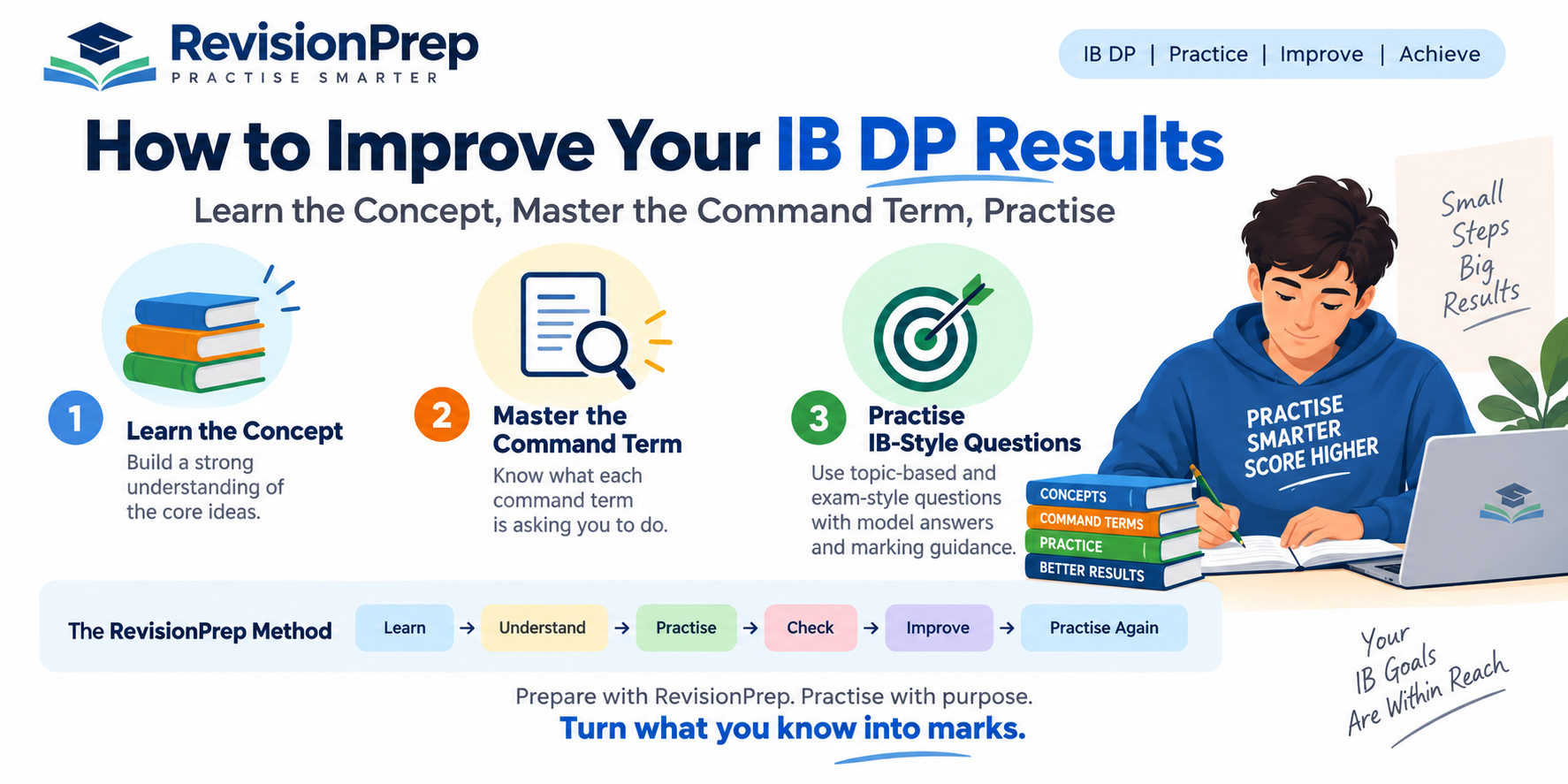
How to Improve Your IB DP Results
Learn the Concept, Master the Command Term, Practise Studying harder does not always mean scoring higher in the IB Diploma Programme. You can understand a topic perfectly and still lose marks because your answer doesn't fully address the question, misses an important step, or doesn't respond to the command term correctly. The solution is simple: Learn the concept. Understand the command term. Practise the skill. 1. Learn the Concept Properly Before solving questions, make sure you understand the underlying concept. Whether you're preparing for IB Mathematics, Biology, Chemistry, Physics, Economics or another DP subject, strong conceptual understanding gives you the foundation for tackling unfamiliar questions. But understanding the concept is only the beginning. 2. Master the Command Term IB questions don't simply test what you know. They test how you use what you know. Command terms such as: Explain • Analyse • Discuss • Evaluate • Compare • Justify • Calculate tell you what kind of response is expected. A student may know the correct content but still lose marks by giving a response that doesn't match the command term. Learn to recognise what each command term requires before you start writing. 3. Practise IB-Style Questions This is where RevisionPrep becomes valuable. Don't revise a chapter and immediately move to another one. Practise. Use topic-based and exam-style questions to test whether you can actually apply what you've learned. RevisionPrep helps you practise with IB-style questions, model answers, marking guidance and examiner insights, so you can understand what separates an incomplete answer from a strong one. 4. Turn Mistakes Into Marks When you get a question wrong, don't simply check the answer and move on. Ask: Did I misunderstand the concept? Did I misread the command term? Did I miss a required step? Did I provide enough explanation or justification? Where exactly did I lose the mark? Then practise that skill again. The RevisionPrep Method Learn → Understand → Practise → Check → Improve → Practise Again IB success isn't just about how much you can remember. It's about how effectively you can apply your knowledge when the question changes. Prepare with RevisionPrep. Practise with purpose. Turn what you know into marks.
Read article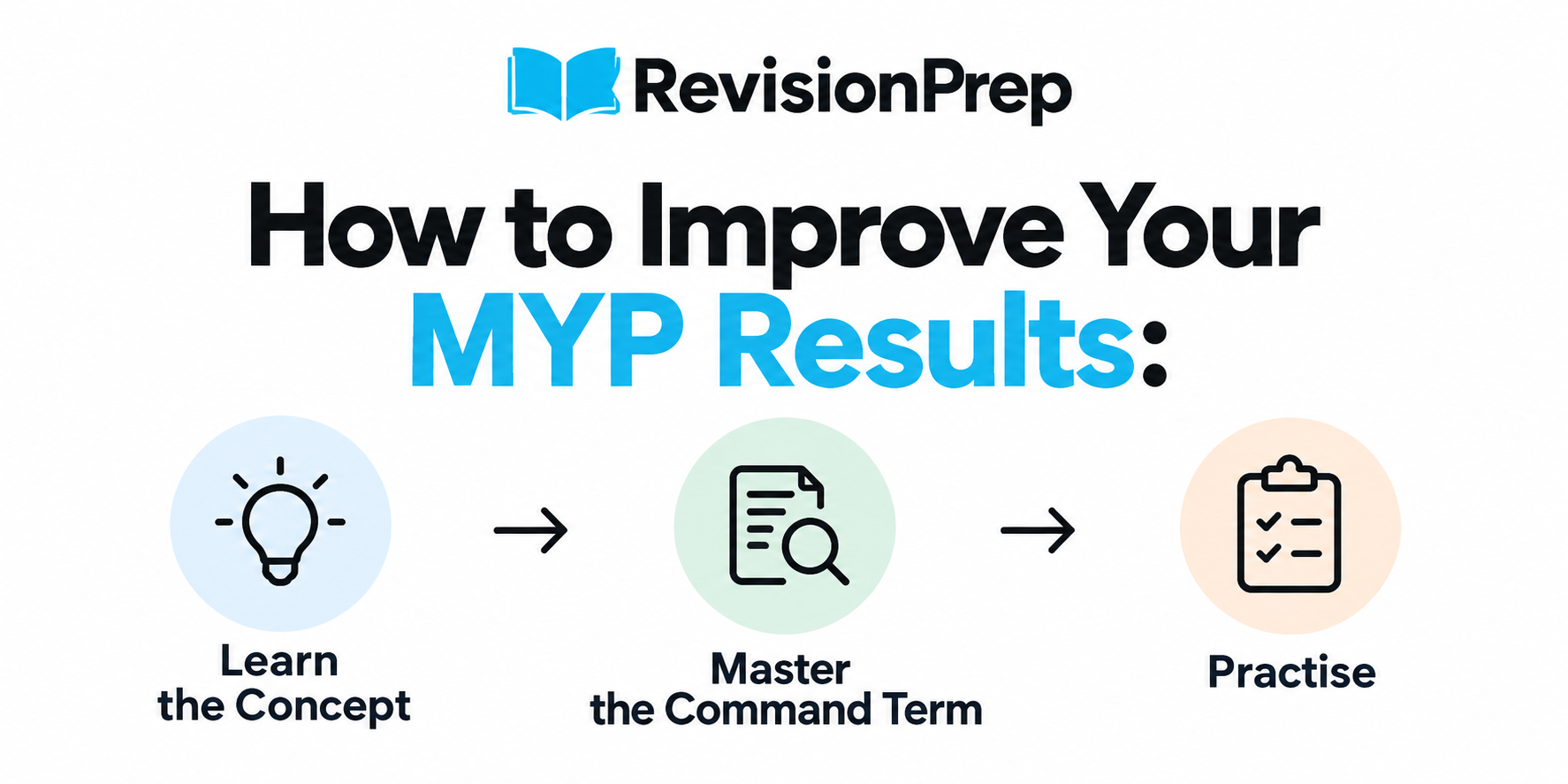
How to Improve Your MYP Results
How to Improve Your MYP Results: Learn the Concept, Master the Command Term, Practise MYP students often spend hours revising concepts but still lose marks in assessments. Why? Knowing the topic is only the first step. Knowing how to answer the question is what turns knowledge into marks. That is where RevisionPrep can make MYP preparation more effective. 1. Understand the Concept Start by learning the concept properly. Whether you are studying algebra, forces, chemical reactions, data handling or another MYP topic, RevisionPrep helps you review the important ideas before you begin practising. But don't stop at reading. 2. Understand the Command Term MYP questions often use command terms such as: Explain • Describe • Analyse • Compare • Justify • Evaluate • Calculate Each one requires a different type of response. For example, “Explain” requires you to make something clear and give the reasoning behind it. “Justify” requires you to support your answer with appropriate evidence or reasoning. Understanding the command term helps you understand what the examiner is actually asking you to do. 3. Practise the Exact Skill This is where practice becomes powerful. Instead of simply reading another page of notes, solve questions based on the concept and command term you have just learned. RevisionPrep provides MYP practice designed around topics, criteria, difficulty and question types, with model answers, marking guidance and examiner insights. So you can see not only what the answer is, but why it earns marks. 4. Learn From Your Mistakes Getting a question wrong is not failure. It tells you exactly what you need to improve. After each practice session, ask: Did I understand the concept? Did I understand the command term? Did I show enough working or reasoning? Did my answer satisfy the MYP criterion? What would a full-mark answer look like? Then practise the skill again. The RevisionPrep Method Learn the concept → Understand the command term → Practise → Check the marking guidance → Improve → Practise again. This is how revision becomes exam preparation. Don't just study more. Practise smarter with RevisionPrep. Explore free MYP practice questions and start building the skills that turn knowledge into marks.
Read article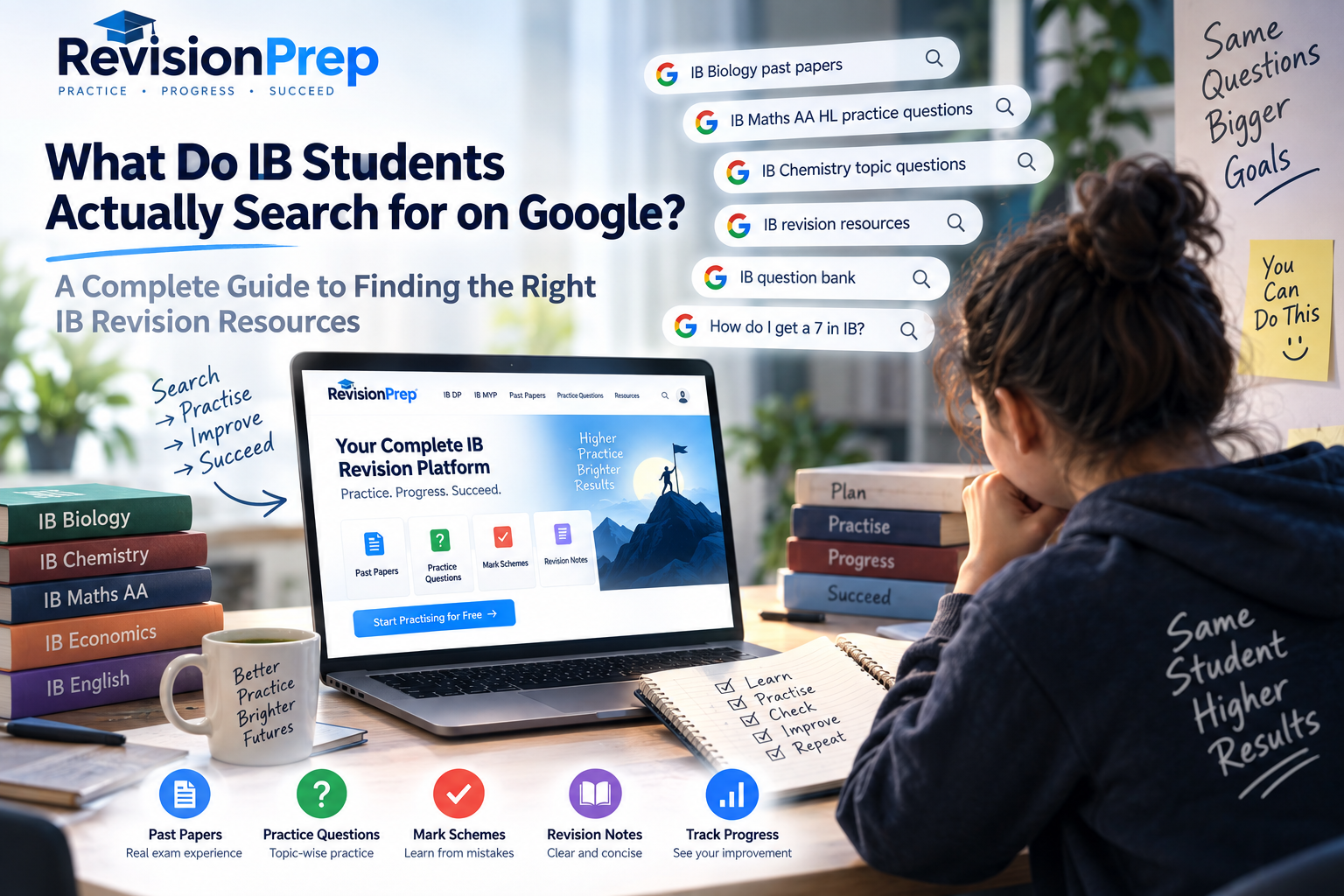
Best Resources for IBDP and MYP Preparations
What Do IB Students Search for on Google? The IB Revision Resources They Actually Need When an IB student gets stuck, they usually do not think, “I need a better revision strategy.” They open Google. They search: IB practice questions. IB past papers. IB Maths AA HL questions. IB Biology HL revision. IB Chemistry topic questions. IB question bank. IB mock exams. How do I get a 7 in IB? These searches all point to the same problem. Students are not simply looking for more IB content. They are looking for a way to practise what they have learned and find out whether they can actually use it. From “I Know This” to “I Can Answer This” One of the biggest challenges in IB revision is the gap between understanding a topic and answering an exam-style question on that topic. A student may understand a Biology concept but struggle with application. A Maths student may know the formula but choose the wrong method. A Chemistry student may remember the theory but lose marks because the response does not fully address the question. This is why effective IB revision cannot stop at notes. Students need to learn, practise, check, identify mistakes and practise again. That is where structured IB practice questions become so important. What Are IB Students Actually Looking For? The search may be different, but the need behind it is often very similar. A student searching for IB revision resources may want concise notes to understand a topic. A student searching for an IB question bank may want to practise one chapter or sub-topic. Someone searching for IB exam-style questions may want questions that feel closer to the way they will actually be assessed. A student searching for IB mock exams may be ready to test their performance under timed conditions. And someone searching for IB mark schemes or worked solutions may already know the answer is wrong — they want to understand why. Good revision resources should therefore help answer one simple question: What should I practise next? This Is Where RevisionPrep Fits RevisionPrep is built around that idea. It is an independent IB MYP and IBDP practice and revision platform, with a large question bank organised by subject, chapter, sub-topic and difficulty. The platform currently offers more than 150,000 MYP and IBDP-styled questions, alongside revision notes, topical worksheets, full-length mock papers, criteria-based practice and model answers. For students, that means revision does not have to begin with endlessly searching for another website, another PDF or another set of notes. They can start with the topic they are actually struggling with. Then practise it. Then check the response. Then identify where marks were lost. Then practise again. That shift from searching to practising is one of the most important changes a student can make. IB DP and MYP Students Have Different Needs Revision is not the same for every IB student. An IB Diploma Programme student preparing for Mathematics AA HL has very different practice needs from an MYP 3 Mathematics student. That is why resources need to be organised around the student's actual programme, level, subject and topic. RevisionPrep covers both IBDP and MYP, with MYP practice organised across Years 1–5 and DP subjects including Mathematics AA, Mathematics AI, Physics, Chemistry, Biology and Economics at SL and HL. For MYP students, criteria-based practice is particularly useful because assessment is not simply about knowing content. Students also need to understand how to respond to different criteria and command terms. The Best Revision Resource Is the One That Helps You Improve There is nothing wrong with reading revision notes. There is nothing wrong with watching a lesson or reviewing a textbook. But at some point, the notes have to become questions. You have to solve the problem. Write the explanation. Interpret the data. Apply the concept. Check the answer. Understand the mistake. And try again. That is the cycle that turns revision into preparation. RevisionPrep is designed around that cycle: Learn → Practise → Check → Improve → Repeat So when your next Google search is “IB practice questions,” “IB question bank,” “IB Maths revision,” “IB Biology questions,” or “IB mock exam,” do not just look for more things to read. Look for something you can actually use to practise. Don't Just Study IB. Practise IB. That is the idea behind RevisionPrep.
Read article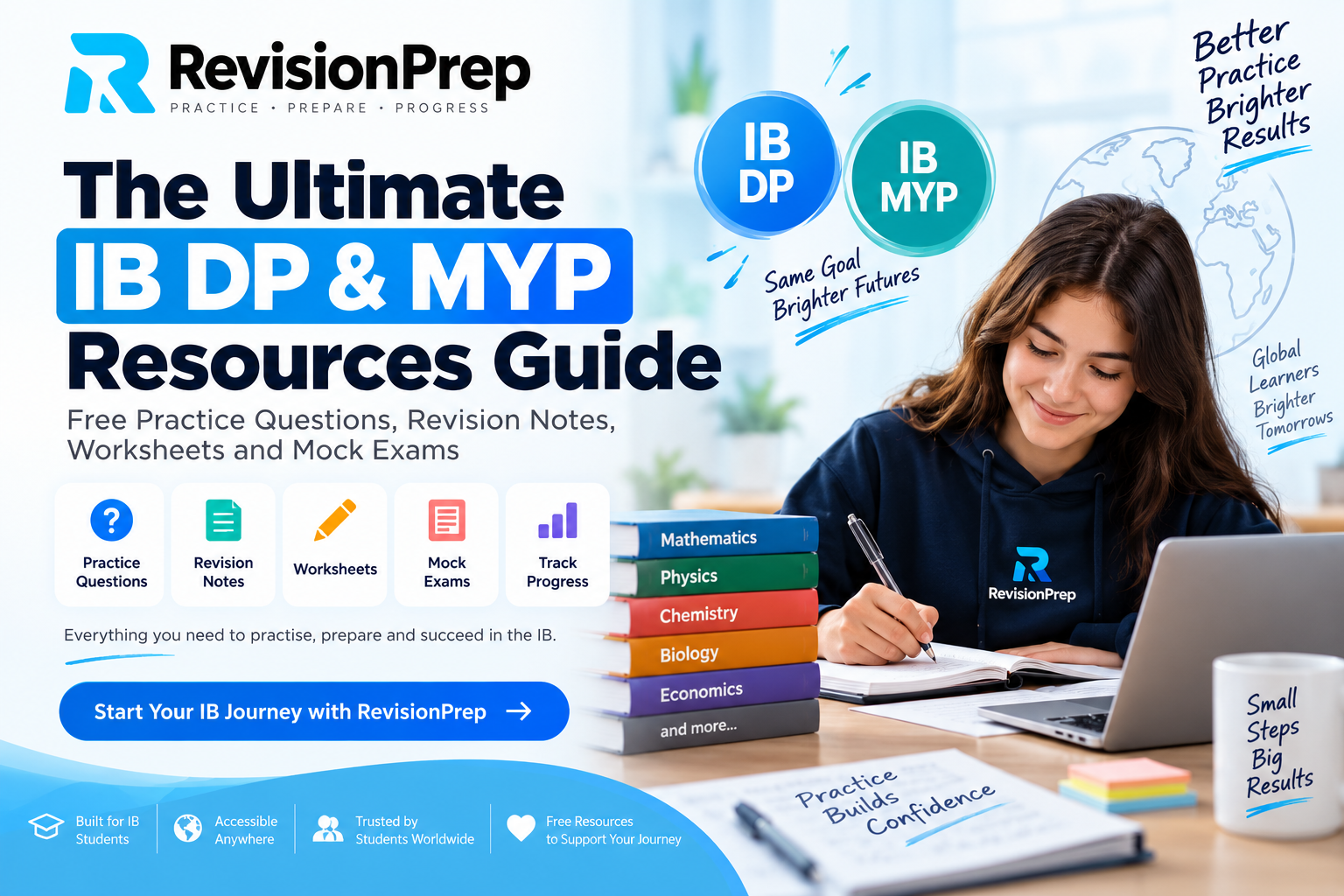
The Ultimate IB DP & MYP Resources Guide:
Free Practice Questions, Revision Notes, Worksheets and Mock Exams Finding good IB resources can be surprisingly difficult. IB students do not simply need textbooks and class notes. Effective IB preparation requires students to understand concepts, practise applying them, answer questions in the style of their assessments, identify weaknesses and repeatedly practise the areas where they lose marks. This is especially important for students in the IB Diploma Programme (IB DP) and the IB Middle Years Programme (IB MYP). The good news is that students now have access to a growing range of online IB revision resources, practice questions, revision notes, worksheets and mock exams. One platform designed specifically around this need is RevisionPrep, an independent IB practice and revision platform offering MYP and IBDP-style questions, revision resources and examination practice. What are the best IB resources for students? A strong IB study plan normally requires several different types of resources. Students may need: IB revision notes IB practice questions IB question banks Topic-by-topic worksheets Subject revision resources Mock examinations Model answers Marking schemes Examiner-style practice MYP assessment practice DP examination practice The important point is that these resources perform different jobs. Revision notes help students understand a concept. Practice questions help students apply that knowledge. Worksheets help students practise a particular topic. Mock exams help students experience the pressure and timing of an examination. A good revision strategy therefore combines learning with deliberate practice. IB DP Resources The IB Diploma Programme is academically demanding and includes a wide range of subjects and assessment components. For DP students, useful resources should make it easy to move from learning a topic to actually answering questions about it. Useful IB DP resources include: IB DP practice questions Practice questions allow students to test whether they can actually apply what they have learned. This is particularly important because IB assessment can require students to analyse information, solve problems, evaluate arguments and apply concepts rather than simply recall definitions. The IB itself describes DP assessment as measuring skills such as analysing and presenting information, evaluating and constructing arguments, solving problems creatively, retaining knowledge and applying standard methods. That makes regular practice an important part of preparation. IB DP revision notes Revision notes are useful when students need a concise explanation of a concept before beginning practice. Instead of rereading an entire textbook chapter, students can use focused notes to refresh the important ideas and then immediately move into questions. IB DP topical worksheets Topical worksheets are particularly useful when a student knows exactly where they have a weakness. For example, an IB Physics student might want to practise mechanics rather than revise the entire syllabus. Similarly, an IB Chemistry student might want additional practice with stoichiometry, bonding, equilibrium or energetics. Topic-focused resources make this type of targeted revision easier. IB DP mock exams Mock examinations are useful near examination periods because they allow students to practise: Working under time pressure Answering a complete paper Managing difficult questions Checking their timing Identifying weak areas Reviewing mistakes after the test The IB uses examinations as a major component of assessment in most DP courses, alongside internal assessment and other assessed components. IB MYP Resources The IB Middle Years Programme is designed for students aged approximately 11–16 and develops connections between subjects, concepts and real-world contexts. MYP students therefore need resources that reflect more than simple memorisation. Useful IB MYP resources include: MYP practice questions MYP revision notes MYP worksheets MYP subject practice MYP assessment questions MYP e-Assessment preparation MYP Year 1 resources MYP Year 2 resources MYP Year 3 resources MYP Year 4 resources MYP Year 5 resources For students approaching the final years of the MYP, assessment-focused practice can become particularly important. The IB provides resources related to MYP e-Assessment, including assessment guidance and practice-related materials. Free IB Practice Questions One of the most useful resources for an IB student is a good IB practice question bank. Why? Because reading a solution is very different from solving a problem independently. A student may understand a chapter while reading their notes but discover during practice that they cannot: Select the correct formula Interpret a graph Explain a scientific process Apply a concept to an unfamiliar situation Structure an extended response Complete a calculation accurately Manage examination time This is why practice should be an integral part of IB revision. RevisionPrep provides MYP and IBDP-style practice questions organised by programme, year, subject and topic. Its MYP practice area, for example, currently provides thousands of free questions organised across MYP 1–5 and different subjects. IB Question Banks An IB question bank can be particularly useful because it gives students a large number of opportunities to practise. Instead of completing the same small selection of questions repeatedly, students can work through different questions covering the same concept. This creates a useful revision cycle: Learn → Practise → Check → Identify weakness → Practise again A good question bank should also make it easy to move from broad revision to specific practice. For example: IB DP → Physics → Topic → Sub-topic → Practice questions or: IB MYP → Year 5 → Mathematics → Topic → Questions RevisionPrep is structured around this type of topic-level practice. IB Revision Resources by Subject Students often search for resources using their exact subject. Some of the most useful searches include: IB Mathematics Resources Students can look for: IB Maths practice questions IB Maths AA practice questions IB Maths AI practice questions IB Maths revision notes IB Maths worksheets IB Maths mock exams IB Maths topic questions IB Physics Resources Useful searches include: IB Physics practice questions IB Physics revision notes IB Physics worksheets IB Physics topic questions IB Physics mock exams IB Physics HL practice IB Physics SL practice IB Chemistry Resources Students may search for: IB Chemistry practice questions IB Chemistry revision notes IB Chemistry worksheets IB Chemistry topic questions IB Chemistry mock exams IB Chemistry HL practice IB Chemistry SL practice IB Biology Resources Useful searches include: IB Biology practice questions IB Biology revision notes IB Biology worksheets IB Biology topic questions IB Biology mock exams IB Biology HL practice IB Biology SL practice IB Economics Resources Students can also search for: IB Economics practice questions IB Economics revision notes IB Economics worksheets IB Economics topic questions IB Economics mock exams IB Economics HL practice IB Economics SL practice Free MYP Practice Questions by Year MYP students often benefit from resources organised according to their year rather than simply searching for generic MYP material. For example: MYP 1 practice questions MYP 2 practice questions MYP 3 practice questions MYP 4 practice questions MYP 5 practice questions This makes revision much more manageable. Instead of searching through resources designed for an entire five-year programme, students can begin with their own MYP year and then select the relevant subject and topic. RevisionPrep currently organises its MYP question resources by MYP year and subject, including Mathematics, Science and the MYP 4–5 science subjects. IB Resources for Practice, Not Just Reading One of the biggest mistakes students make during revision is spending too much time consuming information. They read notes. They watch videos. They highlight textbooks. They reread chapters. But examination performance ultimately depends on what the student can do independently. This is why a good IB resource library should contain both learning material and practice. A useful sequence is: Understand Use notes or lessons to understand the concept. Practise Answer questions without looking at the solution. Check Compare your answer with the model answer or marking guidance. Diagnose Identify exactly where the mistake occurred. Repeat Practise the same skill again using a different question. This turns revision into an active process. Why Topic-by-Topic IB Practice Matters A student does not necessarily need to revise an entire subject every time they sit down to study. Sometimes the problem is much more specific. For example: "I understand most of IB Chemistry, but I keep losing marks on equilibrium." The best resource in that situation is not another complete textbook. It is targeted equilibrium practice. The same applies to mathematics, physics, biology and MYP subjects. Topic-level practice allows students to concentrate their time where it has the greatest potential impact. IB Mock Exams and Examination Practice As examinations approach, students should gradually move from individual questions towards longer timed sessions. A useful progression is: Topic questions → Mixed questions → Timed worksheets → Mock papers → Full examination practice This helps students develop both subject knowledge and examination technique. Mock examinations can reveal problems that ordinary homework does not. A student may know how to solve individual questions but struggle to: Manage the entire paper Allocate time Recover after a difficult question Maintain concentration Decide when to move on Present answers clearly Regular timed practice can help identify these issues before the real examination. Why Students Need More Than One IB Resource There is no single resource that will solve every IB student's problem. A student might use: School lessons for teaching Textbooks for detailed explanations Revision notes for quick review Practice questions for active recall Worksheets for topic practice Mock papers for examination preparation The most effective approach is therefore not necessarily to find the "one perfect IB website." It is to build a complete revision system. Where RevisionPrep Fits RevisionPrep is built specifically around the practice side of IB preparation. The platform brings together: MYP practice questions IBDP practice questions Revision notes Topic-based worksheets Mock examinations Model answers Marking guidance Examiner insights Criteria-based practice Chapter and sub-topic organisation RevisionPrep currently describes its platform as containing more than 150,000 MYP and IBDP-style questions, with resources spanning MYP and several core DP subjects. The aim is simple: Make it easier for IB students to practise what they are learning. Students can select their programme, year or subject, choose a topic and begin practising rather than spending hours searching for scattered resources. Free IB Resources for Students For students looking for free IB resources, the most useful starting point is usually a platform where they can immediately access relevant practice rather than having to search through dozens of unrelated pages. RevisionPrep provides free MYP practice questions and makes revision resources available alongside its practice platform. This makes it useful for students who want to supplement their school resources with additional practice. Build Your IB Revision Library Whether you are studying MYP or the IB Diploma Programme, your revision library should contain resources for three different stages: Learn Use: Revision notes Textbooks Class resources Concept explanations Practise Use: Practice questions Question banks Worksheets Topic questions Test Use: Timed worksheets Mock papers Full-length examinations Mixed-topic practice Combining all three stages is much more powerful than relying exclusively on notes. Start Your IB Revision If you are looking for IB DP resources, IB MYP resources, IB practice questions, IB revision notes, IB worksheets, IB question banks or IB mock exams, RevisionPrep brings these resources together in one student-focused platform. Instead of searching separately for every topic, students can start with their programme and move directly into targeted practice. Explore RevisionPrep and start practising: RevisionPrep — IB MYP & DP practice resources For MYP students specifically, RevisionPrep's free question archive provides practice organised by MYP year, subject and chapter. The goal is not simply to study more. It is to practise better, identify weaknesses faster and become more confident answering IB-style questions. Final Thought IB preparation is not about collecting the largest number of notes. It is about having the right resources at the right stage of revision. Understand the concept. Practise it. Check your mistakes. Return to your weaknesses. Then test yourself under examination conditions. That is how an IB resource library becomes an actual revision system.
Read articleReady to take your IB results further?
Train smart with IB-aligned question banks and examiner-style practice.