
Waves, Sound and Light
The five core ideas MYP 2 Sciences students need before the summative: wave families, colour, sound production, hearing, and the wave equation.
Quick facts
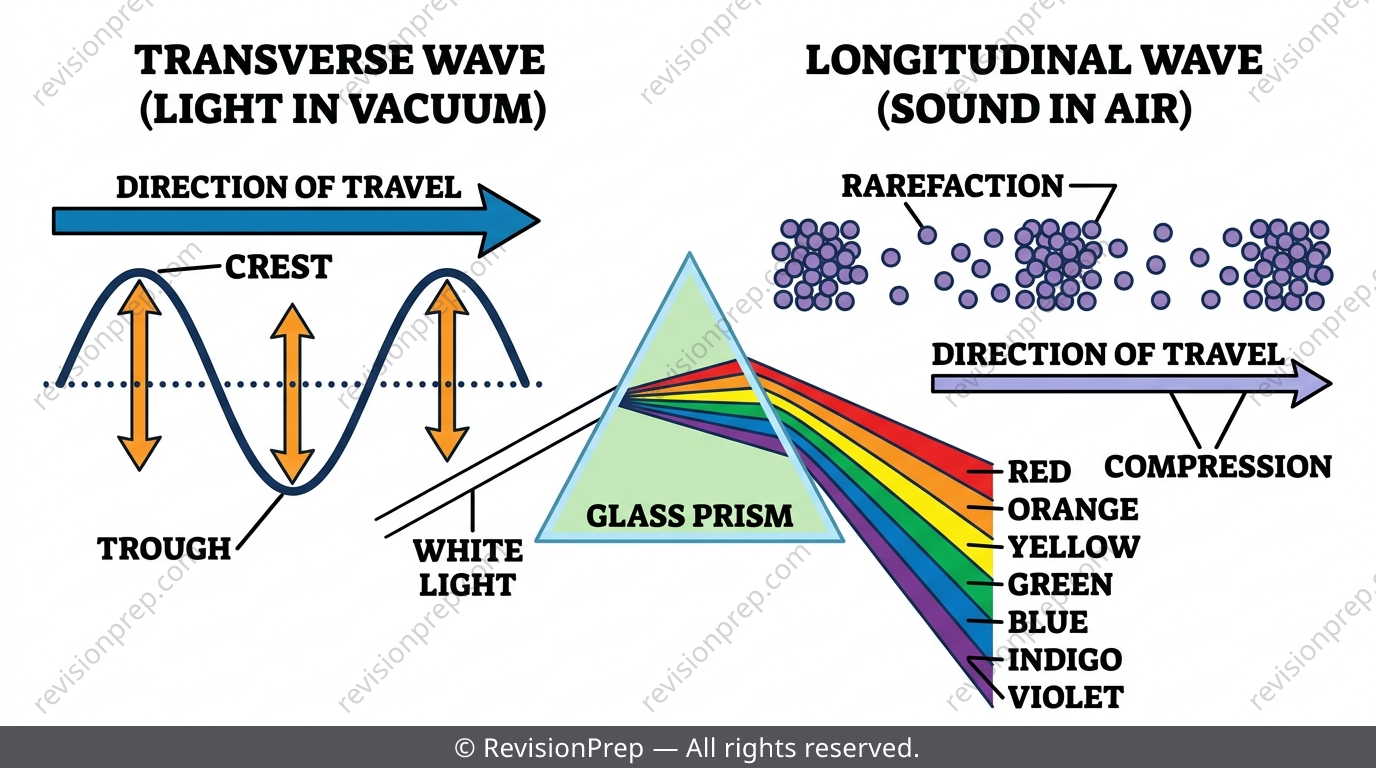
Every MYP 2 Sciences student meets waves through two very different but connected topics: sound and light. Both transfer energy without transferring matter, but sound is a mechanical, longitudinal wave that needs a medium, while light is a transverse electromagnetic wave that travels through empty space. Understanding this contrast is the foundation for everything else — from why a prism disperses white light into a spectrum, to why compressions and rarefactions carry sound through air, to how your ear separates pitch from loudness. This blog distils the five ideas examiners test most often in data-based questions and explain/compare tasks: wave families, colour and the EM spectrum, sound production, hearing, and the wave speed equation . For full worked examples, labelled diagrams, and exam-style practice, the complete MYP 2 revision notes go much deeper than this teaser.
What you’ll be able to do
Sound vs Light: Two Wave Families
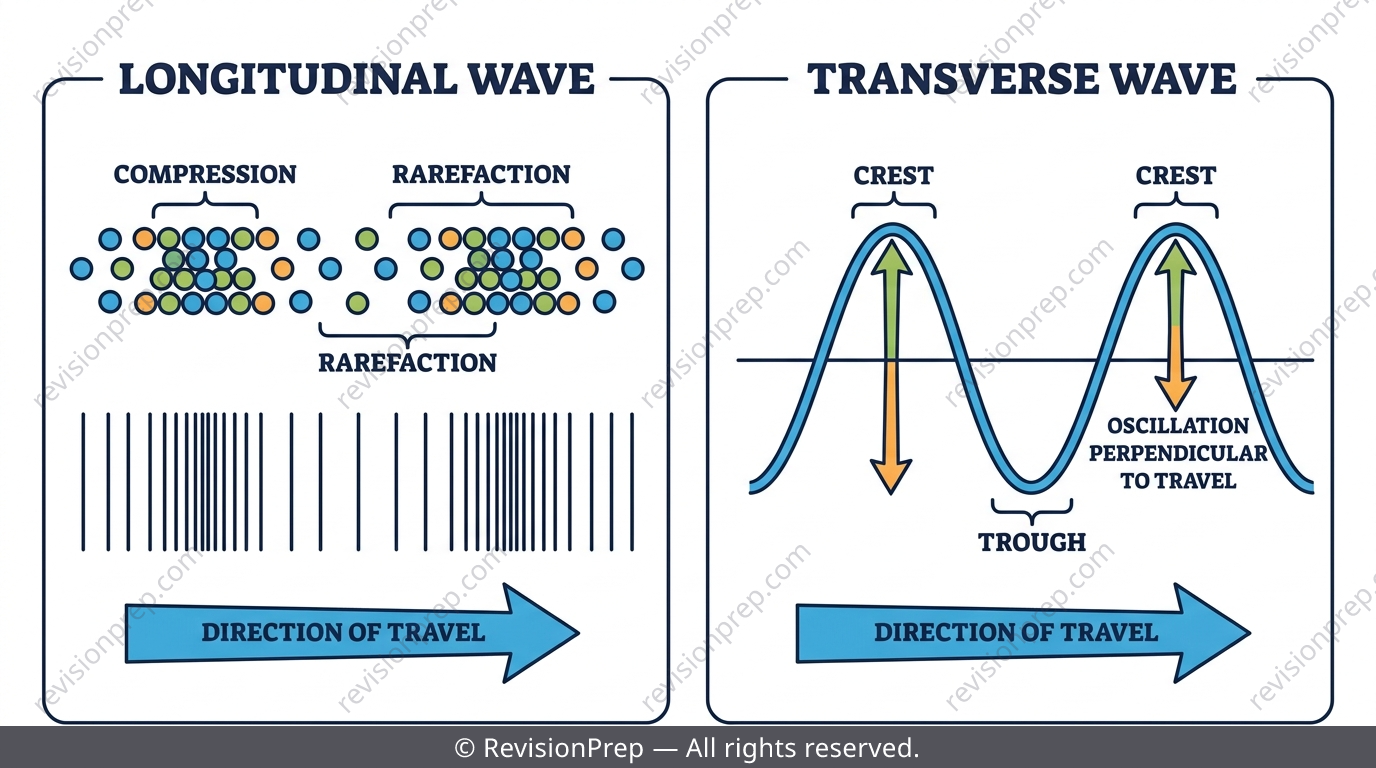
Sound is a mechanical, longitudinal wave — particles vibrate parallel to the direction of travel, so it needs a medium and cannot cross a vacuum. Light is an electromagnetic, transverse wave — the oscillation is perpendicular to travel, which is exactly why it can reach us through empty space and why it can be polarised while sound cannot. Both still obey the same speed–frequency–wavelength relationship, which is the thread linking the whole unit together.
Exam tip
If a question asks you to compare sound and light, always mention medium requirement AND wave type (longitudinal vs transverse) — one without the other loses marks.
Common mistake
Drawing sound as a transverse wave with crests and troughs like a water wave — sound only has compressions and rarefactions.
Mini summary
Sound = longitudinal + needs a medium. Light = transverse + no medium needed.
Colour, Dispersion and the EM Spectrum
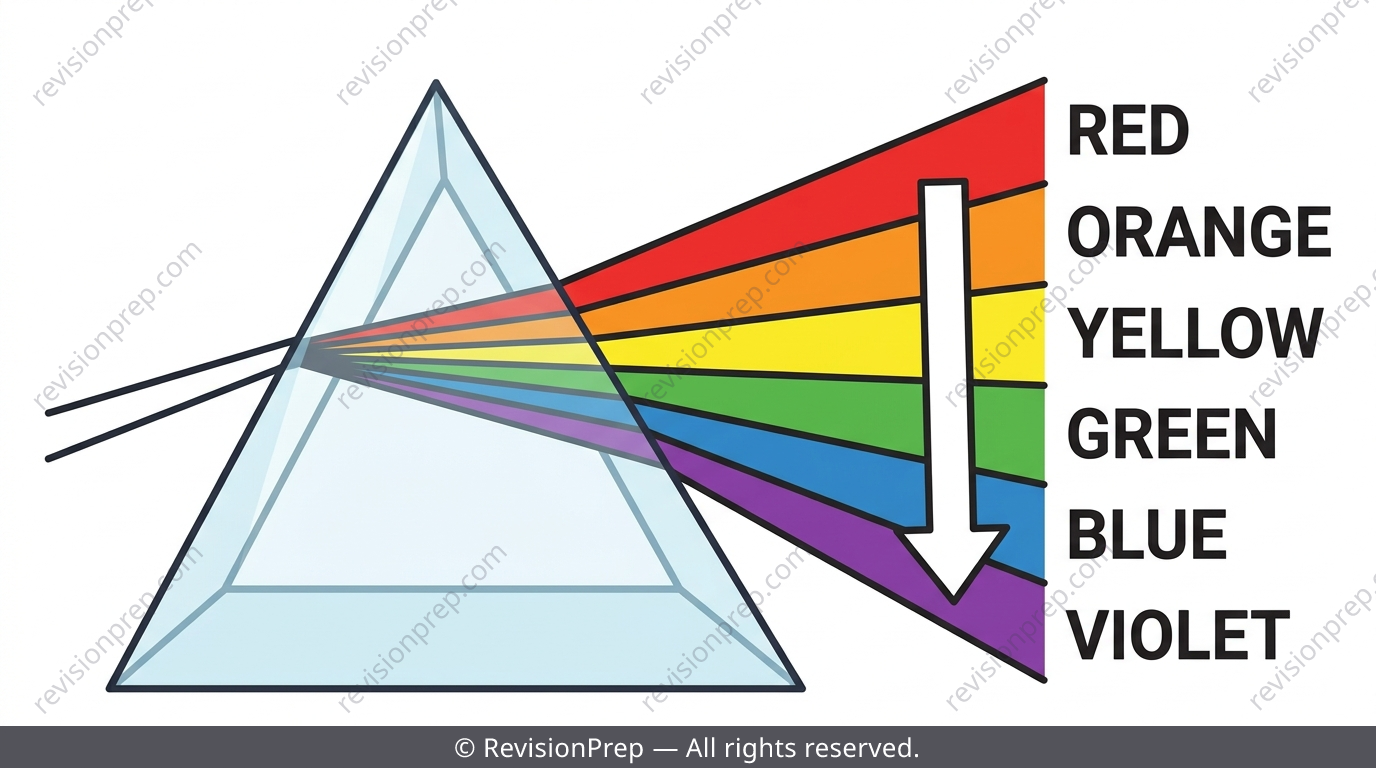
White light is not pure — it's a mixture of every visible wavelength travelling together. Newton proved this in 1666 by splitting sunlight into a spectrum with a prism, then recombining that spectrum back into white light with a second, inverted prism, showing the prism only sorts colours rather than creating them. Colour corresponds directly to wavelength: red has the longest visible wavelength and violet the shortest, and visible light is just a narrow slice of the full electromagnetic spectrum between infrared and ultraviolet.
| Colour | Approx. wavelength range (nm) |
|---|---|
| Violet | ~380–450 |
| Blue | ~450–495 |
| Green | ~495–570 |
| Yellow | ~570–590 |
| Orange | ~590–620 |
| Red | ~620–750 |
Exam tip
If asked to name the scientist who showed white light contains all colours, just write 'Isaac Newton' — a full sentence earns the same one mark as the name alone.
Common mistake
Writing 'the prism adds colour to the light.' Fix: white light already contains all the colours mixed together — the prism refracts each wavelength by a slightly different amount and separates (disperses) colours that were always present.
Mini summary
A prism disperses, not creates, colour — shorter wavelengths bend more than longer ones.
How Sound Waves Are Made: Vibrations, Compressions and Rarefactions
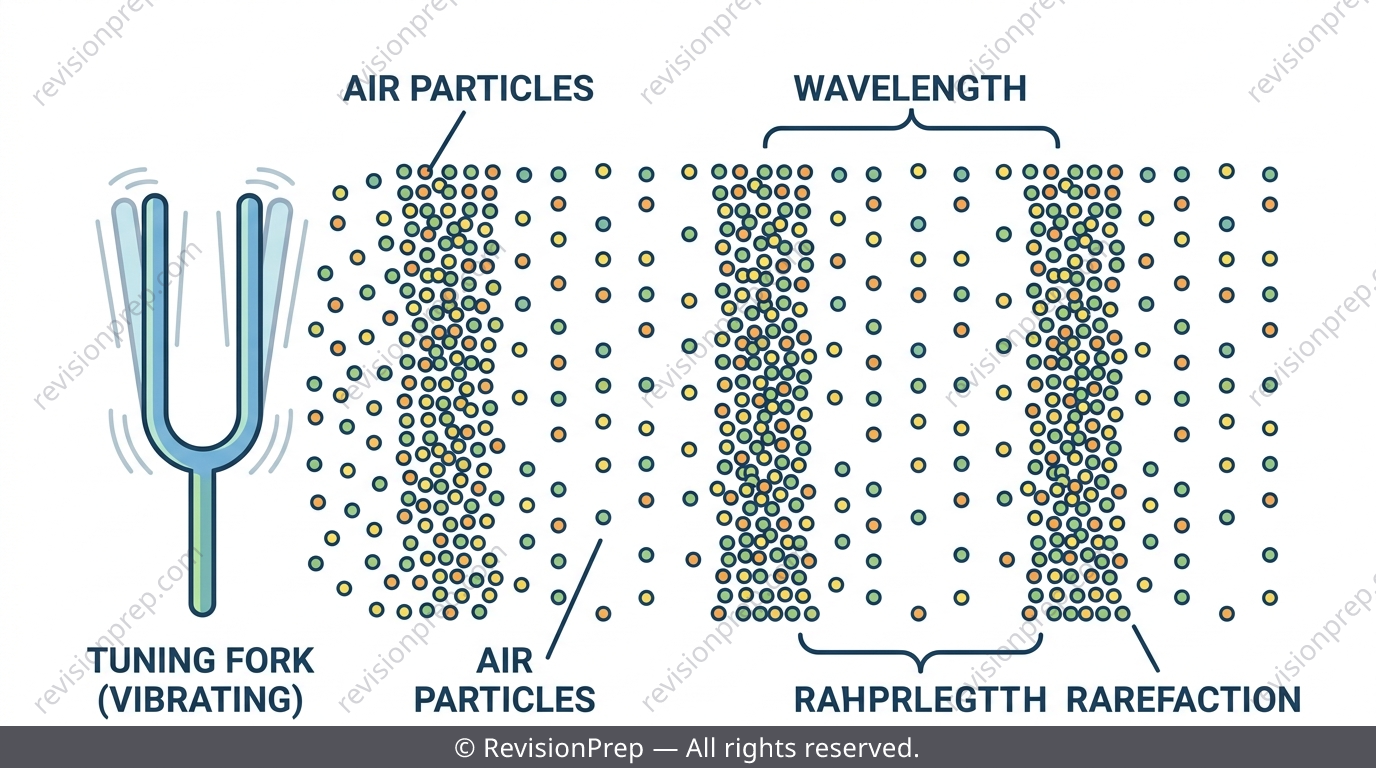
Every sound starts with a vibrating source — a guitar string, vocal cords, a speaker cone — pushing on the surrounding medium's particles, which push on the next ones, carrying the disturbance outward as a longitudinal wave. A compression is where particles are squeezed close together (higher pressure); a rarefaction is where they're spread apart (lower pressure). Because sound relies entirely on particle-to-particle collisions, it cannot travel through a vacuum, and it travels fastest through solids, slower through liquids, and slowest through gases.
Common mistake
Believing sound can travel through empty space, or forgetting that a faster-vibrating source directly produces a higher-frequency sound wave.
Mini summary
Vibration → compressions and rarefactions → sound wave; no medium, no sound.
Pitch, Loudness and the Human Ear
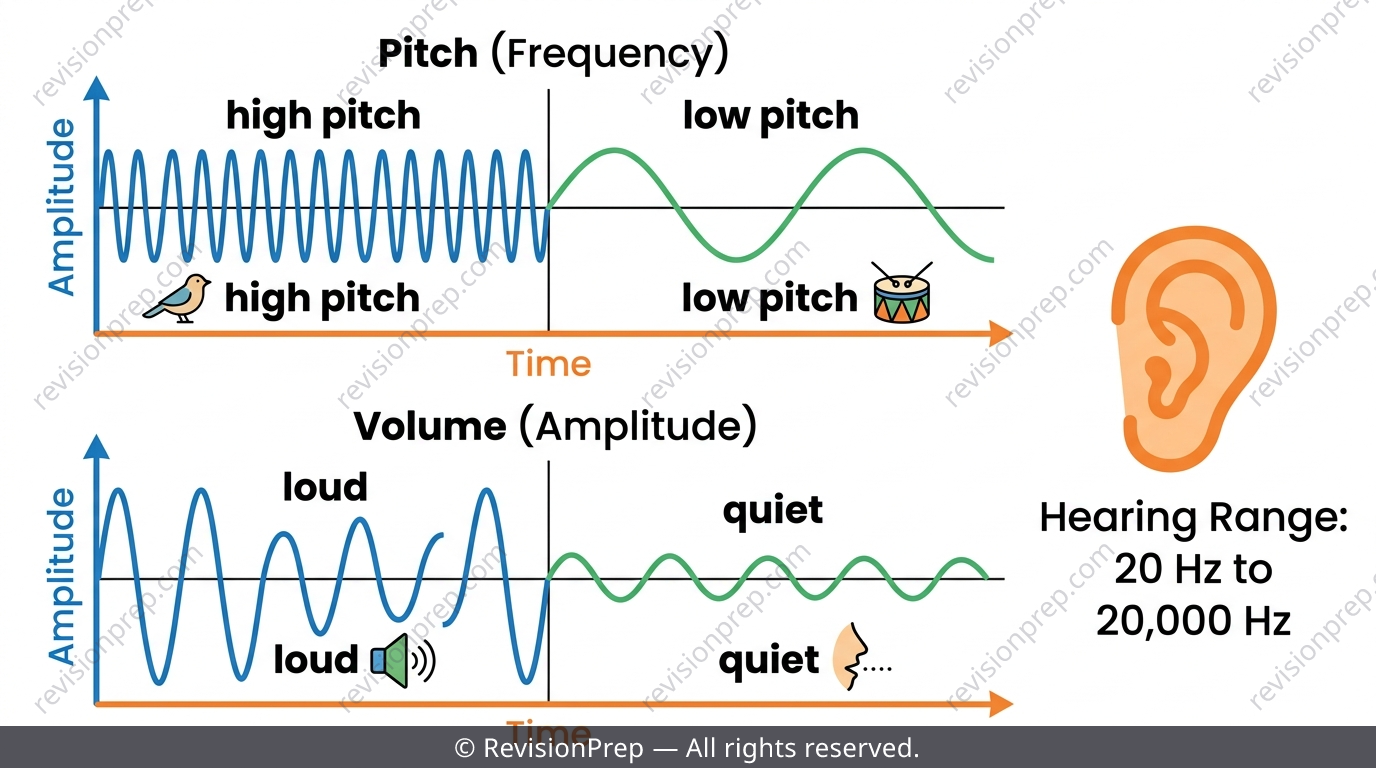
Your ear converts a sound wave's physical properties into two separate perceptions. Frequency (vibrations per second) is perceived as pitch — high frequency sounds high-pitched, low frequency sounds low-pitched. Amplitude (size of the vibration, linked to energy) is perceived as loudness, measured in decibels (dB). Pitch and loudness are completely independent, and typical human hearing spans roughly 20 Hz to 20,000 Hz, with sounds outside this range called infrasound or ultrasound.
Common mistake
Assuming a loud sound must also be high-pitched, or vice versa — changing amplitude does not force a change in frequency.
Mini summary
Frequency → pitch. Amplitude → loudness. Human range: ~20 Hz–20,000 Hz.
The Wave Speed Equation and What Happens at a Boundary
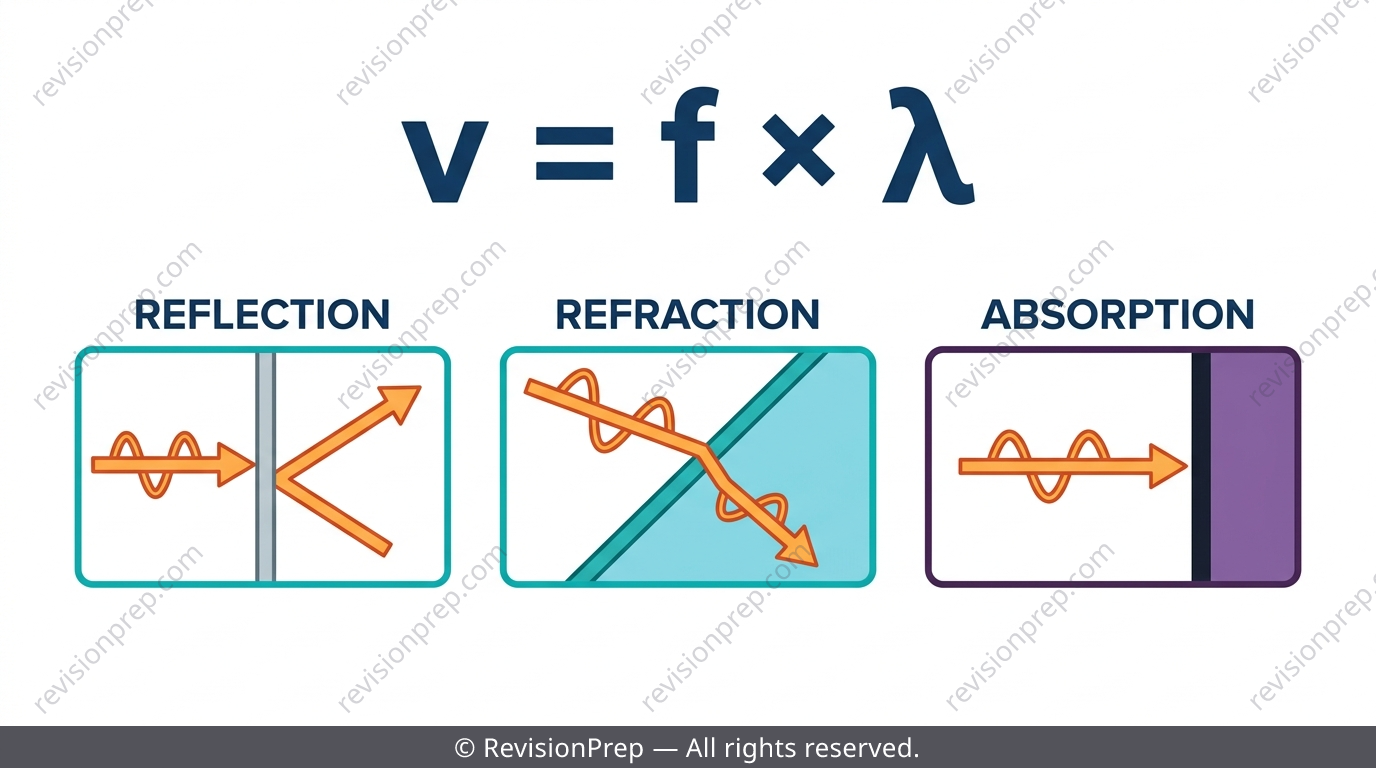
The same core equation, , links speed, frequency and wavelength for both sound and light — memorise it once and apply it to either wave family. Period and frequency are also linked by . When a wave meets a boundary — a prism surface, a mirror, an eardrum — what happens depends on whether you're describing reflection, refraction, or absorption, and these three terms get mixed up constantly in exam answers.
Exam tip
Always name which boundary behaviour you mean — reflection (bounces back), refraction (bends while passing through), or absorption (energy taken in) — rather than using them interchangeably.
Mini summary
works for sound and light; boundary behaviour is reflection, refraction, or absorption — never all three at once.
Quick formula sheet
Practice questions
- State whether sound is a transverse or longitudinal wave.
- Name the scientist who first showed that white light contains all the colours of the spectrum.
- Give the typical frequency range of human hearing in Hz.
- Explain why sound cannot travel through a vacuum but light can.
- Describe, using the terms compression and rarefaction, how a vibrating tuning fork produces a sound wave.
- Explain why red light bends less than violet light when passing through a glass prism.
- A tuning fork vibrates at a known frequency and the speed of sound in air is known. Calculate the wavelength of the sound wave and justify why a whole-number answer is not suspicious.
- A student notices the colours from their windowsill prism are blurry and overlap instead of forming sharp, separate bands. Suggest two reasons for this blurriness, without simply redefining dispersion.
- Compare and contrast how pitch and loudness are each produced and perceived, using the terms frequency and amplitude correctly.
Frequently asked questions
What's the main difference between sound and light waves?+
Sound is a mechanical, longitudinal wave that needs a medium (like air) to travel, while light is an electromagnetic, transverse wave that needs no medium and can travel through a vacuum.
Why can't sound travel through space?+
Sound travels by particles bumping into each other, so without a medium (no air, water, or solid particles), there's nothing to carry the vibration — this is why explosions are silent in real space.
Does a prism create new colours in white light?+
No. White light already contains all the visible colours mixed together; the prism refracts each wavelength by a different amount, which separates (disperses) the colours that were already there.
What determines pitch and loudness of a sound?+
Frequency determines pitch (higher frequency = higher pitch), and amplitude determines loudness (bigger amplitude = louder sound). The two are independent of each other.
What is the wave speed equation and does it work for both sound and light?+
The wave speed equation is (speed = frequency × wavelength), and it applies to both sound waves and light waves, though the speed value itself differs depending on the medium and wave type.
What's the typical human hearing range?+
Most humans can hear sounds from roughly 20 Hz to 20,000 Hz; frequencies below this are infrasound and above are ultrasound, both inaudible to humans but detectable by some animals or instruments.