
Number Concepts & Systems
Sort every number into its correct set, justify it, and never lose a mark on rounding or bounds again.
Quick facts
Every IB MYP 3 maths unit quietly leans on Number Concepts & Systems — it's the toolkit examiners assume you already have. This topic groups numbers into nested sets (natural, whole, integer, rational, real), separates rational numbers from irrational ones, and controls precision through rounding, significant figures and bounds. Most mistakes here aren't about hard maths — they're about boundary confusion: is 0 natural? Is every square root irrational? Should a bound use ≤ or <? Criterion A and B both reward students who can justify a classification with a specific rule or example, not just a gut feeling. This teaser walks through the five ideas that generate almost every mark lost in this chapter, so you can spot the trap before the exam does. For the full depth — every worked example, definition and mark-scheme wording — the complete revision note is linked below.
What you’ll be able to do
The Number System Hierarchy: N, W, Z, Q, R
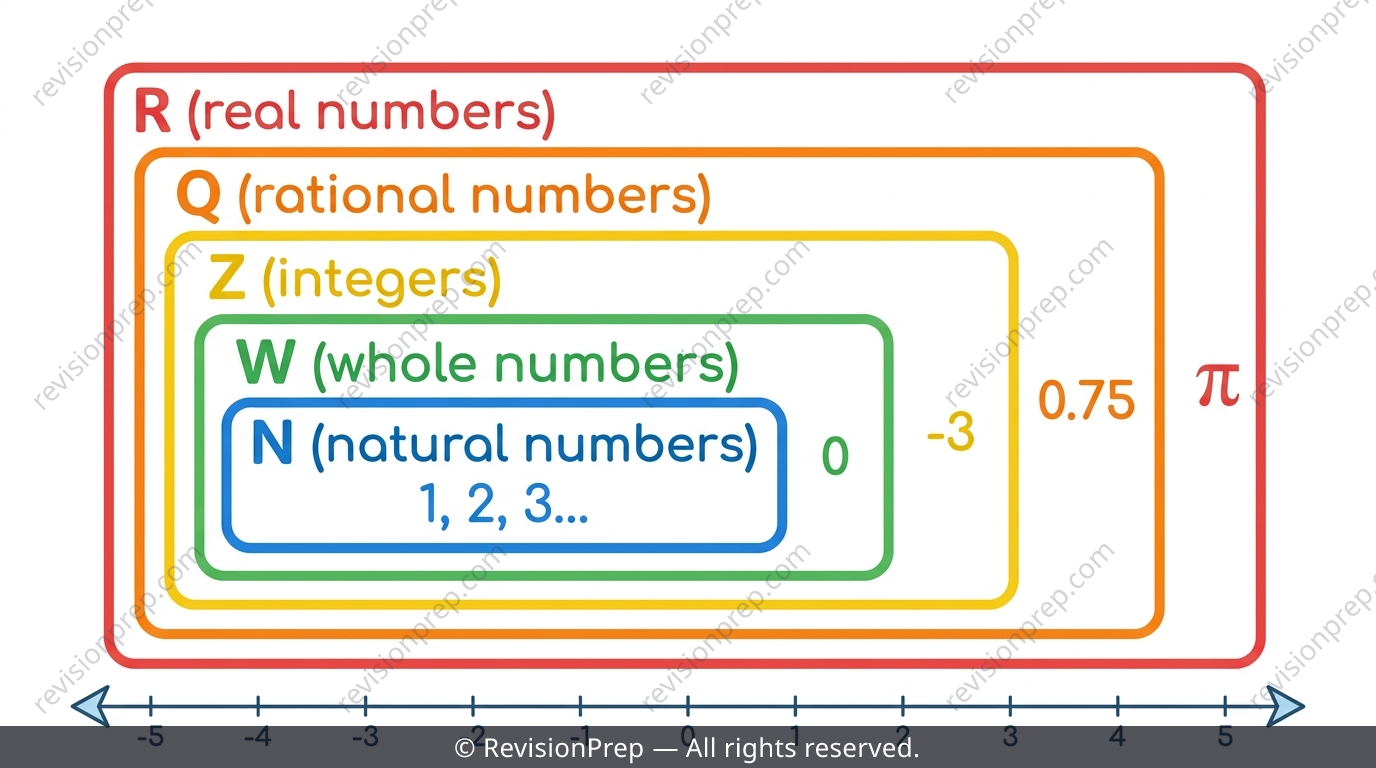
Each number set adds one new freedom to the one before it: natural numbers () only count from 1, whole numbers () add zero, integers () add negatives, rationals () add fractions, and reals () fill every remaining gap with irrationals. Membership is nested — if a number belongs to a smaller set, it automatically belongs to every larger set that contains it. The single most tested boundary in this whole topic is whether 0 counts as natural (it doesn't, by the standard definition).
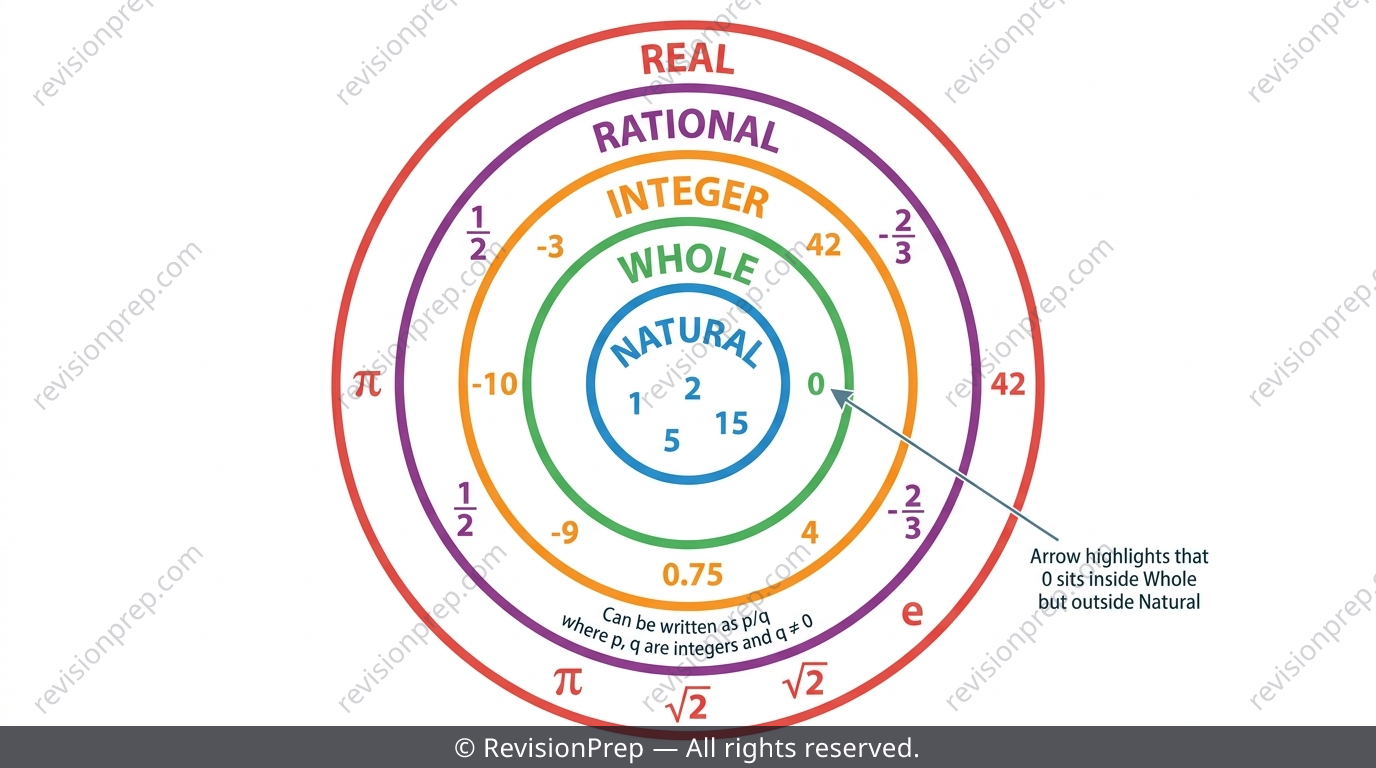
| Set | Symbol | Adds to previous set | Example members | Key exclusion |
|---|---|---|---|---|
| Natural | N | — | 1, 2, 3, ... | No zero, no negatives, no fractions |
| Whole | W | Zero | 0, 1, 2, 3, ... | No negatives, no fractions |
| Integer | Z | Negative counting numbers | ..., -2, -1, 0, 1, 2, ... | No fractions |
| Rational | Q | Fractions (terminating/recurring) | 1/2, -3, 0.75 | No non-repeating decimals |
| Real | R | Irrationals | π, √2, e | Nothing — covers the whole line |
Exam tip
If a question gives you an explicit set definition, quote THEIR definition in your answer — not the one you memorised.
Common mistake
Assuming 0 is a natural number, or treating 'whole' and 'natural' as interchangeable. Memorise: N starts at 1; W = N plus zero.
Mini summary
Nested sets: N ⊂ W ⊂ Z ⊂ Q ⊂ R — and 0 is the boundary examiners test most.
Rational vs Irrational Numbers
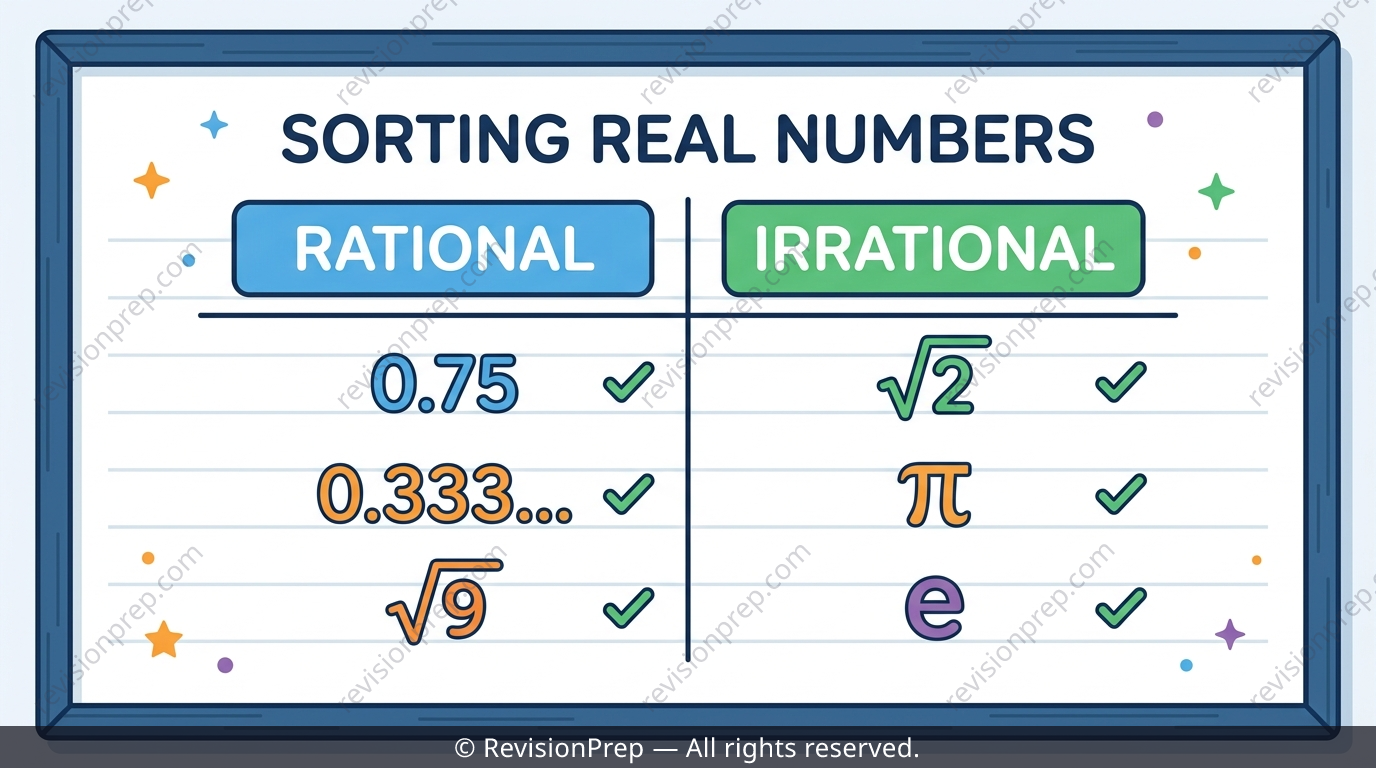
A rational number can always be written exactly as with integers and ; its decimal either terminates or falls into an exact repeating block. An irrational number's decimal never terminates and never repeats, so it can never be forced into fraction form. Not every square root is irrational — always check whether the number underneath is a perfect square first, since and are perfectly rational.
Exam tip
To 'justify' that a number is irrational, name the test explicitly: 'non-terminating and non-recurring' or 'cannot be written as p/q for integers p, q' — naming the number alone earns no reasoning mark.
Common mistake
Assuming every square root sign automatically means irrational. Test for a perfect square before deciding.
Mini summary
Rational = terminates or recurs. Irrational = neither, ever. Check for perfect squares first.
Converting Recurring Decimals to Fractions
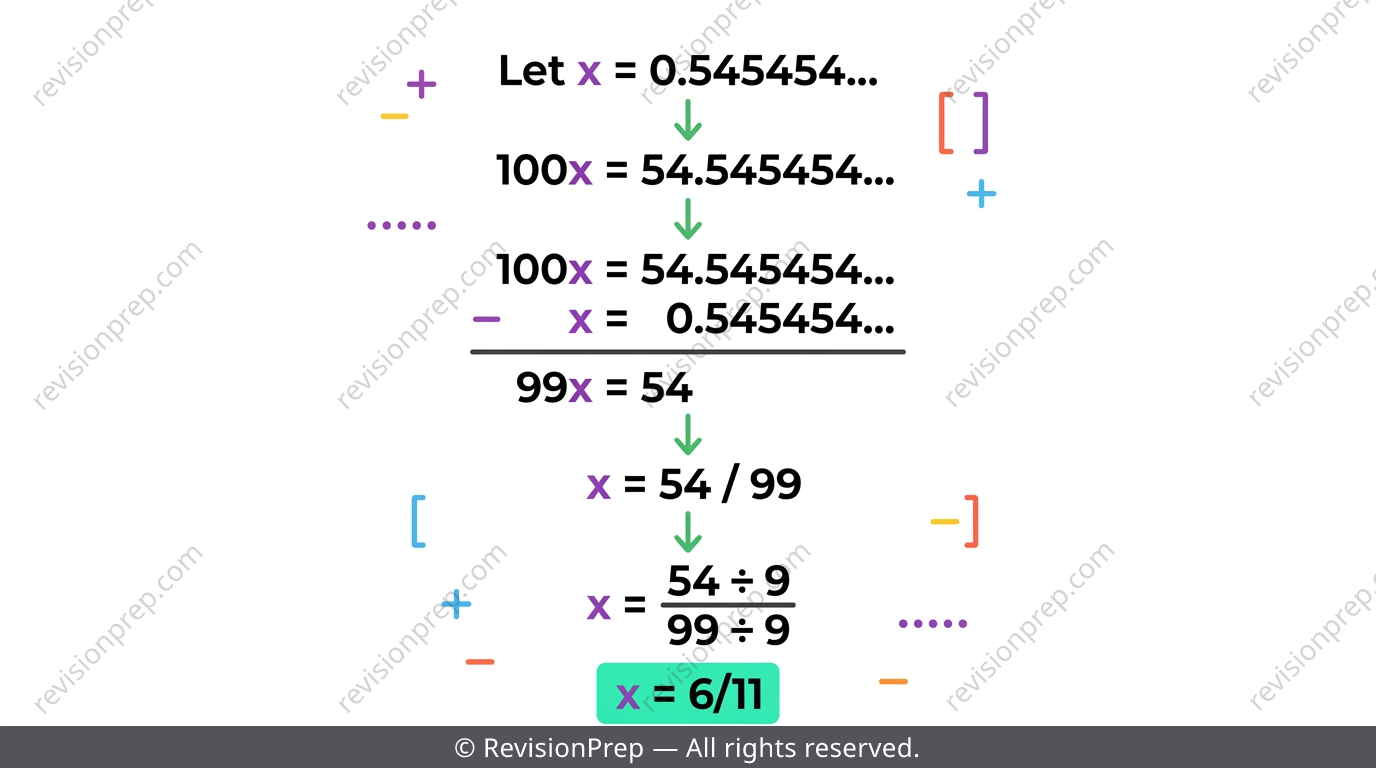
Any recurring decimal can be forced into exact fraction form using one algebraic trick: multiply the decimal by , where is the length of the repeating block, then subtract the original value to cancel the recurring tail completely. What's left is a simple equation you can solve for the fraction. The power of 10 must match the repeating block length exactly, or the tails won't cancel.
Exam tip
Write out the subtraction step clearly () — method marks are awarded for showing the cancellation, not just the final fraction.
Mini summary
Multiply by , subtract the original, solve — every recurring decimal is secretly a fraction.
Decimal Places vs Significant Figures
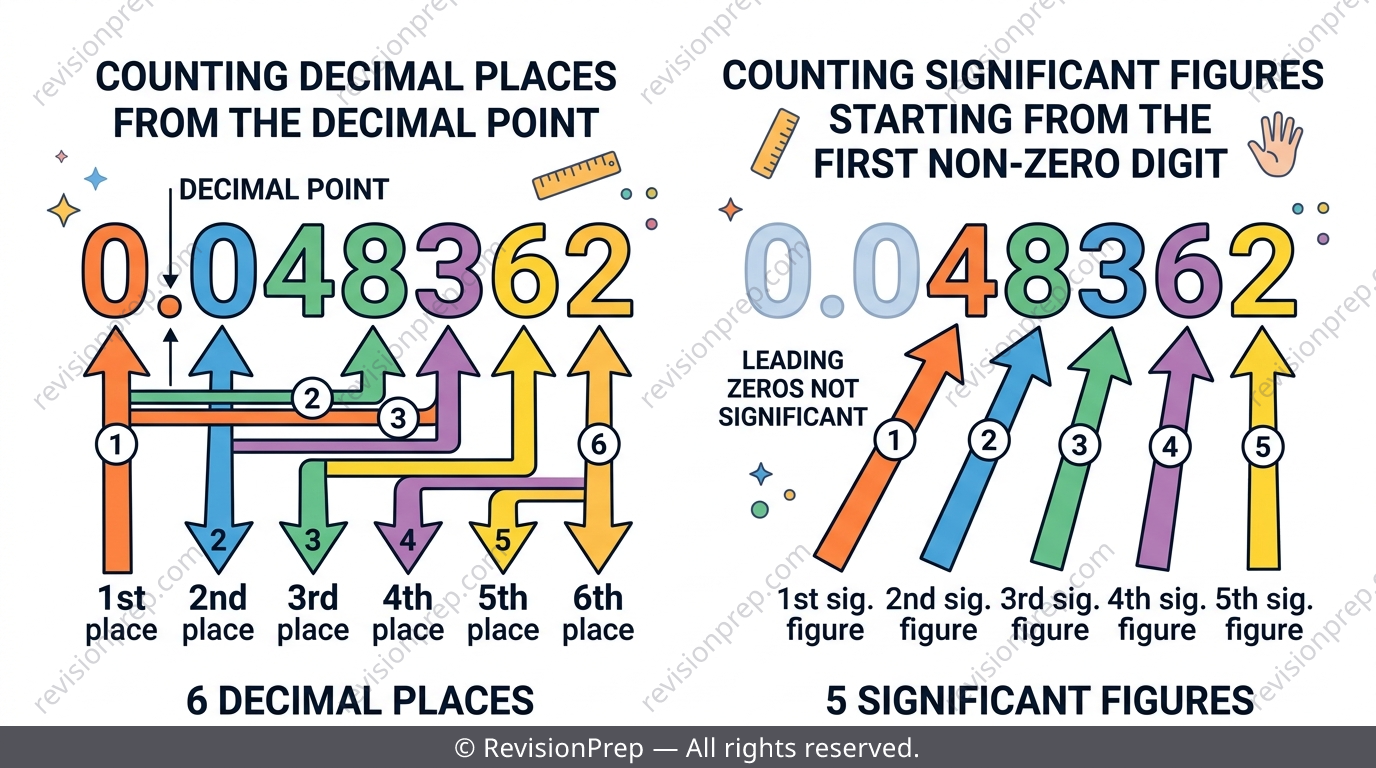
Decimal places count digits after the decimal point; significant figures count meaningful digits starting from the first non-zero digit, no matter where the decimal point falls. Leading zeros before the first non-zero digit are never significant — they're just placeholders. Trailing zeros after a decimal point ARE significant, so has 3 significant figures, not 2.
Exam tip
'Estimate' or 'approximate' means round the inputs first, then calculate — showing your rounded values earns method marks even if the later arithmetic slips.
Common mistake
Counting the leading zeros in a number like as significant figures. They aren't — start counting from the first non-zero digit.
Mini summary
D.p. counts from the decimal point; s.f. counts from the first non-zero digit — leading zeros never count.
Upper and Lower Bounds
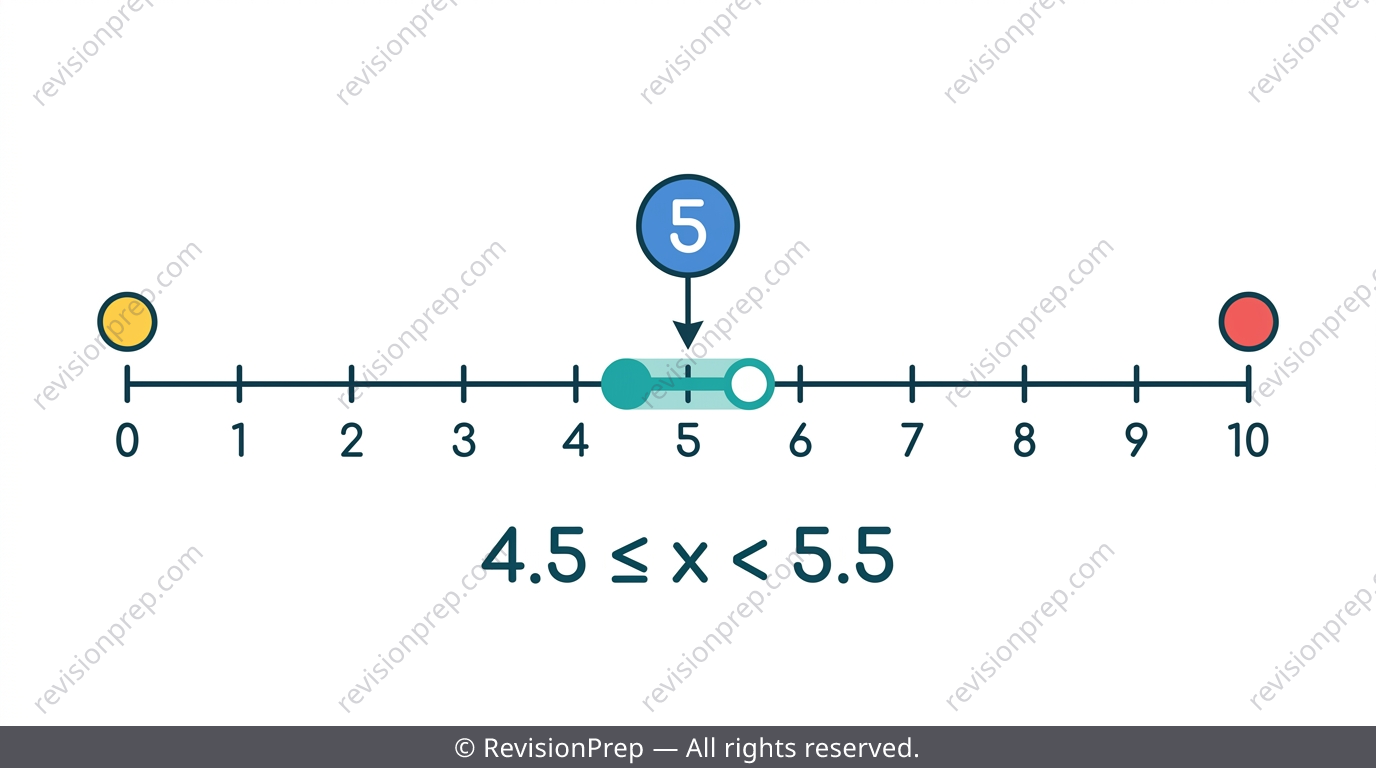
Upper and lower bounds describe the true range a rounded or measured value could actually represent. Find them by adding or subtracting half the place value of the last recorded digit: upper bound = value + 0.5 × (place value), lower bound = value − 0.5 × (place value). The standard convention is a half-open interval — closed at the lower end, open at the upper — because the value at the exact upper bound would actually round up to the next value.
Exam tip
State bounds as , not at both ends, unless the mark scheme explicitly allows equality at both ends.
Common mistake
Writing at both the upper and lower bound. The correct convention is closed-lower, open-upper.
Mini summary
Bounds = value ± half the place value of the last recorded digit — write them half-open.
Quick formula sheet
Practice questions
- State every number set (N, W, Z, Q, R) that the number 0 belongs to.
- Round 0.048362 to 2 decimal places and to 3 significant figures.
- Write 0.75 as a fraction in simplest form.
- Convert 0.\overline{54} into a fraction in simplest form, showing the 10^k subtraction step.
- Classify √9, √2 and π as rational or irrational, giving a reason for each.
- A length is recorded as 12 cm to the nearest centimetre. State the upper and lower bounds using correct inequality notation.
- Explain why 2.50 has 3 significant figures but 0.0025 has only 2, using the definition of significant figures.
- The sums of five consecutive natural numbers follow a pattern starting 1+2+3+4+5=15. Find the general rule linking the sum to the middle number and use it to find 10+11+12+13+14.
- A student claims 'every recurring decimal is irrational because it never stops.' Give a counterexample and explain the flaw in their reasoning.
Frequently asked questions
Is 0 a natural number in IB MYP maths?+
By the standard definition used in this topic, no — natural numbers start at 1. Zero is a whole number, not a natural number, unless a question explicitly gives you a different definition to use.
How do you know if a square root is rational or irrational?+
Check whether the number under the root is a perfect square. If it is (like 9, 16, 25), the root is rational. If not, it's irrational, because no fraction can equal it exactly.
What's the difference between decimal places and significant figures?+
Decimal places count digits after the decimal point. Significant figures count meaningful digits starting from the first non-zero digit, so leading zeros never count but trailing zeros after a decimal point do.
How do you convert a recurring decimal to a fraction?+
Multiply the decimal by 10^k, where k matches the length of the repeating block, then subtract the original decimal to cancel the recurring tail. Solve the resulting equation for the fraction.
Why are upper and lower bounds written with different inequality signs?+
The convention is half-open: closed (≤) at the lower bound and open (<) at the upper bound, because a value exactly at the upper bound would actually round up to the next possible value.
How do I prove a number pattern always works?+
Find and test the general term (like 2n for even numbers). To disprove a claimed pattern, a single counterexample is enough — you don't need to test every case.