
Maths: How a Bouncing Ball Becomes a Geometric Series
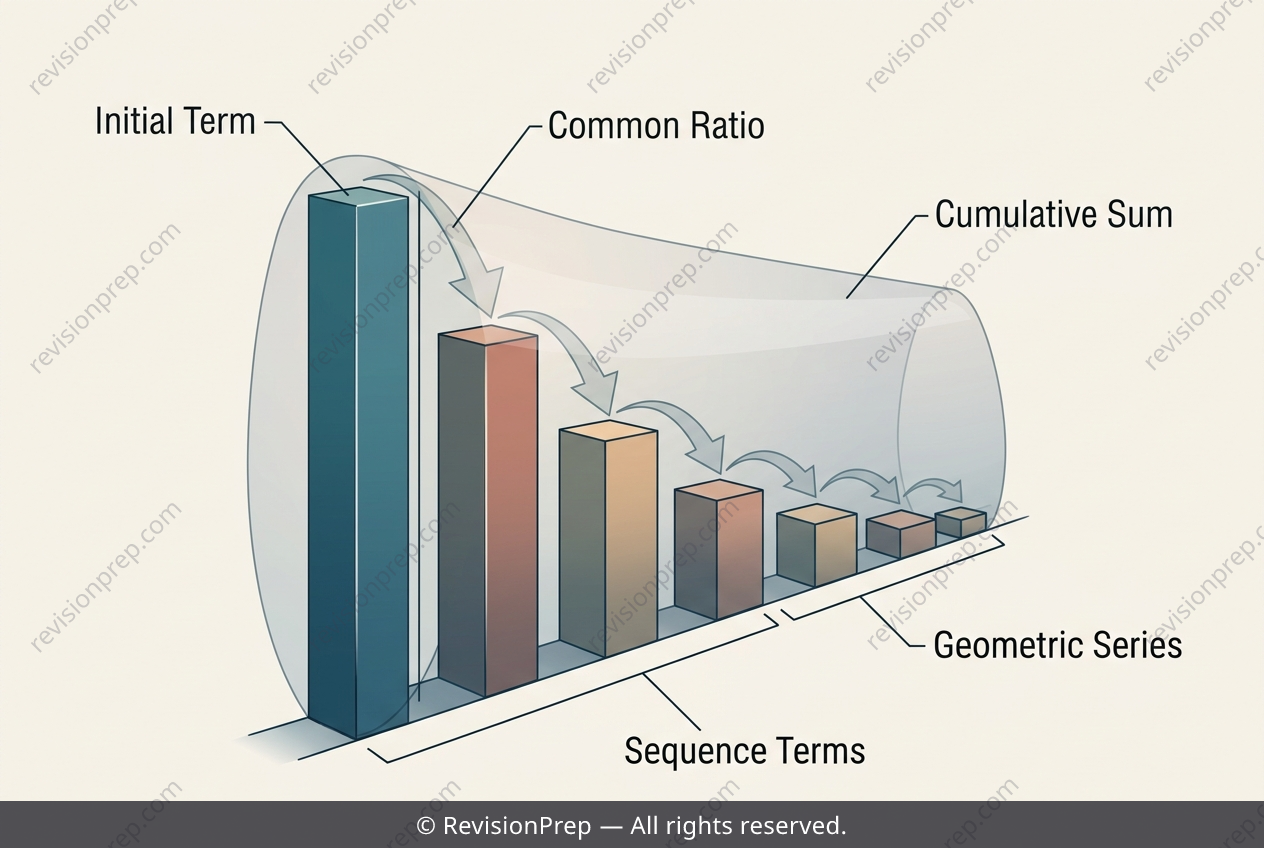
Geometric sequences and series describe quantities that change by a constant multiplicative factor at each step, and they appear everywhere from population growth to the bouncing of a ball. In this problem, a ball dropped from 200 cm rebounds to 60% of its previous height after every bounce, so each successive height is found by multiplying the last by r = 0.6, with first term u1 = 200. Recognising this pattern is what turns a physical process into a clean mathematical model. The concept matters because it lets us predict behaviour far beyond the first few bounces and, crucially, total the distances involved. Each bounce height forms a geometric sequence, and the sum formula Sn = u1(r^n − 1)/(r − 1) aggregates these heights efficiently. The key subtlety is that each bounce is travelled twice — once upward, once downward — while the initial drop counts only once, so the parts connect through careful accounting of direction as well as magnitude.
Start practising IB questions today
150,000+ IB-styled questions, criteria-mapped and instantly accessible.