
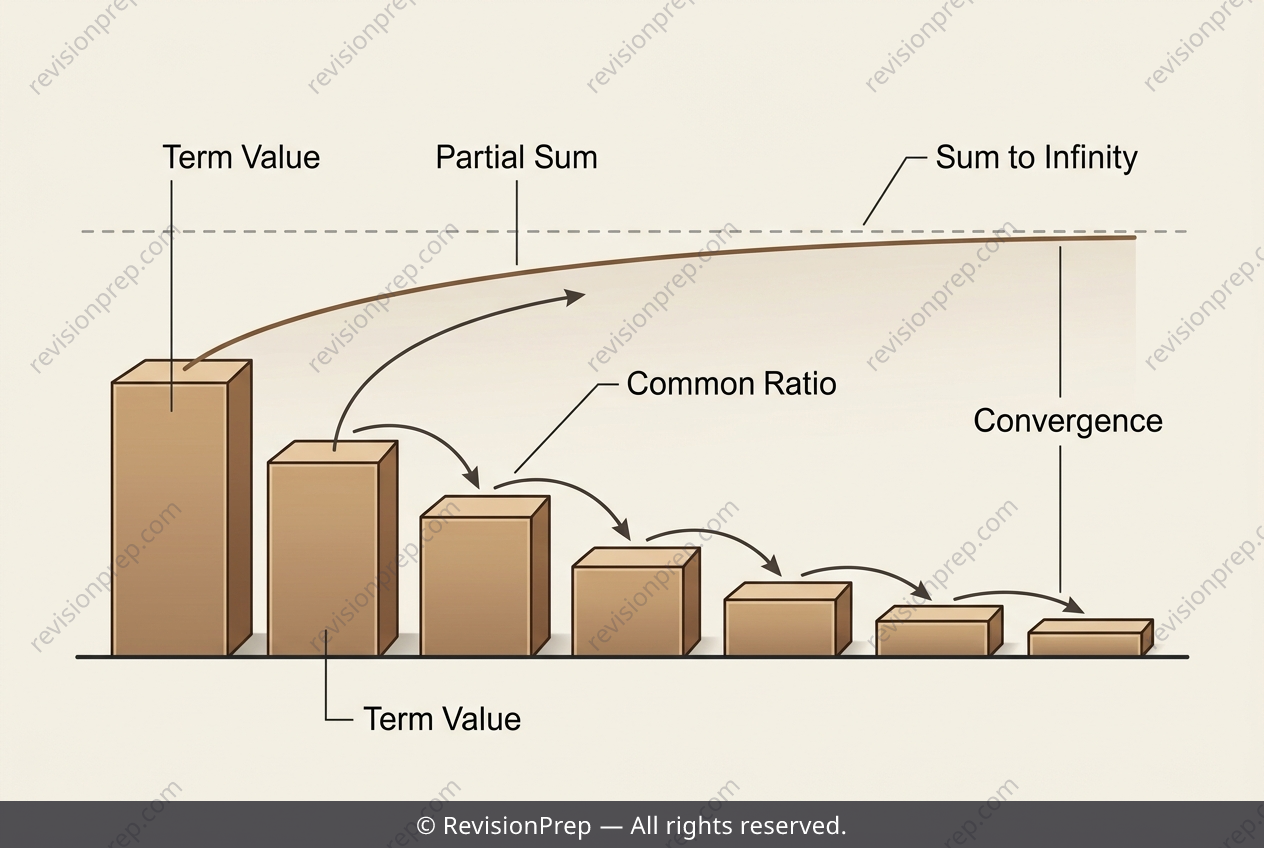
Maths: How Geometric Series Approach a Fixed Limit
Geometric series sit at the heart of Number and Algebra, describing situations where each term is a constant multiple of the one before. The behaviour of such a sequence hinges on its common ratio r: when |r| < 1, successive terms shrink, and the running total creeps ever closer to a fixed limiting value. This idea of convergence — a sum that approaches a bound without quite reaching it — underpins everything from compound interest to infinite decimal expansions. The key tool is the sum formula Sn = u1(1 − rⁿ)/(1 − r), which packages the first term, the ratio, and the number of terms into a single expression. Substituting u1 = 3 and r = 2/3 collapses the denominator neatly, revealing how the term (2/3)ⁿ governs the whole story: as n grows, this power decays toward zero, so Sn climbs toward its ceiling. Understanding this relationship between the decaying power and the partial sum is what makes convergence feel intuitive rather than abstract.
Start practising IB questions today
150,000+ IB-styled questions, criteria-mapped and instantly accessible.