
Maths: How Logarithms Hide a Straight Line
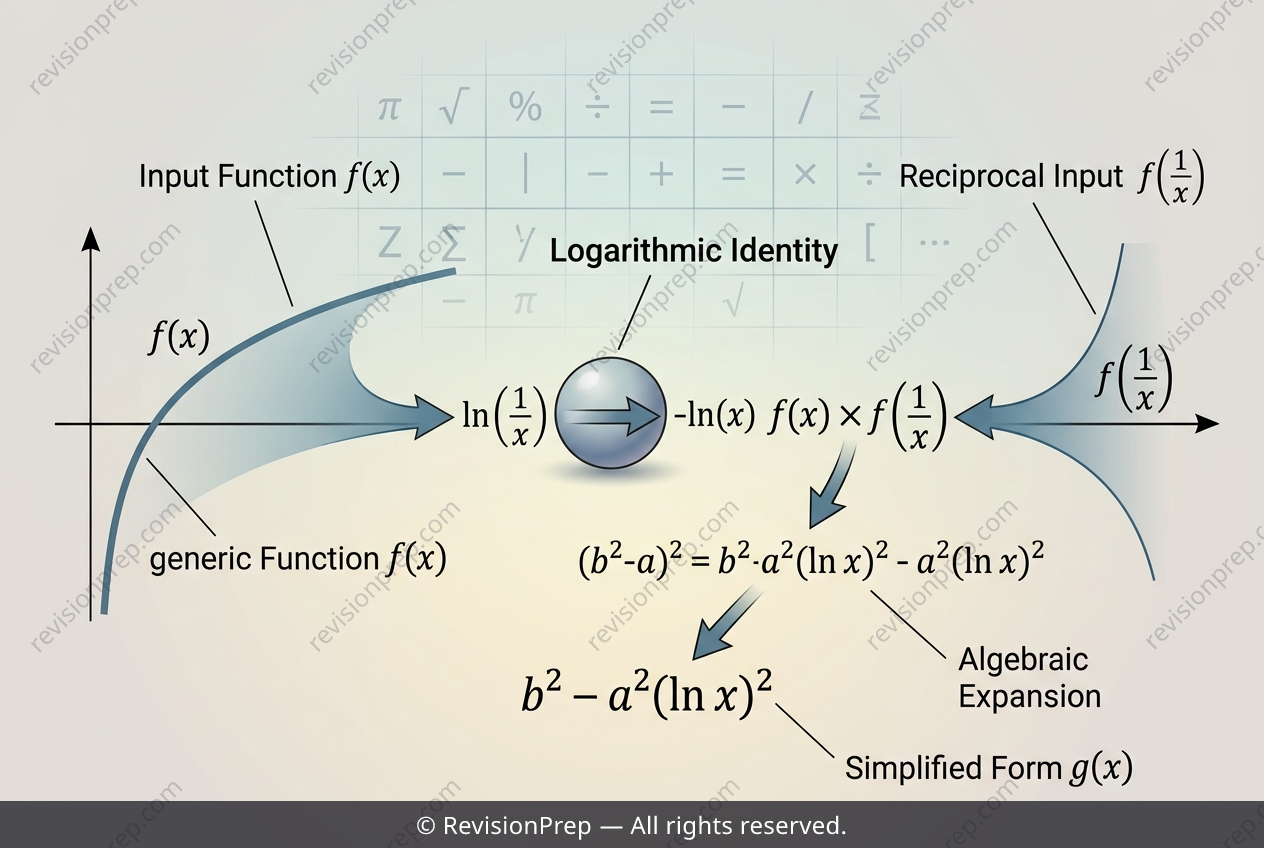
Logarithmic functions sit at the heart of Maths AA HL, linking exponential growth to straight-line behaviour through the identity ln(1) = 0 and the power rule ln(e²) = 2. A function of the form f(x) = a ln(x) + b is really a straight line in disguise: plotting f against ln x gives gradient a and vertical intercept b, so two points on the curve are enough to pin down both constants. This matters because many real-world models — sound intensity, pH, radioactive decay — are built on exactly this structure. The richness emerges when log laws meet algebraic manipulation. Recognising that ln(1/x) = −ln x turns f(1/x) into b − a ln x, so the product f(x)·f(1/x) collapses into the difference of two squares, b² − a²(ln x)². Solving f(x) = 0 isolates a single logarithm, while g(x) = 0 yields a squared logarithm with two symmetric roots, reflecting the reflection property built into the original function.
Start practising IB questions today
150,000+ IB-styled questions, criteria-mapped and instantly accessible.